What you'll learn
- Split any Korean word into syllable blocks and say each block in order.
- Apply three sound changes: liaison, final-sound reduction and tensification.
- Read 감사합니다 correctly and explain why it sounds like "gamsahamnida".
- Read 30 unseen words at three levels and check them against answers.
- Explain why a final consonant is moved, not dropped, before a silent ㅇ.
Before you start: you should know the Hangul letters and how they stack in blocks, including the batchim in syllable blocks. The lesson takes about 40 minutes. This is step two of the reading Hangul path.
What Does It Mean to Read a Korean Word?
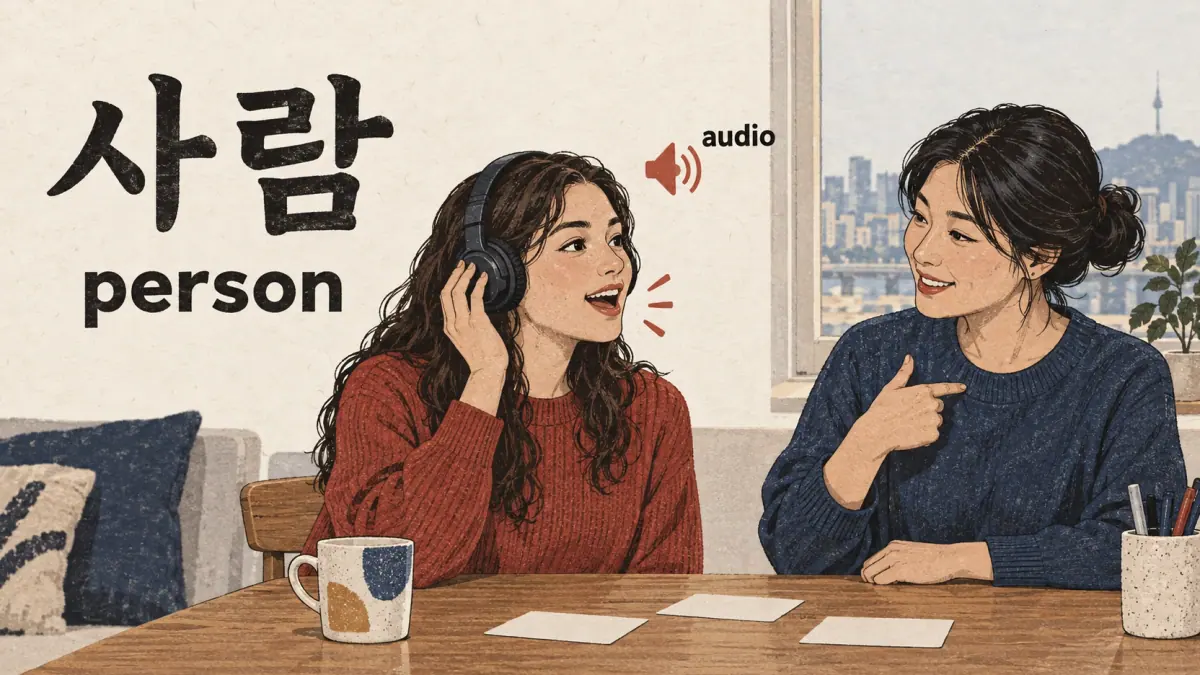
To read a Korean word means to turn its written blocks into the sounds a Korean speaker would say. This is decoding. It is separate from knowing what the word means, which you build with vocabulary. For this lesson you only need to say each word correctly and check your answer against audio.
A Korean word is a row of syllable blocks. Each block is one beat, and each beat has a fixed internal order: initial consonant, vowel, then an optional final consonant. For example, 사람 (person) has two blocks, 사 and 람. The block 람 holds ㄹ, ㅏ and ㅁ, so it says "ram".
Why Can't You Just Read Letter by Letter?
You cannot just read letter by letter because Korean letters sit inside blocks, and because the sound of a block changes with its neighbours. Reading letters one after another would give you ㅎ ㅏ ㄴ ㄱ ㅜ ㄱ ㅓ for 한국어, which has no clear syllable breaks and gets the sound wrong.
Two facts explain the problem:
- Letters are grouped. The block is the unit of reading, not the letter. The blocks of 한국어 are 한, 국 and 어.
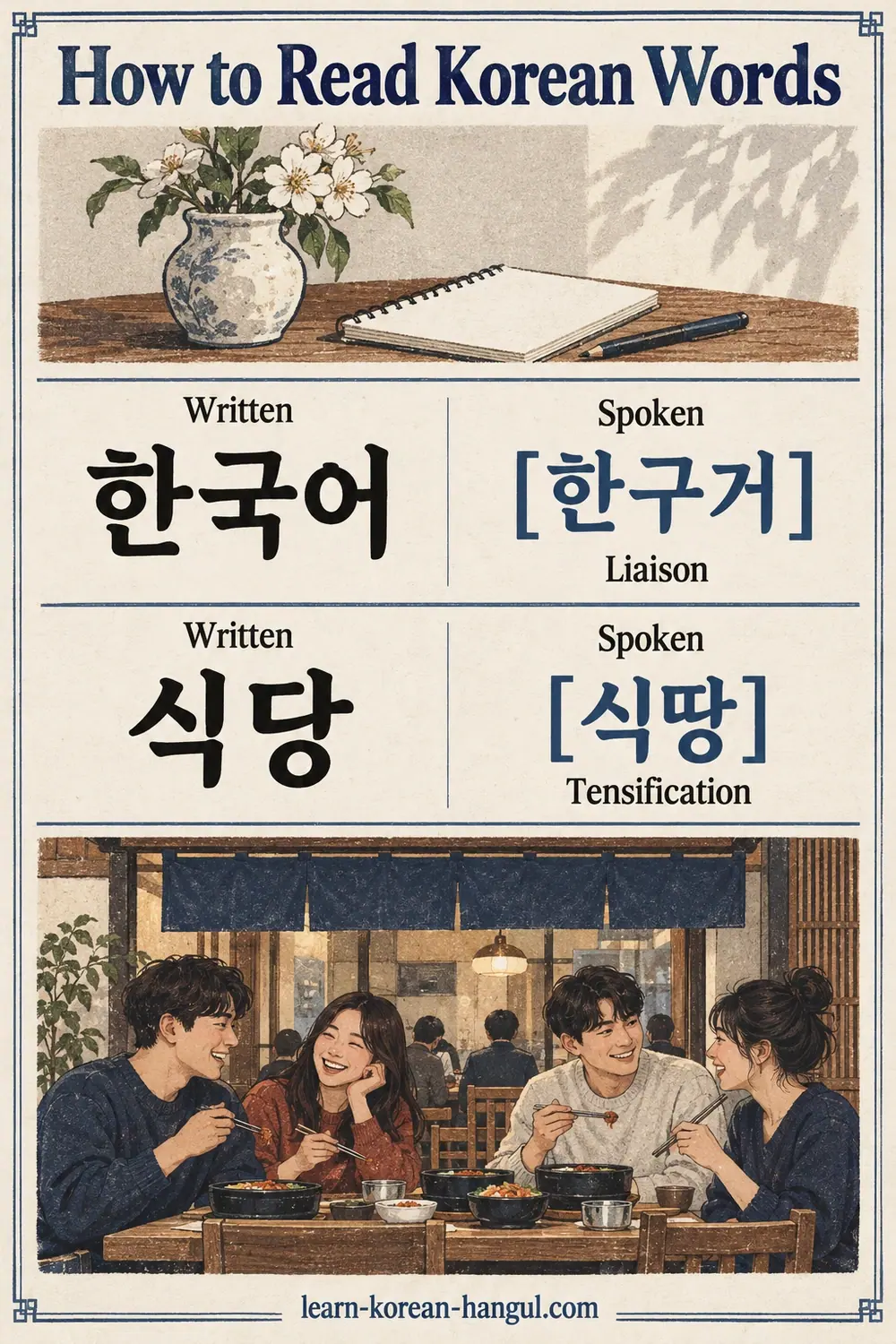
- Spelling shows the base form. The same word keeps the same letters in every sentence, but the pronunciation shifts. 한국어 is spelled with ㄱ at the bottom of 국, yet you say [한구거], with the ㄱ moved over to the next block.
So reading well needs a method that checks the blocks and the neighbours. The four passes below do exactly that.
How to Read Korean Words in Four Passes
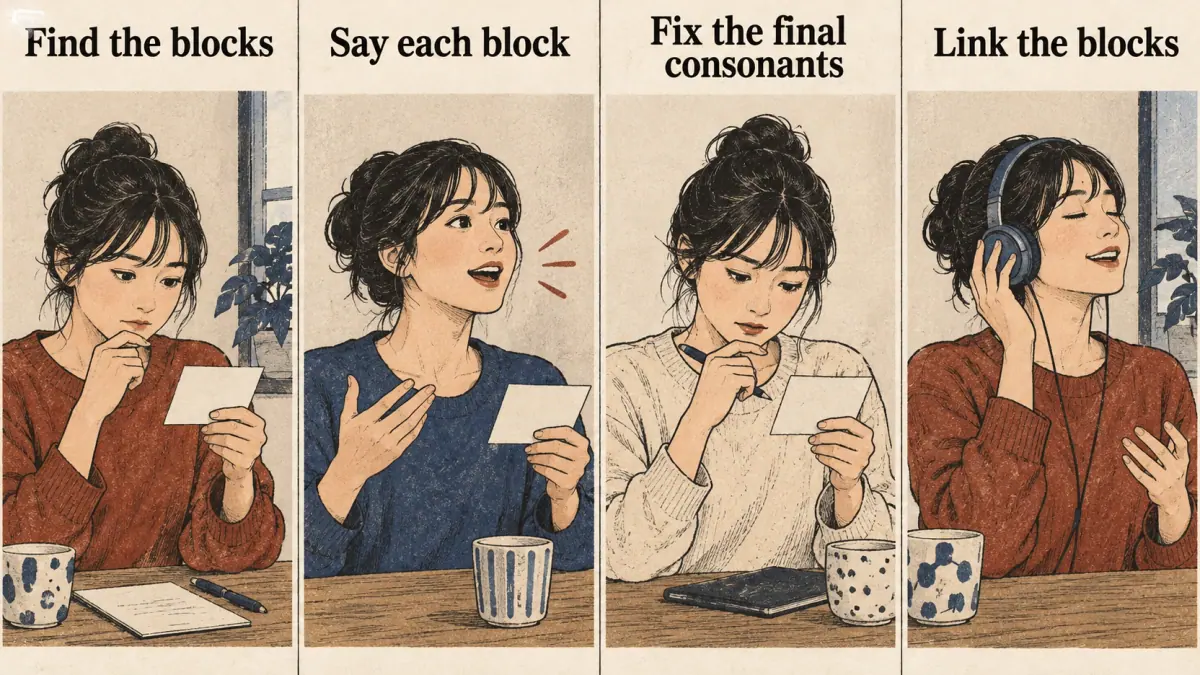
To read a Korean word, make four quick passes over it: find the blocks, say each block, fix the final consonants, then link the blocks. Each pass is simple, and doing them in order stops most beginner errors.
Pass 1: Find the Blocks
Look for each square shape and count the beats. 한국어 has three blocks. 감사합니다 has five: 감, 사, 합, 니, 다. If a block has a consonant at the bottom, mark it, because that is where the sound changes happen.
Success checkpoint: you can tap once for each block before you say anything.
Pass 2: Say Each Block
Read each block as initial, vowel, final. 한 is ㅎ + ㅏ + ㄴ = "han". 국 is ㄱ + ㅜ + ㄱ = "guk". 어 is silent ㅇ + ㅓ = "eo". At this stage, say the blocks as if they stood alone, even if you know a change is coming.
Success checkpoint: each block has a clear sound in your head.
Pass 3: Fix the Final Consonants
Check each bottom consonant against the seven final sounds. In the final position, every consonant is reduced to one of ㄱ, ㄴ, ㄷ, ㄹ, ㅁ, ㅂ or ㅇ, as explained in the seven final sounds lesson. So ㅅ, ㅈ, ㅊ, ㅌ and ㅎ at the bottom of a block are all said like ㄷ when nothing follows. That is why 꽃 (flower) is [꼳] and 옷 (clothes) is [옫].
Success checkpoint: you can say the final sound of 꽃, 옷 and 밖 without adding a vowel.
Pass 4: Link the Blocks
If a block ends in a consonant and the next block starts with silent ㅇ, move the consonant to the front of the next block. This is called liaison (연음), and the liaison lesson covers it in depth. So 한국어 becomes 한 + 구 + 거, read [한구거]. Also check the tensification rule: after a final ㄱ, ㄷ or ㅂ sound, the next ㄱ, ㄷ, ㅂ, ㅅ or ㅈ is read tense, as covered by the tensification rule.
Success checkpoint: you say the word at an even pace with no pause between the linked blocks.
| Pass | Question to ask | Example: 한국어 |
|---|---|---|
| 1 | How many blocks? | 3 blocks: 한, 국, 어 |
| 2 | What does each block say? | han, guk, eo |
| 3 | Is any final consonant reduced? | ㄴ and ㄱ are already basic finals |
| 4 | Does a final move to the next block? | ㄱ moves: 한구거 |
The common mistake at every pass is skipping straight to the full word. Slow down for the first week and run all four passes in your head.
Worked Example: Reading 감사합니다

To read 감사합니다 ("thank you"), run the four passes and watch for the one sound change in the middle.
- Pass 1. Five blocks: 감 / 사 / 합 / 니 / 다.
- Pass 2. 감 is gam, 사 is sa, 합 is hap, 니 is ni, 다 is da. Alone, this reads "gam-sa-hap-ni-da".
- Pass 3. The final ㅂ in 합 is a basic final, so no reduction is needed.
- Pass 4. There is no silent ㅇ after 합, so no liaison. But ㅂ is followed by ㄴ, and a ㅂ sound before ㄴ turns into ㅁ. So 합니 is read [함니].
The result is [감사함니다], which is why beginners hear "gamsahamnida". The sound change is called nasalization, and the nasalization lesson explains it in detail.
Check yourself: if you read 합니다 as "hap-ni-da", your Pass 4 missed the ㅂ → ㅁ change.
Which Three Sound Changes Appear First?
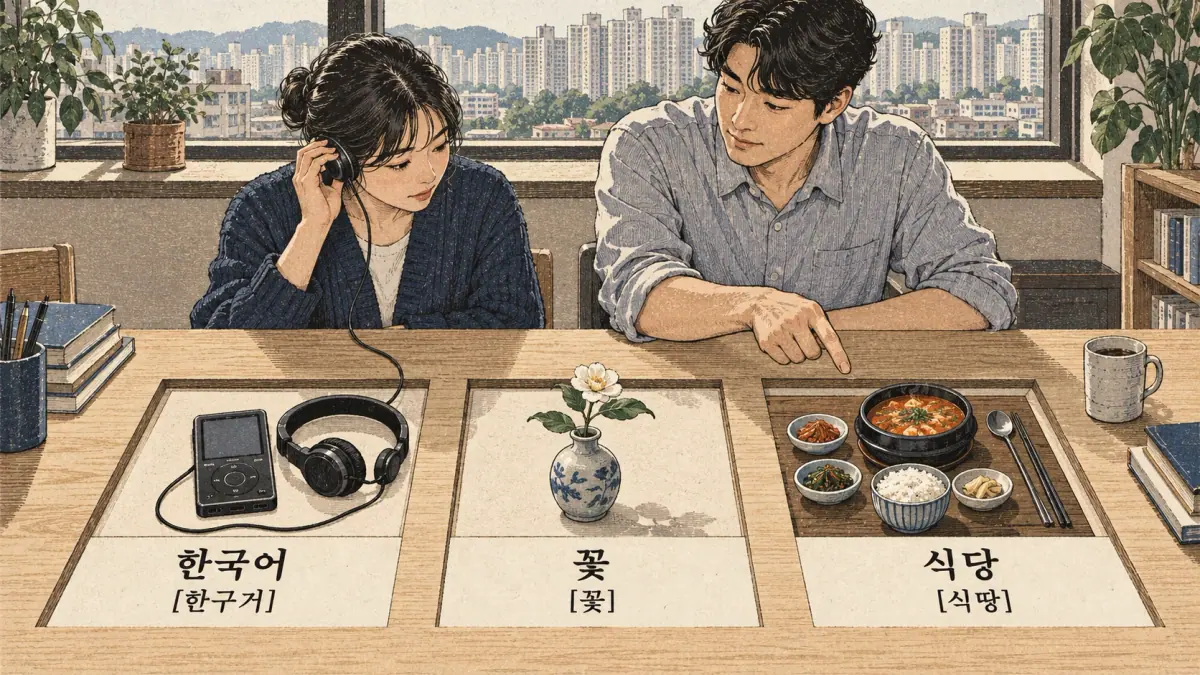
The three sound changes that appear first are liaison, final-sound reduction and tensification. Together they explain most gaps between spelling and speech in beginner words. Each one has a short rule and an example.
| Change | Rule | Written | Spoken | Audio |
|---|---|---|---|---|
| Liaison | A final consonant moves to a following silent ㅇ | 한국어 | [한구거] | above |
| Final-sound reduction | A bottom consonant becomes one of 7 sounds | 꽃 | [꼳] | above |
| Tensification | After ㄱ/ㄷ/ㅂ finals, ㄱ ㄷ ㅂ ㅅ ㅈ turn tense | 식당 | [식땅] | below |
Each rule links to a full lesson. This page teaches you to spot them, and the pronunciation section teaches every exception. Note that the rules are not optional: Korean speakers apply them automatically, so using them makes your speech sound natural. The next section covers the mistakes learners make when applying them.
What Do Learners Get Wrong When Reading Words?
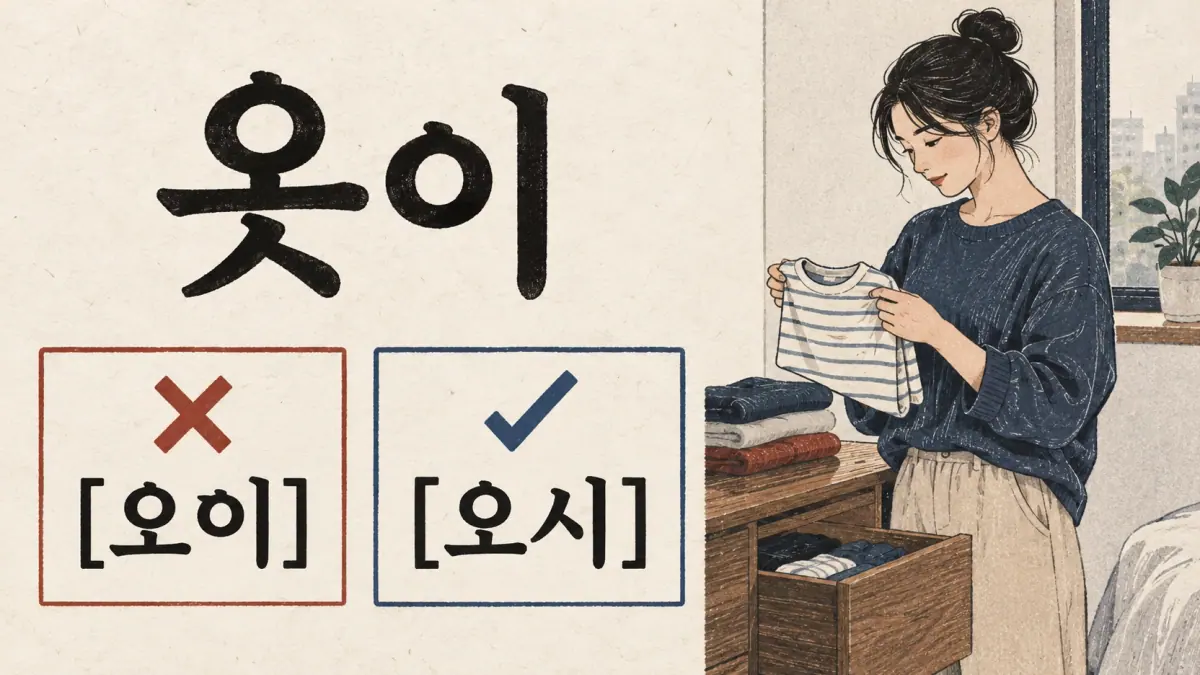
Learners most often get wrong the way a final consonant behaves before a silent ㅇ, the idea that spelling equals sound, and the role of ㅇ at the bottom of a block.
Misconception 1: "The final consonant is dropped before ㅇ." Learners often assume the consonant disappears. Actually it moves to the next block, because that block has an empty first slot. This process is called resyllabification. So 옷이 (clothes plus the subject particle) is read [오시], not [오디] and not [오이].
Misconception 2: "Every letter is pronounced as written." Learners often assume spelling gives the sound directly. Actually spelling shows the word's base form, and speech changes it. 학교 is spelled with a ㄱ at the bottom of 학 and a ㄱ at the start of 교, and it is read [학꾜].
Misconception 3: "ㅇ is always silent." At the start of a block, ㅇ is silent. At the bottom, it sounds like "ng". So 강 (river) is read "gang", not "ga".
Misconception 4: "Romanization tells you the real sound." Revised Romanization follows pronunciation for liaison and nasalization (한국어 is hangugeo, 감사합니다 is gamsahamnida), but not for tensification: 학교 is written hakgyo although it is spoken with a tense initial sound. Treat romanization as a hint and trust audio.
A fast way to catch these errors is a self-check routine: read the word, say your answer aloud, then reveal the bracketed pronunciation and the romanization and see where they differ from the spelling. The difference is the sound change you missed.
Practice: 30 Words in Three Levels
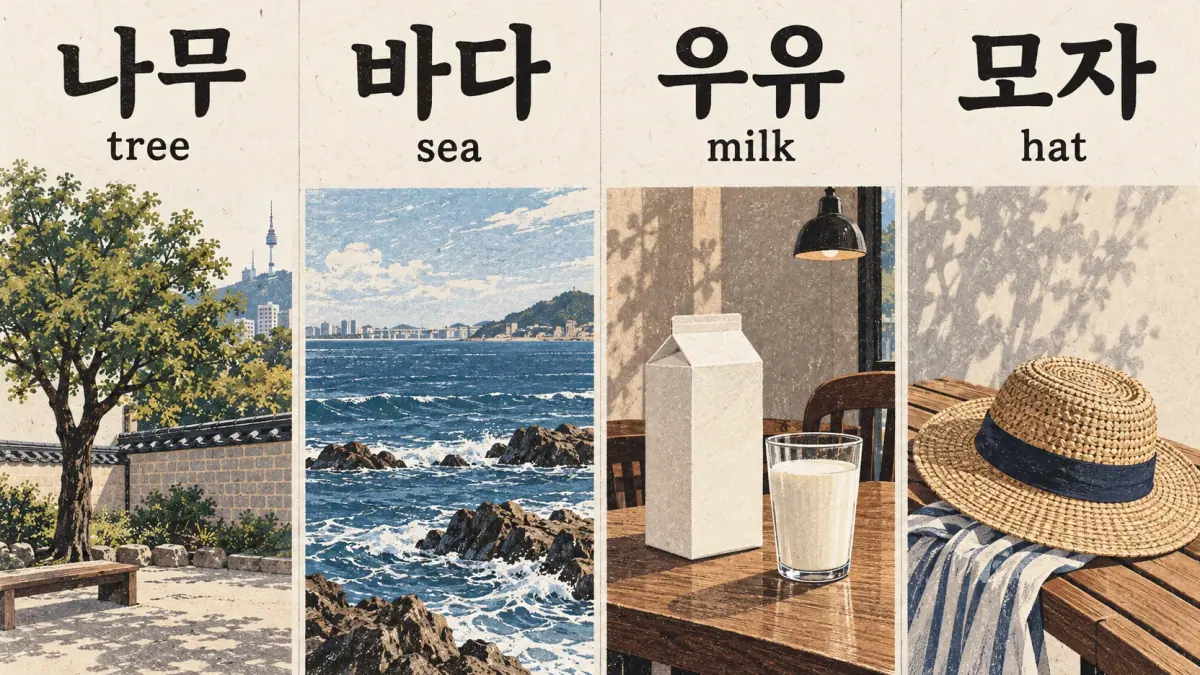
Read each word aloud using the four passes. Cover the right-hand column, say the word, and then check. Level 1 has no sound changes, level 2 adds final consonants, and level 3 has the sound changes from this page.
Practice · Read
한국어
한국어
Korean language; read [한구거]
감사합니다
감사합니다
thank you; read [감사함니다]
꽃
꽃
flower; read [꼳]
식당
식당
restaurant; read [식땅]
옷이
옷이
clothes plus subject particle; read [오시]
나무
나무
tree
바다
바다
sea
우유
우유
milk
아기
아기
baby
가수
가수
singer
모자
모자
hat
아이
아이
child
오리
오리
duck
도시
도시
city
하나
하나
one
한국
한국
Korea
사람
사람
person
친구
친구
friend
물
물
water
밥
밥
cooked rice; meal
집
집
house
문
문
door
강
강
river
사랑
사랑
love
감자
감자
potato
음악
음악
music; read [으막]
학교
학교
school; read [학꾜]
옷
옷
clothes; read [옫]
있어요
있어요
there is; read [이써요]
합니다
합니다
does; polite ending; read [함니다]
먹어요
먹어요
eat; read [머거요]
책이
책이
book plus subject particle; read [채기]
Level 1: Open Blocks (no final consonants)
| # | Word | Say it | Meaning |
|---|---|---|---|
| 1 | 나무 | [나무] | tree |
| 2 | 바다 | [바다] | sea |
| 3 | 우유 | [우유] | milk |
| 4 | 아기 | [아기] | baby |
| 5 | 가수 | [가수] | singer |
| 6 | 모자 | [모자] | hat |
| 7 | 아이 | [아이] | child |
| 8 | 오리 | [오리] | duck |
| 9 | 도시 | [도시] | city |
| 10 | 하나 | [하나] | one |
Level 2: Blocks with a Final Consonant
| # | Word | Say it | Meaning |
|---|---|---|---|
| 11 | 한국 | [한국] | Korea |
| 12 | 사람 | [사람] | person |
| 13 | 친구 | [친구] | friend |
| 14 | 물 | [물] | water |
| 15 | 밥 | [밥] | cooked rice; a meal |
| 16 | 집 | [집] | house |
| 17 | 문 | [문] | door |
| 18 | 강 | [강] | river |
| 19 | 사랑 | [사랑] | love |
| 20 | 감자 | [감자] | potato |
Level 3: Words with Sound Changes
| # | Word | Say it | Meaning | Change |
|---|---|---|---|---|
| 21 | 음악 | [으막] | music | liaison |
| 22 | 한국어 | [한구거] | Korean language | liaison |
| 23 | 학교 | [학꾜] | school | tensification |
| 24 | 식당 | [식땅] | restaurant | tensification |
| 25 | 꽃 | [꼳] | flower | final-sound reduction |
| 26 | 옷 | [옫] | clothes | final-sound reduction |
| 27 | 있어요 | [이써요] | there is; I have | liaison of ㅆ |
| 28 | 합니다 | [함니다] | does (polite) | nasalization |
| 29 | 먹어요 | [머거요] | eat; I eat | liaison |
| 30 | 책이 | [채기] | the book (as subject) | liaison |
Scoring: nine or ten correct at a level means you can move on. If you miss three or more at level 3, repeat the four passes on the missed words only. Words that stay hard go into the Hangul flashcard decks, and the 30 words appear in the matching deck for listening practice.
A simple three-day routine keeps the practice manageable:
- Day 1: read level 1 aloud twice, then level 2 once, and check every word against audio.
- Day 2: read level 3 with all four passes, then re-read any level 1 or 2 word you missed.
- Day 3: cover the right-hand columns and read all 30 words in a row, noting which changes still trip you.
What This Lesson Does Not Cover
This lesson does not cover every sound change in Korean. It deliberately leaves out nasalization beyond 합니다 (as in 국물 [궁물]), palatalization (같이 read [가치]), weakened ㅎ (좋아요 read [조아요]) and double final consonants (읽어요 read [일거요]). These come up soon, so use the pronunciation rules section when you meet them.
The practice set is also small. It trains the method, not a large vocabulary. For a bigger variety of words and short sentences, move on to the graded sets.
What Should You Learn Next?
Next, practise your four passes on the graded sets in Hangul reading practice, which add audio answers and an error log. For an easy win with words you already know, try English loanwords in Hangul, and test your ears with the Hangul quizzes. When you can run all four passes without pausing, you have learned how to read Korean words block by block. The parent page is the reading Hangul path.
Frequently Asked Questions
Why Is Korean Spelling Different from Pronunciation?
Korean spelling keeps the base form of each word visible, and speech then changes the sound according to the neighbouring sounds. 꽃 is always spelled the same but is read [꼳], [꼬치] or [꼳또] depending on what follows. Linguists call this morphophonemic spelling, and it means one spelling serves many contexts.
How Many Korean Words Should I Practise Reading Each Day?
Ten to twenty new words per session is a workable range for a beginner, read aloud and checked against audio. Revisit missed words the next day and add new ones only when most of the old ones feel easy. The quality of checking matters more than the total count.
Should I Learn Sound-Change Rules before Reading Words?
No. Read first, then add rules one at a time as you meet them. Start with the three on this page: liaison, final-sound reduction and tensification. A full rule list read before you have seen examples is hard to remember, while a rule attached to a word you just misread sticks quickly.
Is It Okay to Read Korean Words Slowly at First?
Yes. Slow, correct reading builds the right habits, and speed follows with practice. Reading fast with wrong sounds is harder to fix later. Aim for accuracy first, then repeat the same words until blocks feel automatic. Timing yourself too early tends to push beginners into guessing.
Do Koreans Read Words as Whole Shapes?
Experienced readers recognise common words and endings as whole shapes, as English readers do. Beginners must decode block by block first, and repeated decoding is what builds that automatic recognition over time. Frequent chunks such as 요 and 니다 become quick to read after many repetitions in real texts.