어서 오세요. 어디로 가세요? / 서울역으로 가 주세요. / 네, 알겠습니다. 안전벨트 매 주세요. / 서울역까지 얼마나 걸려요? / 길이 안 막히면 이십 분쯤 걸려요. / 좀 더워요. 에어컨 좀 켜 주세요. / 네, 켰어요. 곧 서울역이에요. 어디에서 세워 드릴까요? / 여기서 세워 주세요. / 네, 요금은 만 사천 원이에요. / 카드로 계산할게요. 감사합니다.
What you'll learn
- State the destination, the stop request and the payment method after hearing the dialogue.
- Use the -아/어 주세요 pattern: 가 주세요, 켜 주세요, 세워 주세요.
- Hear the ㄹ link in 서울역 and the number in 만 사천 원.
- Understand a short driver version of a question.
Before you start: you need to read Hangul and know the Sino-Korean numbers up to 100. Time: about 20 minutes. Level: A2. The transcript stays hidden until you have listened once.
Key facts
- 서울역 contains a ㄹ link, heard as [서울력] with the next sound joined on.
What Is Korean Taxi Dialogue Audio?
Korean taxi dialogue audio is a short clip of a passenger and a driver, with questions that check whether you caught the destination, the time and the fare. This one runs from boarding to payment, so it holds three requests you can reuse in any taxi.
The listening goal is concrete. The driver talks quickly and drops words, and the passenger's requests all end in 주세요. The phrases are collected in Korean taxi phrases, and the fare uses the number system explained in Korean money numbers.
First, see what makes a taxi ride hard to follow by ear.
What Makes This Dialogue Hard to Follow by Ear?
Drivers often speak fast and shorten questions. The full question 어디로 가세요? often turns into 어디 가세요?, and the endings blur. The place name 서울역 also sounds different from how it is written.
| What you see | What you hear | Where learners slip |
|---|---|---|
| 서울역으로 | [서울려그로] | A ㄴ is added before 역, becomes ㄹ, and the final ㄱ links to 으 |
| 알겠습니다 | [알겓씀니다] | ㅆ closes the syllable, then ㅅ and ㅂ change |
| 막히면 | [마키면] | ㄱ and ㅎ merge into ㅋ |
| 이십 분쯤 | [이십뿐쯤] | 분 becomes tense after the stop ㅂ |
The first row is ㄴ-insertion with ㄹ assimilation, followed by liaison. The second row combines neutralisation (ㅆ said as ㄷ), tensification and nasalization, the third is aspiration (격음화) and the fourth is tensification. All are covered by the standard pronunciation rules (표준 발음법) of the National Institute of Korean Language (국립국어원). Korean liaison explains the linking in the first row.
Next is the routine.
How Does the Dialogue Practice Work?
Two listens come before any reading.
- Listen once at normal speed. Do not pause. Write down the destination and the fare.
- Listen again slowly. Replay any line you missed up to three times.
- Open the transcript. Compare it with your notes.
- Replay the marked lines. Then play the whole dialogue once more.
You will know it worked when you write 14,000 and the destination without hesitation. The usual mistake is to hear only the first number. If a clip is too fast even when slow, understand spoken Korean shows how to find your bottleneck.
Begin with the gist.
First Listen: the Gist
Play the audio once. Answer in English.
- Where does the passenger want to go?
- How does the passenger pay in the end?
Gist means the overall outcome. Replay the clip if you are not sure, then move on.
The second listen focuses on the details.
Second Listen: the Details
Play the slow version and answer.
- How long does the ride take if there is no traffic?
- What does the passenger ask the driver to turn on?
- How much is the fare, in digits?
- Where does the passenger ask the driver to stop?
어서 오세요. 어디로 가세요? / 서울역으로 가 주세요. / 네, 알겠습니다. 안전벨트 매 주세요. / 서울역까지 얼마나 걸려요? / 길이 안 막히면 이십 분쯤 걸려요. / 좀 더워요. 에어컨 좀 켜 주세요. / 네, 켰어요. 곧 서울역이에요. 어디에서 세워 드릴까요? / 여기서 세워 주세요. / 네, 요금은 만 사천 원이에요. / 카드로 계산할게요. 감사합니다.
If question 5 was hard, the problem is almost always 만. Check the transcript to see.
Transcript, Translation and Key
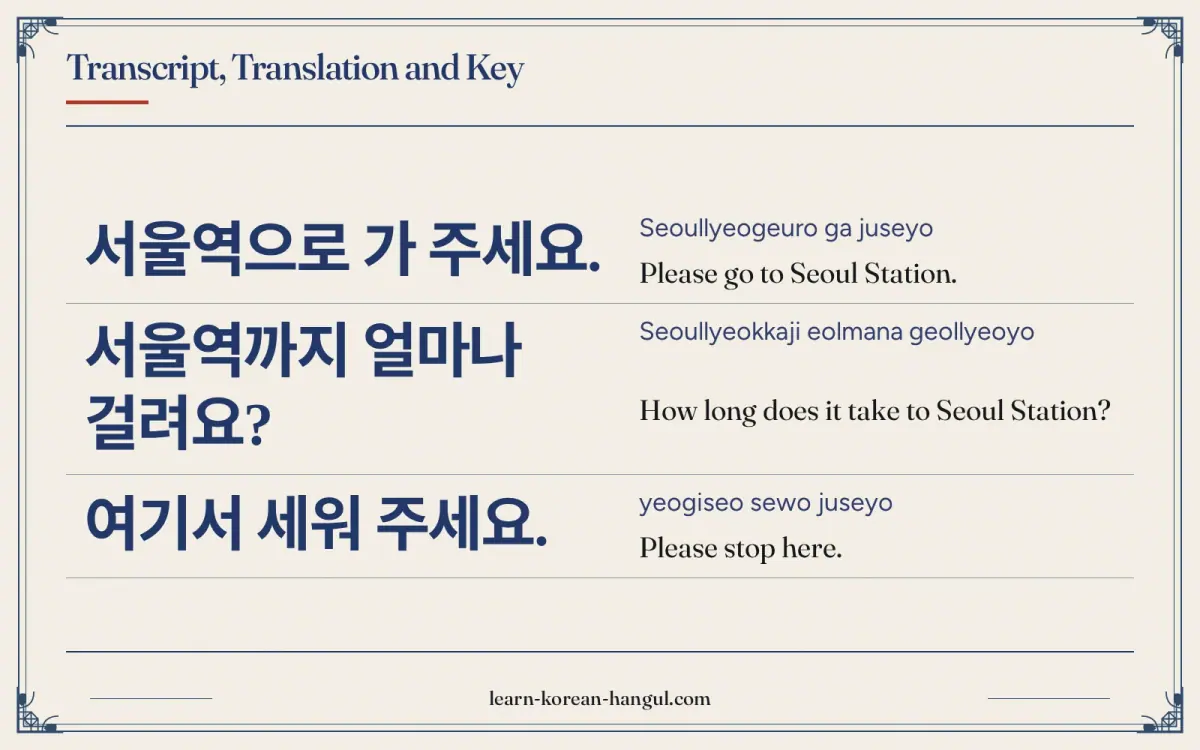
Read the transcript after both listens. Each line has its own clip.
Taking a Taxi to Seoul Station
Driver
어서 오세요. 어디로 가세요?
eoseo oseyo. eodiro gaseyo
Welcome. Where are you going?
Passenger
서울역으로 가 주세요.
Seoullyeogeuro ga juseyo
Please go to Seoul Station.
Driver
네, 알겠습니다. 안전벨트 매 주세요.
ne, algetseumnida. anjeonbelteu mae juseyo
Yes, understood. Please fasten your seat belt.
Passenger
서울역까지 얼마나 걸려요?
Seoullyeokkaji eolmana geollyeoyo
How long does it take to Seoul Station?
Driver
길이 안 막히면 이십 분쯤 걸려요.
giri an makimyeon isip bunjjeum geollyeoyo
If the road is not jammed, about twenty minutes.
Passenger
좀 더워요. 에어컨 좀 켜 주세요.
jom deowoyo. eeokeon jom kyeo juseyo
It is a bit hot. Please turn on the air conditioning.
Driver
네, 켰어요. 곧 서울역이에요. 어디에서 세워 드릴까요?
ne, kyeosseoyo. got Seoullyeogieyo. eodieseo sewo deurilkkayo
Yes, it is on. We will be at Seoul Station soon. Where shall I stop?
Passenger
여기서 세워 주세요.
yeogiseo sewo juseyo
Please stop here.
Driver
네, 요금은 만 사천 원이에요.
ne, yogeumeun man sacheon wonieyo
Yes, the fare is 14,000 won.
Passenger
카드로 계산할게요. 감사합니다.
kadeuro gyesanhalgeyo. gamsahamnida
I will pay by card. Thank you.
Answer key
- Seoul Station (서울역).
- By card (카드로).
- About twenty minutes (이십 분쯤).
- The air conditioning (에어컨).
- 14,000 won (만 사천 원).
- Here (여기서).
Line-by-Line Notes
- Line 1, 어서 오세요. The standard greeting to a customer who has just arrived. Drivers say it as you board.
- Line 3, 알겠습니다. "Understood". It is the formal way to accept a request, and drivers use it even though the rest of the talk is polite style.
- Line 5, 길이 안 막히면. 막히다 (to be blocked, jammed) with -(으)면 "if". Korean drivers often mention traffic first.
- Line 7, 세워 드릴까요? Literally "shall I stop it for you?". 드리다 is the humble form of 주다, used for what you do for the customer.
- Line 9, 요금은. 요금 is "fare" or "fee", and 은 marks it as the topic.
The sound changes in these lines are next.
Which Sound Changes Are Hidden in the Dialogue?
Four written forms sound different from their spelling. Play each one alone, and then the driver's short version of the first question.
In 서울역으로, the ㄴ added before 역 turns into ㄹ because the 울 before it ends in ㄹ. The final ㄱ of 역 then moves onto 으, so you hear [서울려그로]. In 막히면, the ㄱ and ㅎ join into a single ㅋ sound, so 히 is not heard separately. These rules are regular, so they help even with new words. The short question loses the 로, but the question word 어디 still tells you it is a question.
Next, the first request gets a worked example.
Worked Example: 서울역으로 가 주세요.
Three requests carry the whole ride, and all share one pattern.
서울역으로 가 주세요.
Seoullyeogeuro ga juseyo
Please go to Seoul Station.
- Name the destination. 서울역 is "Seoul Station". 으로 shows direction, "towards". It is 으로 after a final consonant such as ㄱ, and 로 after a vowel.
- Add the verb. 가 is the verb 가다 (to go) in its short -아/어 form.
- Close with 주세요. -아/어 주세요 means "please do it for me". Together: "Please go (for me) to Seoul Station."
The same pattern gives the other requests.
여기서 세워 주세요.
yeogiseo sewo juseyo
Please stop here.
- Say where. 여기서 is the short form of 여기에서, "here" as the place of the action.
- Use the pattern again. 세워 comes from 세우다 (to stop something, to make stand), so you are asking the driver to stop the car.
Now the payment, which uses 로 in a different job.
카드로 계산할게요.
kadeuro gyesanhalgeyo
I will pay by card.
- Read 로 as "by means of". 카드로 is "with a card". The same particle that marked direction in 서울역으로 now marks the tool.
- Read -ㄹ게요. 계산할게요 is a promise: "I will pay". It is heard as [계산할께요] with a tense ㄱ.
Compare this with a shop order, which uses the bare form.
In a shop, 이거 주세요 means "Please give me this". 주세요 there is a main verb. In the taxi requests, -아/어 주세요 is attached to another verb, so the structure is 'verb + for me'. Learners often mix the two, so the next section lists the usual slips.
What Mistakes Do Learners Make Here?
Learners often assume that 주세요 alone is the whole request. Actually, in a taxi it follows a verb, and the verb carries the action. Four slips are common.
- Saying 서울역 주세요. That means "give me Seoul Station". Say 서울역으로 가 주세요.
- Writing 서울역으로 as it sounds, 서울려그로. The spelling keeps 역, and the sound change happens only in speech.
- Using 에 and 으로 as if they were the same. 으로 points in a direction, and 에 names the goal. Taxi requests usually use 으로, as in 서울역으로 가 주세요.
- Hearing 만 사천 원 as 사천 원. The word 만 (10,000) is short. Without it, 14,000 becomes 4,000.
Test these in the practice set below.
Practice and Answer Key
- How do you ask a driver to go to 시청 (City Hall)?
- Which particle marks "by card": 으로 or 로? Why?
- Write the request "Please turn on the air conditioning".
- What does 세워 주세요 ask the driver to do?
Answers
- 시청으로 가 주세요.
- 로, because 카드 ends in a vowel.
- 에어컨 좀 켜 주세요.
- To stop the car.
Where to Go Next
Play the dialogue again tomorrow, hide the transcript and write the fare. When it feels easy, continue with Korean phone call dialogue, which moves from the street to a conversation by phone. All dialogues are listed in Korean audio dialogues.
What this page does not cover. It does not cover taxi apps, night surcharges or toll roads.
Return to this Korean taxi dialogue audio when you want to check that you still hear the destination before the verb.
Frequently Asked Questions
What does 가 주세요 mean?
가 주세요 means "please go (for me)". 가 is the short form of the verb 가다, and 주세요 turns it into a polite request. The pattern -아/어 주세요 works with most verbs: 켜 주세요 (please turn on), 세워 주세요 (please stop), 기다려 주세요 (please wait). Put the destination first: 서울역으로 가 주세요.
How do I ask the driver to stop?
Say 여기서 세워 주세요 (yeogiseo sewo juseyo), "Please stop here." Replace 여기서 with a landmark to be more exact, for example 저기 앞에서 세워 주세요, "Please stop up ahead." Say it a little before the spot, since drivers need time to pull over.
How do I pay by card?
Say 카드로 계산할게요 (kadeuro gyesanhalgeyo), "I will pay by card." 카드로 means "with a card", and 계산할게요 is a polite promise. If you want cash instead, say 현금으로 계산할게요. The word 현금 means cash.
Why is 으로 used with a destination?
으로 and 로 mark direction, "towards", and also a tool or method. With a place it says where you are heading: 서울역으로 가 주세요. The form is 으로 after a final consonant such as the ㄱ of 서울역, and 로 after a vowel, as in 카드로. After a final ㄹ, use 로.