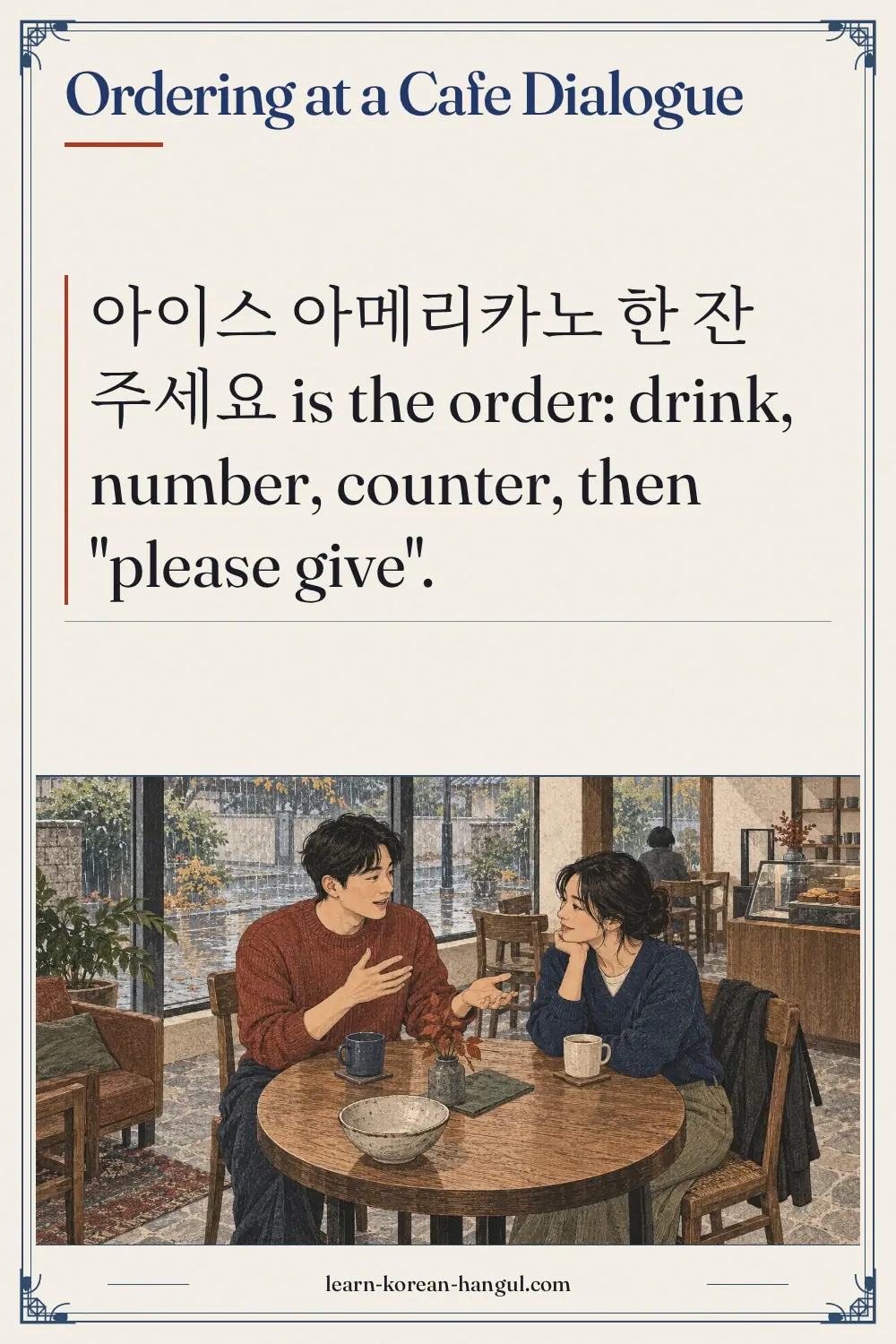
어서 오세요. 주문하시겠어요? / 아이스 아메리카노 한 잔 주세요. / 사이즈는 어떻게 하시겠어요? / 큰 걸로 주세요. / 매장에서 드시겠어요, 포장하시겠어요? / 포장해 주세요. / 삼천오백 원입니다. / 카드로 계산할게요. / 네. 영수증 필요하세요? / 아니요, 괜찮아요. 감사합니다.
What you'll learn
- State the drink, the size and the price after hearing the dialogue once or twice.
- Recognise the barista's question 하시겠어요? and answer it with 주세요.
- Hear 삼천오백 원입니다 as [삼처노백 워님니다] and still write 3,500.
- Tell a quantity (한 잔, native number) from a price (삼천오백, Sino-Korean number).
Before you start: you need to read Hangul and know the numbers 1 to 10 in both systems. Time: about 20 minutes. Level: A1. The transcript stays hidden until you have listened once.
Key facts
- 삼천오백 원입니다 states the price, which is 3,500 won, in Sino-Korean numbers.
What Is an Ordering at a Cafe Dialogue?
An ordering at a cafe dialogue is a short recording of the exchange that happens at a cafe counter: a greeting, an order, a few follow-up questions, a price and a payment. Cafe orders follow almost the same sequence every time, so they are the best place to train your ear on real Korean service speech.
In this recording the barista does most of the asking and the customer does most of the choosing. You hear one honorific form (하시겠어요) that you must recognise, and one request form (주세요) that you can use yourself. The same phrases appear in Korean restaurant phrases, and the menu words appear on a Korean cafe menu.
The sentences are short, but several are hard to catch by ear, as the next section shows.
What Makes This Dialogue Hard to Follow by Ear?
Service speech is fast, and the barista speaks in fixed phrases that blur into one stream. Prices are the hardest part. A number spoken quickly after a long phrase like 사이즈는 어떻게 하시겠어요? is easy to lose.
| What you see | What you hear | Where learners slip |
|---|---|---|
| 삼천오백 원입니다 | [삼처노백 워님니다] | The ㄴ of 천 and the ㄴ of 원 each move to the next block, and the ㅂ of 입 becomes ㅁ |
| 하시겠어요 | [하시게써요] | The ㅆ of 겠 moves to the next block |
| 계산할게요 | [계산할께요] | ㄹ게 is heard with a tense ㄲ |
| 어떻게 | [어떠케] | ㅎ joins ㄱ and gives a ㅋ sound |
The first two rows involve a final consonant jumping to the next block. This is liaison (연음), described in the standard pronunciation rules (표준 발음법) of the National Institute of Korean Language (국립국어원). The ending -(으)ㄹ게 in the third row falls under a separate rule (Article 27) that makes the ㄱ after -(으)ㄹ tense, and in the fourth row ㅎ and ㄱ merge into ㅋ (aspiration, 격음화).
With the traps in mind, here is how the practice runs.
How Does the Dialogue Practice Work?
Two listens come before any reading, so your ear does the work first.
- Listen once at normal speed. Do not pause. Try to note the drink, the size and the number you hear at the end.
- Listen again slowly. Use the slow player. Replay any line you missed up to three times.
- Open the transcript. Compare it with your notes and mark each line you misheard.
- Replay only the marked lines. Then play the whole dialogue once more.
You will know it worked when you can state the drink, the size and the price with no help. A common mistake is to write the price as digits you guess from the number of syllables. Listen for the pattern 삼 (3) + 천 (1,000) + 오 (5) + 백 (100) instead. If the audio feels too fast, understand spoken Korean shows how to find your listening bottleneck.
The first listen is for the overall order.
First Listen: the Gist
Play the normal-speed audio once, without the transcript. Answer these questions in English.
- What does the customer order?
- Does the customer drink in the cafe or take the drink away?
Gist means the main points. If you missed either answer, play the clip again before continuing.
The second listen adds the numbers and the choices.
Second Listen: the Details
Play the slow recording and answer these questions.
- Which size does the customer choose?
- How much does the customer pay?
- How does the customer pay?
어서 오세요. 주문하시겠어요? / 아이스 아메리카노 한 잔 주세요. / 사이즈는 어떻게 하시겠어요? / 큰 걸로 주세요. / 매장에서 드시겠어요, 포장하시겠어요? / 포장해 주세요. / 삼천오백 원입니다. / 카드로 계산할게요. / 네. 영수증 필요하세요? / 아니요, 괜찮아요. 감사합니다.
The price is the question learners miss most, because the sound [삼처노백] does not match the written 삼천오백. When your answers are ready, the transcript shows what was said.
Transcript, Translation and Key
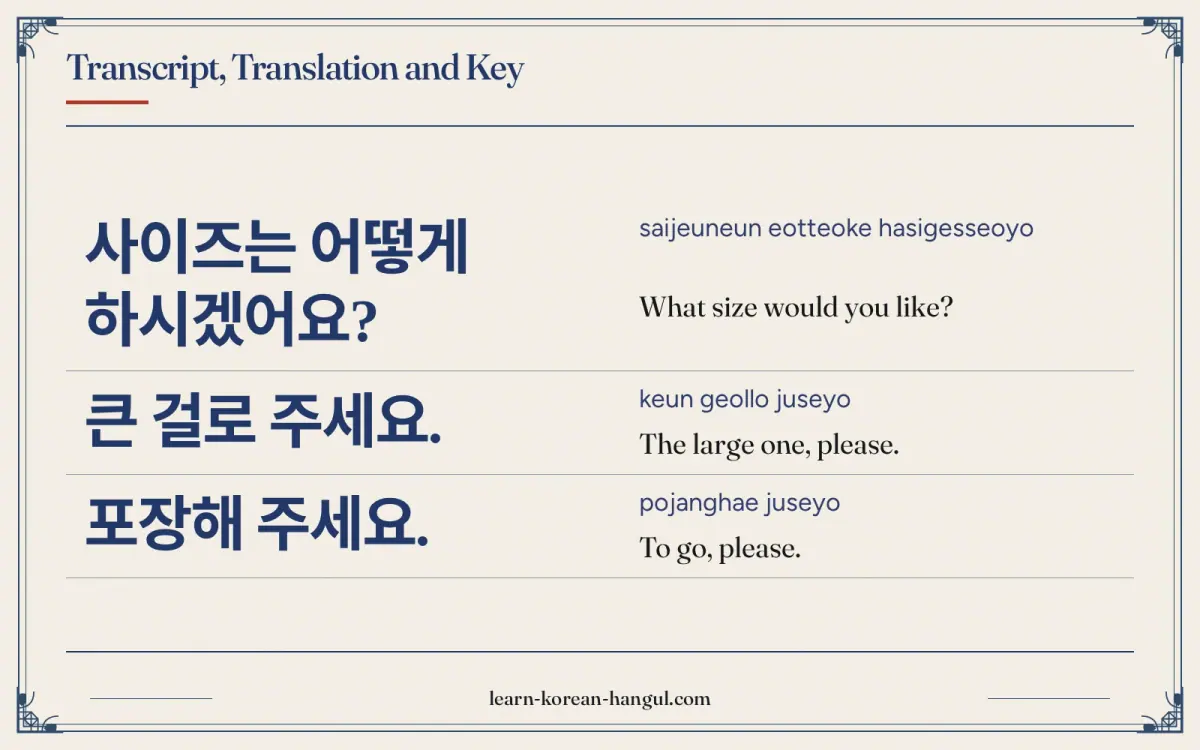
Read the transcript only after both listens. Each line has its own clip.
Ordering an Iced Americano
Barista
어서 오세요. 주문하시겠어요?
eoseo oseyo. jumunhasigesseoyo
Welcome. Would you like to order?
Customer
아이스 아메리카노 한 잔 주세요.
aiseu amerikano han jan juseyo
One iced americano, please.
Barista
사이즈는 어떻게 하시겠어요?
saijeuneun eotteoke hasigesseoyo
What size would you like?
Customer
큰 걸로 주세요.
keun geollo juseyo
The large one, please.
Barista
매장에서 드시겠어요, 포장하시겠어요?
maejangeseo deusigesseoyo, pojanghasigesseoyo
Will you have it here or take it to go?
Customer
포장해 주세요.
pojanghae juseyo
To go, please.
Barista
삼천오백 원입니다.
samcheonobaek wonimnida
That is 3,500 won.
Customer
카드로 계산할게요.
kadeuro gyesanhalgeyo
I will pay by card.
Barista
네. 영수증 필요하세요?
ne. yeongsujeung piryohaseyo
Yes. Do you need a receipt?
Customer
아니요, 괜찮아요. 감사합니다.
aniyo, gwaenchanayo. gamsahamnida
No, that is fine. Thank you.
Answer key
- An iced americano (아이스 아메리카노), one cup (한 잔).
- To go. The customer says 포장해 주세요.
- The large one: 큰 걸로 주세요.
- 3,500 won, said 삼천오백 원.
- By card: 카드로 계산할게요.
Line-by-Line Notes
- Line 1, 주문하시겠어요? 주문 means "order". The barista's -시겠어요 is a polite offer: "Will you order?"
- Line 2, 한 잔. 한 is the form of native 하나 (one) before a counter, and 잔 counts cups and glasses.
- Line 4, 큰 걸로. 큰 means "big", 걸 is short for 것을, and -로 marks the choice, so "with the big one".
- Line 7, 원입니다. 입니다 is the formal polite copula, standard in shop announcements.
- Line 9, 필요하세요? Literally "is a receipt necessary?", the usual way to offer one.
The sound changes in these lines deserve a closer listen.
Which Sound Changes Are Hidden in the Dialogue?
Four written forms differ from what you hear. Play each one alone.
In 삼천오백, the ㄴ of 천 sounds like the start of the next block, so you hear [삼처노백]. In 원입니다 the same movement happens, and then ㅂ before ㄴ turns into ㅁ (nasalization), giving [워님니다]. Said without any pause, the ㄱ of 백 also links to 원, so the whole price can sound like [삼처노배궈님니다]. In 계산할게요 the ending -ㄹ게요 takes a tense ㄲ sound, written ㄱ and heard [께]. Each change is regular, so once you know the pattern you can predict the sound. Korean nasalization explains the ㅂ change in more depth.
Next, the sentence at the centre of the dialogue gets a full breakdown.
Worked Example: 아이스 아메리카노 한 잔 주세요.
This is the sentence you will use yourself, and it fits any drink order.
아이스 아메리카노 한 잔 주세요.
aiseu amerikano han jan juseyo
One iced americano, please.
- Name the item. 아이스 아메리카노 is two loanwords: ice and americano. No particle is needed in a quick order.
- Add the quantity. 한 잔 is native one plus the cup counter. The quantity uses a native number, never 일 잔.
- Add the request. 주세요 is the polite request form of 주다 (to give), so the whole sentence is "Please give (me) one cup of iced americano."
- Say it as the barista hears it. Keep 한 잔 together: [한 잔 주세요].
The price uses the other number system. The amount is read in Sino-Korean numbers.
So the same dialogue contains both systems: native 한 for the cup and Sino-Korean 삼천오백 for the money. Korean money numbers explains why. A frequent confusion follows from it.
What Mistakes Do Learners Make Here?
Learners often assume the barista's questions and the customer's replies use the same endings. They do not, and four slips are common.
- Answering 하시겠어요? with 하시겠어요. The barista uses the honorific -시- to show respect for you. You answer with 주세요 or 할게요, not with the honorific form about yourself.
- Writing 일 잔 instead of 한 잔. Cups are counted with native numbers: 한 잔, 두 잔, 세 잔.
- Hearing 삼천오백 as 삼 오백. The 천 is easy to lose between 삼 and 오, because its ㄴ slides onto 오. Listen for the "cheo-no" inside [삼처노백].
- Writing 원입니다 as 원임니다. The ㅁ you hear in [워님니다] comes from nasalization; the spelling keeps the ㅂ of 입니다.
These slips are fixed by one more listen with the questions in mind. Test yourself below.
Practice and Answer Key
- What does the barista ask in line 3?
- How is 한 잔 spelled and counted: with 일 or with 한?
- Write the price in digits as you hear 삼천오백 원.
- Which verb stem is in 포장해 주세요: 포장하다 or 포장되다?
Answers
- 사이즈는 어떻게 하시겠어요?, "What size would you like?"
- With 한, a native number before the counter 잔.
- 3,500 won.
- 포장하다, "to pack, to wrap", so 포장해 주세요 is "please pack it".
Where to Go Next
Play the dialogue again after a day with the transcript hidden and check whether you can still give the price. The next dialogue changes the setting to a first meeting: Korean introduction dialogue audio. More set pieces are listed in Korean audio dialogues.
What this page does not cover. It does not teach the full counter system, kiosk ordering or chain-specific size names, and it uses text-to-speech voices, so a real barista may speak faster.
Return to this ordering at a cafe dialogue whenever you want a quick check that you can still catch a drink, a size and a price.
Frequently Asked Questions
What does 하시겠어요 mean?
하시겠어요 is 하다 (to do) with the honorific -시- and the intention marker -겠-, plus the polite ending -어요. Together they ask "Would you like to do it?" Staff use it for choices, as in 사이즈는 어떻게 하시겠어요? You do not use it about yourself; you answer with 주세요 or 할게요.
How is 3,500 said?
3,500 is said 삼천오백 (samcheon-obaek) in Sino-Korean numbers: 삼 (3), 천 (1,000), 오 (5), 백 (100). A speaker usually drops 일 before 천 and 백, so 1,500 is 천오백, not 일천오백. In a fast conversation the sound is [삼처노백], so listen for the 천.
What size words are used?
In ordinary speech people say 큰 걸로 (the large one) or 작은 걸로 (the small one) and point at the menu. Some chains print their own size names, such as 톨, 그란데 or 벤티. Check the printed menu of the cafe, because these names are brand-specific rather than a general rule.
Is 입니다 formal?
입니다 is the formal polite form of "to be", used in announcements and by staff reading prices. The friendlier polite form is 이에요 or 예요, so you may hear both, as in 삼천오백 원이에요. Both are polite. As a customer you can use either when you state an amount or a name.