What you will learn
- Identify the time or date heard in at least 18 of 20 items.
- Hear the two-system pattern in every time: a native hour with a Sino-Korean minute.
- Recognise the irregular month names 유월 (June) and 시월 (October).
Before you start: you should know telling time in Korean and dates in Korean. Time: about 20 minutes. Audio plays only when you press a button.
Key Facts
- 세 시 십오 분 combines a native hour and a Sino-Korean minute.
- 다섯 시 반 uses 반 (half) for the half hour.
- 오월 and 유월 are month names; 유월 and 시월 are the irregular forms.
- 월요일 is the first weekday item, and the weekday items run from 월요일 to 일요일.
- Two items use 에 ("at") with a time, and one item tests 시 (o'clock) against 시간 (hours).
Last updated: 2026-10-09.
What Is Korean Time Listening Practice?
Korean time listening practice is a discrimination task on spoken clock times, months, dates and weekdays: you hear a phrase and choose the time or date that was said. A Korean clock time joins two number systems. The hour uses a native Korean number (한, 두, 세, 네), and the minute uses a Sino-Korean number (오, 십오, 삼십). Dates use only Sino-Korean numbers.
Listen to the pattern. 세 시 십오 분 means 3:15, and 다섯 시 반 means 5:30.
Revised Romanization (RR), the official Latin-letter system, writes them as se si sibo bun and daseot si ban. RR is a learning aid on this page, and the Hangul and the audio are the reference. The next section explains why times by ear are hard.
Why Is This Hard for English Speakers?
English speakers find Korean times hard because the hour and the minute use different number words, and the date order is reversed. In English, "three fifteen" uses one set of numbers. In Korean, 세 (3) is native and 십오 (15) is Sino-Korean, so the ear must switch systems in the middle of one phrase.
| Problem | Example | What to listen for |
|---|---|---|
| Two systems in one phrase | 세 시 십오 분 | native hour, then Sino-Korean minute |
| Half hour | 다섯 시 반 | 반 replaces 삼십 분 |
| Irregular months | 유월, 시월 | no final ㄱ or ㅂ in the month name |
| Date order | 오월 오 일 | month first, then day |
| Hour or duration | 한 시 / 한 시간 | 시간 means a length of time |
Listen to two more phrases before the set starts: a month and a weekday.
After the final stop sound of 다섯, 여섯, 일곱 and 아홉, 시 becomes tense, so 일곱 시 is spoken [일곱씨]. Listen for it. Next, how the set works.
How Does the Set Work?
The set works in three steps: listen, choose, then check the key. Every item plays one phrase, and you choose between two or three printed options.
- Press play and listen once at normal speed.
- Listen for the unit word (시, 분, 월, 일, 요일). It tells you which number system to expect.
- Choose the time or date you heard. Replay at slow speed only if you are unsure.
- After item 20, open the answer key and score yourself.
Items 1 to 10 are clock times. Items 11 to 20 are months, dates and weekdays. You will know the method works when you catch the unit word before the number. The times come first.
Listen: Items 1 to 10
Items 1 to 10 cover hours, minutes, the half hour, a.m. and p.m., and the particle 에 (at). Two items use 에 in the form "at X o'clock".
Practice · Read
Show answer
세 시 십오 분
se si sibo bun
3:15 (slow)
Show answer
다섯 시 반
daseot si ban
5:30 (slow)
| Item | Choose one | Meaning | Tests |
|---|---|---|---|
| 1 | 세 시 십오 분 / 세 시 오십 분 | 3:15 / 3:50 | 십오 versus 오십 |
| 2 | 다섯 시 반에 / 여섯 시 반에 | at 5:30 / at 6:30 | 에 and 반 |
| 3 | 일곱 시 이십 분 / 일곱 시 이 분 | 7:20 / 7:02 | 이십 versus 이 |
| 4 | 두 시 / 열두 시 | 2:00 / 12:00 | 두 versus 열두 |
| 5 | 한 시 / 열한 시 | 1:00 / 11:00 | 한 versus 열한 |
| 6 | 아홉 시 삼십 분 / 아홉 시 반 | 9:30 / 9:30 | two forms, one time |
| 7 | 오전 / 오후 | a.m. / p.m. | 오전 versus 오후 |
| 8 | 오후 세 시에 / 오후 네 시에 | at 3 p.m. / at 4 p.m. | 에 and 세 versus 네 |
| 9 | 열 시 오 분 전 / 열 시 오십 분 | five to ten / 10:50 | 전 (before) |
| 10 | 한 시 / 한 시간 | 1 o'clock / one hour | 시 versus 시간 |
Item 6 has two options that name the same time. Item 10 compares a clock time with a length of time. Items 11 to 20 follow.
Listen: Items 11 to 20
Items 11 to 20 cover months, dates and weekdays. Items 13 and 14 test the two irregular months 유월 and 시월.
Practice · Read
Show answer
세 시 십오 분
se si sibo bun
3:15 (slow)
Show answer
다섯 시 반
daseot si ban
5:30 (slow)
| Item | Choose one | Meaning | Tests |
|---|---|---|---|
| 11 | 일월 / 이월 | January / February | 일 versus 이 |
| 12 | 오월 오 일 / 오월 이십오 일 | 5 May / 25 May | 오 versus 이십오 |
| 13 | 유월 / 오월 | June / May | irregular 유월 |
| 14 | 시월 / 사월 | October / April | irregular 시월 |
| 15 | 월요일 / 화요일 | Monday / Tuesday | weekday names |
| 16 | 수요일 / 목요일 | Wednesday / Thursday | weekday names |
| 17 | 금요일 / 일요일 | Friday / Sunday | weekday names |
| 18 | 월요일 아침 / 월요일 저녁 | Monday morning / Monday evening | part of day |
| 19 | 삼월 십 일 / 삼월 십이 일 | 10 March / 12 March | 십 versus 십이 |
| 20 | 시월 구 일 / 시월 십구 일 | 9 October / 19 October | 구 versus 십구 |
Item 20 is 9 October, the date of Hangul Day (한글날). Use the key in the next section.
Answer Key and Scoring
The answer key lists the phrase played in each item with a cue. The interactive set reveals it only after you submit. Count one point per correct choice at the first listen.
| Item | Played | Cue |
|---|---|---|
| 1 | 세 시 십오 분 | 십오: 십 first, 15 minutes |
| 2 | 다섯 시 반에 | 다섯 is 5; 에 means at |
| 3 | 일곱 시 이십 분 | 이십 is 20 |
| 4 | 열두 시 | 열 is 10, 두 is 2: 12 |
| 5 | 한 시 | 한 is 1 |
| 6 | either | 삼십 분 and 반 are both 30 minutes |
| 7 | 오후 | 후 means after |
| 8 | 오후 네 시에 | 네 is 4 |
| 9 | 열 시 오 분 전 | 오 분 전 is five minutes before |
| 10 | 한 시간 | 시간 is a length of time |
| 11 | 이월 | 이 is 2 |
| 12 | 오월 이십오 일 | 이십오 is 25 |
| 13 | 유월 | 유 not 육 |
| 14 | 시월 | 시 not 십 |
| 15 | 화요일 | 화 is fire |
| 16 | 목요일 | 목 is wood |
| 17 | 일요일 | 일 is sun |
| 18 | 월요일 저녁 | 저녁 is evening |
| 19 | 삼월 십이 일 | 십이 is 12 |
| 20 | 시월 십구 일 | 십구 is 19 |
Item 6 counts as correct whichever option you choose, because both name 9:30.
| Score out of 20 | Meaning | Next action |
|---|---|---|
| 18 to 20 | At or above 90 percent | Continue to audio dialogues |
| 13 to 17 | Most times and dates are stable | Repeat the missed half |
| 0 to 12 | Times and dates are not yet stable | Review telling time and dates, then retest |
The score is a self-check and does not judge your pronunciation. Next, what to do with the pattern of your misses.
What to Do after a Low Score?
After a low score, compare the two halves. Items 1 to 10 are times, and items 11 to 20 are dates and weekdays. Fix the weaker half first.
- Times weak: say the hour and minute with the system labels in your head. For 세 시 십오 분, think "native, Sino-Korean".
- Months weak: write the twelve month names with the irregular ones circled: 유월 and 시월.
- Weekdays weak: learn the seven names as a list, 월 화 수 목 금 토 일, then add 요일.
The rules are explained in telling time in Korean and dates in Korean. Retest after a day. The worked example takes one phrase through the routine.
Worked Example: 세 시 십오 분
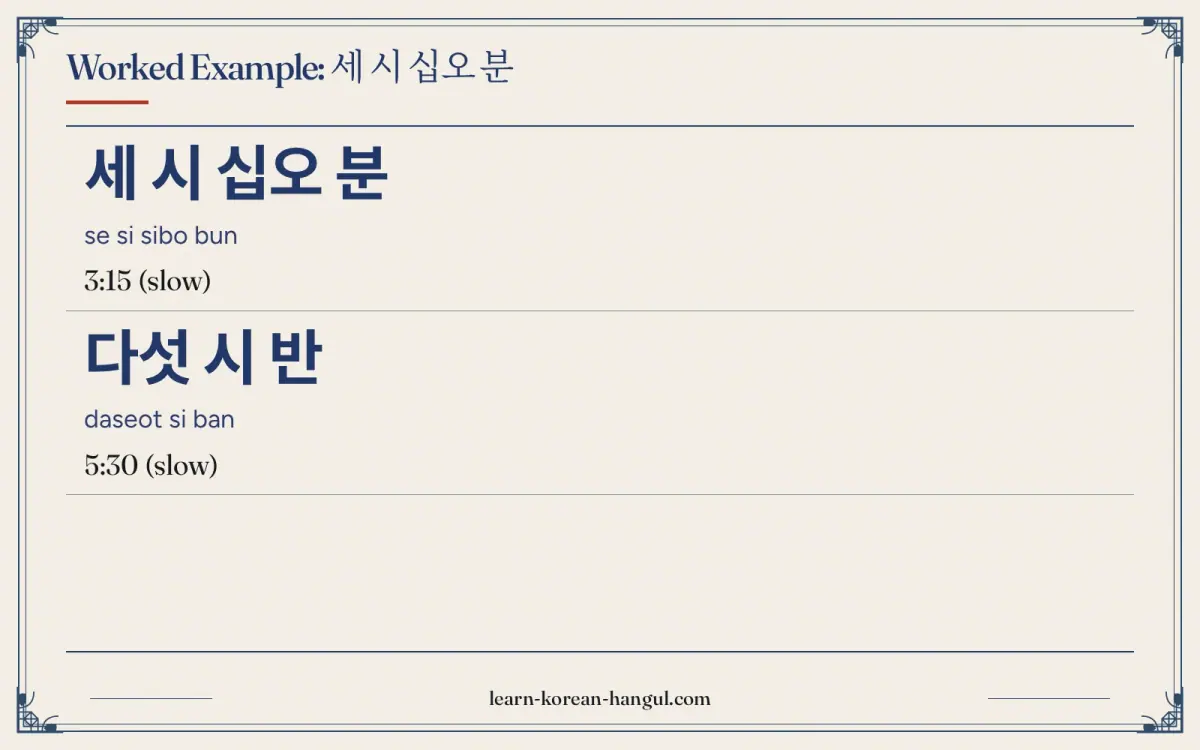
The worked example takes the full time pattern through the whole task.
- Listen. Play the slow clip.
세 시 십오 분
se si sibo bun
3:15 (slow)
- Find the unit words. 시 comes after 세, and 분 comes after 십오.
- Pick the system for each part. Before 시, expect a native number: 세 is 3. Before 분, expect a Sino-Korean number: 십오 is 15.
- Assemble. The hour is 3 and the minute is 15, so the time is 3:15.
- Check the sound. 십오 분 is spoken [시보분], with the final ㅂ moving to the next syllable.
Apply the same steps to 다섯 시 반: the native hour 다섯 is 5, and 반 means half, so the time is 5:30.
다섯 시 반
daseot si ban
5:30 (slow)
The mistakes to avoid come next.
What Mistakes Do Learners Make Here?
The most common mistake is to use one number system for the whole phrase, and the second is to spell the months as they are numbered.
- Learners often assume the hour and the minute use the same numbers. Actually the hour is native and the minute is Sino-Korean, so 세 시 십오 분 mixes two systems.
- Learners often assume June is 육월 and October is 십월. Actually the standard spellings are 유월 and 시월, which drop the final consonant of 육 and 십.
- Learners often assume 한 시 and 한 시간 mean the same. Actually 한 시 is 1 o'clock and 한 시간 is one hour of duration.
The weekday names combine one character with 요일. Month and day follow Korean date order, so 5 May is 오월 오 일. Try the written check below.
Practice and Answer Key
Use this written check after the audio set. Write the time or date.
- 여섯 시 반
- 열한 시 오십 분
- 유월 이십 일
- 시월 구 일
- 금요일 저녁
Answer key: 1. 6:30. 2. 11:50. 3. 20 June. 4. 9 October. 5. Friday evening.
As a speaking task, say today's date and the current time aloud in Korean, then record yourself. Write the answer before you check. For written practice, try Korean dictation practice. The word pairs behind this set are explained in Korean minimal pairs. Before this lesson, review Korean Numbers Listening Practice.
Where to Go Next
The Korean time listening practice above covers clock times, months, dates and weekdays in 20 items. It does not cover years, durations beyond 한 시간, seasons, or time in a full sentence, and it does not judge how you speak. Combine it with the listening strategies for better results.
Next: Audio Dialogues. To return to all the drills, see Sound Discrimination.
Frequently Asked Questions
Why is the hour native and the minute Sino-Korean? The counter 시 takes native numbers, and 분 takes Sino-Korean numbers. This is a fixed convention of Korean, so it has to be learned, not derived. In 세 시 십오 분, 세 is native for 3 and 십오 is Sino-Korean for 15. Hearing the unit word first tells you which system to expect.
What does 반 mean? 반 means half, and it is used for the half hour. 다섯 시 반 is 5:30, the same time as 다섯 시 삼십 분. The short form is more common in speech. 반 is a single syllable, so listen for it right after 시.
Why are June and October spelled 유월 and 시월? The month names are the Sino-Korean numbers 육 (6) and 십 (10) plus 월 (month), but speakers came to drop the final consonant in these two names. The Hangul Orthography (Article 52) writes such customary readings as they are spoken, so the standard spellings are 유월 and 시월, and you hear them that way.
How do I say a date? A Korean date goes from largest to smallest: year, month, day. Each part is a Sino-Korean number plus 년, 월 or 일. So 9 October is 시월 구 일, and 5 May is 오월 오 일. A weekday name can follow the date.