
Dates in Korean: the Essentials

A Korean date is a Sino-Korean number plus a unit word, repeated three times. Sino-Korean numbers are the series 일, 이, 삼 borrowed from Chinese. The unit words are 년 (year), 월 (month) and 일 (day). The weekday comes last, either in full (목요일) or in parentheses (목).
| Part | Unit | Example | Spoken |
|---|---|---|---|
| Year | 년 | 2026년 | 이천이십육 년 |
| Month | 월 | 10월 | 시월 |
| Day | 일 | 8일 | 팔 일 |
| Weekday | 요일 | 목요일 | 목요일 |
Two months do not follow the number exactly. June is 유월 (not 육월) and October is 시월 (not 십월), because 육 and 십 lose their final consonant before 월. The other ten months read as their number plus 월, such as 삼월 (March) and 십이월 (December).
The order is the first thing to compare with English. The same day is written differently in the three most common systems.
| Region | Order | Same day written |
|---|---|---|
| Korea | year, month, day | 2026년 10월 8일 |
| United States | month, day, year | 10/8/2026 |
| United Kingdom | day, month, year | 8/10/2026 |
Because the UK and US strings can mean different dates when the numbers are both 12 or under, Korean writers add the unit words, which label each number and remove doubt. The pages below teach each piece of the pattern.
What Pages Are in This Section?
The section has four lessons. Each lesson teaches one part of the date, includes audio and ends with a practice set. Start with the format, then add years, days and the question form.
Format and Years
Korean date format: year, month, day order explained teaches the full pattern, the spoken reading 이천이십육 년 시월 팔 일 목요일 and four numeric notations (2026년 10월 8일, 2026. 10. 8., 2026-10-08 and 26.10.08). It includes a drill that converts US and UK dates into Korean order.
How to say year in Korean: 년, birth years and 2026 shows how to read any year as a single Sino-Korean number, such as 천구백구십구 년 for 1999. It adds the relative words 올해, 작년 and 내년, the birth-year pattern 99년생 and the question 몇 년생이세요?
Days and Asking
Korean days of the month: 1일 to 31일 with audio gives the full list from 일 일 to 삼십일 일 with 31 audio clips. It flags the days that change sound (6일, 16일, 31일) and separates a date such as 삼 일 from a counted span such as 사흘.
What is the date in Korean now? Ask and answer today's date teaches 오늘 며칠이에요?, 오늘 몇 월 며칠이에요? and 오늘 무슨 요일이에요? It adds the birthday question, the formal and casual forms and a six-line dialogue with audio.
Where Are Months and Weekdays?

The month and weekday word lists live in the vocabulary section, not here. This hub teaches how the pieces fit together in a date, while the vocabulary pages teach the words and their pronunciation in depth.
- Months in Korean lists the twelve month names with notes on 유월 and 시월.
- Days of the week in Korean lists 월요일 to 일요일 with the short forms used in calendars.
The same scope split applies to time of day. For clock time, read telling time in Korean, and for lengths of time read Korean time counters.
How Are Dates Different from Durations?

A date names a position on the calendar, while a duration measures how much time passes. The unit words are the same in two cases, which makes this a frequent source of mistakes.
| Unit | In a date | In a duration |
|---|---|---|
| 일 | 삼 일 (the 3rd) | 삼 일 (three days), or 사흘 |
| 월 / 달 | 삼월 (March) | 삼 개월 or 세 달 (three months) |
| 년 | 이천이십육 년 (the year 2026) | 이 년 (two years) |
Use 월 for names on the calendar and 달 or 개월 for counts. Use native day words like 사흘 only for spans, never for dates.
Words That Place a Date near Today

Five small words place a date near today, and they appear in almost every real date conversation: 그저께 (the day before yesterday), 어제 (yesterday), 오늘 (today), 내일 (tomorrow) and 모레 (the day after tomorrow). Pair each with a day number to answer questions like "What is tomorrow's date?".
| Word | Meaning | If today is October 8 |
|---|---|---|
| 어제 | yesterday | 시월 칠 일 |
| 오늘 | today | 시월 팔 일 |
| 내일 | tomorrow | 시월 구 일 |
| 모레 | day after tomorrow | 시월 십 일 |
The question page covers these words with a dialogue, and the days page shows the full list from 1일 to 31일. For fixed national days that make good reading practice, such as 한글날 on 9 October, see the days page as well.
A Five-Minute First Lesson
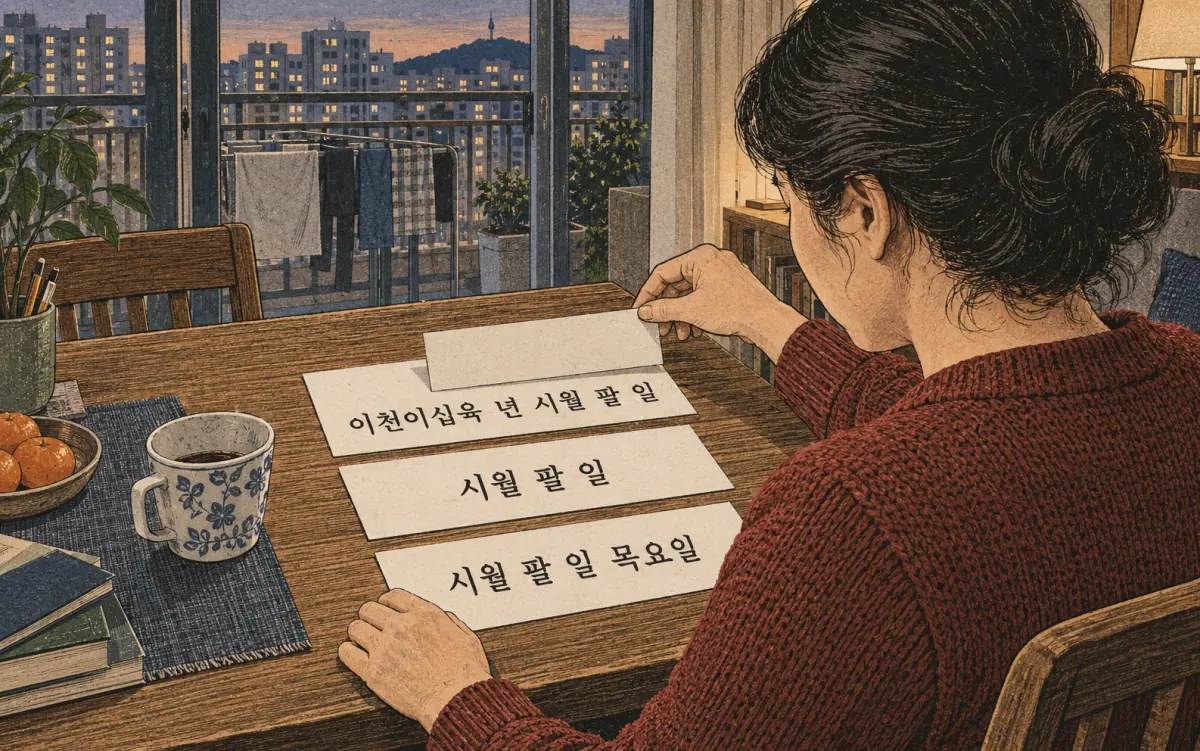
A first lesson takes five minutes and has three steps. First, read the date aloud in full: 이천이십육 년 시월 팔 일. Second, remove the year: 시월 팔 일. Third, add the weekday: 시월 팔 일 목요일. These three lines contain every unit word in this hub, and saying them each morning is the quickest way to make the pattern stick.
Which Date Page Should You Read First?
Read the date format page first if you need to write dates, and read the question page first if you need to speak today. The decision table below maps each need to a lesson.
| If you want to... | Start with |
|---|---|
| write or read a full date on a form | Korean date format |
| say a year, a birth year or "next year" | How to say year in Korean |
| read a calendar or say the 21st | Korean days of the month |
| ask or answer what day it is | What is the date in Korean now |
If you are unsure, follow the order above: format, years, days, then the question. Each page builds on the previous one, and the whole set of dates in Korean takes about two hours at an unhurried pace.
For new learners, a daily habit helps: say today's date aloud each morning, first with the weekday and then without the year. After a week, the unit words feel automatic, and the 월 and 일 sounds no longer need a table.
Frequently Asked Questions
Why do dates start with the year?
Korean orders information from the largest unit to the smallest, the same way an address goes from city to street. A date therefore runs year, month, day. The format also matches the international ISO 8601 style (2026-10-08), so Korean dates sort correctly in files and databases without any conversion.
How do I say today's date?
Say 오늘은 시월 팔 일이에요 for October 8, replacing the month and day with the real ones. To ask, say 오늘 며칠이에요? or 오늘 몇 월 며칠이에요? In daily speech the year is left out. Add the weekday last if needed: 오늘은 시월 팔 일 목요일이에요.
Is the date written with dots or hyphens?
Both appear. Official forms use dots with spaces and a final dot (2026. 10. 8.), apps and databases use hyphens (2026-10-08), and receipts and notes use short dotted forms (26.10.08). The most readable written form uses the unit words: 2026년 10월 8일. All of them keep year, month, day order.
How do I say "the 1st"?
Say 일 일, written 1일. The first 일 is the number one and the second 일 is the unit "day". The date uses Sino-Korean numbers, so 하루 (one day, as a span) cannot name the first of the month. The lunar first day has its own word, 초하루. A month plus day reads 시월 일 일.
How do I say the date in a text message?
Use numerals with units and drop the year if it is clear: 10월 8일 (목). Chat also uses 10/8 (목) or 10.8 목. Read it aloud as 시월 팔 일 목요일. Add the time after the date when you set a plan: 10월 8일 목요일 오후 3시.
Return to Korean Numbers for the other number sections, including counters, money and telling time.