
| Korean | Name | Romanization | Family | Sound |
|---|---|---|---|---|
| ㅏ | 아 | a | basic | a in "father" |
| ㅑ | 야 | ya | basic | ya in "yacht" |
| ㅓ | 어 | eo | basic | between u in "cup" and aw in "law" |
| ㅕ | 여 | yeo | basic | y + ㅓ |
| ㅗ | 오 | o | basic | o in "go", shorter and pure |
| ㅛ | 요 | yo | basic | yo in "yoga" |
| ㅜ | 우 | u | basic | oo in "moon" |
| ㅠ | 유 | yu | basic | "you" |
| ㅡ | 으 | eu | basic | oo in "moon" with lips spread |
| ㅣ | 이 | i | basic | ee in "see" |
| ㅐ | 애 | ae | compound | e in "bed" |
| ㅒ | 얘 | yae | compound | ye in "yes" |
| ㅔ | 에 | e | compound | e in "bed" |
| ㅖ | 예 | ye | compound | ye in "yes" |
| ㅘ | 와 | wa | compound | "wah" |
| ㅙ | 왜 | wae | compound | we in "wet" |
| ㅚ | 외 | oe | compound | we in "wet" |
| ㅝ | 워 | wo | compound | "wuh" |
| ㅞ | 웨 | we | compound | we in "wet" |
| ㅟ | 위 | wi | compound | "wee" |
| ㅢ | 의 | ui | compound | ㅡ gliding into ㅣ |
What Are Korean Vowels?
Korean vowels (모음, moeum) are the Hangul letters that stand for vowel sounds, such as ㅏ [a] and ㅜ [u]. Every Korean syllable block has exactly one vowel letter at its centre, with a consonant before it and sometimes one after it. Vowels are half of the Korean alphabet; the other half is Korean consonants.
Each vowel is a short stroke pattern. You can tell vowels from consonants by shape: a vowel is built from lines and short ticks, while consonants are shapes that imitate the mouth, such as ㄱ and ㅁ.
How Many Korean Vowels Are There?
There are 21 Korean vowels in modern Hangul. Korean textbooks split them into 10 basic vowels (ㅏ ㅑ ㅓ ㅕ ㅗ ㅛ ㅜ ㅠ ㅡ ㅣ) and 11 compound vowels (ㅐ ㅒ ㅔ ㅖ ㅘ ㅙ ㅚ ㅝ ㅞ ㅟ ㅢ). The rules for Hangul spelling, Hangul Orthography of the National Institute of Korean Language, count them this way, by shape.
Some English guides say Korean has only 6 or 8 vowels. They are counting sounds, not letters. This course counts letters (21) and then teaches the six simple vowels first, because the other fifteen build on them.
How Are Korean Vowels Built from Three Strokes?

Korean vowels are built from three symbols: a short tick for heaven, a horizontal line for earth, and a vertical line for a standing person. The 1446 designers described this plan in the Hunminjeongeum Haerye. The tick was originally a round dot.
Put a tick beside the vertical line and you get ㅏ (tick on the right) or ㅓ (tick on the left). Put a tick on the horizontal line and you get ㅗ (above) or ㅜ (below). Add a second tick and you get a y-vowel: ㅏ becomes ㅑ. Join two vowels and you get a compound vowel: ㅏ + ㅣ makes ㅐ.
Every vowel can be taken apart in this way, so you never have to learn 21 unrelated shapes. The next sections follow the four groups.
Basic Korean Vowels

The six simple vowels ㅏ, ㅓ, ㅗ, ㅜ, ㅡ and ㅣ come first. Each is a single steady sound, and each is the base for the others. ㅓ and ㅡ have no exact English equivalent and need the most listening. Start with basic Korean vowels, where all six have a lesson, mouth cues and audio.
Y-Vowels: Adding a Stroke
The y-vowels ㅑ ㅕ ㅛ ㅠ ㅒ ㅖ add a short second tick to a simple vowel, which adds a "y" glide: ㅏ [a] becomes ㅑ [ya]. Four come from simple vowels and two (ㅒ and ㅖ) from ㅐ and ㅔ. Adding one stroke gives the Korean y-vowels, so you learn six sounds from six stroke edits.
Compound Vowels: Adding ㅣ
Compound vowels join two vowel shapes. Adding ㅣ to ㅏ or ㅓ gives ㅐ and ㅔ, the most frequent pair, and joining ㅡ and ㅣ gives ㅢ. The group has 11 letters in all, including ㅒ, ㅖ and the six w-vowels. Korean compound vowels explains how each is built, with a merger table.
W-Vowels: Starting with ㅗ or ㅜ
The six w-vowels ㅘ ㅙ ㅚ ㅝ ㅞ ㅟ start with ㅗ or ㅜ, which turns into a short "w" glide before the second vowel. ㅘ is ㅗ + ㅏ and ㅝ is ㅜ + ㅓ. Combining ㅗ or ㅜ with another vowel gives the Korean w-vowels.
Where Does a Vowel Go in a Syllable Block?
A vowel goes to the right of its consonant if its long stroke is vertical, and under its consonant if its long stroke is horizontal. If it has both, the consonant sits at the top left and the vowel wraps around it.
| Long stroke | Consonant goes | Vowels | Example |
|---|---|---|---|
| Vertical | left | ㅏ ㅑ ㅓ ㅕ ㅣ ㅐ ㅒ ㅔ ㅖ | 가 |
| Horizontal | top | ㅗ ㅛ ㅜ ㅠ ㅡ | 고 |
| Both | top left | ㅘ ㅙ ㅚ ㅝ ㅞ ㅟ ㅢ | 과 |
A vowel written alone takes the silent consonant ㅇ: ㅏ becomes 아. The silent ㅇ keeps the block shape and makes no sound at the start of a block. Placement rules lead straight into Korean syllable blocks.
Which Korean Vowels Sound the Same Today?

Most present-day speakers, especially in Seoul, pronounce ㅐ and ㅔ the same, and pronounce ㅙ, ㅚ and ㅞ the same. The spellings still differ, so you must learn them word by word, as with 개 "dog" and 게 "crab".
The standard-language rules, the Standard Pronunciation Rules of the National Institute of Korean Language, still list ten monophthongs (ㅏ ㅐ ㅓ ㅔ ㅗ ㅚ ㅜ ㅟ ㅡ ㅣ) and eleven diphthongs, and allow ㅚ and ㅟ to be said as diphthongs. This is the textbook view. For listening, the useful inventory is smaller, about seven to eight vowels. Mouth diagrams are on Korean vowel sounds.
In What Order Should You Learn the Vowels?
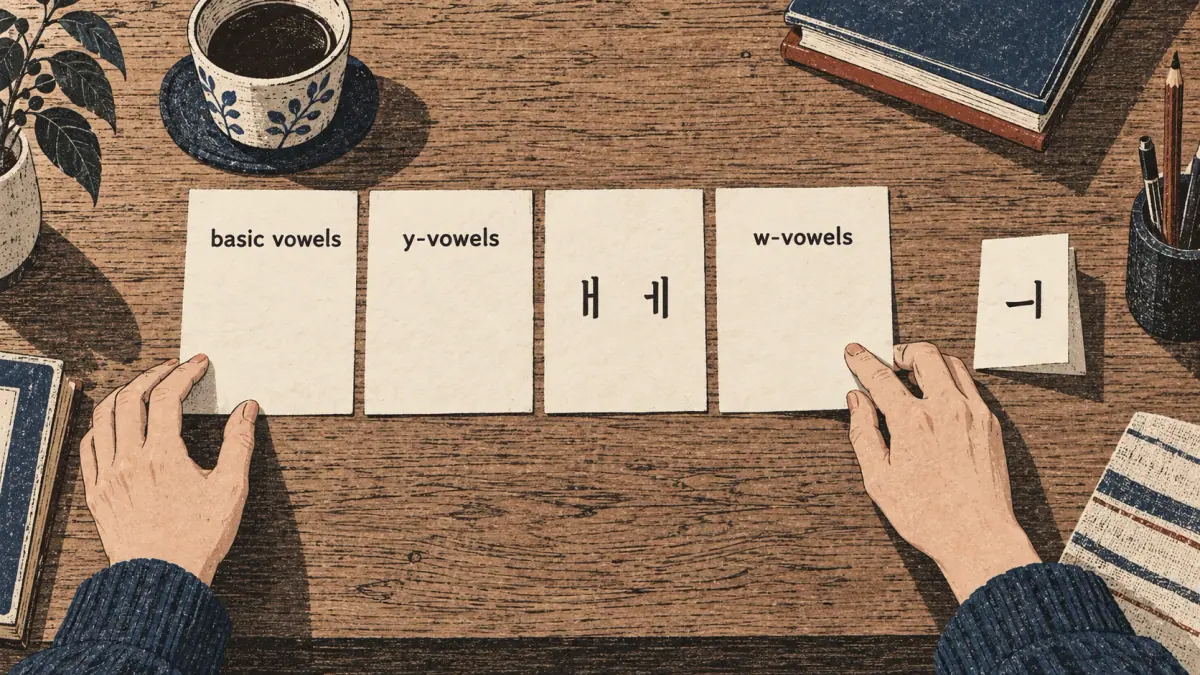
Learn the six simple vowels first, then the y-vowels, then ㅐ and ㅔ, then the w-vowels, and leave ㅢ for last. This order follows how much each group reuses earlier shapes.
- Brand-new to Hangul: begin with the basic vowels, and listen to ㅓ against ㅗ and ㅡ against ㅜ until they sound different.
- Already know the basic six: go to the y-vowels, which are only a stroke different.
- Reading signs and menus soon: add ㅐ and ㅔ, then the w-vowels ㅘ and ㅝ.
- Preparing for verbs: learn ㅘ and ㅝ early because 봐요 and 줘요 contain them.
Begin with the basic vowels and use the Hangul flashcard decks to drill every vowel. Practise this step with the interactive hangul alphabet.
All 21 Korean Vowels Compared
Print this table as a Korean vowels chart. The order is Korean dictionary order.
| Letter | Name | Revised Romanization | Group | Block layout |
|---|---|---|---|---|
| ㅏ | 아 | a | simple | vertical |
| ㅐ | 애 | ae | compound | vertical |
| ㅑ | 야 | ya | y-vowel | vertical |
| ㅒ | 얘 | yae | y-vowel | vertical |
| ㅓ | 어 | eo | simple | vertical |
| ㅔ | 에 | e | compound | vertical |
| ㅕ | 여 | yeo | y-vowel | vertical |
| ㅖ | 예 | ye | y-vowel | vertical |
| ㅗ | 오 | o | simple | horizontal |
| ㅘ | 와 | wa | w-vowel | mixed |
| ㅙ | 왜 | wae | w-vowel | mixed |
| ㅚ | 외 | oe | w-vowel | mixed |
| ㅛ | 요 | yo | y-vowel | horizontal |
| ㅜ | 우 | u | simple | horizontal |
| ㅝ | 워 | wo | w-vowel | mixed |
| ㅞ | 웨 | we | w-vowel | mixed |
| ㅟ | 위 | wi | w-vowel | mixed |
| ㅠ | 유 | yu | y-vowel | horizontal |
| ㅡ | 으 | eu | simple | horizontal |
| ㅢ | 의 | ui | compound | mixed |
| ㅣ | 이 | i | simple | vertical |
The names are the letters written with silent ㅇ. The rules officially name the ten basic vowels; the others are read the same way in practice. Drill the sounds with the Hangul flashcard decks.
Frequently Asked Questions

Are Korean vowels easier than English vowels? Mostly yes. Most Hangul vowel letters have one stable sound, while English letters stand for many. The harder part for English speakers is hearing contrasts that English does not use, especially ㅓ against ㅗ and ㅡ against ㅜ. Regular listening practice with minimal pairs such as 어/오 is the usual fix.
Why does Korean write a vowel with ㅇ? Every syllable block needs a consonant in its first position. When a syllable begins with a vowel sound, the silent letter ㅇ fills that slot and makes no sound at the start of a block. So the vowel ㅏ is written as 아, and the same rule makes 어, 오, 우 and 이.
Do Korean vowels have names? Yes. The ten basic vowels are named by their sound plus ㅇ: 아, 야, 어, 여, 오, 요, 우, 유, 으 and 이. The remaining eleven are read as syllables the same way in classrooms, for example 애 for ㅐ. The consonants have longer names, such as 기역 for ㄱ.
Can a Korean word start with a vowel sound? Yes. Words such as 아이 "child" and 오이 "cucumber" begin with a vowel sound. In writing, they begin with the silent ㅇ, so the first block of 아이 is 아. The silent ㅇ is why Hangul never has a block without a consonant slot.
Is ㅢ a vowel or two? ㅢ is one vowel letter written with two parts, ㅡ and ㅣ. In speech it glides from ㅡ to ㅣ. Its reading depends on position: [ui] at the start of a word, as in 의사, [i] after a consonant, as in 희망 [히망], and optionally [e] as the particle 의 meaning "of". Those readings come later.