
What you'll learn
- Say 10,000, 30,000, 250,000 and 1,000,000 in Korean using 만.
- Split any number into groups of four digits and read it aloud.
- Read prices, the 만 원 note, salaries and population figures.
- Explain why Korean counts in 10,000s and why 일만 is rare in daily speech.
Prerequisites: 1000 in Korean and Sino-Korean numbers 1-100. Estimated time: 25 minutes.
How Do You Say 10000 in Korean?
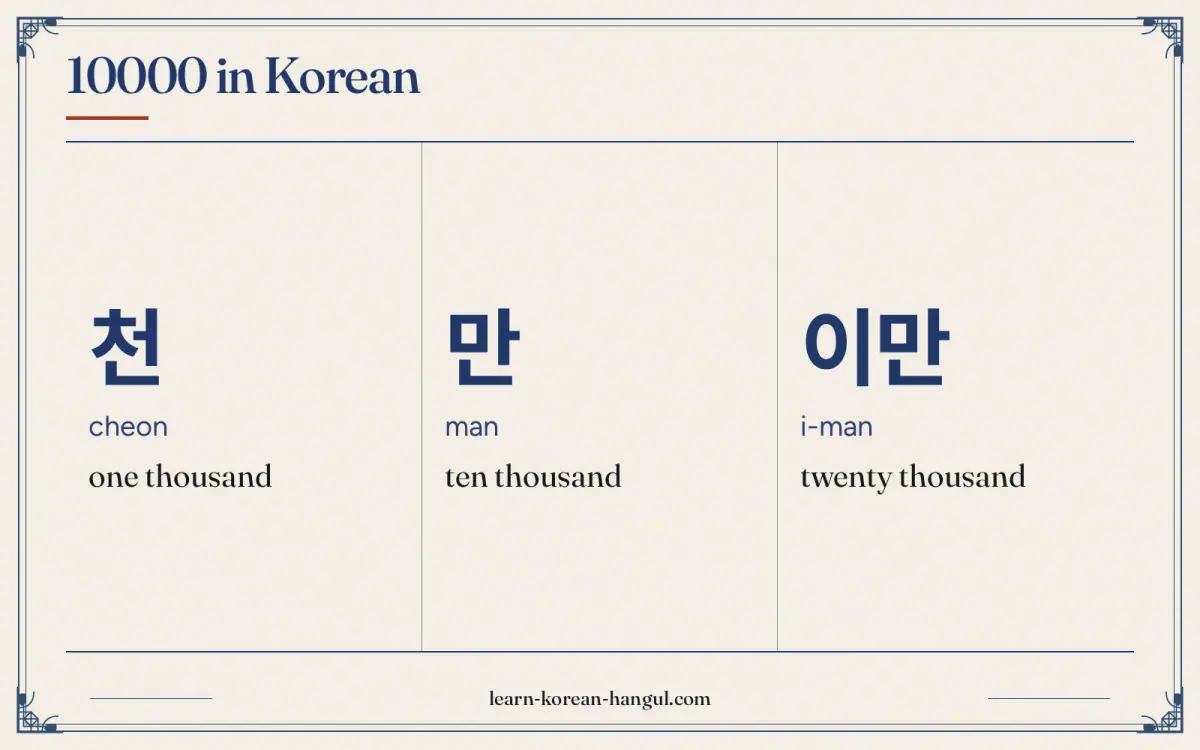
To say 10000 in Korean, say 만 (man). The word 만 is a single syllable that means ten thousand, and it works like English "thousand" or "million": a unit that other numbers multiply. It belongs to the Sino-Korean numbers, the set used for money, dates and measurements.
| Digits | Hangul | Revised Romanization | Meaning |
|---|---|---|---|
| 1,000 | 천 | cheon | one thousand |
| 10,000 | 만 | man | ten thousand |
| 20,000 | 이만 | i-man | twenty thousand |
| 30,000 | 삼만 | sam-man | thirty thousand |
| 50,000 | 오만 | o-man | fifty thousand |
With money, the word 원 (won) follows: 만 원 means 10,000 won. It is pronounced [마눤] because the final ㄴ of 만 moves onto the silent ㅇ of 원, a link called liaison (연음) in the National Institute of Korean Language (국립국어원) standard pronunciation rules (표준 발음법). The same linking turns 오만 원 into [오마눤].
In digits, Koreans write 10,000 with commas every three digits, just like English. They read it with the unit 만, which sits four digits from the right. This mismatch between the comma and the reading is the one thing you need to learn. The next section explains why it exists.
Why Does Korean Count in Groups of 10,000?
Korean counts in groups of 10,000 because the Sino-Korean number system groups digits in fours, and 만 is the name of the first four-digit group. English groups digits in threes, so it has the units thousand, million and billion. Korean has the units 만, 억 and 조, and each is 10,000 times the one before.
| Unit | Digits | Zeros | Korean |
|---|---|---|---|
| 10,000 | 10,000 | 4 | 만 |
| 100,000,000 | 100,000,000 | 8 | 억 |
| 1,000,000,000,000 | 1,000,000,000,000 | 12 | 조 |
Inside each four-digit group, Korean reuses the small units 십 (10), 백 (100) and 천 (1,000). So the number 3,456 is 삼천사백오십육, and the number 3,456 followed by 만 is 삼천사백오십육만, which is 34,560,000. The grouping repeats at every level: four digits, then a unit, then four more digits.
This system came into Korean together with the Sino-Korean numbers, which were borrowed from Chinese. You do not need the history to use it. You only need the pattern: read four digits, say the unit, move left. The detailed method for any number is in how to say large numbers in Korean. Here the focus is on 만.
How Do 만 Multiples Work?
만 multiples work like counting 1 to 10 with 만 added at the end: 만, 이만, 삼만, up to 구만, and then 십만. To read a multiple, say the Sino-Korean digit and then 만. The first one is the exception: 10,000 is just 만, not 일만.
| Number | Hangul | Spoken | Revised Romanization |
|---|---|---|---|
| 10,000 | 만 | [만] | man |
| 20,000 | 이만 | [이만] | i-man |
| 30,000 | 삼만 | [삼만] | sam-man |
| 40,000 | 사만 | [사만] | sa-man |
| 50,000 | 오만 | [오만] | o-man |
| 60,000 | 육만 | [융만] | yung-man |
| 70,000 | 칠만 | [칠만] | chil-man |
| 80,000 | 팔만 | [팔만] | pal-man |
| 90,000 | 구만 | [구만] | gu-man |
| 100,000 | 십만 | [심만] | sim-man |
Two spoken forms need attention. 육만 is pronounced [융만] because a final ㄱ before ㅁ turns into a nasal [ㅇ]. 십만 is pronounced [심만] because a final ㅂ before ㅁ turns into [ㅁ]. Both are nasalization, a rule of the standard pronunciation (표준 발음법). Korean speakers do this without noticing.
The multiples continue in the same way. 이십만 is 200,000, 삼십만 is 300,000 and 구십만 is 900,000. For the digits in front of 만, you can use any Sino-Korean number up to 9,999. That freedom is what makes the pattern powerful. The next section shows how to use it on a big number.
How Do You Read Numbers Like 250,000?
To read a number like 250,000, split the digits into groups of four from the right, then read each group and add its unit. The method has three steps, and it works for every number in this lesson.
- Write the number with no commas: 250000.
- Count four digits from the right and mark the group: 25 | 0000.
- Read the left group, say 만, then read the right group (if it is not zero): 이십오 + 만 = 이십오만.
So 250,000 is 이십오만, which means 25 groups of 10,000. It is not 이백오십천 (250 thousands), which is how an English speaker might build it from "two hundred fifty thousand". Korean has the unit 만, so it uses it.
| Digits | Split in fours | Korean | Meaning |
|---|---|---|---|
| 30,000 | 3 | 0000 | 삼만 | thirty thousand |
| 250,000 | 25 | 0000 | 이십오만 | two hundred fifty thousand |
| 1,250,000 | 125 | 0000 | 백이십오만 | one million two hundred fifty thousand |
| 12,000 | 1 | 2000 | 만 이천 | twelve thousand |
| 15,500 | 1 | 5500 | 만 오천오백 | fifteen thousand five hundred |
| 3,450,000 | 345 | 0000 | 삼백사십오만 | three million four hundred fifty thousand |
The worked example is 3,450,000. The split is 345 | 0000. The left group 345 is 삼백사십오, then add 만. The right group is all zeros, so you stop. The result is 삼백사십오만. When the right group is not zero, you read it after 만: 3,452,000 is 삼백사십오만 이천.
Practise by covering the Korean column and reading the digits aloud. Then check each answer against the audio. The key habit is to find the four-digit group before you speak, and to ignore the commas. Next, see what lies beyond 만.
What Comes after 만?
After 만, the next big unit is 억, which is 10,000 times 만 (100,000,000). In between, Korean builds larger numbers by putting 십, 백 and 천 in front of 만. The table shows the steps.
| Number | Korean | Built from |
|---|---|---|
| 100,000 | 십만 | 10 × 10,000 |
| 1,000,000 | 백만 | 100 × 10,000 |
| 10,000,000 | 천만 | 1,000 × 10,000 |
| 100,000,000 | 일억 | 1 × 100,000,000 |
| 1,000,000,000,000 | 일조 | 1 × 1,000,000,000,000 |
Notice that 일억 and 일조 keep the 일. The rule is: 만 drops its 일 in daily speech, but 억 and 조 keep it. So 100,000,000 is 일억. The details of 억 are in the page on 만 and 억 in prices.
Why does this matter for you? English speakers see 1,000,000 as "one million", a new word. Korean sees 100 groups of 10,000. When you read 1,000,000, find the four-digit group: 100 | 0000. The left group is 100, which is 백. The unit is 만. So 백만.
How Is 만 Used in Money?
만 is the main unit for prices in Korea. Most notes and prices above a few thousand won use it, and the 10,000-won note is so common that it has its own name: 만 원짜리. The suffix 짜리 names an item by its value, so 만 원짜리 means "the one worth 10,000 won".
| Amount | Hangul | Meaning |
|---|---|---|
| 1,000원 | 천 원 | 1,000 won note or price |
| 5,000원 | 오천 원 | 5,000 won |
| 10,000원 | 만 원 | 10,000 won |
| 50,000원 | 오만 원 | 50,000 won |
| 12,500원 | 만 이천오백 원 | 12,500 won |
| 150,000원 | 십오만 원 | 150,000 won |
The 10,000-won note and the 50,000-won note are two of the four paper notes in daily use. You can find the full set in the page on the Korean won. The counter 원 itself is covered in the 원 counter lesson.
Shop signs and menus often write 만 as a unit symbol next to digits. A price of 35,000 won may appear as 3만 5천 원 or 3만5천원. Read it by pieces: 3만 is 삼만, 5천 is 오천, so the price is 삼만 오천 원. Learn to read this shorthand, because it is common on shop signs and in advertisements.
Shop Dialogue
The dialogue below shows 만 in a real exchange. The customer pays with two 10,000-won notes and gets change. The notes are counted with the counter 장 (sheet), covered in the 장 counter lesson.
- 손님: 이 책 얼마예요? (How much is this book?)
- 직원: 만 이천 원이에요. (It is 12,000 won.)
- 손님: 만 원짜리 두 장 드릴게요. (I will give you two 10,000-won notes.)
- 직원: 거스름돈 팔천 원 드릴게요. (Here is 8,000 won in change.)
Check the arithmetic: 20,000 minus 12,000 is 8,000, which is 팔천. Notice that 두 장 uses a native number with the sheet counter, while 만 이천 원 uses Sino-Korean numbers with won. Both systems appear in one scene, and the counter decides which one is used.
How Do You Read Salaries and Populations?
Salaries, rents and populations use the same groups of four digits. The two common units are 만 for amounts under 100 million and 억 for amounts above it. The examples below are illustrations of how the phrases are built.
| Situation | Phrase | Meaning |
|---|---|---|
| Monthly salary | 월급이 삼백만 원이에요. | The monthly salary is 3,000,000 won. |
| Monthly rent | 월세가 오십만 원이에요. | The monthly rent is 500,000 won. |
| Population | 인구가 오천만 명이에요. | The population is 50,000,000 people. |
| Large deal | 집값이 오억 원이에요. | The house price is 500,000,000 won. |
In 삼백만, the left group is 300 (삼백) and the unit is 만, so the number is 3,000,000. In 오천만, the left group is 5,000 (오천), so the number is 50,000,000. In both cases, you read the left group first and attach the unit. These phrases are examples of structure, not official figures.
Note the counter 명 for people in 오천만 명. People use native numbers with 명 for small groups (세 명), but large populations use Sino-Korean numbers (오천만 명), because native numbers stop at 99.
Is 10,000 일만 or 만?
In daily speech, 10,000 is 만, not 일만. The form 일만 is formal and appears in documents, bank forms and contracts. Shop clerks, friends and TV presenters say 만 원. If you say 일만 원 in a shop, you will be understood, but you will sound like you are reading a form.
| Number | Daily speech | Formal or written |
|---|---|---|
| 10,000 | 만 | 일만 |
| 20,000 | 이만 | 이만 |
| 100,000,000 | 일억 | 일억 |
| 10,001 | 만 일 | 일만 일 |
The rule is that 만 drops the 일 at the start of a number, but not inside it. In 만 일 (10,001), the final 일 stays because it means 1.
How Do You Write and Space 만 Amounts?
In Hangul, amounts are spaced at every 만 unit, and the counter 원 is a separate word. In digits, the counter attaches to the number. This follows the spelling rules in the 한글 맞춤법 (Hangul spelling rules): Article 44 spaces large numbers at the 만 unit, and Article 43 spaces counters from Hangul numbers but allows them to attach to digits.
| Form | Example | Rule |
|---|---|---|
| Digits | 15,500원 | counter attached |
| Hangul | 만 오천오백 원 | space after 만, space before 원 |
| Hangul | 삼만 오천 원 | space after 만 |
| Mixed | 3만 5천 원 | digit plus unit |
The rule gives a quick reading cue. When you see a space in a Hangul number, you are probably at a 만 or 억 boundary. That cue helps you split long numbers into their four-digit groups.
Does 만 Change with the Currency?
No. The number word stays the same, and only the currency word changes: 만 원 (10,000 won), 만 달러 (10,000 dollars) and 만 엔 (10,000 yen). To say 10000 in Korean for any amount of money, use 만 and add the currency.
| Currency | Phrase | Meaning |
|---|---|---|
| Korean won | 만 원 | 10,000 won |
| US dollar | 만 달러 | 10,000 dollars |
| Japanese yen | 만 엔 | 10,000 yen |
This page does not give exchange rates, because they change every day. To convert 10,000 won into another currency, use a live rate from your bank or a currency app, then read the answer in your own language. The reading of the Korean number does not depend on the rate.
Daily-Life Phrases with 만
Most real uses of 만 fall into a few daily scenes: shopping, transport, banking and rent. Learn these phrases as whole chunks.
| Scene | Phrase | Meaning |
|---|---|---|
| Shop | 이거 만 원이에요. | This is 10,000 won. |
| Taxi | 택시비가 이만 원쯤 나왔어요. | The taxi fare came to about 20,000 won. |
| Market | 오만 원짜리 있어요? | Do you have a 50,000-won note? |
| Bank | 십만 원 찾고 싶어요. | I want to withdraw 100,000 won. |
| Rent | 월세는 칠십만 원이에요. | The rent is 700,000 won a month. |
| Event | 참가비는 삼만 원이에요. | The entry fee is 30,000 won. |
The ending 쯤 in 이만 원쯤 means "about". The phrase 찾고 싶어요 in the bank line means "I want to withdraw". Each phrase combines a 만 amount with 원, so you can swap the numbers and keep the structure.
Misconceptions about 만
Learners often assume that 만 is a direct match for English "thousand", or that a million is hard to say in Korean. Both ideas mislead.
Misconception 1: 만 means "thousand". 만 is 10,000, ten times a thousand. The Korean word for thousand is 천.
Misconception 2: a million is hard to say in Korean. Korean has no separate unit for it, but 백만 (100 × 만) is the normal word, and it is built from words you already know.
Misconception 3: commas show where the units are. Commas mark groups of three digits. The Korean units are four digits apart, so the commas and the reading do not line up.
Misconception 4: 만 can be used with native numbers. Money and large numbers use Sino-Korean numbers. A form such as 열 만 is not used.
Common Mistakes and Fixes
The most frequent errors with 10,000-based numbers are about regrouping. Each one has a simple fix.
| Mistake | Why it is wrong | Fix |
|---|---|---|
| 일만 원 (in a shop) | Formal form in daily speech | 만 원 |
| 백오십천 원 | Grouped by thousands | 십오만 원 |
| 이백오십천 | Grouped by thousands | 이십오만 |
| 십 만 | Space inside one four-digit group | 십만 |
| 열 만 원 | Native number with money | 십만 원 |
| 만 만 | Unit repeated | 억 |
The last row shows the next unit: 만 times 만 is 억. Remember the rule of thumb: find the four-digit group first, then read.
Practice Set
Try these five questions before you check the answers below.
- How do you say 10,000 in Korean?
- Read 30,000 won aloud in Korean.
- Read 250,000 in Korean.
- What does 백만 mean?
- Write 15,500 won in Hangul.
Practice · 8
How do you say 10,000 in Korean?
Show answer
만
10,000 is 만. 천 is 1,000 and 십만 is 100,000.
How do you read 250,000?
Show answer
이십오만
Split in fours from the right: 25 | 0000. Read 25 and add 만. Korean does not group by thousands.
What does 백만 mean?
Show answer
1,000,000
백만 is 100 groups of 10,000, which is one million. 십만 is 100,000 and 천만 is 10,000,000.
How do you write 15,500 won in Hangul?
Show answer
만 오천오백 원
15,500 splits as 1 | 5500: 만, then 오천오백, then the counter 원.
How is 만 원 pronounced?
Show answer
[마눤]
The final ㄴ of 만 moves onto the silent ㅇ of 원 (liaison), so 만 원 is said [마눤].
How do you say 100,000 won?
Show answer
십만 원
Money and large numbers use Sino-Korean numbers, so 10 × 만 is 십만. A native number with 만, such as 열 만, is not used.
A price sign reads 3만 5천 원. How do you read it?
Show answer
삼만 오천 원
Read the shorthand by pieces: 3만 is 삼만 and 5천 is 오천.
What is 만 times 만?
Show answer
억
만 times 만 is 억 (100,000,000); repeating 만 만 is wrong.
Reference
| Digits | Hangul | Revised Romanization | Meaning |
|---|---|---|---|
| 1,000 | 천 | cheon | one thousand |
| 10,000 | 만 | man | ten thousand |
| 20,000 | 이만 | i-man | twenty thousand |
| 30,000 | 삼만 | sam-man | thirty thousand |
| 50,000 | 오만 | o-man | fifty thousand |
| Unit | Digits | Zeros | Korean |
|---|---|---|---|
| 10,000 | 10,000 | 4 | 만 |
| 100,000,000 | 100,000,000 | 8 | 억 |
| 1,000,000,000,000 | 1,000,000,000,000 | 12 | 조 |
| Number | Hangul | Spoken | Revised Romanization |
|---|---|---|---|
| 10,000 | 만 | [만] | man |
| 20,000 | 이만 | [이만] | i-man |
| 30,000 | 삼만 | [삼만] | sam-man |
| 40,000 | 사만 | [사만] | sa-man |
| 50,000 | 오만 | [오만] | o-man |
| 60,000 | 육만 | [융만] | yung-man |
| 70,000 | 칠만 | [칠만] | chil-man |
| 80,000 | 팔만 | [팔만] | pal-man |
| 90,000 | 구만 | [구만] | gu-man |
| 100,000 | 십만 | [심만] | sim-man |
| Digits | Split in fours | Korean | Meaning |
|---|---|---|---|
| 30,000 | 3 | 0000 | 삼만 | thirty thousand |
| 250,000 | 25 | 0000 | 이십오만 | two hundred fifty thousand |
| 1,250,000 | 125 | 0000 | 백이십오만 | one million two hundred fifty thousand |
| 12,000 | 1 | 2000 | 만 이천 | twelve thousand |
| 15,500 | 1 | 5500 | 만 오천오백 | fifteen thousand five hundred |
| 3,450,000 | 345 | 0000 | 삼백사십오만 | three million four hundred fifty thousand |
| Number | Korean | Built from |
|---|---|---|
| 100,000 | 십만 | 10 × 10,000 |
| 1,000,000 | 백만 | 100 × 10,000 |
| 10,000,000 | 천만 | 1,000 × 10,000 |
| 100,000,000 | 일억 | 1 × 100,000,000 |
| 1,000,000,000,000 | 일조 | 1 × 1,000,000,000,000 |
| Amount | Hangul | Meaning |
|---|---|---|
| 1,000원 | 천 원 | 1,000 won note or price |
| 5,000원 | 오천 원 | 5,000 won |
| 10,000원 | 만 원 | 10,000 won |
| 50,000원 | 오만 원 | 50,000 won |
| 12,500원 | 만 이천오백 원 | 12,500 won |
| 150,000원 | 십오만 원 | 150,000 won |
| Situation | Phrase | Meaning |
|---|---|---|
| Monthly salary | 월급이 삼백만 원이에요. | The monthly salary is 3,000,000 won. |
| Monthly rent | 월세가 오십만 원이에요. | The monthly rent is 500,000 won. |
| Population | 인구가 오천만 명이에요. | The population is 50,000,000 people. |
| Large deal | 집값이 오억 원이에요. | The house price is 500,000,000 won. |
| Number | Daily speech | Formal or written |
|---|---|---|
| 10,000 | 만 | 일만 |
| 20,000 | 이만 | 이만 |
| 100,000,000 | 일억 | 일억 |
| 10,001 | 만 일 | 일만 일 |
| Form | Example | Rule |
|---|---|---|
| Digits | 15,500원 | counter attached |
| Hangul | 만 오천오백 원 | space after 만, space before 원 |
| Hangul | 삼만 오천 원 | space after 만 |
| Mixed | 3만 5천 원 | digit plus unit |
| Currency | Phrase | Meaning |
|---|---|---|
| Korean won | 만 원 | 10,000 won |
| US dollar | 만 달러 | 10,000 dollars |
| Japanese yen | 만 엔 | 10,000 yen |
| Scene | Phrase | Meaning |
|---|---|---|
| Shop | 이거 만 원이에요. | This is 10,000 won. |
| Taxi | 택시비가 이만 원쯤 나왔어요. | The taxi fare came to about 20,000 won. |
| Market | 오만 원짜리 있어요? | Do you have a 50,000-won note? |
| Bank | 십만 원 찾고 싶어요. | I want to withdraw 100,000 won. |
| Rent | 월세는 칠십만 원이에요. | The rent is 700,000 won a month. |
| Event | 참가비는 삼만 원이에요. | The entry fee is 30,000 won. |
| Mistake | Why it is wrong | Fix |
|---|---|---|
| 일만 원 (in a shop) | Formal form in daily speech | 만 원 |
| 백오십천 원 | Grouped by thousands | 십오만 원 |
| 이백오십천 | Grouped by thousands | 이십오만 |
| 십 만 | Space inside one four-digit group | 십만 |
| 열 만 원 | Native number with money | 십만 원 |
| 만 만 | Unit repeated | 억 |
Answers
- 만.
- 삼만 원.
- 이십오만.
- 1,000,000, which is 100 groups of 10,000.
- 만 오천오백 원.
What This Lesson Does Not Cover
This lesson covers 만 and the numbers built on it. It does not cover the unit 억 and above in depth (see 만 and 억 in prices), the numbers below 10,000 (see 1000 in Korean), or the full method for any number (see how to say large numbers in Korean). It also leaves out currency exchange and the history of the won.
What to Learn Next
The next step is the page on 만 and 억 in prices, which extends the pattern to millions and billions. To review the smaller unit first, return to 1000 in Korean. Now that 10000 in Korean is clear, you can practise with the Korean won page and the full list in Sino-Korean numbers 1-100.
Frequently Asked Questions
Is 10,000 일만 or 만?
In everyday speech and prices, say 만. The form 일만 exists in formal and written contexts such as contracts, but a shop clerk will say 만 원, not 일만 원. The 일 stays before the bigger units 억 and 조, as in 일억 (100,000,000), and when 1 is the last digit, as in 만 일 (10,001).
How do I say 100,000 in Korean?
Say 십만. Korean multiplies 십 (10) by 만 (10,000), so 100,000 is 10 groups of 10,000. There is no separate word for a hundred thousand. In the same way, 200,000 is 이십만 and 900,000 is 구십만. Notice that 십만 is a reading by groups, not a new unit.
How much is 만 원?
만 원 is 10,000 won. It is the common name for the 10,000-won note, which is also called 만 원짜리. A cup of coffee may cost less than that and a restaurant meal may cost around it, but prices change by place and year, so read the tag. The amount 만 원 itself never changes.
What is 1 million in Korean?
1,000,000 is 백만, which means 100 groups of 10,000. This is the part that surprises English speakers, because the word for a million is built from 백 (100) and 만 (10,000). Ten million is 천만 (1,000 groups of 10,000), and one hundred million is 일억, the next unit.
What comes after 만?
The next unit is 억, which is 100,000,000 (10,000 times 10,000). After that comes 조, which is 1,000,000,000,000. Between 만 and 억, Korean keeps reusing 십, 백 and 천 in front of 만: 십만, 백만, 천만. Every new unit is 10,000 times the previous one.