What you'll learn
- Convert 1 million, 1 billion and 1 trillion into 만, 억 and 조.
- Split any big number into groups of four digits and read it.
- Read 3.5 billion won, 250만 원 and 2.3 trillion won aloud.
- Spot the common errors that move a number by a factor of ten.
Prerequisites: large numbers in Korean up to 만. Estimated time: 25 minutes.
Korean Numbers Million: the Essentials
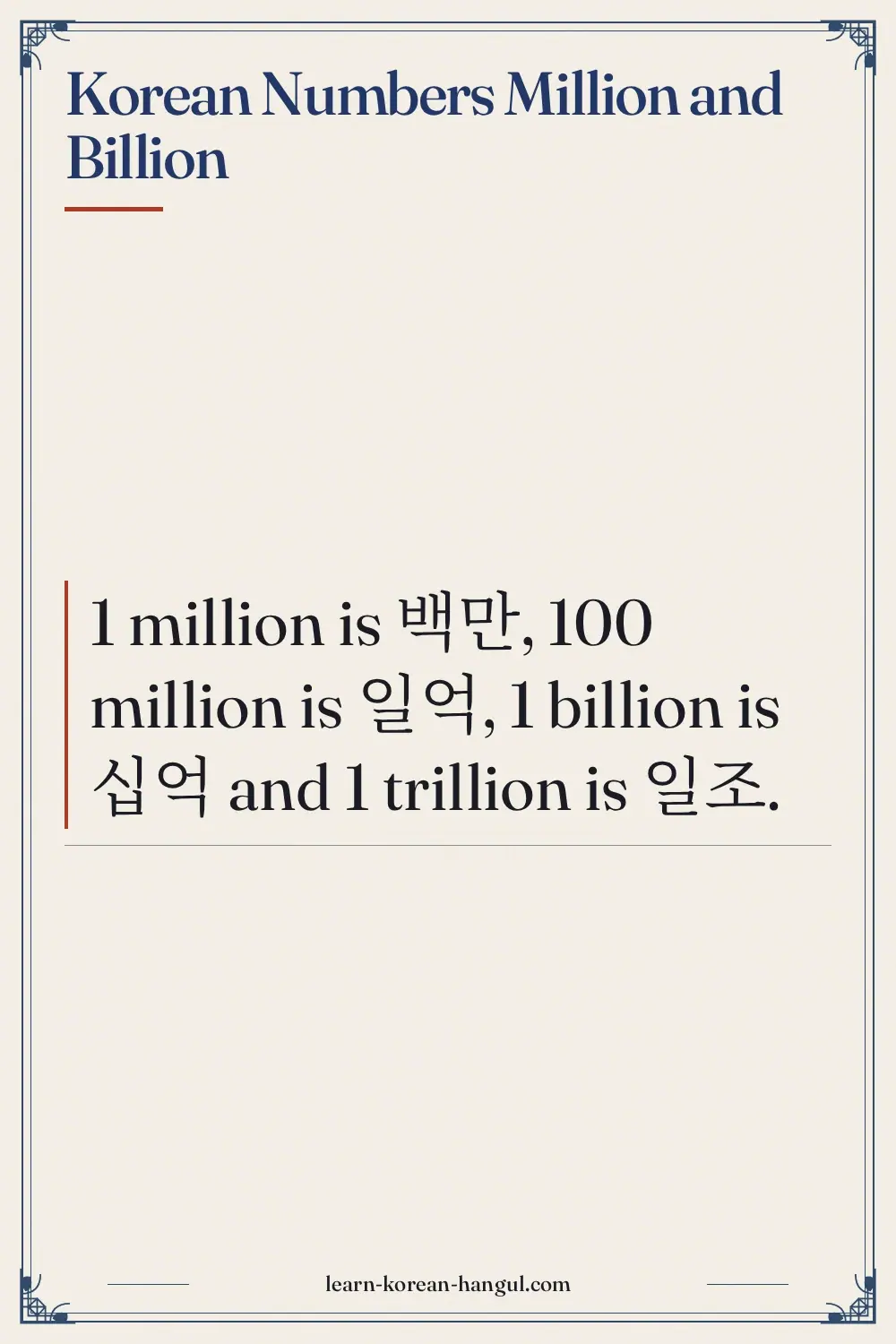
Korean numbers million, billion and trillion are built from the units 만, 억 and 조 plus a small multiplier. There is no word for million, so Korean says "100 ten-thousands". The table shows the amounts that English speakers use most.
| English | Digits | Korean unit form | Hangul reading |
|---|---|---|---|
| 1 million | 1,000,000 | 100만 | 백만 |
| 10 million | 10,000,000 | 1000만 | 천만 |
| 100 million | 100,000,000 | 1억 | 일억 |
| 1 billion | 1,000,000,000 | 10억 | 십억 |
| 10 billion | 10,000,000,000 | 100억 | 백억 |
| 100 billion | 100,000,000,000 | 1000억 | 천억 |
| 1 trillion | 1,000,000,000,000 | 1조 | 일조 |
Sound changes appear when the parts run together: 백만 is said [뱅만] (nasalization), 일억 is said [이럭] and 십억 is said [시벅] (the final consonant moves to the next syllable), and 일조 is said [일쪼] (ㅈ becomes tense after ㄹ in a Sino-Korean word). The audio clips above let you hear them.
An easy way to remember the bridge from English is the sequence 100, 10, 1. A million is 100 만, a billion is 10 억 and a trillion is 1 조. The English words step up by a factor of 1,000, but each Korean unit steps up by 10,000, so the multiplier shrinks from 100 to 10 to 1 as you climb. When the multiplier would reach 10,000, the next unit takes over.
The numbers in the table use the standard short-scale meaning of English "billion", which is 1,000 million. That meaning is the usual one in current English and in financial news. Knowing the units themselves comes next.
What Do 만, 억 and 조 Mean?
The units 만 (man), 억 (eok) and 조 (jo) are Sino-Korean words for 10,000, 100,000,000 and 1,000,000,000,000. Each unit is 10,000 times the unit before it, and each comes from a Chinese character: 萬, 億 and 兆. They are the Korean equivalent of "thousand", "million" and "billion" in the sense of marking a new group, but each group holds four digits.
| Unit | Hanja | Value | Zeros | English name |
|---|---|---|---|---|
| 만 | 萬 | 10,000 | 4 | ten thousand |
| 억 | 億 | 100,000,000 | 8 | one hundred million |
| 조 | 兆 | 1,000,000,000,000 | 12 | one trillion |
| 경 | 京 | 10,000,000,000,000,000 | 16 | ten quadrillion |
Count the zeros to check any conversion. A 만 has four zeros, an 억 has eight and a 조 has twelve. English million has six, billion has nine and trillion has twelve. The only amount where the two systems line up exactly is the trillion: 1조 is 1,000,000,000,000.
Why Does Korean Count in Groups of Four?
Korean counts in groups of four because its number words come from the Chinese system of myriads, in which a new unit begins every 10,000. English begins a new unit every 1,000, so a Korean reader hears "35 億" where an English reader sees "3,500 million". Neither system is more logical. They simply break the same digits at different places.
For learners, the practical meaning is that the comma in 3,500,000,000 is misleading. English commas fall every three digits, but Korean units fall every four. Ignore the commas and mark your own breaks. The next section shows how.
How Do You Convert Prices from English Units?
To convert an amount to Korean, split the digits into groups of four from the right, read each group as a small number, add the unit after each group and finish with 원 for money. The steps work for any size.
- Write the plain digits. Remove the commas: 3,500,000,000 becomes 3500000000.
- Mark groups of four from the right. 35 | 0000 | 0000.
- Read each non-zero group as a small number. 35 is 삼십오.
- Add the unit after each group. The second group from the right is 만, the third is 억 and the fourth is 조. A group of four zeros is silent.
- Add the counter. Put 원 after the amount for money, with a space before it.
You will know the answer is right if you can undo it: 삼십오억 is 35 times 100,000,000, which is 3,500,000,000.
| Amount | Groups | Reading |
|---|---|---|
| 2,500,000 | 250 | 0000 | 이백오십만 |
| 45,000,000 | 4500 | 0000 | 사천오백만 |
| 120,000,000 | 1 | 2000 | 0000 | 일억 이천만 |
| 3,500,000,000 | 35 | 0000 | 0000 | 삼십오억 |
| 1,200,000,000,000 | 1 | 2000 | 0000 | 0000 | 일조 이천억 |
| 1,234,567,890 | 12 | 3456 | 7890 | 십이억 삼천사백오십육만 칠천팔백구십 |
The reading in the last row shows the spacing rule. The National Institute of Korean Language (국립국어원) spelling rules (한글 맞춤법 제44항) say to leave a space after each 만 unit when you write a large number in Hangul, so 십이억 삼천사백오십육만 칠천팔백구십 has three spaced parts. Spoken Korean carries no spaces, but the pauses fall in the same places.
Is There a Shortcut for English Speakers?
Yes, use the multiplication bridge. To turn English millions into 만, multiply by 100: 2.5 million times 100 is 250, so 250만. To turn English billions into 억, multiply by 10: 3.5 billion times 10 is 35, so 35억. To turn English trillions into 조, change nothing: 1.2 trillion is 1.2조, which you can also read as 일조 이천억. This shortcut avoids the comma problem altogether.
Two small examples show the bridge in action. A budget of 45 million won is 45 × 100 = 4,500 만, so 사천오백만 원. A bid of 12 billion won is 12 × 10 = 120 억, so 백이십억 원. The same bridge works with decimals: 1.5 billion times 10 is 15, so 1.5 billion is 15억, read 십오억. The bridge is a speed tool for amounts you see in English articles. For amounts you hear in Korean, the reverse works too: 오십억 is 50 억, which is 5 billion, because you divide by 10.
Once the method feels automatic, you can put it to work on the figures that real Korean articles quote.
How Do You Read Figures in the News?
Korean news and property listings quote amounts in mixed digits and units, so you must read the Arabic numerals and the Hangul unit together. A headline writes 3억 5천만 원, and you read it 삼억 오천만 원. The digits 3 and 5 are read as Sino-Korean numbers, and the units 억 and 만 are read as written.
| Written | Spoken | Meaning |
|---|---|---|
| 9억 원 | 구억 원 | 900 million won, a typical way to quote an apartment |
| 5천만 원 | 오천만 원 | 50 million won, a typical way to quote a yearly salary |
| 2조 3천억 원 | 이조 삼천억 원 | 2.3 trillion won, a company's yearly revenue |
| 12조 원 | 십이조 원 | 12 trillion won, the scale of a large project or a big company's yearly investment |
These are sample amounts for practice and not quoted prices. Here are full sentences that use them:
- 이 아파트는 구억 원이에요. (This apartment is 900 million won.)
- 연봉이 오천만 원이에요. (The yearly salary is 50 million won.)
- 올해 매출은 이조 삼천억 원이었어요. (This year's revenue was 2.3 trillion won.)
The word 연봉 (yeonbong) means "annual salary" and 매출 (maechul) means "sales" or "revenue". Both come up whenever a news report gives a company or a job in numbers. The currency tie-in matters too: because one won is a small unit, apartments, deposits and salaries quickly reach millions and billions, so 억 and 만 are the working units for property and pay. The lesson on the 원 counter covers reading small prices, and the page on Korean won covers notes and coins.
Where Do 만 and 억 Appear in Daily Life?
Housing is the clearest daily example. Korean rental listings quote a monthly rent (월세, wolse) in 만 won, a deposit (보증금, bojeunggeum) in 만 or 억 won, and a lump-sum lease (전세, jeonse) in 억 won. A sample listing could read 보증금 오천만 원에 월세 오십만 원, which means "a 50,000,000-won deposit and 500,000 won rent a month". The particle 에 here joins the two amounts in one phrase. These amounts are practice figures and not market prices.
A restaurant bill, a train ticket and a coffee stay in thousands of won, so the units 만 and 억 mostly appear in contracts, salaries, property and company news. If you can read 오십만 원 for rent and 삼억 원 for a lease, you can follow most housing talk.
A reading habit helps. Look for the largest unit first, because it tells you the scale: 조 means trillions, 억 means hundreds of millions to billions, and 만 means tens of thousands to tens of millions. Then read the smaller groups after it.
Worked Example: from an English Sentence to Korean
Take the English sentence "The shop made 2.5 million won today, and the owner saved 12 billion won over the years." Two amounts need converting, and the bridge handles both in a few seconds.
- 2.5 million won. Multiply 2.5 by 100 to get 250, then add 만: 250만, read 이백오십만 원.
- 12 billion won. Multiply 12 by 10 to get 120, then add 억: 120억, read 백이십억 원.
- Check by zeros. 250만 is 2,500,000, which matches 2.5 million. 120억 is 12,000,000,000, which matches 12 billion.
The Korean sentences are 오늘 매출은 이백오십만 원이에요 (Today's sales are 2,500,000 won) and 사장님은 백이십억 원을 모았어요 (The owner saved 12,000,000,000 won). The verb 모으다 means "to gather" or "to save", and 사장님 is the polite word for a shop owner or company president.
The method never needed the word million or billion in Korean. It needed only the number in front of the unit and the unit itself. That is the whole skill, so the next section lists how it usually goes wrong.
Common Mistakes and Fixes
Most mistakes with Korean numbers million and billion come from English grouping habits or from a misplaced zero. Check your readings against this list.
- Grouping in threes. Wrong: reading 3,500,000,000 as 3 | 500 | 000 | 000. Right: 35 | 0000 | 0000, or 삼십오억.
- Moving one zero. 천만 is 10,000,000 and 일억 is 100,000,000. They differ by a factor of ten, so count the zeros.
- Calling a billion 백억. A billion is 십억. 백억 is ten billion.
- Mixing 억 and 만 in prices. 9억 is 900,000,000 and 9천만 is 90,000,000. They differ by a factor of ten, which is the gap between a house and a car in some listings.
- Dropping 일 before 억 or 조. Say 일억 and 일조, not bare 억 and 조, when the amount is exactly one unit.
- Using native numbers. Wrong: 열억. Right: 십억. Large numbers and money use Sino-Korean numbers.
- Forgetting 원. A bare 오천만 is a number. Add 원 for money: 오천만 원.
Expert insight: the fastest sanity check is the zero count. Count eight zeros for 억 and four for 만, then compare with the English figure. If you find a mismatch, look for a missing or extra group of four.
Limitation: this lesson converts exact amounts into words. Approximate expressions such as 수억 원 (several hundred million won) and the casual slang for big sums are not covered, and some speakers say a bare 억 in conversation where the amount is obvious. Learn the full forms first and let listening add the shortcuts.
Practice Set
Answer each item aloud before you read the answer line.
- Say 1,000,000 in Korean.
- Say 1,000,000,000 in Korean.
- Say 1,000,000,000,000 in Korean.
- Read 3.5 billion won.
- Read 250만 원.
- Which is larger, 9억 or 9천만?
Practice · 5
What is 1 million in Korean?
Show answer
백만
What is 1 billion in Korean?
Show answer
십억
How do you read 3,500,000,000 won?
Show answer
삼십오억 원
How many zeros does 억 have?
Show answer
8
Which is larger?
Show answer
9억
Answers:
- 백만.
- 십억.
- 일조.
- 삼십오억 원.
- 이백오십만 원.
- 9억 (900,000,000 is ten times 90,000,000).
Five or more correct means the units are secure.
What to Learn Next
You can now handle Korean numbers million, billion and trillion: split into fours, read each group and add 만, 억 or 조. Continue in this order:
- Large numbers in Korean for the full grouping method.
- 10,000 in Korean for the unit that starts everything.
- Korean won for notes, coins and everyday prices.
- The 원 counter for reading price tags.
- Money and Prices for the whole section.
Frequently Asked Questions
What is 1 billion in Korean?
One billion (1,000,000,000) is 십억, which means ten times 억. Written with digits it is 10억. English uses the short-scale billion, a thousand million, and Korean reaches the same value by counting ten units of 억. One hundred million is 일억, and ten billion is 백억.
How do I read 3.5 billion won?
Write the amount as 3,500,000,000 and split it into fours from the right: 35 | 0000 | 0000. The leading group is 35 and the unit is 억, so the reading is 삼십오억 원. The shortcut is to multiply the English billions by ten: 3.5 billion times ten gives 35 억.
Is it 일억 or 억 for 100 million?
Say 일억 for exactly 100,000,000. The digit 일 is dropped before 십, 백, 천 and 만, but it is kept before 억 and 조. In news and conversation about prices you will also hear a bare 억 when the number is obvious, but learners should use the full form.
What comes after 조 in Korean?
The next unit is 경 (京), which is 10,000 times 조, or 10 to the power of 16. Everyday Korean seldom needs it, because 조 already covers national budgets and the largest company revenues. Each new unit multiplies the previous one by 10,000: 만, then 억, then 조, then 경.
How do I say 1.5 million in Korean?
Multiply 1.5 by 100 to get 150, then add 만: 150만, read 백오십만. The reading comes from 1,500,000 split as 150 | 0000. For money add 원 and a space: 백오십만 원. Do not look for a word for million, because Korean has none, only the unit 만 for ten thousand.