What you'll learn
- Read ten price tags aloud, from 800원 to 1,200,000원.
- Drop and keep the digit 일 correctly: 천 원, 이천 원, 만 원.
- Ask 얼마예요? and answer with a price.
- Use 짜리 and 어치 after an amount.
Prerequisites: Sino-Korean numbers 1-100. Estimated time: 40 minutes.
What Is the Korean Counter Won?
The Korean counter won is the unit word 원 placed after a number to give a price. A counter is a small word that follows a number and says what kind of thing is counted. Here the thing counted is money, so 원 works like "dollars" or "euros" in English. It always follows a Sino-Korean number: 천 원, 오천 원, 만 원.
| Part | Role | Example |
|---|---|---|
| Number | Sino-Korean, built in groups of four digits | 삼만 오천 |
| Counter | 원, the unit of money | 원 |
| Ending | 이에요 or 입니다, when the price is the answer | 삼만 오천 원이에요 |
In Korean grammar, 원 is a unit noun (단위 명사), a kind of bound noun (의존 명사) that needs a number in front of it. It never stands alone and it never takes a native number, so a price such as "one won" is 일 원, not 한 원. The word is said [원], and it joins smoothly to a vowel that follows: 삼천 원이에요 sounds like [삼처눠니에요].
The rule is short, but it hides a skill: you must read the number correctly first. The next section gives the method in steps.
How Do You Read a Price?
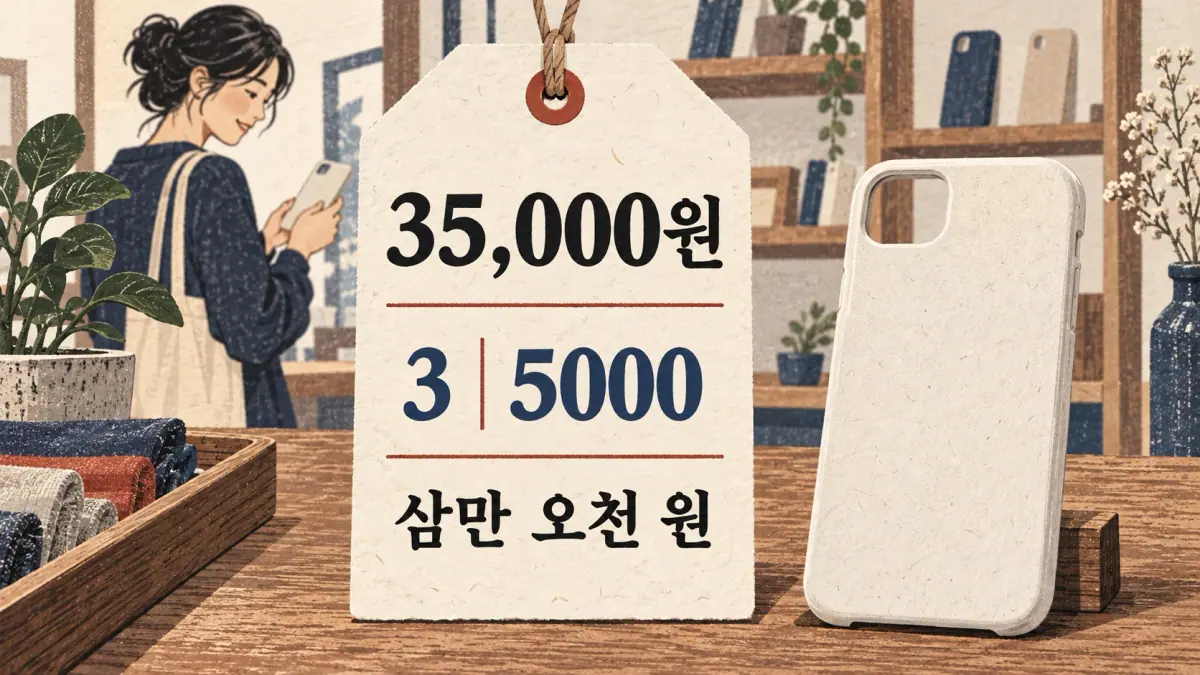
To read a price, split the digits into groups of four from the right, read each group, add the unit word and finish with 원. This takes four steps, and the same steps work for any amount from 10원 to a million won.
- Mark groups of four digits from the right. Ignore the commas, because commas fall every three digits.
- Read each group as a small number. Use 천 (1,000), 백 (100) and 십 (10) with the digit before each one.
- Add the group unit. Say 만 after the group in the ten-thousands place, and 억 for the next group.
- End with 원. Add a space before it in Hangul writing.
You will know the reading is correct if you can add the words back into the digits. For 35,000, the groups are 3 | 5000. The first group is 삼, so with the unit it is 삼만. The second group is 오천. The whole price is 삼만 오천 원.
When Is 일 Dropped?
The digit 일 (1) is dropped when it stands alone before 십, 백, 천 or 만, and it is kept when it is the last digit of the number or of a four-digit group (십일 원, 십일만 원). The unit 억 is the exception: 100,000,000 won is 일억 원. So 1,000 is 천 and not 일천, and 10,000 is 만 and not 일만. Digits 2 to 9 are always kept: 이천 (2,000), 삼만 (30,000).
| Amount | Correct | Not used in prices |
|---|---|---|
| 1,000원 | 천 원 | 일천 원 |
| 10,000원 | 만 원 | 일만 원 |
| 2,000원 | 이천 원 | |
| 30,000원 | 삼만 원 | |
| 11원 | 십일 원 | |
| 10,001원 | 만 일 원 |
Two points follow from the table. First, 일 comes back whenever it ends the number, as in 십일 원 or 만 일 원. Second, 일만 and 일천 are real written forms found in formal documents, but a shop never says them aloud.
Ten Price-Tag Examples

Practise with ten prices that cover the whole range you will meet in shops, cafes and markets. The third column shows the four-digit groups, so you can see where each reading comes from.
| Price tag | Groups | Spoken reading |
|---|---|---|
| 800원 | 800 | 팔백 원 |
| 1,500원 | 1500 | 천오백 원 |
| 4,200원 | 4200 | 사천이백 원 |
| 9,900원 | 9900 | 구천구백 원 |
| 12,000원 | 1 | 2000 | 만 이천 원 |
| 35,000원 | 3 | 5000 | 삼만 오천 원 |
| 49,900원 | 4 | 9900 | 사만 구천구백 원 |
| 100,000원 | 10 | 0000 | 십만 원 |
| 250,000원 | 25 | 0000 | 이십오만 원 |
| 1,200,000원 | 120 | 0000 | 백이십만 원 |
Look at the last three rows. Because Korean counts by 10,000, 100,000 is 10 groups, which gives 십만, and 1,200,000 is 120 groups, which gives 백이십만. Many learners expect "hundred thousand" words that do not exist. The spacing follows the National Institute of Korean Language (국립국어원) rule that large numbers in Hangul are spaced at every 만 unit (한글 맞춤법 제44항), which is why 삼만 오천 has a space inside it.
Say each price aloud twice: once slowly with the groups, and once at normal speed. If you can do all ten without checking the table, you can read most price tags in Korea. The next skill is to ask for the price.
What Changes above 100 Million Won?
Above 100,000,000 won, a third group joins the number, and its unit is 억. House prices, company budgets and salaries of whole teams use it. The method is the same: split into fours, read each group, add its unit, and finish with 원. For example, 350,000,000원 splits as 3 | 5000 | 0000, which reads 삼억 오천만 원. The group of zeros at the end is silent.
This is the point where the lesson on Korean Numbers Million and Billion: 만, 억, 조 Explained takes over, so read it before you tackle property listings.
How Do You Ask How Much Something Costs?

To ask a price, say 얼마예요? The word 얼마 means "how much", and 예요 is the polite "is". Point at the item and add 이거 ("this one") for clarity: 이거 얼마예요? The shopkeeper answers with the amount and 이에요 or 입니다.
| Korean | Meaning | When |
|---|---|---|
| 이거 얼마예요? | How much is this? | pointing at one item |
| 전부 얼마예요? | How much is it in total? | at the cashier |
| 삼천 원이에요. | It's 3,000 won. | the answer, polite |
| 삼천 원입니다. | It is 3,000 won. | the answer, formal |
Here is a short exchange at a snack stall. The buyer asks for the price of one item, hears the answer and orders three.
- 손님: 이거 얼마예요? (How much is this?)
- 점원: 이천오백 원이에요. (It's 2,500 won.)
- 손님: 세 개 주세요. (Three, please.)
- 점원: 칠천오백 원입니다. (That is 7,500 won.)
이거 얼마예요?
How much is this?
이천오백 원이에요.
It's 2,500 won.
세 개 주세요.
Three, please.
칠천오백 원입니다.
That is 7,500 won.
The check is 2,500 times 3, which is 7,500, and 칠천오백 is 7,500. Notice 세 개: the counter 개 takes a native number (세), while the price takes Sino-Korean numbers (칠천오백). Both systems appear in one short scene, which is normal. The lesson on the 개 counter covers the native half, and for a wider set of lines see the Korean shopping phrases page.
For the single word, the page on price in Korean gives the full answer to that query. This lesson teaches how to say the numbers that go with it.
Worked Example: Adding Prices at a Convenience Store
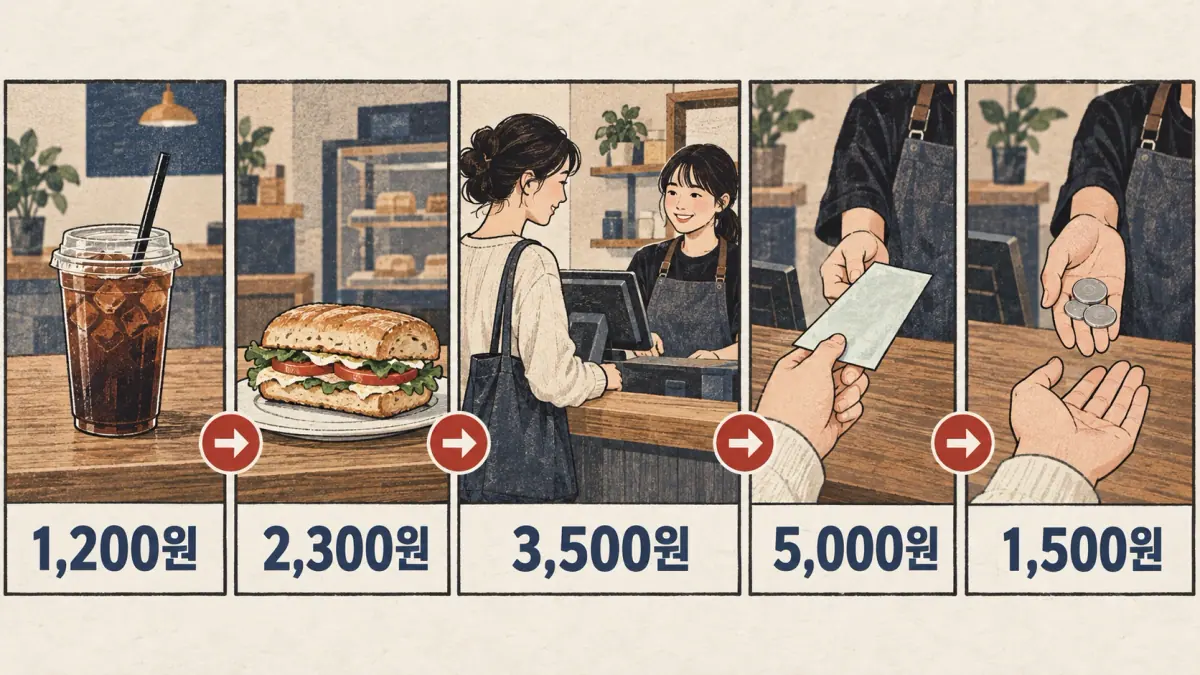
Prices become useful when you can add them in your head and say the total. Take two items, a drink at 1,200원 and a sandwich at 2,300원, and pay with a 5,000-won note. Each amount is read with the four-digit rule.
| Step | Amount | Spoken |
|---|---|---|
| Drink | 1,200원 | 천이백 원 |
| Sandwich | 2,300원 | 이천삼백 원 |
| Total | 3,500원 | 삼천오백 원 |
| You pay | 5,000원 | 오천 원 |
| Change | 1,500원 | 천오백 원 |
The numbers are samples for practice and not quoted prices. The method is what matters: add the digits first (1,200 plus 2,300 is 3,500), read the total in one go, then read the change. Cashiers in Korea usually say the total and the amount you handed over, so listen for the words 받았습니다 (received) and 거스름돈 (change). A common cashier line is 삼천오백 원입니다.
Five More Prices for Daily Life
Real prices appear on bus screens, ticket machines and menu boards, and they mix hundreds, thousands and ten-thousands. Use the sample prices below to test yourself, and cover the right column before you read each one aloud. These are practice amounts, not current price quotes.
| Situation | Sample price | Spoken reading |
|---|---|---|
| A cup of coffee | 4,500원 | 사천오백 원 |
| A lunch set | 9,000원 | 구천 원 |
| A bus fare | 1,500원 | 천오백 원 |
| A cinema ticket | 14,000원 | 만 사천 원 |
| A phone case | 12,900원 | 만 이천구백 원 |
Notice that 14,000 is 만 사천 and 12,900 is 만 이천구백. In both, the group in front of 만 is simply 1, so the reading starts with 만 without a digit. The same shape appears in every price from 10,000 to 19,999 won, so learn it once and reuse it. When a price ends in 900 or 990, the shop is using a common marketing habit, and the reading stays regular: 구백 for 900 and 구백구십 for 990.
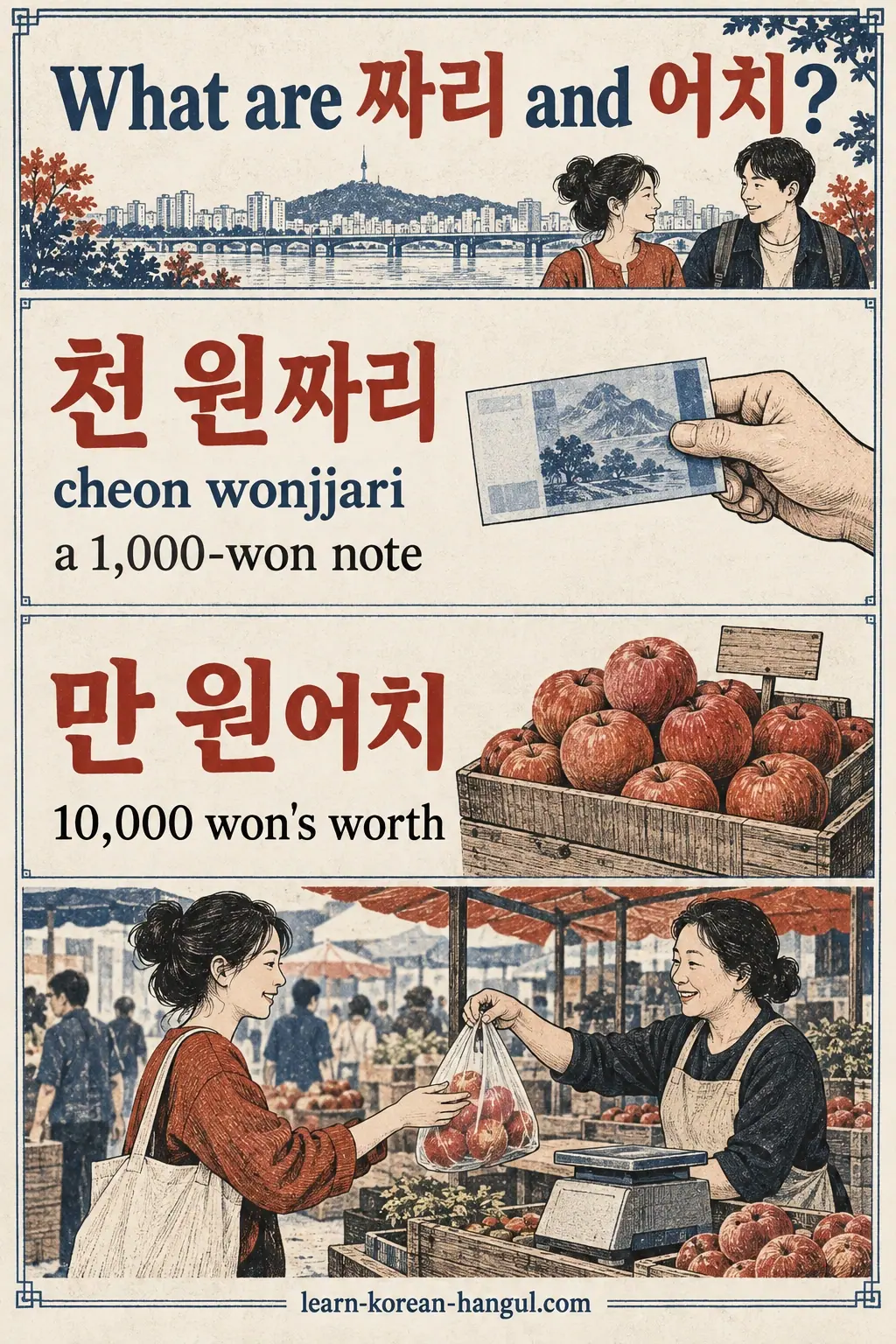
What Are 짜리 and 어치?

Two suffixes attach straight to an amount of money and change its meaning. 짜리 names a thing that has that price or value. 어치 names an amount that is worth that much. A suffix is a word part added to the end of another word, and neither of these takes a space.
| Suffix | Meaning | Example | Translation |
|---|---|---|---|
| 짜리 | having that value | 천 원짜리 | a 1,000-won note |
| 짜리 | having that value | 오천 원짜리 점심 | a 5,000-won lunch |
| 어치 | worth that much | 만 원어치 | 10,000 won's worth |
| 어치 | worth that much | 삼천 원어치 주세요. | Please give me 3,000 won's worth. |
The difference is easiest to remember with a market scene. A fruit or vegetable seller often sells loose produce by the scoop or by weight, so instead of a number of apples you can ask for an amount of money: 삼천 원어치 주세요. A bank clerk, on the other hand, hands you a 천 원짜리, because the note itself has that value. Use 어치 when you buy by budget, and 짜리 when you describe a thing by its price.
Spoken Shortcuts with Prices
In speech, Koreans often shorten prices when the context is clear. The cashier may say 삼천 and leave out 원. A seller may say 만오천 for 15,000. These shortcuts are common and easy to understand once you know the full form.
Some useful phrases around prices, with plain meanings:
- 싸요 / 비싸요: it is cheap / it is expensive. Add 너무 for "too": 너무 비싸요 (It's too expensive).
- 만 원대: in the 10,000-won range, which covers about 10,000 to 19,999 won. 만 원대 선물 means a gift costing from 10,000 to just under 20,000 won.
- 공짜 / 무료: free of charge. 무료 is the neutral word used on signs and in ads, and 공짜 is casual speech.
- 깎아 주세요: please give a discount. 천 원만 깎아 주세요 means "please take 1,000 won off".
The last phrase is the polite way to haggle, and it uses numbers directly: 천 원만 깎아 주세요 puts the amount first, with 만 meaning "only". Haggling is normal in traditional markets (시장) and unusual in department stores and chain shops, where prices are fixed. The words 깎아 주세요 are a request, not a demand, so a smile helps.
Common Mistakes and Fixes
Most price mistakes come from English habits: saying numbers in threes, adding 일 and choosing the wrong number system. Check your reading against this list.
- Reading in threes. Wrong: 삼십오 천 원. Right: 삼만 오천 원. Korean has no word for 35 thousand.
- Saying 일만 원 or 일천 원. Right: 만 원 and 천 원. Add the digit only for 2 to 9.
- Using native numbers. Wrong: 한 원, 세 천 원. Right: 일 원 and 삼천 원. Prices use Sino-Korean numbers.
- Putting 원 before the number. Wrong: 원 오천. Right: 오천 원. The counter follows the number, unlike the symbol ₩.
- Confusing 5,000 and 50,000. 오천 is 5,000 and 오만 is 50,000. Listen for 천 or 만.
- Forgetting the ending. A bare 삼천 원 is fine as a label. In a reply, add 이에요: 삼천 원이에요.
Limitation: this lesson teaches the standard spoken forms. Real shop talk includes slang and shortcuts that change by region and age, and prices written as 9 for 9,000 on some menus are covered in the Korean won lesson. Learn the full form first and let listening teach you the rest.
Practice Set
Answer each item before you read the answer line.
- Read 4,200원 aloud.
- Read 35,000원 aloud.
- Ask how much this is.
- How do you say a 1,000-won note?
- What is wrong with 한 원?
- How do you ask for 3,000 won's worth?
Practice · 8
How do you read 35,000원 aloud?
Show answer
삼만 오천 원
Split into fours (3 | 5000): 삼만, then 오천, then 원. Korean has no word for "35 thousand".
How do you read 100,000원 aloud?
Show answer
십만 원
100,000 is ten groups of 10,000, so it is 십만 원.
How do you read 10,001원 aloud?
Show answer
만 일 원
일 is dropped before 만, but kept when it is the last digit: 만 일 원.
How do you say "Please give me 3,000 won's worth"?
Show answer
삼천 원어치 주세요.
어치 means "worth" and attaches with no space, and prices use Sino numbers.
How do you ask "How much is this?"
Show answer
이거 얼마예요?
얼마 means "how much". 전부 얼마예요? asks for the total.
How do you read 350,000,000원 aloud?
Show answer
삼억 오천만 원
Split into fours (3 | 5000 | 0000): 삼억, then 오천만, then 원.
How do you say "Please take 1,000 won off"?
Show answer
천 원만 깎아 주세요.
깎아 주세요 asks for a discount, and 만 here means "only".
How do you read 14,000원 aloud?
Show answer
만 사천 원
The group before 만 is 1, so the reading starts with 만 alone: 만 사천 원. 사천 원 is only 4,000.
Answers:
- 사천이백 원 (sacheon-ibaek won).
- 삼만 오천 원 (samman ocheon won).
- 이거 얼마예요? (igeo eolmayeyo?).
- 천 원짜리 (cheon wonjjari).
- 원 takes Sino-Korean numbers, so the form is 일 원.
- 삼천 원어치 주세요 (samcheon woneochi juseyo).
Five or more correct means the reading rule is secure.
What to Learn Next
You can now read any price with the Korean counter won, ask 얼마예요? and use 짜리 and 어치. Continue in this order:
- Korean Won: Notes, Coins and How to Say Prices for the notes and coins you will hold.
- Korean Numbers Million and Billion: 만, 억, 조 Explained for sums above 100,000 won.
- 1000 in Korean and 10000 in Korean for the two most common prices.
- Korean shopping vocabulary for the words you need around the numbers.
Frequently Asked Questions
Is 원 pronounced won?
Yes, closely. The Hangul 원 is said [원]: a w glide, the vowel ㅓ and a final n. It sounds much like the English words "won" and "one", not like "own". The spelling won comes from Revised Romanization, where ㅝ is written wo. Listen to the audio on this page to check the vowel.
How do I say 1,000 won?
Say 천 원. Korean drops the 일 before 천, so 일천 원 is not used in speech. The same holds for 10,000 won, which is 만 원. Keep the digit for 2 to 9: 이천 원 is 2,000 won and 삼만 원 is 30,000 won.
What is 어치?
The suffix 어치 means "worth" and attaches straight to an amount: 만 원어치 is 10,000 won worth. You use it when you buy by budget instead of by quantity, as in 삼천 원어치 주세요, which asks for 3,000 won worth of something. It is a different job from 짜리.
Is it 일만 원 or 만 원?
In prices and everyday speech it is 만 원. The form 일만 원 exists in formal documents and cheques, where writers spell out every digit, but shops and cashiers do not say it aloud. Use 만 원 whenever you speak. The same applies to 천 원, which is never 일천 원 in speech.
How do I haggle with numbers?
Name the amount you want off, then add 만 and 깎아 주세요: 천 원만 깎아 주세요 means please take 1,000 won off. Haggle in traditional markets, not in chain shops or department stores. Keep the request polite and short, and accept a no. The Korean counter won rules stay the same.