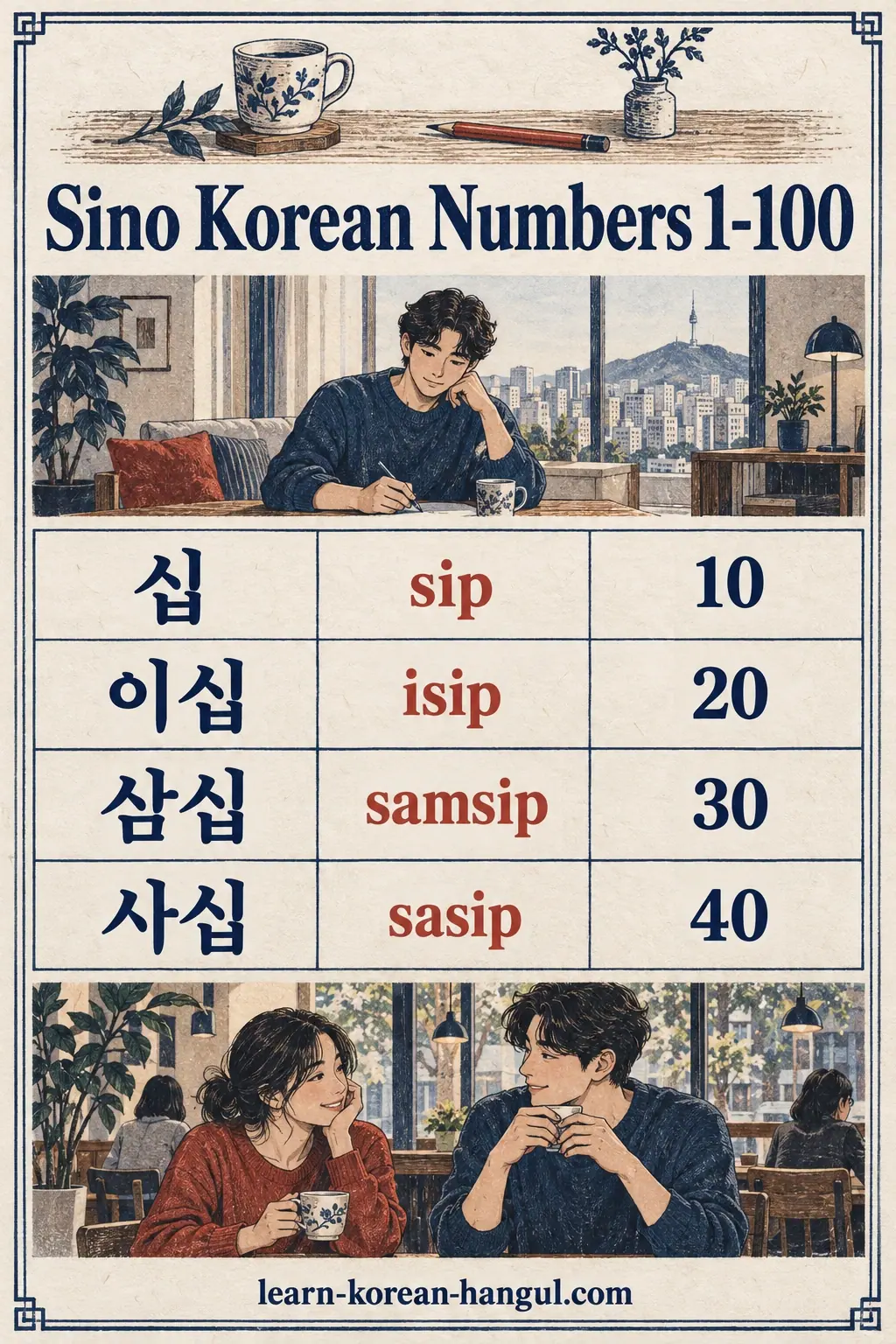
What you'll learn
- Say and write the ten base digits, 일 (1) to 십 (10).
- Build any number from 11 to 99 with the tens-plus-units formula.
- Read the full list from 1 to 100 aloud, including the sound changes in 십일, 십이, 십오 and 십육.
- Avoid the three mistakes that mark a beginner: 일십, native 열 in tens, and 일백.
- Prerequisites: you can read Hangul. Estimated time: 30 minutes.
Sino Korean Numbers 1-100: the Essentials

Sino-Korean numbers (한자어 수사, hanja-eo susa) are the Korean number words borrowed from Chinese characters. Koreans use them for minutes, dates, money, floors, phone numbers and labels. They are called Sino because they come from the same characters as Chinese numbers, such as 三 (삼, three).
Everything on this page grows from eleven words, shown with audio below.
| Number | Hangul | Reading aid | Notes |
|---|---|---|---|
| 0 | 영 / 공 | yeong / gong | 영 in maths and scores, 공 in phone numbers |
| 1 | 일 | il | |
| 2 | 이 | i | |
| 3 | 삼 | sam | |
| 4 | 사 | sa | |
| 5 | 오 | o | |
| 6 | 육 | yuk | |
| 7 | 칠 | chil | |
| 8 | 팔 | pal | |
| 9 | 구 | gu | |
| 10 | 십 | sip |
The reading aid column uses the Revised Romanization of Korean, the official system of the National Institute of Korean Language (국립국어원). It only helps you sound out the Hangul. Always trust the Hangul and the audio first.
Expert insight: most Sino-Korean digits are a single short syllable, so 일 and 이, or 삼 and 사, are easy to mishear on the phone or in a noisy shop. That is why long digit strings are read slowly and in groups. Keep the two number systems apart as well: if you need a reminder of which system applies where, the lesson on Sino vs native Korean numbers has the rule.
With ten digits in hand, you can already build every number to 99.
How Do You Build 11 to 99?
You build 11 to 99 by putting the tens first and the units after. Sino-Korean numbers work like place value in arithmetic: the tens word says how many tens, and the units word says how many ones. No extra word joins them.
There are three formulas.
| Pattern | Formula | Example | Meaning |
|---|---|---|---|
| Units alone | digit | 칠 | 7 |
| Ten and a unit | 십 + unit | 십삼 | 13 (ten + three) |
| Tens digit and a unit | tens digit + 십 + unit | 이십오 | 25 (two tens + five) |
| Round tens | tens digit + 십 | 구십 | 90 (nine tens) |
Follow these steps to read any number from 11 to 99.
- Split the number into tens and units: 47 is 4 tens and 7 ones.
- Say the tens: 4 tens is 사십 (digit 사 + 십).
- Add the units: 7 is 칠.
- Join them with no gap in Hangul: 사십칠.
You'll know it worked when you can say 82 as 팔십이 without looking: 팔 (8) + 십 (10) + 이 (2).
The dropped 일 rule. Korean does not say "one ten" or "one hundred" with 일. The number 10 is 십, never 일십. The number 11 is 십일, never 일십일. The number 100 is 백, never 일백, in everyday speech. The digit 일 appears only as the last digit, as in 이십일 (21).
The build rule is simple, but the full list shows how it plays out, and a few numbers sound different from how they are written.
What Are the Full Numbers 1-100?
The full list from 1 to 100 appears below in blocks of ten, each with Hangul, a reading aid and a note on sound. The "Sound" column shows how the number is pronounced when it differs from the spelling. A dash means you pronounce it as written. Each block has one audio clip that reads the whole row.
1 to 10
| Number | Hangul | Reading aid | Sound |
|---|---|---|---|
| 1 | 일 | il | — |
| 2 | 이 | i | — |
| 3 | 삼 | sam | — |
| 4 | 사 | sa | — |
| 5 | 오 | o | — |
| 6 | 육 | yuk | — |
| 7 | 칠 | chil | — |
| 8 | 팔 | pal | — |
| 9 | 구 | gu | — |
| 10 | 십 | sip | — |
11 to 20
| Number | Hangul | Reading aid | Sound |
|---|---|---|---|
| 11 | 십일 | sibil | [시빌] |
| 12 | 십이 | sibi | [시비] |
| 13 | 십삼 | sipsam | [십쌈] |
| 14 | 십사 | sipsa | [십싸] |
| 15 | 십오 | sibo | [시보] |
| 16 | 십육 | simnyuk | [심뉵] |
| 17 | 십칠 | sipchil | — |
| 18 | 십팔 | sippal | — |
| 19 | 십구 | sipgu | [십꾸] |
| 20 | 이십 | isip | — |
21 to 30
| Number | Hangul | Reading aid | Sound |
|---|---|---|---|
| 21 | 이십일 | isibil | [이시빌] |
| 22 | 이십이 | isibi | [이시비] |
| 23 | 이십삼 | isipsam | [이십쌈] |
| 24 | 이십사 | isipsa | [이십싸] |
| 25 | 이십오 | isibo | [이시보] |
| 26 | 이십육 | isimnyuk | [이심뉵] |
| 27 | 이십칠 | isipchil | — |
| 28 | 이십팔 | isippal | — |
| 29 | 이십구 | isipgu | [이십꾸] |
| 30 | 삼십 | samsip | — |
31 to 40
| Number | Hangul | Reading aid | Sound |
|---|---|---|---|
| 31 | 삼십일 | samsibil | [삼시빌] |
| 32 | 삼십이 | samsibi | [삼시비] |
| 33 | 삼십삼 | samsipsam | [삼십쌈] |
| 34 | 삼십사 | samsipsa | [삼십싸] |
| 35 | 삼십오 | samsibo | [삼시보] |
| 36 | 삼십육 | samsimnyuk | [삼심뉵] |
| 37 | 삼십칠 | samsipchil | — |
| 38 | 삼십팔 | samsippal | — |
| 39 | 삼십구 | samsipgu | [삼십꾸] |
| 40 | 사십 | sasip | — |
41 to 50
| Number | Hangul | Reading aid | Sound |
|---|---|---|---|
| 41 | 사십일 | sasibil | [사시빌] |
| 42 | 사십이 | sasibi | [사시비] |
| 43 | 사십삼 | sasipsam | [사십쌈] |
| 44 | 사십사 | sasipsa | [사십싸] |
| 45 | 사십오 | sasibo | [사시보] |
| 46 | 사십육 | sasimnyuk | [사심뉵] |
| 47 | 사십칠 | sasipchil | — |
| 48 | 사십팔 | sasippal | — |
| 49 | 사십구 | sasipgu | [사십꾸] |
| 50 | 오십 | osip | — |
51 to 60
| Number | Hangul | Reading aid | Sound |
|---|---|---|---|
| 51 | 오십일 | osibil | [오시빌] |
| 52 | 오십이 | osibi | [오시비] |
| 53 | 오십삼 | osipsam | [오십쌈] |
| 54 | 오십사 | osipsa | [오십싸] |
| 55 | 오십오 | osibo | [오시보] |
| 56 | 오십육 | osimnyuk | [오심뉵] |
| 57 | 오십칠 | osipchil | — |
| 58 | 오십팔 | osippal | — |
| 59 | 오십구 | osipgu | [오십꾸] |
| 60 | 육십 | yuksip | [육씹] |
61 to 70
| Number | Hangul | Reading aid | Sound |
|---|---|---|---|
| 61 | 육십일 | yuksibil | [육씨빌] |
| 62 | 육십이 | yuksibi | [육씨비] |
| 63 | 육십삼 | yuksipsam | [육씹쌈] |
| 64 | 육십사 | yuksipsa | [육씹싸] |
| 65 | 육십오 | yuksibo | [육씨보] |
| 66 | 육십육 | yuksimnyuk | [육씸뉵] |
| 67 | 육십칠 | yuksipchil | [육씹칠] |
| 68 | 육십팔 | yuksippal | [육씹팔] |
| 69 | 육십구 | yuksipgu | [육씹꾸] |
| 70 | 칠십 | chilsip | [칠씹] |
71 to 80
| Number | Hangul | Reading aid | Sound |
|---|---|---|---|
| 71 | 칠십일 | chilsibil | [칠씨빌] |
| 72 | 칠십이 | chilsibi | [칠씨비] |
| 73 | 칠십삼 | chilsipsam | [칠씹쌈] |
| 74 | 칠십사 | chilsipsa | [칠씹싸] |
| 75 | 칠십오 | chilsibo | [칠씨보] |
| 76 | 칠십육 | chilsimnyuk | [칠씸뉵] |
| 77 | 칠십칠 | chilsipchil | [칠씹칠] |
| 78 | 칠십팔 | chilsippal | [칠씹팔] |
| 79 | 칠십구 | chilsipgu | [칠씹꾸] |
| 80 | 팔십 | palsip | [팔씹] |
81 to 90
| Number | Hangul | Reading aid | Sound |
|---|---|---|---|
| 81 | 팔십일 | palsibil | [팔씨빌] |
| 82 | 팔십이 | palsibi | [팔씨비] |
| 83 | 팔십삼 | palsipsam | [팔씹쌈] |
| 84 | 팔십사 | palsipsa | [팔씹싸] |
| 85 | 팔십오 | palsibo | [팔씨보] |
| 86 | 팔십육 | palsimnyuk | [팔씸뉵] |
| 87 | 팔십칠 | palsipchil | [팔씹칠] |
| 88 | 팔십팔 | palsippal | [팔씹팔] |
| 89 | 팔십구 | palsipgu | [팔씹꾸] |
| 90 | 구십 | gusip | — |
91 to 100
| Number | Hangul | Reading aid | Sound |
|---|---|---|---|
| 91 | 구십일 | gusibil | [구시빌] |
| 92 | 구십이 | gusibi | [구시비] |
| 93 | 구십삼 | gusipsam | [구십쌈] |
| 94 | 구십사 | gusipsa | [구십싸] |
| 95 | 구십오 | gusibo | [구시보] |
| 96 | 구십육 | gusimnyuk | [구심뉵] |
| 97 | 구십칠 | gusipchil | — |
| 98 | 구십팔 | gusippal | — |
| 99 | 구십구 | gusipgu | [구십꾸] |
| 100 | 백 | baek | — |
The pattern repeats every ten numbers. Once you have read 11 to 20 and 21 to 30, the other eight blocks are the same pattern with a new tens word: 삼십, 사십, 오십, 육십, 칠십, 팔십, 구십.
The tens words are worth learning as a set.
| Tens | Hangul | Reading aid |
|---|---|---|
| 10 | 십 | sip |
| 20 | 이십 | isip |
| 30 | 삼십 | samsip |
| 40 | 사십 | sasip |
| 50 | 오십 | osip |
| 60 | 육십 | yuksip |
| 70 | 칠십 | chilsip |
| 80 | 팔십 | palsip |
| 90 | 구십 | gusip |
If you look at the Sound column, only some rows differ from the spelling, and the next section explains why.
Why Do Some Numbers Sound Different from the Spelling?

Some Sino-Korean numbers sound different from their spelling because Korean applies sound rules between syllables. Three rules matter for numbers 1 to 100. The standard pronunciation rules (표준 발음법) of the National Institute of Korean Language describe all of them.
Rule 1: liaison (연음). A final consonant moves to the next syllable when that syllable starts with the silent consonant ㅇ. The ㅂ of 십 moves to the next syllable in 십일, 십이 and 십오:
| Spelling | Sounds like | Reading aid |
|---|---|---|
| 십일 (11) | [시빌] | sibil |
| 십이 (12) | [시비] | sibi |
| 십오 (15) | [시보] | sibo |
| 이십일 (21) | [이시빌] | isibil |
Rule 2: ㄴ-insertion and nasalisation. In 십육 (16), the syllable 육 after a final consonant gets an extra ㄴ sound ([십뉵]), and ㅂ before ㄴ turns into ㅁ. The result is [심뉵]. The same change makes 이십육 sound like [이심뉵] and 오십육 like [오심뉵].
Rule 3: tensing (경음화). After a final ㄱ or ㅂ sound, a plain ㄱ, ㅅ or ㅂ becomes tense, so 십삼 (13), 십사 (14) and 십구 (19) sound like [십쌈], [십싸] and [십꾸], and 육십 (60) sounds like [육씹]. In Sino-Korean words, ㅅ after a final ㄹ is also tense, so 칠십 (70) and 팔십 (80) sound like [칠씹] and [팔씹]. The Sound column marks every case.
Do not try to memorise every rule. Learn the spelling, listen to the audio, and notice the pattern: a number ending in 일, 이 or 오 after 십 links its syllables, 육 after 십 turns into [뉵], and 삼, 사 and 구 after 십 sound tense.
Honest limit: the brackets above show the standard pronunciation, said carefully. Fast everyday speech blurs some syllables, and the audio is text-to-speech, so use the clips for rhythm and the brackets for the target sounds.
Sound changes explain why the list can look surprising. A few habits cause actual mistakes, and the next section lists them.
Which Mistakes Do Learners Make with Sino Korean Numbers?
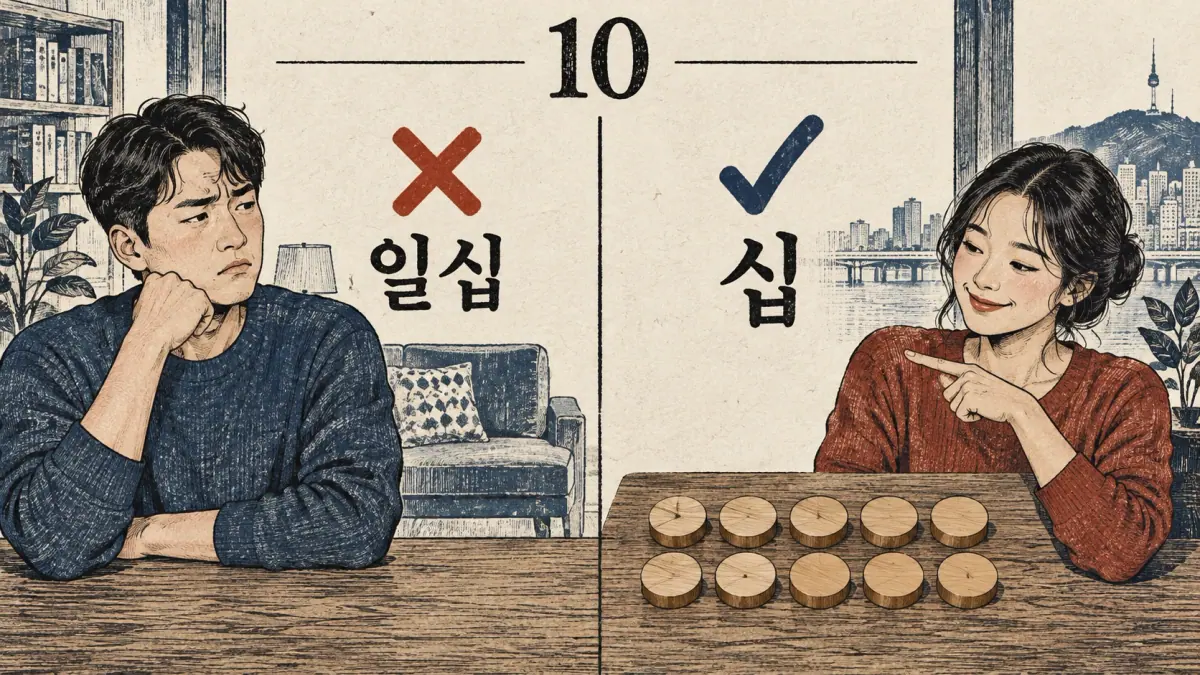
Learners make three common mistakes with Sino-Korean numbers, and each has a quick fix. The list below shows the wrong form, the right form and the reason.
| Mistake | Wrong | Right | Why |
|---|---|---|---|
| Adding 일 before 십 | 일십 | 십 | Korean drops 일 before 십 |
| Adding 일 before 백 | 일백 (everyday) | 백 | 일백 is only for formal writing |
| Using native 열 in the tens | 열오 | 십오 | 열 belongs to the native system |
| Mixing native digits with 십 | 두십 | 이십 | 십 pairs with Sino digits only |
| Spelling the sound | 심뉵 | 십육 | brackets show sound, not spelling |
The last row needs care. The brackets in the table, such as [심뉵], show the sound only. In writing, always spell the number the regular way: 십육, 이십육, 오십육.
There is also a counting mistake that is not about the numbers at all: using Sino-Korean numbers to count objects. The phrase 사과 삼 개 sounds wrong, and the native 사과 세 개 is correct. The counter 개 takes native numbers up to 99. The page on native Korean numbers 1-100 covers the other list.
Knowing the mistakes helps you avoid them. The next question is where the numbers are used.
Where Do You Use the Numbers 1 to 100?
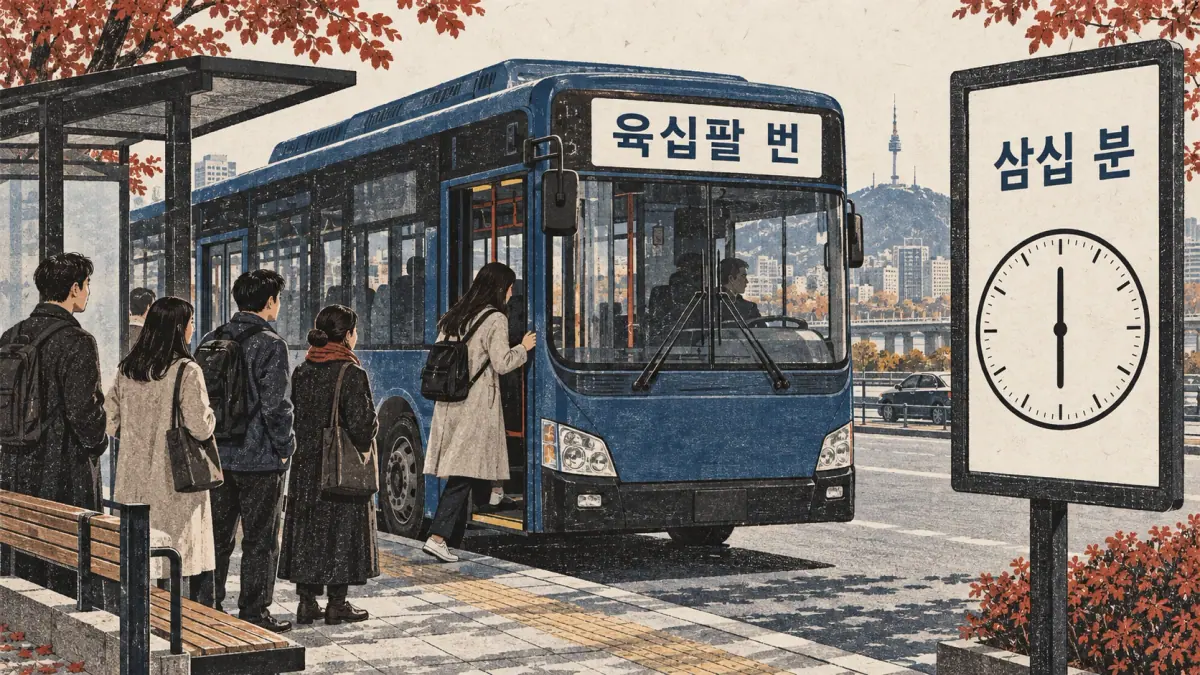
Sino-Korean numbers from 1 to 100 label things and measure amounts. They are the right choice for minutes, numbered items, scores, floors and percentages. Here are the most common uses for the 1-100 range.
| Use | Counter or word | Example | Meaning |
|---|---|---|---|
| Minutes | 분 | 삼십 분 | 30 minutes |
| Seconds | 초 | 오십 초 | 50 seconds |
| Bus or menu number | 번 | 육십팔 번 | number 68 |
| Test score | 점 | 구십 점 | 90 points |
| Floor | 층 | 이십오 층 | 25th floor |
| Percentage | 퍼센트 | 팔십 퍼센트 | 80 percent |
| Day of the month | 일 | 삼십일 일 | the 31st |
The first two rows connect directly to telling time in Korean, where minutes use these numbers. Prices use them too, together with 만 for 10,000, which the guide to Korean money numbers explains.
Here is one sentence that puts three of the numbers in context. The sentence 육십팔 번 버스는 삼십 분 걸려요 means "Bus number 68 takes 30 minutes."
You can use a number only after you can say it, so the next section is a practice set.
Practice Set: Read the Numbers
Read each item aloud before you check the answer. These items pretend you are reading a menu, a bus list and a score board.
- Menu item 35 (the number on the menu).
- Bus number 68.
- A score of 90 points.
- The 11th floor.
- 56 minutes.
- Correct the mistake: 일십오.
Answers:
- 삼십오 번 (samsibo beon)
- 육십팔 번 (yuksippal beon)
- 구십 점 (gusip jeom)
- 십일 층 (sibil cheung)
- 오십육 분 (osimnyuk bun), sounds like [오심뉵뿐]
- 십오. Korean does not use 일 before 십 in 15.
Practice · 8
How do you say 36 in Sino-Korean?
Show answer
삼십육
Put the tens first and the units after: 3 tens (삼십) + 6 (육) gives 삼십육.
How do you say 15 in Sino-Korean?
Show answer
십오
Korean drops 일 before 십, and native 열 does not combine with Sino digits, so 15 is 십오.
How do you say 100 in Sino-Korean?
Show answer
백
100 is 백. 십 is 10 and 구십 is 90; the digit 일 is not said before 백 in everyday speech.
How do you say 20 in Sino-Korean?
Show answer
이십
십 pairs with Sino digits only, so 20 is 이 + 십. 십이 is 12.
How is 십육 (16) pronounced?
Show answer
[심뉵]
ㄴ is inserted before 육 and ㅂ before ㄴ becomes ㅁ, so 십육 sounds like [심뉵]. It is still spelled 십육.
How do you say a score of 90 points?
Show answer
구십 점
Scores use Sino-Korean numbers with 점: 구 (9) + 십 (10) gives 구십 점.
Which counting phrase for three apples is correct?
Show answer
사과 세 개
The counter 개 takes native numbers up to 99, so 사과 삼 개 sounds wrong; the native 세 개 is correct.
How do you write the 30-minute phrase with a counter?
Show answer
삼십 분
The number is written as one solid word, and a counter after it is a separate word: 삼십 분.
If you answered five or more correctly, move on. If not, review the tens words and the dropped 일 rule.
How Do You Write the Numbers in Hangul and Digits?
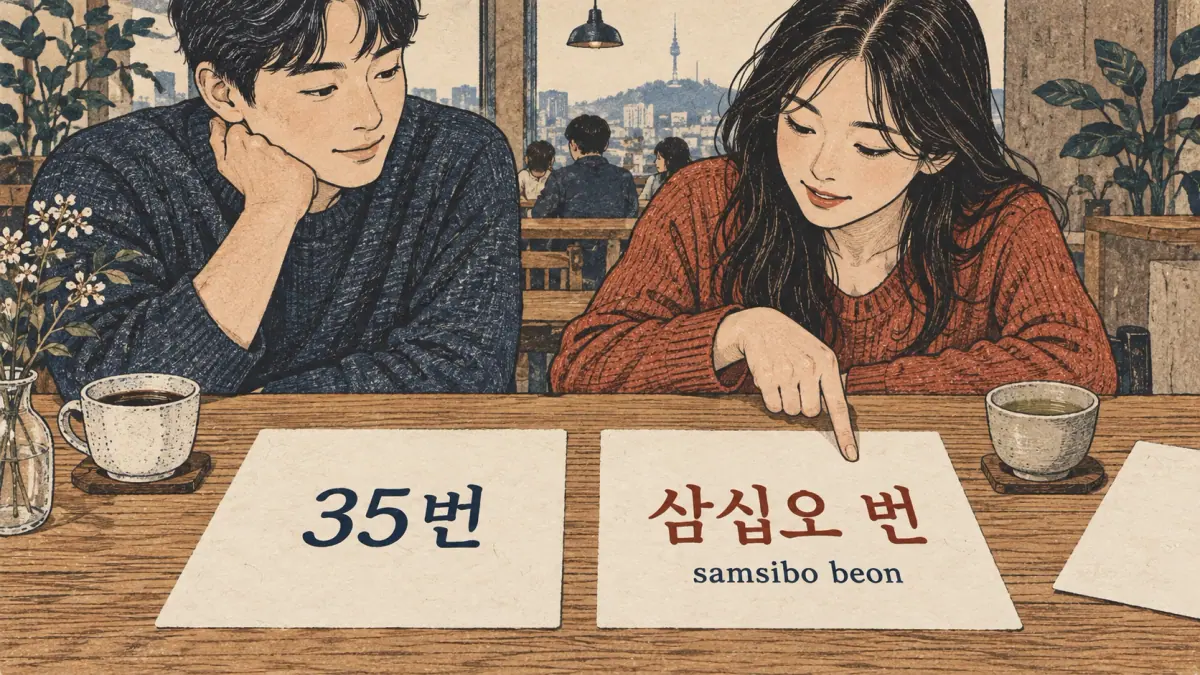
Write Sino-Korean numbers in Hangul as one solid word up to 만 (10,000): 삼십오, 육십팔, 구십구. The spelling rules (한글 맞춤법 제44항) of the National Institute of Korean Language put a space only at each 만 unit in larger numbers. A counter after the number is a separate word, so you write 삼십오 번 with a space.
Korean text also uses Arabic digits, and a counter then attaches directly: 35번, 68번, 90점. Both forms are read the same way, as 삼십오 번, 육십팔 번 and 구십 점.
| Digits | Hangul | Read aloud |
|---|---|---|
| 35번 | 삼십오 번 | samsibo beon |
| 68번 | 육십팔 번 | yuksippal beon |
| 90점 | 구십 점 | gusip jeom |
Digits do not always mean "read as one number". A phone number such as 010 is read digit by digit as 공일공, not as 십, while a price such as 90점 is read as the whole number 구십. The guide to how to say a phone number in Korean covers the digit-by-digit style.
Writing and reading are now clear. The last section marks where this list ends.
What Does This List Not Cover?
This list stops at 100. It does not teach large numbers, native numbers or counters. For each of those topics there is a separate page:
- 100 and above: 만 (10,000) and 억 (100 million) are in large numbers in Korean.
- The native list: the other system for counting objects is in native Korean numbers 1-100.
- Choosing a system: Sino vs native Korean numbers shows when to use each.
- The hanja: the Chinese characters behind each digit are not taught here.
What Should You Learn Next?
You can now read the Sino Korean numbers 1-100 and build any of them from tens and units. Continue in this order:
- Large numbers in Korean for 100, 1,000, 10,000 and beyond, which builds on the same pattern.
- Telling time in Korean to use the numbers for minutes.
- Native Korean numbers 1-100 to compare the two systems side by side.
- Korean money numbers to read prices.
Keep the rule in mind: the ten digits and 십 cover Sino Korean numbers 1-100.
Frequently Asked Questions
Is 100 일백 or 백?
In everyday speech 100 is 백. Korean drops the 일 before 십 and 백, so 10 is 십 and 100 is 백. The form 일백 exists in formal documents, legal texts and cheques where the extra syllable prevents errors, but a learner should say 백 for prices, scores and counting.
How do you say 0 to 10 in Sino-Korean?
Zero is 영 (yeong) or 공 (gong), and 1 to 10 are 일, 이, 삼, 사, 오, 육, 칠, 팔, 구, 십. Use 영 in maths, temperatures and scores, and 공 when reading phone numbers or codes digit by digit. The ten digits from 일 to 십 are the only words you must memorise.
Why does 16 sound like 심뉵?
Two sound rules combine in 십육. The 육 after 십 gets an inserted ㄴ sound, so the word becomes [십뉵]. Then ㅂ before ㄴ turns into ㅁ, giving [심뉵]. The spelling stays 십육 in writing. The same change appears in 이십육 [이심뉵] and 오십육 [오심뉵], so the pattern is regular.
Can I use Sino numbers for counting apples?
No. Apples, people and animals use native Korean numbers with counters: 사과 세 개, not 사과 삼 개. Sino-Korean numbers cover minutes, dates, money, floors, phone numbers and labels. If you want to count objects, learn the native numbers and the 개 counter first.
How do I write the numbers in Hangul without spaces?
Write Sino-Korean numbers solid up to 만 (10,000), so 삼십오, 육십팔 and 구십구 have no spaces inside. The spelling rules of the National Institute of Korean Language (한글 맞춤법 제44항) put a space after each 만 unit only in very large numbers. Counters such as 번 are separate words: 삼십오 번.