What you'll learn
- Count one to ten people respectfully with 분, using the correct native number forms.
- Ask 몇 분이세요? like restaurant staff and answer it correctly as a guest.
- Match 분 with honorific verbs such as 오셨어요 in a full sentence.
- Tell 분 (people) apart from 분 (minutes) by the number in front of it.
- Use the pronouns 이분, 그분 and 저분 with the right spelling.
Prerequisites: the 명 counter and native numbers 1-10. Estimated time: 25 minutes.
What Is the Korean Counter Bun?
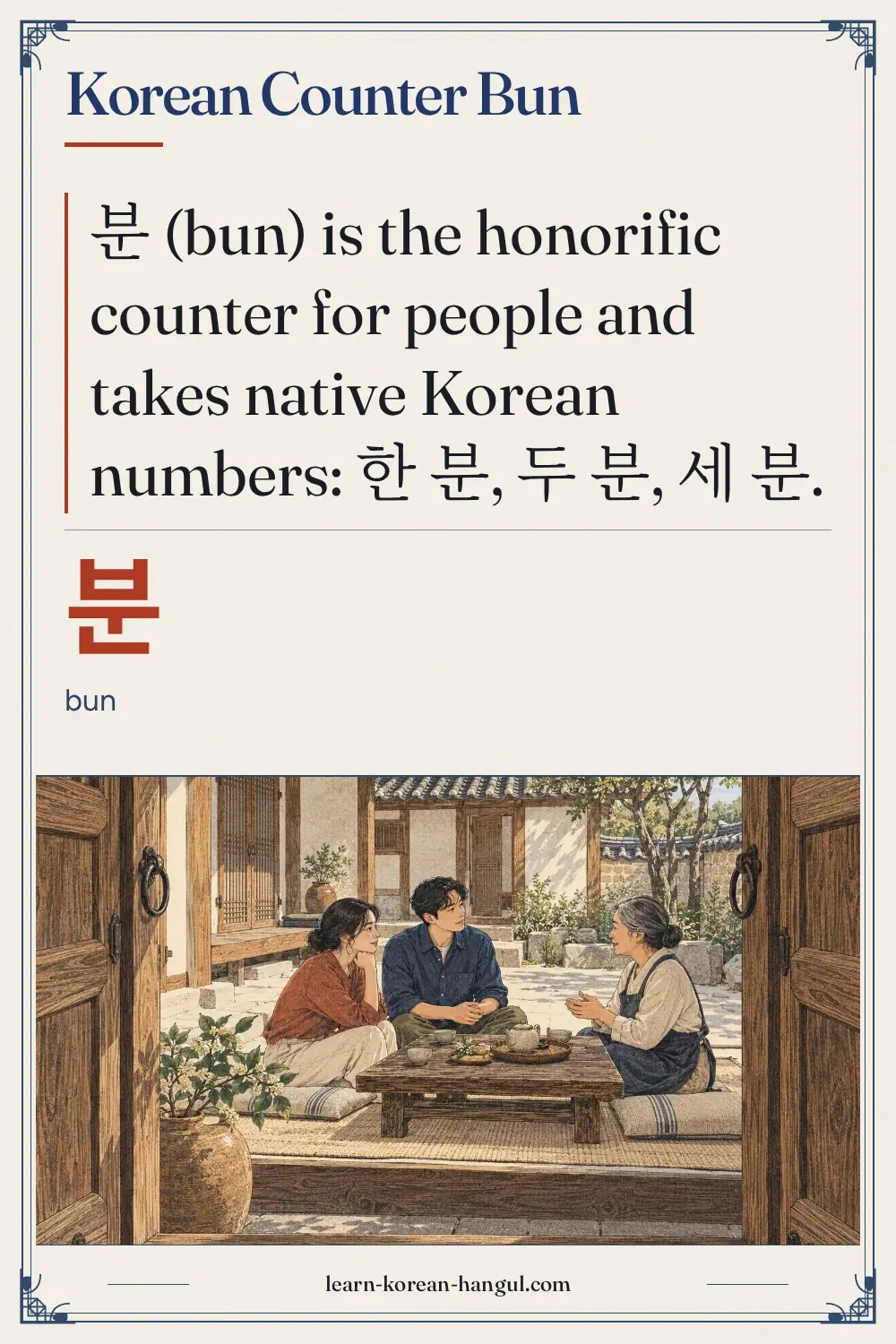
The Korean counter bun (분) is a bound noun that counts people while showing respect to them. A bound noun (의존 명사) is a noun that cannot stand alone and always needs a word in front of it, such as a number. In counting, 분 does the same job as 명, the ordinary people counter, but it adds the meaning "honoured person".
The pattern is the same as for every Korean counter: noun + native number + 분.
| Noun | Number + 분 | Meaning |
|---|---|---|
| 손님 (sonnim, guest or customer) | 손님 두 분 | two guests |
| 선생님 (seonsaengnim, teacher) | 선생님 세 분 | three teachers |
| 어르신 (eoreusin, elder) | 어르신 한 분 | one elderly person |
| 고객님 (gogaengnim, customer) | 고객님 네 분 | four customers |
| 부모님 (bumonim, parents) | 부모님 두 분 | both parents |
Notice that most nouns in the table already end in 님, the honorific suffix for people. 분 belongs to the same family of respectful words, so 님 and 분 usually appear together. The 국립국어원 standard dictionary (표준국어대사전) describes this 분 as a word that "raises" the person it counts, which is exactly how Korean honorifics work: you lift the other person, never yourself.
The counter 분 is a native Korean word with no Chinese character behind it. The minute 분 comes from the character 分. The two words only share a spelling and a sound, and the number system you put before them is what keeps them apart. The next section shows those numbers.
Counting People Politely with 분, from 1 to 10
To count people politely, say a native Korean number and then 분, with a space between them: 한 분, 두 분, 세 분. The number forms are exactly the ones you already use with 명, including the five short forms 한, 두, 세, 네 and 스무.
| Number | With 분 | Spoken | Revised Romanization | Meaning |
|---|---|---|---|---|
| 1 | 한 분 | [한분] | han bun | one person |
| 2 | 두 분 | [두분] | du bun | two people |
| 3 | 세 분 | [세분] | se bun | three people |
| 4 | 네 분 | [네분] | ne bun | four people |
| 5 | 다섯 분 | [다섣뿐] | daseot bun | five people |
| 6 | 여섯 분 | [여섣뿐] | yeoseot bun | six people |
| 7 | 일곱 분 | [일곱뿐] | ilgop bun | seven people |
| 8 | 여덟 분 | [여덜분] | yeodeol bun | eight people |
| 9 | 아홉 분 | [아홉뿐] | ahop bun | nine people |
| 10 | 열 분 | [열분] | yeol bun | ten people |
Reference · Native Numbers
| Noun | Number + 분 | Meaning |
|---|---|---|
| 손님 (sonnim, guest or customer) | 손님 두 분 | two guests |
| 선생님 (seonsaengnim, teacher) | 선생님 세 분 | three teachers |
| 어르신 (eoreusin, elder) | 어르신 한 분 | one elderly person |
| 고객님 (gogaengnim, customer) | 고객님 네 분 | four customers |
| 부모님 (bumonim, parents) | 부모님 두 분 | both parents |
| Number | With 분 | Spoken | Revised Romanization | Meaning |
|---|---|---|---|---|
| 1 | 한 분 | [한분] | han bun | one person |
| 2 | 두 분 | [두분] | du bun | two people |
| 3 | 세 분 | [세분] | se bun | three people |
| 4 | 네 분 | [네분] | ne bun | four people |
| 5 | 다섯 분 | [다섣뿐] | daseot bun | five people |
| 6 | 여섯 분 | [여섣뿐] | yeoseot bun | six people |
| 7 | 일곱 분 | [일곱뿐] | ilgop bun | seven people |
| 8 | 여덟 분 | [여덜분] | yeodeol bun | eight people |
| 9 | 아홉 분 | [아홉뿐] | ahop bun | nine people |
| 10 | 열 분 | [열분] | yeol bun | ten people |
| Situation | Counter | Example | Why |
|---|---|---|---|
| Staff counting customers | 분 | 손님 두 분 | Service speech raises the customer |
| Guest describing own group | 명 | 저희는 두 명이에요 | Never raise yourself |
| Student talking about teachers | 분 | 선생님 세 분 | Teachers are senior |
| Talking about classmates | 명 | 친구 세 명 | Equals, no respect needed |
| Speaking of your parents to others | 분 | 부모님 두 분 다 | Parents are elders |
| News report or statistic | 명 | 관객 천 명 | Neutral reporting |
| Babies and children | 명 | 아이 두 명 | 분 would sound odd |
| Your group | Natural answer | Meaning |
|---|---|---|
| Alone | 혼자예요. | I'm alone. |
| Two | 두 명이요. | Two people. |
| Four | 네 명이에요. | There are four of us. |
| Two now, one later | 두 명인데 한 명 더 와요. | Two, and one more is coming. |
| Level | Sentence | Meaning |
|---|---|---|
| Neutral | 학생 세 명이 왔어요. | Three students came. |
| Honorific | 손님 세 분이 오셨어요. | Three guests came (respectful). |
| Formal honorific | 손님 세 분께서 오셨습니다. | Three guests have arrived (formal). |
| Unbalanced | 손님 세 분이 왔어요. | Grammatical, but the verb does not match the counter |
| Feature | 분 (people) | 분 (minutes) |
|---|---|---|
| Meaning | honoured person | one sixtieth of an hour |
| Origin | native Korean word | Sino-Korean, from 分 |
| Number system | native: 한, 두, 세 | Sino: 일, 이, 삼 |
| Three | 세 분 | 삼 분 |
| Ten | 열 분 | 십 분 |
| Twenty | 스무 분 | 이십 분 |
| Question | 몇 분이세요? (how many people?) | 몇 분 걸려요? (how many minutes does it take?) |
| Pronoun | Meaning | Neutral version |
|---|---|---|
| 이분 | this person (near me) | 이 사람 |
| 그분 | that person (near you, or already mentioned) | 그 사람 |
| 저분 | that person over there | 저 사람 |
| 여러분 | everyone, you all | (no neutral pair) |
Look at the "Spoken" column for 5, 6, 7 and 9. When a number ends in a consonant sound such as [ㄷ] or [ㅂ], the ㅂ of 분 becomes tense and sounds like [뿐]. This is tensification (경음화), a regular rule in the 국립국어원 standard pronunciation rules (표준 발음법, Article 23). Revised Romanization does not mark tensification, so 다섯 분 is still written daseot bun.
Above ten, the same shortening happens at the end of each number: 열한 분 (11), 열두 분 (12), 스무 분 (20), 스물두 분 (22). In a classroom or office you will rarely need more than that, because large honoured groups are usually described with other words.
Groups of 100 People or More
From 100 up, Korean switches to Sino-Korean numbers for 분, just as it does for 명: 백 분 (100 people) and 천 분 (1,000 people). You will see this most often in shop and event notices such as 선착순 100분 (the first 100 customers), where a business counts its customers respectfully. Because the same notice could mean "100 minutes" in another context, the surrounding words, such as 선착순 (first come, first served) or 고객, make the meaning clear.
Expert tip: large numbers written in digits, such as 50분 on a poster, are often read with Sino-Korean numbers in announcements. For anything you say yourself at A1 level, stay with small native numbers, where the rule is clean.
You can now count any group respectfully. The harder question is when to do it.
When Do You Use 분 Instead of 명?
Use 분 when you count people you want to treat with respect and you are not one of them: customers, guests, teachers, elders, a client's team or strangers you are serving. Use 명 for yourself, for any group that includes you, for friends and children, and for neutral facts such as statistics. The 명 counter is never rude, but 분 sounds warmer and more correct when you serve or address others.
| Situation | Counter | Example | Why |
|---|---|---|---|
| Staff counting customers | 분 | 손님 두 분 | Service speech raises the customer |
| Guest describing own group | 명 | 저희는 두 명이에요 | Never raise yourself |
| Student talking about teachers | 분 | 선생님 세 분 | Teachers are senior |
| Talking about classmates | 명 | 친구 세 명 | Equals, no respect needed |
| Speaking of your parents to others | 분 | 부모님 두 분 다 | Parents are elders |
| News report or statistic | 명 | 관객 천 명 | Neutral reporting |
| Babies and children | 명 | 아이 두 명 | 분 would sound odd |
A useful test has two questions. First, would you add 님 or use an honorific verb (with -시-) for this person? Second, are you outside the group? If both answers are yes, use 분. If either is no, use 명. For example, a host at a dinner says 손님 열 분이 오셨어요 about the guests, but a guest who arrives with friends says 저희 다섯 명이에요 about their own party.
Your own family is the one place learners hesitate. Modern Korean speakers do use 분 for their own grandparents or parents when they speak respectfully about them, as in 부모님 두 분 다 서울에 계세요 (Both of my parents live in Seoul). They do not use 분 for younger siblings or their own children.
With the choice made, the most common use of 분 is a single question you will hear in every restaurant.
How Do You Ask 몇 분이세요?
To ask how many people are in a group, politely, say 몇 분이세요? (myeot buniseyo?). It is the standard question that restaurant, café and hotel staff ask when you walk in. The guest answers with 명, not 분.
The question breaks into four parts:
- 몇 (myeot): how many.
- 분 (bun): honoured people.
- 이시 (isi): the verb 이다 (to be) with the honorific marker -시-.
- -어요 (eoyo): the polite ending, which joins 이시 to make 이세요.
The whole phrase is spoken as one unit, [멷뿌니세요], with the same tense [뿐] you saw after 다섯.
Here is the full exchange at the door of a restaurant:
- 직원: 어서 오세요. 몇 분이세요?
- 손님: 두 명이요.
- 직원: 두 분이시면 이쪽으로 오세요.
(Staff: Welcome. How many are you? Guest: Two people. Staff: If it is two of you, please come this way.)
어서 오세요. 몇 분이세요?
Welcome. How many are you?
두 명이요.
Two people.
두 분이시면 이쪽으로 오세요.
If it is two of you, please come this way.
The staff member uses 분 twice, once in the question and once in the reply, because both times they are talking about you. The guest uses 명, because the guest is talking about their own group. The answer 두 명이요 is a short, natural form of 두 명이에요; both are polite.
| Your group | Natural answer | Meaning |
|---|---|---|
| Alone | 혼자예요. | I'm alone. |
| Two | 두 명이요. | Two people. |
| Four | 네 명이에요. | There are four of us. |
| Two now, one later | 두 명인데 한 명 더 와요. | Two, and one more is coming. |
When you are alone, 혼자 (alone) is more natural than 한 명. You will also hear variants of the staff question: 일행이 몇 분이세요? (How many are in your party?) and, on the phone, 몇 분 예약하시겠어요? (For how many people would you like to book?). More ordering scripts are on the Korean restaurant phrases page.
The question works because the counter and the verb agree in politeness. That agreement is the next point.
Matching 분 with Honorific Verbs
The counter 분 normally comes with an honorific verb, one that contains the marker -시-, because the whole sentence raises the same person. Korean grammar calls this subject honorification (주체 높임). If the counter is respectful but the verb is plain, the sentence sounds unbalanced, like saying "the honoured guests showed up, yeah".
| Level | Sentence | Meaning |
|---|---|---|
| Neutral | 학생 세 명이 왔어요. | Three students came. |
| Honorific | 손님 세 분이 오셨어요. | Three guests came (respectful). |
| Formal honorific | 손님 세 분께서 오셨습니다. | Three guests have arrived (formal). |
| Unbalanced | 손님 세 분이 왔어요. | Grammatical, but the verb does not match the counter |
The formal row adds 께서, the honorific form of the subject particle 이/가. You hear it in announcements and speeches. At A1 level, the honorific row is enough: 분 + 이/가 + a verb with -시-. Other verbs follow the same rule: 계세요 (are there, honorific of 있어요), 드세요 (eat, honorific of 먹어요) and 기다리세요 (wait).
Expert insight: a learner who says 손님 두 분 but then uses a plain verb is understood, yet the mismatch is one of the clearest signs of textbook Korean. Fix the verb first, because Koreans notice it more than the counter. The broader system is explained on the Korean honorifics page.
Honorific 분 has one more trap: a second word with the same sound.
How Is 분 (people) Different from 분 (minutes)?
분 for people and 분 for minutes are two different words that are spelled and pronounced the same. The quickest way to tell them apart is the number: the people counter takes native Korean numbers (세 분, three people), and the minute counter takes Sino-Korean numbers (삼 분, three minutes). The minute counter is taught on the minutes and seconds page.
| Feature | 분 (people) | 분 (minutes) |
|---|---|---|
| Meaning | honoured person | one sixtieth of an hour |
| Origin | native Korean word | Sino-Korean, from 分 |
| Number system | native: 한, 두, 세 | Sino: 일, 이, 삼 |
| Three | 세 분 | 삼 분 |
| Ten | 열 분 | 십 분 |
| Twenty | 스무 분 | 이십 분 |
| Question | 몇 분이세요? (how many people?) | 몇 분 걸려요? (how many minutes does it take?) |
How Do You Tell Them Apart When You Hear 몇 분?
The question word 몇 works with both systems, so 몇 분 alone is ambiguous. Use these three checks, in order:
- Listen for the number. A native number (한, 두, 세, 열) means people. A Sino number (일, 이, 삼, 십) means minutes.
- Listen for the verb. 이세요 or 오세요 points to people. 걸려요 (it takes) or 남았어요 (are left) points to time.
- Check the setting. At a restaurant door it is people. At a bus stop or a ticket counter it is usually time.
Here is a pair that differs only in the number: 세 분 기다려 주세요 asks three respected people to wait, while 삼 분 기다려 주세요 asks someone to wait three minutes.
The number decides the meaning every time. Spelling adds one more clue, through a small set of pronouns.
What Do 이분, 그분 and 저분 Mean?
이분, 그분 and 저분 are honorific pronouns meaning "this person", "that person" and "that person over there". Each one joins a pointing word (이, 그, 저) to 분, and the 국립국어원 dictionary lists each as a single word, so they are written without a space.
| Pronoun | Meaning | Neutral version |
|---|---|---|
| 이분 | this person (near me) | 이 사람 |
| 그분 | that person (near you, or already mentioned) | 그 사람 |
| 저분 | that person over there | 저 사람 |
| 여러분 | everyone, you all | (no neutral pair) |
Spacing matters here. 이분 (this person) is one word, but 이 분 with a space is the Sino number 이 (two) plus minutes, so it reads as "two minutes". Spoken aloud, the two sound alike, which is why native readers rely on the space.
You also meet 분 after describing words, as a polite version of 사람 (person): 좋은 분 (a good person), 어떤 분 (which person, what kind of person) and 한국 분 (a Korean person). These are not counts, but they come from the same respectful noun. 여러분, used at the start of every class and speech, is the most frequent of all.
Now that you know the forms and the traps, here are the errors learners actually make.
Common Mistakes and Fixes
Most mistakes with 분 come from mixing the two number systems or from applying respect in the wrong direction. Check your sentences against this list.
- Sino numbers for people. Wrong: 손님 이 분. Right: 손님 두 분. With a Sino number, 분 turns into minutes.
- Raising your own group. Wrong: 저희는 세 분이에요. Right: 저희는 세 명이에요. Never count yourself with 분.
- Plain verb with 분. Wrong: 선생님 두 분이 왔어요. Right: 선생님 두 분이 오셨어요.
- Native numbers for minutes. Wrong: 세 분 기다려 주세요 (when you mean three minutes). Right: 삼 분 기다려 주세요.
- Spacing the pronoun. Wrong: 이 분은 누구세요? Right: 이분은 누구세요?
- 분 for children or friends. Wrong: 친구 두 분 about your classmates. Right: 친구 두 명.
Learners often assume that 분 is simply "more polite" and therefore safe for everyone. Actually it is directional: it raises the person you talk about, so using it for yourself or your friends sounds odd and even self-important. When you are unsure, 명 is the safe default, because it is neutral rather than rude.
Limitation: this lesson covers the counting use of 분 and its closest relatives. It does not cover the full honorific verb system, the formal -습니다 style in detail, or other words spelled 분, such as 분 (powder) in 분말. Those belong to separate lessons.
Use the practice set to check that the rules have stuck.
Practice Set
Answer each item before you read the answers at the end.
- Say "three teachers" respectfully.
- Staff ask you 몇 분이세요? You are with one friend. Answer.
- Is 이십 분 twenty people or twenty minutes?
- Correct the sentence: 손님 네 분이 왔어요.
- Write "this person" as one honorific word.
- Say "Please wait five minutes" with the right number.
Practice · 5
How do you say three guests respectfully?
Show answer
손님 세 분
분 takes native numbers, and 셋 shortens to 세 before a counter.
Staff ask 몇 분이세요? You are a group of two. What do you say?
Show answer
두 명이요.
Answer about your own group with 명 and a native number.
What does 십 분 mean?
Show answer
ten minutes
A Sino-Korean number before 분 means minutes.
Which sentence matches the counter with the verb?
Show answer
선생님 두 분이 오셨어요.
분 pairs with an honorific verb containing -시-.
How is 'this person' written?
Show answer
이분
이분 is one word; 이 분 reads as two minutes.
Answers:
- 선생님 세 분 (seonsaengnim se bun).
- 두 명이요. or 두 명이에요. Use 명 for your own group.
- Twenty minutes. Twenty people would be 스무 분.
- 손님 네 분이 오셨어요. The verb needs -시- to match 분.
- 이분 (ibun), written without a space.
- 오 분 기다려 주세요. Minutes take the Sino number 오, not 다섯.
If you got five or six right, you are ready for the comparison page.
What to Learn Next
You now know the Korean counter bun: a native number, then 분, used for other people you respect, with an honorific verb to match. Continue in this order:
- How to count people in Korean compares 명, 분 and 사람 side by side, with scenarios such as weddings, notices and family talk.
- The 명 counter is the neutral form you use for yourself and your friends; review it if the answers above felt shaky.
- Minutes and seconds teaches the other 분 with Sino-Korean numbers.
- Honorific nouns shows the 님 and 분 family of respectful words.
- Counting People and Animals lists every people and animal counter on the site.
Frequently Asked Questions
Can I say 한 분 about myself?
No. 분 raises the person you count, and Korean never raises the speaker. About yourself, say 한 명 or, more naturally, 혼자예요 (I am alone). The same applies to any group that includes you: 저희는 세 명이에요. Staff will still use 분 about you, and that is correct from their side.
Is 분 only used in restaurants?
No. Restaurants are where most learners hear it first, but 분 appears wherever people serve or respect others: hotels, hospitals, banks, shops, classrooms and events. A teacher may say 학부모님 세 분 for three parents, and a shop notice says 선착순 100분 for the first 100 customers.
Can I use 분 for my own parents or grandparents?
Yes. When you speak about your parents or grandparents with respect, 분 is natural: 부모님 두 분 다 서울에 계세요 means both of my parents live in Seoul. Use an honorific verb as well. Do not use 분 for your younger siblings, your children or yourself, because it is for people you look up to.
Is it rude to count customers with 명?
It is not rude, but it sounds flat. 명 is neutral, so 손님 두 명 is grammatical, and you will hear it in casual places and in talk between staff. When you speak to customers or about them in front of them, 분 is the expected service form, paired with an honorific verb.
Do I write a space between the number and 분?
Yes, when the number is written in Hangul: 두 분, 세 분. 한글 맞춤법 Article 43 writes a counter separately from the number before it. With Arabic digits the counter is usually attached, as in 선착순 100분. Remember that 이분, meaning this person, is a single word, not a number plus a counter.