What you'll learn
- Say one to ten people with 명, using the correct native number forms.
- Ask and answer 몇 명이에요? in a short restaurant dialogue.
- Choose between 명, 분 and 사람 for a given situation.
- Spot and fix five common counting mistakes.
Prerequisites: native Korean numbers 1-10. Estimated time: 30 minutes.
What Is the Korean Counter Myeong?
The Korean counter myeong (명) is a small word that follows a number and means "person" when you count. A counter is a word that tells you what kind of thing a number refers to. English has a few, such as "two pieces of paper" or "three heads of cattle". Korean needs one almost every time, and 명 is the counter for human beings.
The pattern is: noun + number + 명.
| Noun | Number + 명 | Meaning |
|---|---|---|
| 학생 (haksaeng) | 학생 세 명 | three students |
| 친구 (chingu) | 친구 두 명 | two friends |
| 가족 (gajok) | 가족 네 명 | a family of four |
| 아이 (ai) | 아이 한 명 | one child |
The word 명 comes from the Chinese character 名, but it takes native Korean numbers (하나, 둘, 셋), not the Sino-Korean ones (일, 이, 삼). So 두 명 is correct and 이 명 is not. The next section shows the full set of forms from one to ten.
How Do You Count People with 명?

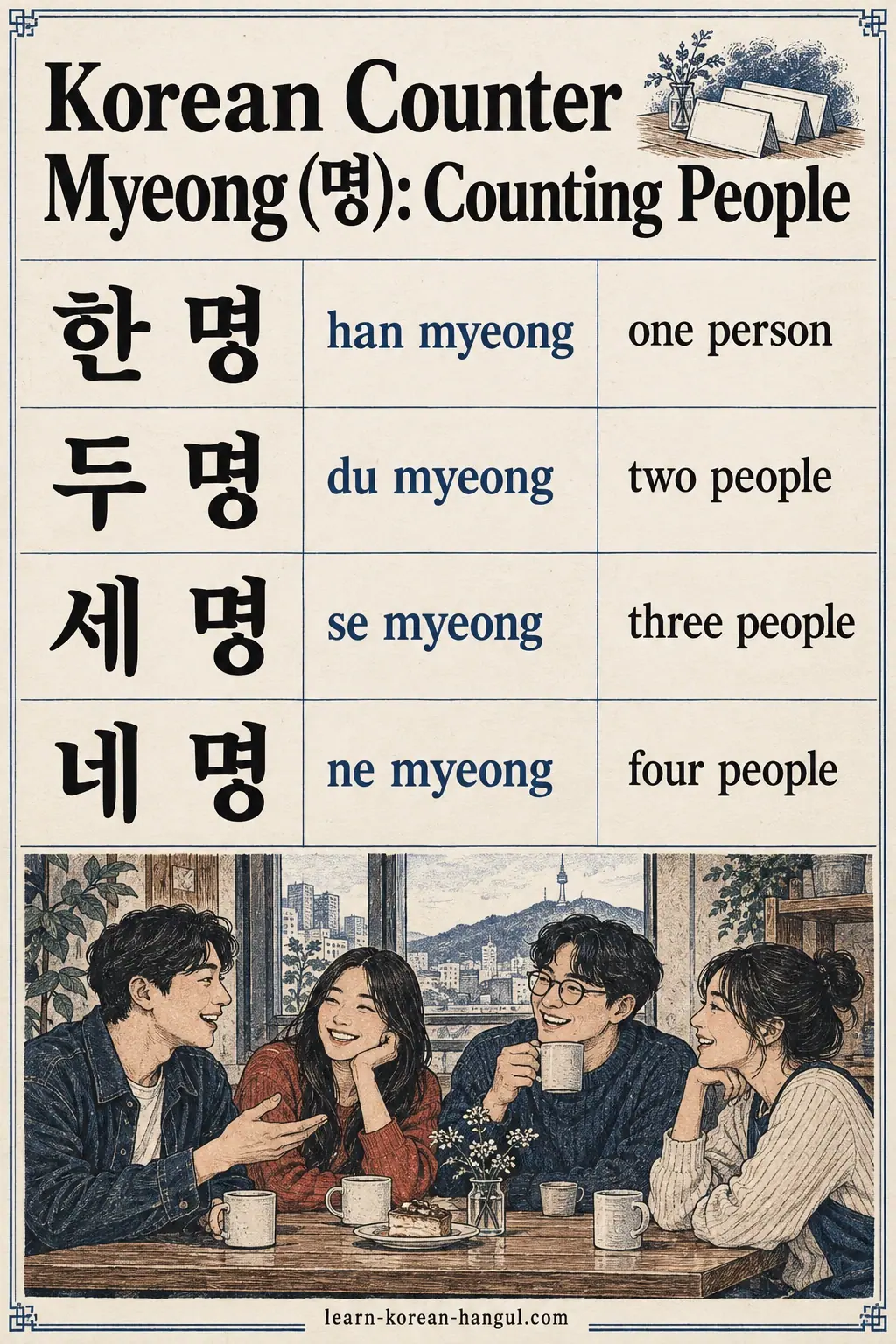
To count people with 명, say a native number and then 명, with a space between them: 한 명, 두 명, 세 명. Five numbers change shape before a counter, so learn the shortened form once and reuse it for every counter in the language.
| Number | Before 명 | Spoken | Revised Romanization | Meaning |
|---|---|---|---|---|
| 1 | 한 명 | [한 명] | han myeong | one person |
| 2 | 두 명 | [두 명] | du myeong | two people |
| 3 | 세 명 | [세 명] | se myeong | three people |
| 4 | 네 명 | [네 명] | ne myeong | four people |
| 5 | 다섯 명 | [다선 명] | daseot myeong | five people |
| 6 | 여섯 명 | [여선 명] | yeoseot myeong | six people |
| 7 | 일곱 명 | [일곰 명] | ilgop myeong | seven people |
| 8 | 여덟 명 | [여덜 명] | yeodeol myeong | eight people |
| 9 | 아홉 명 | [아홈 명] | ahop myeong | nine people |
| 10 | 열 명 | [열 명] | yeol myeong | ten people |
Look at the "Spoken" column for 5 to 9. The final consonant of the number meets the ㅁ of 명, and the sound changes. In 다섯 명 the ㅅ is said as [ㄷ] and then becomes [ㄴ] before ㅁ, so you hear [다선 명]. In 일곱 명 and 아홉 명 the final ㅂ becomes [ㅁ], giving [일곰 명] and [아홈 명]. This is nasalization, a regular rule in the National Institute of Korean Language (국립국어원) standard pronunciation rules (표준 발음법). You do not need to think about it when you speak, because the mouth does it naturally. You only need it to understand why the spoken form differs from the spelling.
Now you have the first ten. The shortened forms deserve their own look.
Which Number Forms Change before 명?
Five numbers shorten before any counter: 하나 becomes 한, 둘 becomes 두, 셋 becomes 세, 넷 becomes 네 and 스물 becomes 스무. These short forms are numeral determiners (수 관형사): they stand in front of the counter the way an adjective stands in front of a noun.
| Full number | Counting form | Example with 명 |
|---|---|---|
| 하나 (1) | 한 | 한 명 |
| 둘 (2) | 두 | 두 명 |
| 셋 (3) | 세 | 세 명 |
| 넷 (4) | 네 | 네 명 |
| 스물 (20) | 스무 | 스무 명 |
Larger numbers keep their full form, but the same shortening applies at the end of any number: 열한 명 (11), 열두 명 (12), 열세 명 (13), 열네 명 (14), 스물한 명 (21), 서른두 명 (32). Tens such as 서른 명 (30), 마흔 명 (40), 쉰 명 (50), 예순 명 (60), 일흔 명 (70), 여든 명 (80) and 아흔 명 (90) stay as they are.
Expert tip: if you only remember one short form, remember 스무. Learners often say 스물 명, which sounds wrong to Korean ears. The same trap appears with 스무 살 (twenty years old), covered on the 살 counter page.
Large Groups: 100 People and Above
Groups of 100 or more use Sino-Korean numbers with 명: 백 명 (100 people), 이백 명 (200), 천 명 (1,000) and 만 명 (10,000). Native numbers stop at 99 in everyday counting, so a stadium crowd is 오만 명, not a native form. In compounds, Korean also uses the Sino counter 인 (人), as in 1인 가구 (a one-person household) and 4인 가족 (a family of four). You will see these on signs and in news, but in speech 명 is far more common.
You can now count any group. Next comes the question that starts the conversation.
How Do You Ask How Many People There Are?

To ask how many people there are, say 몇 명이에요? The word 몇 (myeot) means "how many", so 몇 명 means "how many people". It is pronounced [면 명] because the final ㅊ of 몇 is said as [ㄷ] and then turns into [ㄴ] before ㅁ.
| Situation | Question | Answer |
|---|---|---|
| Asking a friend | 몇 명이에요? | 세 명이에요. |
| Asking about family | 가족이 몇 명이에요? | 가족이 네 명이에요. |
| Class size | 학생이 몇 명 있어요? | 학생이 스무 명 있어요. |
| Host at a restaurant | 몇 분이세요? | 두 명이에요. |
Notice the last row. The host says 분, a respectful counter, but the guest answers with plain 명. A speaker never uses an honorific counter for themselves or for a group that includes themselves, because honorifics raise the other person, not you. This one habit separates a natural answer from a textbook one.
Here is the same idea as a short dialogue at a restaurant door.
- 직원: 어서 오세요. 몇 분이세요?
- 손님: 두 명이에요.
- 직원: 이쪽으로 오세요.
(Staff: Welcome. How many are in your party? Guest: Two of us. Staff: Please come this way.)
Which counter does the staff member use, and why? That is the next question.
When Should You Use 분 Instead?
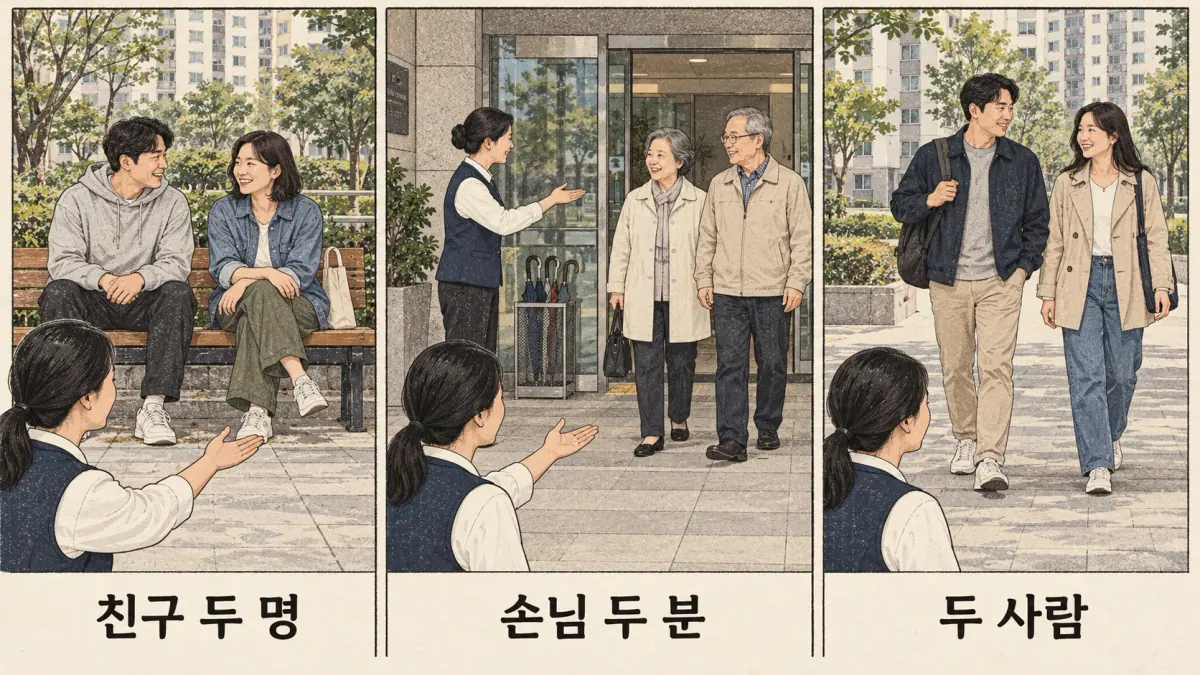
Use 분 when you count or ask about people you want to treat with respect, such as customers, guests, teachers, elders or someone you do not know well. Use 명 for yourself, friends, family members and neutral reporting. A third option, 사람, is the full noun for "person" and also works with numbers.
| Counter | Level | Typical speaker | Example |
|---|---|---|---|
| 명 | neutral | anyone, about anyone | 친구 두 명 |
| 분 | honorific | staff, hosts, announcers about other people | 손님 두 분 |
| 사람 | neutral, noun | anyone | 두 사람 |
Both 명 and 분 take native numbers: 한 분, 두 분, 세 분. The full lesson is on the 분 counter page, and the choice between all three is compared on how to count people in Korean.
A short rule of thumb works well: if you would add 님 or 께서 when naming the person, use 분. If you are talking about yourself or someone close, use 명. When unsure, 명 never offends anyone, although it can sound slightly flat when you address a customer.
With the counter chosen, the next step is fitting the counted phrase into a full sentence.
Sentence Patterns with 명

A counted phrase fits into a sentence in two ways: the number and counter can follow the noun directly, or the whole phrase can take its own particle. The four patterns below cover most daily use. In each, the verb stays the same whatever the number.
| Pattern | Example | Meaning |
|---|---|---|
| noun + 이/가 + number + 명 + 있어요 | 학생이 세 명 있어요. | There are three students. |
| noun + number + 명 + 이/가 + verb | 친구 두 명이 왔어요. | Two friends came. |
| noun + 은/는 + number + 명 + 이에요 | 우리 가족은 네 명이에요. | Our family is four people. |
| number + 명 + 예약했어요 | 네 명 예약했어요. | I booked for four. |
Two small details matter here. First, 이에요 attaches directly to 명 when the counted phrase ends the sentence, so you say 네 명이에요 (it is four people). Second, the verb 있어요 means "exist" or "have", and it is the standard verb for "there are". When people arrive or leave, switch to 왔어요 (came) or 갔어요 (went).
You can also add 모두 (everyone, in total) to make a total: 모두 열 명이에요 means "ten people in all". This is a handy phrase when a teacher counts a class.
Daily-Life Phrases with 명

The counter 명 appears in a few predictable places, and each one teaches a different kind of sentence. Knowing the scene tells you which verb and which politeness level to expect.
| Scene | Typical phrase | Meaning |
|---|---|---|
| Restaurant reservation | 여섯 명 자리 있어요? | Is there a table for six? |
| Taxi | 네 명 탈 수 있어요? | Can four people ride? |
| Classroom | 우리 반은 스무 명이에요. | Our class is twenty people. |
| Family | 형제가 세 명이에요. | I have three siblings. |
| Hotel or room booking | 두 명이 묵을 거예요. | Two people will stay. |
| Event signup | 열 명 신청했어요. | Ten people applied. |
In a restaurant you will hear the staff use 분 and answer with 명. In a taxi, a hotel or an office, the same split applies. You, the customer, say 명, and the employee uses 분 about you. For the full ordering scripts, see Korean restaurant phrases.
Misconceptions about 명
Learners often hold three false beliefs about the counter 명. Each one is easy to fix once you see the reason, and each one is worth fixing early because it spreads to other counters.
"명 is the Sino-Korean counter, so it takes Sino-Korean numbers." The word 명 does come from a Chinese character, but counters are not required to match their number system. Korean counters for everyday items mostly take native numbers whatever their origin. Think of the pairing as a habit, not a rule of etymology. A few exceptions exist, such as 원 for money and 층 for floors, and they take Sino-Korean numbers.
"Using 분 is always more polite, so I should use it for everyone." Using 분 about yourself or your friends sounds strange, and it can even sound arrogant. 분 raises the person you speak about. It is not a general politeness button, so use it only for guests, elders and customers.
"Counting people is the same as saying the number." In Korean, 둘 alone means "two (things)", but 두 명 means "two people". Without the counter, the sentence is vague. In casual speech Koreans sometimes say 둘이 (two of us), but that is a separate pattern: the bare number 둘 takes the particle 이, and no counter is used.
These misconceptions disappear with a few repetitions. The common mistakes below show the same ideas in short form.
Common Mistakes and Fixes
Most errors with 명 come from carrying habits over from English or mixing the two number systems. Check your sentence against this list.
- Using Sino-Korean numbers. Wrong: 이 명, 삼 명. Right: 두 명, 세 명. 명 takes native numbers up to 99.
- Using the full number form. Wrong: 하나 명, 둘 명, 셋 명, 스물 명. Right: 한 명, 두 명, 세 명, 스무 명.
- Using 명 for animals. Wrong: 고양이 두 명. Right: 고양이 두 마리, taught on the 마리 counter page.
- Calling yourself 분. Wrong: 저희는 두 분이에요 when speaking about your own group. Right: 저희는 두 명이에요.
- Dropping the counter. In Korean you normally need 명: 학생 세 is incomplete. Say 학생 세 명.
There is also a spacing point. Korean spelling rules (한글 맞춤법 제43항) write a counter separately from a number written in Hangul: 세 명. When you write the number with Arabic digits, the counter is usually attached: 3명. The rule allows this, so both forms are correct; the difference is only the number format.
Limitation: this lesson teaches the standard classroom pattern. Real speech sometimes drops 명 when the context is clear, for example 둘이 왔어요 (two came), where 둘 stands alone with the particle 이. That is a different pattern and is not a mistake, but you should master the full pattern first.
Use the next section to test yourself.
Practice Set
Answer each item before you read the answer line.
- Say "five students" in Korean.
- Say "twenty people" in Korean.
- Ask a friend how many people are coming.
- A host asks 몇 분이세요? Answer for a group of three.
- Correct the mistake: 친구 이 명.
- Which is wrong, and why: 가족이 네 명이에요 or 가족이 사 명이에요?
Answers:
- 학생 다섯 명 (haksaeng daseot myeong).
- 스무 명 (seumu myeong), not 스물 명.
- 몇 명 와요? (myeot myeong wayo?), literally "How many people are coming?"
- 세 명이에요. Use 명, not 분, for your own group.
- 친구 두 명. Replace the Sino-Korean 이 with the native 두.
- 가족이 사 명이에요 is wrong. 명 needs the native form 네, not Sino-Korean 사.
If you got four or more, you are ready to move on.
What to Learn Next
You now know how to use the Korean counter myeong for people: native number, then 명, with 분 reserved for respect. Move on in this order:
- The 분 counter for the respectful form you heard from the restaurant host.
- The 마리 counter for animals, because 명 is for humans only.
- Native Korean numbers 1-10 if the forms in the table still feel unsteady.
- Counting People and Animals for the full set of people and animal counters.
Frequently Asked Questions
Can 명 be used for babies?
Yes. 명 counts every human being, including babies and children: 아기 한 명 means one baby. Nothing about age changes the counter. If you want to show respect to an adult, you switch to 분. For a baby or a child, 명 is the normal and polite choice, and 분 would sound odd.
What is the difference between 명 and 사람?
사람 means person and can be counted directly, as in 두 사람. 명 is a counter that needs a number before it, as in 두 명. Both mean two people. 명 is shorter and more common in counting, and 사람 sounds a little more descriptive, as in 한 사람 한 사람, meaning each person one by one.
How do I ask how many people in a restaurant?
A staff member asks 몇 분이세요? using the honorific 분. You answer with 명, never 분: 두 명이에요 means there are two of us. If you are the one asking a friend, say 몇 명이에요? Use 몇 분이세요? only when you speak to a customer, guest or elder.
Do I add 이 or 가 after 명?
Only when the counted phrase is the subject. In 학생이 세 명 있어요, the subject marker 이 sits on 학생, not on 명. You can also put it at the end, as in 학생 세 명이 있어요. Both are correct. Never put 이 or 가 between the number and 명.