
Korean Counters: the Essentials
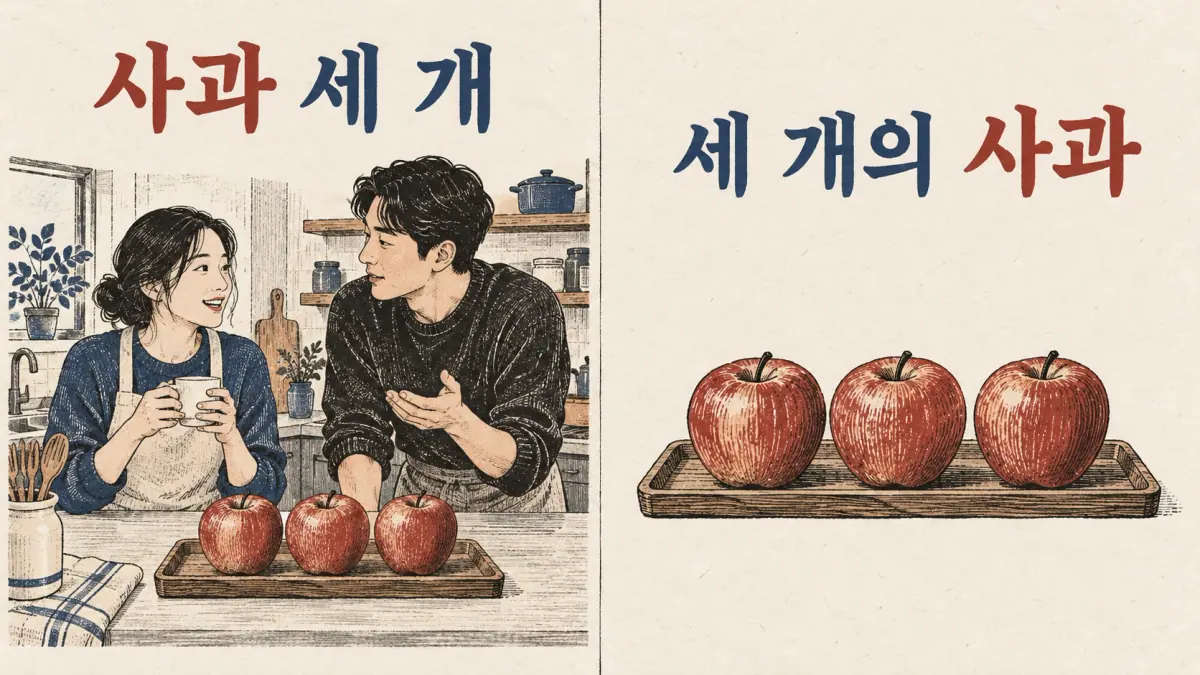
A Korean counter is a unit noun, usually a bound noun (의존 명사), that follows a number and names the unit or category of what you count. Korean nouns rarely carry a plural ending (the optional 들 is usually left off after a number), so the counter tells the listener what the number refers to. English has a few counters too, such as "two sheets of paper" or "three pairs of shoes". Korean uses one almost every time.
The standard pattern is noun + number + counter. A second pattern, number + counter + 의 + noun, appears in writing.
| Pattern | Example | Meaning | Where used |
|---|---|---|---|
| noun + number + counter | 사과 세 개 | three apples | speech and everyday writing |
| number + counter + 의 + noun | 세 개의 사과 | three apples | formal writing |
Write the number and the counter with a space between them, as in 세 개. The spelling rules (한글 맞춤법 제43항) of the National Institute of Korean Language (국립국어원) treat the counter as a separate word. With Arabic digits, the counter may be written attached: 3개.
Once you know the pattern, the real question is which counter fits which thing.
Which Counter Do You Use for What?
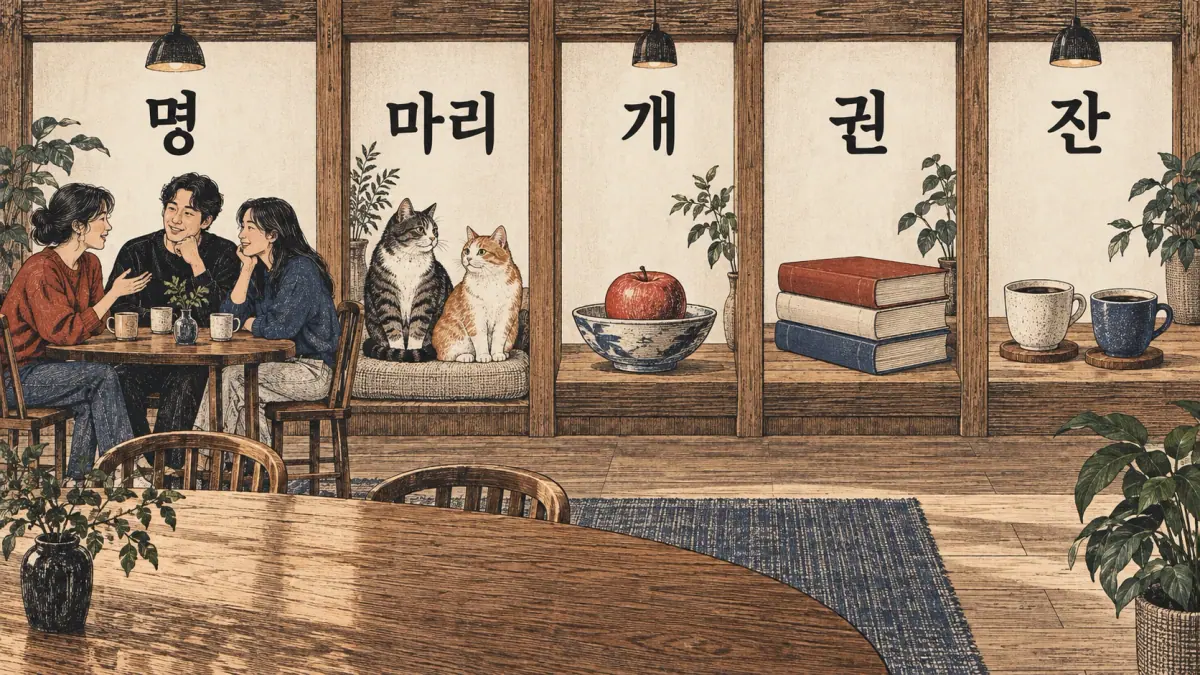
Choose the counter by the kind of thing you count. The table gives a starting set for the objects you meet most often.
| You are counting | Counter | Example | Meaning |
|---|---|---|---|
| People | 명 | 학생 세 명 | three students |
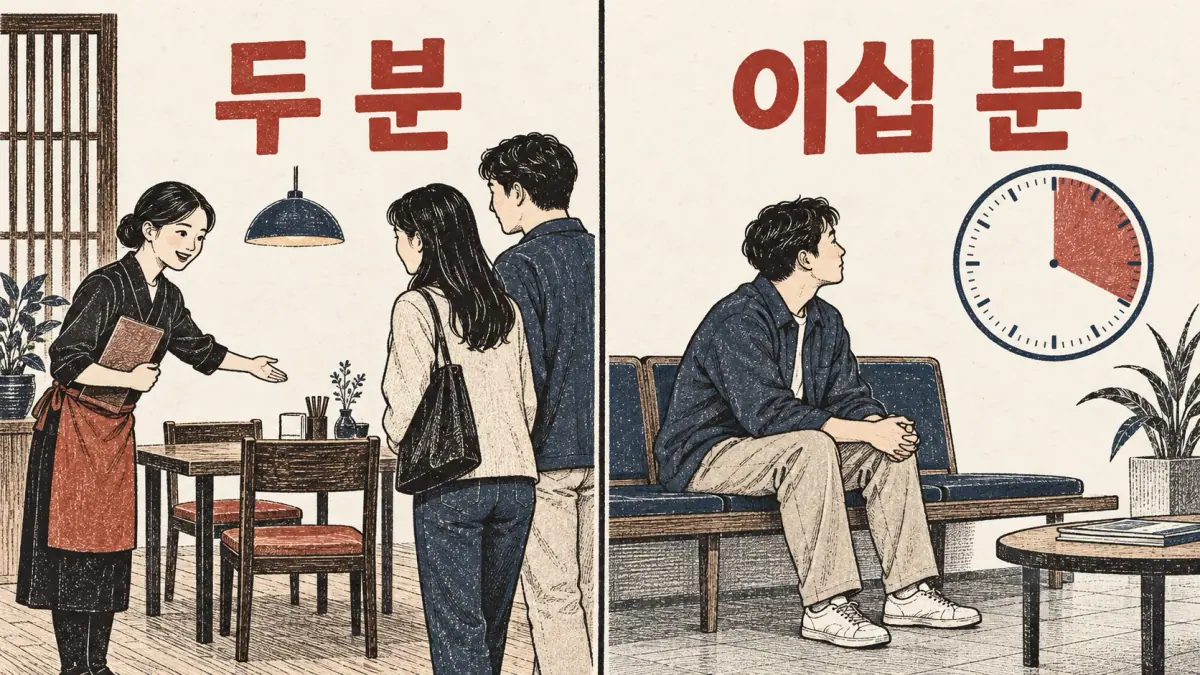
| Respected people | 분 | 손님 두 분 | two guests |
| Animals | 마리 | 고양이 두 마리 | two cats |
| Small objects | 개 | 사과 한 개 | one apple |
| Books | 권 | 책 세 권 | three books |
| Paper, tickets | 장 | 표 두 장 | two tickets |
| Cars, machines | 대 | 차 한 대 | one car |
| Cups | 잔 | 커피 두 잔 | two cups of coffee |
| Bottles | 병 | 맥주 한 병 | one bottle of beer |
| Floors | 층 | 삼 층 | the third floor |
| Occasions | 번 | 두 번 | twice |
The default is 개. If you do not know the counter, say 개 for any small, countable object. It does not work for people or animals, which always need their own counters.
Which Number System Goes with Which Counter?
Most everyday counters take native Korean numbers, and a small set takes Sino-Korean numbers. The split is the most useful rule in this section.
| Number system | Counters | Examples |
|---|---|---|
| Native (하나, 둘, 셋) | 개, 명, 분 (person), 마리, 권, 장, 대, 잔, 병, 그릇, 살, 번 (times) | 세 개, 두 명, 한 마리 |
| Sino-Korean (일, 이, 삼) | 층, 원, 분 (minute), 인분, 번 (order number) | 삼 층, 오백 원, 이 인분 |
Two counters sit in both rows. The counter 분 means "person" in the honorific sense with native numbers (두 분) and "minute" with Sino-Korean numbers (이십 분). The counter 번 means "times" with native numbers (두 번, twice) and "number" with Sino-Korean ones (삼 번, number three). The meaning of the word decides the number system, not the sound.
From 100 on, all counters switch to Sino-Korean numbers: 백 개, 백 명. The next section lists the lessons that teach each counter.
The Counter Pages, Grouped
Seven pages sit under this hub: five groups of counters, a lesson on the rules and a one-page chart. Open the group that matches what you want to count.
People and Animals
Counting People and Animals teaches 명, 분 and 마리. It explains why a restaurant host asks 몇 분이세요? and the guest answers 두 명이에요, and how pets, fish and insects are counted. Start here if you want to talk about family, friends or pets.
Things
Counting Things teaches 개, 권, 장, 대, 벌 and 켤레. It covers the fallback rule for 개 and the shape logic that makes each specific counter easier to remember.
Food and Drinks
Counting Food and Drinks teaches 잔, 병, 그릇 and 인분. It is the best group for travellers, because it covers ordering in cafés and restaurants.
Time Spans
Time Counters teaches the counters for hours, days, weeks, months and years, such as 시간, 일, 주, 개월 and 년. Read it when you need to say how long something takes.
Floors and Times
Counting Times and Floors teaches 번 for occasions and 층 for floors of a building. It is short, practical and useful in elevators, buses and appointments.
Rules and Reference
The lesson on how Korean counters work covers word order, number choice and spacing in depth. The Korean counters chart puts the whole system on one page by object, number system and example, and the Korean counters flashcards deck helps you review. Two lessons are good first stops: the 개 counter and the 명 counter.
How Do You Ask How Many with 몇?

To ask how many, put the question word 몇 before the counter: 몇 개, 몇 명, 몇 마리. The counter you pick in the question is the counter you hear in the answer, so the question also tells you which unit to use.
| Counting | Question | Sample answer |
|---|---|---|
| Items | 몇 개예요? | 세 개예요. |
| People | 몇 명이에요? | 두 명이에요. |
| Animals | 몇 마리예요? | 한 마리예요. |
| Books | 몇 권이에요? | 네 권이에요. |
| Floors | 몇 층이에요? | 오 층이에요. |
The answer in the last row uses a Sino-Korean number because 층 takes that system. Listen for that switch, and you will rarely pick the wrong number set.
What Is Not Covered Here?
This section covers counters, not the numbers themselves, and not every unit word. Numbers are taught in Korean Numbers, ages with 살 and 세 are in Age in Korean, and money with 원 is in Money and Prices. Ordinal forms such as 첫째 and 두 번째 belong to Ordinal Numbers.
Where Should You Start?

Start with the lesson that matches your next conversation. These four situations cover most learners:
- Meeting people: begin with the 명 counter, then 살 for age.
- Ordering food: begin with 잔 and 병 in food and drinks.
- Shopping: begin with 개, then 권, 장 and 대.
- Planning your day: begin with time counters and 번.
If you are unsure, read how Korean counters work first, then learn the 개 counter. Mastering Korean counters takes repetition, so use the chart and the flashcards to review.
Frequently Asked Questions
Why does Korean need counters?
Korean usually adds no plural ending to a counted noun, so a number alone does not say what is being counted. The counter fills that gap: 세 개 means three items, 세 명 three people, 세 마리 three animals. The counter works like English words in 'three pieces of paper' or 'three head of cattle'.
What is the most common Korean counter?
개 is the most common. It counts most small objects: 사과 한 개, 의자 두 개. Next come 명 for people, 마리 for animals and 살 for age. If you forget a more specific counter, 개 is the safe fallback for objects, though it does not work for people or animals.
How many counters are there?
The standard dictionary lists far more counters than a learner needs. About a dozen cover most daily situations: 개, 명, 마리, 권, 잔, 병, 장, 대, 살, 번, 층 and 원. Learn these first, then add others such as 켤레, 벌 and 그릇 as you meet them in real situations.
Do I have to use a counter every time?
Not always. When the context is clear, Koreans may say the bare number: 사과 하나 주세요, with the standalone 하나 and no counter. But when you attach a number to a noun, as in 사과 세 개, the counter is normal. Use the counter in writing, in tests and with unfamiliar objects.
Which counters are on TOPIK I?
Counters are part of beginner vocabulary, and TOPIK I study lists usually include 개, 명, 마리, 권, 병, 잔, 장, 대, 살, 번, 층 and 원. Check the exam organizer's current word list, because lists change. These are also the counters that appear most in daily life, so they are a good place to start.