What you'll learn
- Say the four operations with 더하기, 빼기, 곱하기 and 나누기.
- Read eight sums aloud, including one with a remainder.
- Name the results: 합, 차, 곱, 몫 and 나머지.
- Recognise 20 core math terms and a dozen geometry and algebra words.
- Use classroom phrases such as 계산해 보세요 and 정답은 ...입니다.
- Prerequisites: Sino-Korean numbers 1-100. Estimated time: 25 minutes.
What Are the Korean Math Terms for the Four Operations?
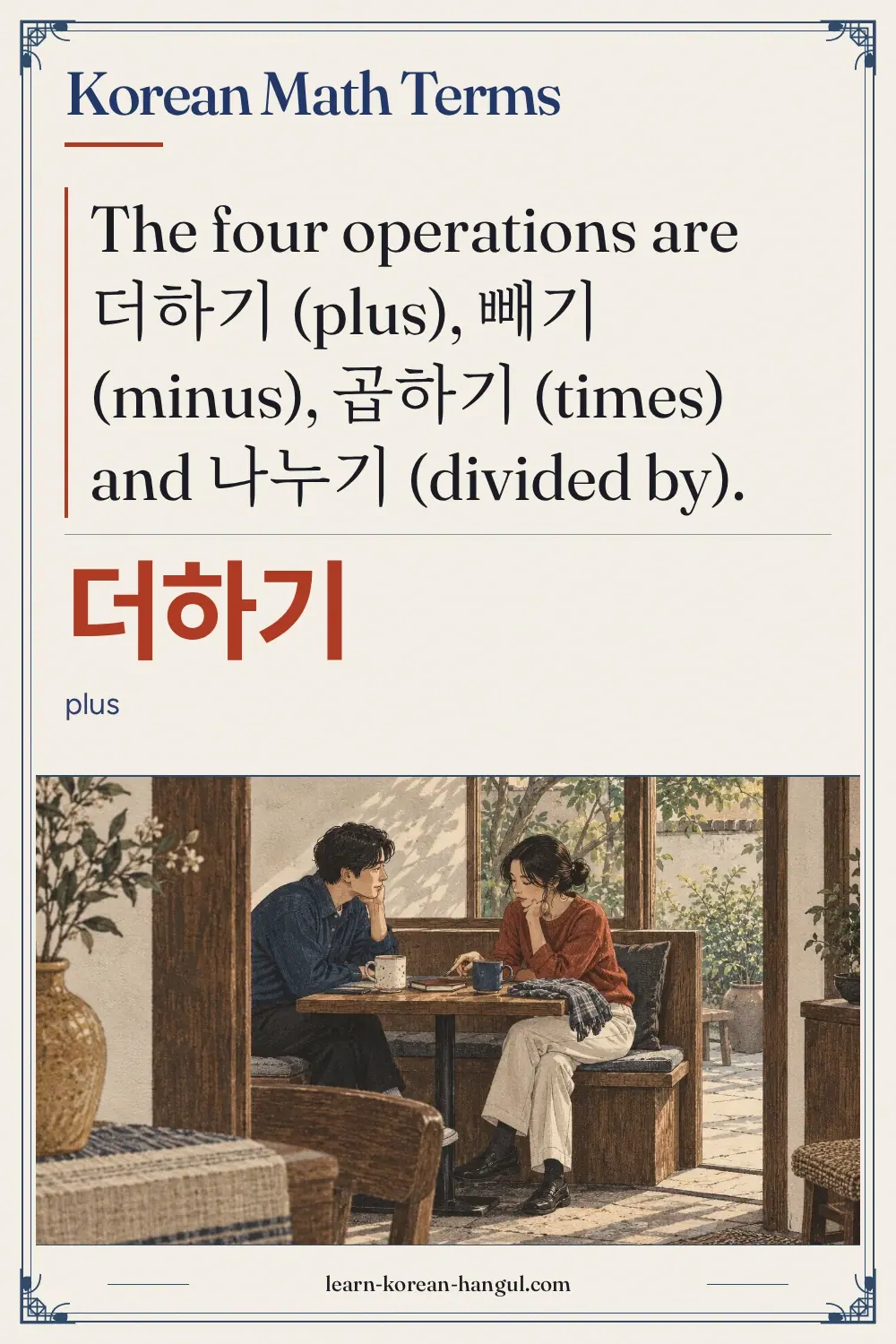
The four Korean math terms for operations are 더하기 (plus), 빼기 (minus), 곱하기 (times) and 나누기 (divided by). Each one comes from a verb: 더하다 (to add), 빼다 (to subtract), 곱하다 (to multiply) and 나누다 (to divide). Adding -기 turns a verb into a noun, which is why the operation words end in 기. Together the four are called 사칙연산, "the four rules of calculation".
| Operation | Symbol | Spoken word | From the verb | Operation as a school topic |
|---|---|---|---|---|
| plus | + | 더하기 | 더하다 | 덧셈 |
| minus | − | 빼기 | 빼다 | 뺄셈 |
| times | × | 곱하기 | 곱하다 | 곱셈 |
| divided by | ÷ | 나누기 | 나누다 | 나눗셈 |
| equals | = | 은/는, 같다 | 같다 | 등호 (the sign) |
Two words need a pronunciation note. 곱하기 is said [고파기], because the final ㅂ of 곱 and the ㅎ of 하 merge into an aspirated [ㅍ], following the 국립국어원 standard pronunciation rules on aspiration. The spelling does not change. And 같다 is said [갇따]: the final ㅌ is pronounced as [ㄷ], and the ㄷ after it turns tense.
The operation word sits between two numbers, so the pattern is "number + word + number". A noun like 덧셈 names the topic ("addition"), while 더하기 appears inside a sentence that reads a sum aloud.
How Do You Read a Sum Aloud?
To read a sum aloud, say the first number, the operation word, the second number with 은 or 는, and then the result. The particle 은 follows a number ending in a consonant, and 는 follows a number ending in a vowel. The result needs no ending in a spoken sum.
| Sum | Spoken form | Operation |
|---|---|---|
| 5 + 3 = 8 | 오 더하기 삼은 팔 | plus |
| 12 + 9 = 21 | 십이 더하기 구는 이십일 | plus |
| 9 − 4 = 5 | 구 빼기 사는 오 | minus |
| 30 − 12 = 18 | 삼십 빼기 십이는 십팔 | minus |
| 6 × 7 = 42 | 육 곱하기 칠은 사십이 | times |
| 4 × 25 = 100 | 사 곱하기 이십오는 백 | times |
| 12 ÷ 4 = 3 | 십이 나누기 사는 삼 | divided by |
| 17 ÷ 5 = 3 R 2 | 십칠 나누기 오는 삼, 나머지는 이 | divided by, with a remainder |
Check the particle each time. In 오 더하기 삼은 팔, the second number 삼 ends in the consonant ㅁ, so it takes 은. In 구 빼기 사는 오, the number 사 ends in a vowel, so it takes 는. In 육 곱하기 칠은 사십이, 칠 ends in ㄹ, so 은. When the second number is a longer number such as 이십오, the last syllable decides: 오 is a vowel, so 는, as in 사 곱하기 이십오는 백.
A question about a sum uses 얼마 ("how much"): 이 더하기 삼은 얼마예요? ("What is two plus three?"). The answer repeats the pattern: 이 더하기 삼은 오예요. After a vowel, the polite ending is 예요, so 오예요; after a consonant, it is 이에요, so 팔이에요.
The numbers themselves are drilled in Sino-Korean numbers 1-100, and larger values such as 천 and 만 are in large Korean numbers. The next question is what to call the answers.
How Do You Say the Results: Sum, Difference, Product, Quotient?
Korean has a name for each result of a calculation: 합 (sum), 차 (difference), 곱 (product), 몫 (quotient) and 나머지 (remainder). They are used when talking about the answer rather than reading the sum. 합 is the result of adding, 차 the result of subtracting, 곱 the result of multiplying, and 몫 and 나머지 the two results of dividing.
| Word | Meaning | Example |
|---|---|---|
| 합 | sum | 오와 삼의 합은 팔이에요. The sum of 5 and 3 is 8. |
| 차 | difference | 구와 사의 차는 오예요. The difference of 9 and 4 is 5. |
| 곱 | product | 육과 칠의 곱은 사십이에요. The product of 6 and 7 is 42. |
| 몫 | quotient | 십이 나누기 사의 몫은 삼이에요. The quotient is 3. |
| 나머지 | remainder | 나머지는 이예요. The remainder is 2. |
The pattern "A와/과 B의 합" means "the sum of A and B": 와 follows a vowel and 과 follows a consonant, and 의 links the pair to the result. Watch the pronunciation of 몫: it is said [목], and when the particle 이 follows, 몫이 sounds like [목씨]. The ㅅ of the final cluster ㄱㅅ shows up only before a vowel. Every learner meets this in the first 몫 problem.
A division sentence usually states both results: 몫은 삼이고 나머지는 이예요 ("the quotient is 3 and the remainder is 2"). With the vocabulary for operations and results in place, the next layer is the set of core terms that appear in every textbook.
What Other Core Terms Do You Need?
Twenty core terms cover most of a beginner math lesson. They name kinds of numbers, results, and common operations such as squaring. Learn them as whole words, with the example sentence for each.
| # | Term | Meaning | Example |
|---|---|---|---|
| 1 | 수 | number | 수를 세요. Count the numbers. |
| 2 | 숫자 | digit, numeral | 숫자 일곱 개 seven digits |
| 3 | 정수 | integer | 일, 이, 삼은 정수예요. |
| 4 | 분수 | fraction | 삼 분의 일은 분수예요. |
| 5 | 소수 | decimal | 영 점 오는 소수예요. |
| 6 | 짝수 | even number | 이, 사, 육은 짝수예요. |
| 7 | 홀수 | odd number | 일, 삼, 오는 홀수예요. |
| 8 | 양수 | positive number | 오는 양수예요. |
| 9 | 음수 | negative number | 마이너스 오는 음수예요. |
| 10 | 합 | sum | 합을 구하세요. |
| 11 | 차 | difference | 차를 구하세요. |
| 12 | 곱 | product | 곱을 구하세요. |
| 13 | 몫 | quotient | 몫을 구하세요. |
| 14 | 나머지 | remainder | 나머지를 구하세요. |
| 15 | 제곱 | square (power of 2) | 이의 제곱은 사예요. |
| 16 | 제곱근 | square root | 구의 제곱근은 삼이에요. |
| 17 | 평균 | average | 평균을 구하세요. |
| 18 | 약수 | divisor | 육의 약수는 일, 이, 삼, 육이에요. |
| 19 | 배수 | multiple | 이의 배수는 이, 사, 육, 팔 등이에요. |
| 20 | 답 | answer | 답은 오예요. |
Two terms deserve a warning. 소수 means "decimal" (小數) in this table, but 소수 (素數) also means "prime number", and the two words sound identical. Context decides: 소수점 is "decimal point", while 소수는 이, 삼, 오... refers to primes. Context almost never leaves doubt, but the homophone surprises learners. The second warning is 곱: as a noun it means "product" in math, while 곱하기 is the operation word. Say 곱을 구하세요 ("find the product") and 곱하기를 하세요 ("multiply").
The verb 구하다, which appears in four rows of the table, means "to find, to work out" and is the standard verb for asking someone to compute a result. Its polite command is 구하세요.
How Do You Say Geometry and Algebra Words?
Geometry and algebra add a second layer of vocabulary: the names of shapes, the measurements and the letters used in equations. Most are Sino-Korean words, so they share the same reading as the numbers. The table gives starter words for each area.
| Area | Word | Meaning |
|---|---|---|
| shapes | 삼각형 | triangle |
| shapes | 사각형 | quadrilateral, square-like shape |
| shapes | 정사각형 | square |
| shapes | 직사각형 | rectangle |
| shapes | 원 | circle |
| measures | 각도 | angle (size) |
| measures | 직각 | right angle |
| measures | 둘레 | perimeter |
| measures | 넓이 | area |
| measures | 부피 | volume |
| algebra | 변수 | variable |
| algebra | 방정식 | equation |
In algebra, letters are read by their English names: x is 엑스 and y is 와이. An equation such as x + 2 = 5 is read 엑스 더하기 이는 오, with the same operation words as arithmetic. The verb for solving is 풀다: 방정식을 풀어 보세요 means "Please solve the equation". The geometry words follow the numbers: 삼각형 means "three-angle shape", and 사각형 means "four-angle shape", so the number in the name is the Sino-Korean 삼 or 사. Learners find the shapes easy to remember once they notice this pattern.
Shapes and equations raise the next question of style: whether to say 더하기 or the English-based 플러스.
Which Style Do You Use, 더하기 or 플러스?
Use 더하기 and 빼기 for arithmetic, and use the loanwords 플러스 and 마이너스 for signs, positive and negative values and some fixed expressions. Both are normal Korean, and the choice depends on the setting. School practice favours 더하기, but 플러스 is also heard in everyday speech.
| Setting | 더하기 / 빼기 | 플러스 / 마이너스 |
|---|---|---|
| reading a sum in class | 이 더하기 삼은 오 | possible, less standard |
| the + and − signs | 더하기 기호 | 플러스 기호 |
| a negative value | 음수 | 마이너스 오 |
| a temperature below zero | 영하 | 마이너스 (informal) |
| "a bonus, extra" | not used | 플러스 알파 |
| a bank balance | not used | 마이너스 통장 (overdraft account) |
The loanwords come from English "plus" and "minus", and they fit best where Korean needs a short sign word. The native-based forms 더하기 and 빼기 fit where a verb is understood: you are doing the adding. A good rule is to use 더하기 whenever you could say "add" in English, and 플러스 whenever you could say "plus" or "positive".
Expert insight: in a spoken sum, learners can safely stay with 더하기, 빼기, 곱하기 and 나누기. They cover all four operations in the same style, and a teacher or examiner will recognise them at once. The loanwords matter more when you read signs, bank balances and weather forecasts.
What Classroom Phrases Are Useful?
Classroom math runs on a few repeated phrases, and they are worth learning as chunks. A teacher gives instructions, a student answers, and both check the result. The phrases below appear in textbooks and in everyday homework help.
| Korean | Meaning | When |
|---|---|---|
| 계산해 보세요. | Please calculate. | teacher's instruction |
| 문제를 푸세요. | Please solve the problem. | teacher's instruction |
| 정답은 오입니다. | The correct answer is five. | giving the answer |
| 답은 오예요. | The answer is five. | everyday |
| 맞아요. | That is right. | checking |
| 틀렸어요. | That is wrong. | checking |
| 다시 해 보세요. | Please try again. | after a mistake |
| 어떻게 풀었어요? | How did you solve it? | asking for method |
The ending -아/어 보세요 means "please try doing", and it makes an instruction gentle: 계산해 보세요 is "try calculating". The formal 입니다 in 정답은 오입니다 is how answers are announced in textbooks and exams, and 예요 is its everyday cousin. A short exchange shows the pattern:
이 더하기 삼은 얼마예요?
What is two plus three?
이 더하기 삼은 오예요.
Two plus three is five.
맞아요. 그럼 삼 곱하기 이는요?
Right. Then what is three times two?
삼 곱하기 이는 육이에요.
Three times two is six.
Worked Example: a Shopping Receipt
A learner checks a restaurant bill and reads the sums aloud in three sentences.
- 김밥 이천 원 더하기 라면 사천 원은 육천 원이에요. "Gimbap 2,000 won plus ramen 4,000 won is 6,000 won."
- 만 원 빼기 육천 원은 사천 원이에요. "10,000 won minus 6,000 won is 4,000 won, the change."
- 이천 원 곱하기 삼은 육천 원이에요. "2,000 won times 3 is 6,000 won."
The checkpoint: every number is Sino-Korean, the operation word sits between the numbers, and the particle 은 or 는 sits on the second number. The currency word 원 can follow any of them. If a particle felt unclear, the mistakes below show the usual slips.
Common Mistakes and Fixes
- 오 더하기 삼이 팔 → 오 더하기 삼은 팔. A sum uses the topic particle, not 이.
- 삼는 → 삼은. 삼 ends in ㅁ, so it takes 은.
- 오 더하기 세 → 오 더하기 삼. Math uses Sino-Korean numbers, not 세.
- 곱하기 as [곱하기] → [고파기]. The ㅂ and ㅎ merge into [ㅍ].
- 몫이 said as [모기] → [목씨]. Before a vowel, the ㅅ of the final cluster carries over and is said tense.
- 십칠 나누기 오는 삼 (and nothing more) → add 나머지는 이. When a division leaves something over, state the remainder too.
Learners often assume that Korean needs a word for "equals" in every sum. Actually the particle 은 or 는 does that job in speech, and 같다 is used only in writing or in definitions. The practice set below checks the points above.
Practice Set
Say each answer aloud, then check below.
- Read 4 + 6 = 10.
- Read 8 − 3 = 5.
- Read 3 × 9 = 27.
- Read 20 ÷ 4 = 5.
- "the remainder"
- "square root"
- Fix the error: 칠 더하기 이가 구
Practice · 8
How do you read 5 + 3 = 8?
Show answer
오 더하기 삼은 팔
The second number takes the topic particle, and 삼 ends in a consonant, so it takes 은.
How do you read 6 × 7 = 42?
Show answer
육 곱하기 칠은 사십이
곱하기 means times, and 칠 ends in ㄹ, so it takes 은.
How do you read 12 ÷ 4 = 3?
Show answer
십이 나누기 사는 삼
나누기 means divided by, and 사 ends in a vowel, so it takes 는.
Which word means "remainder"?
Show answer
나머지
나머지 is the remainder. 몫 is the quotient and 차 is the difference.
Which word means "square root"?
Show answer
제곱근
제곱근 is the square root. 제곱 is the square and 약수 is a divisor.
How is 곱하기 pronounced?
Show answer
[고파기]
The final ㅂ and the ㅎ merge into an aspirated [ㅍ].
What does 짝수 mean?
Show answer
even number
짝수 is an even number. 홀수 is odd and 음수 is negative.
How do you say the negative number −3?
Show answer
마이너스 삼
Put 마이너스 before the number for a negative value.
Answers: 1. 사 더하기 육은 십. 2. 팔 빼기 삼은 오. 3. 삼 곱하기 구는 이십칠. 4. 이십 나누기 사는 오. 5. 나머지. 6. 제곱근. 7. 칠 더하기 이는 구.
If item 7 tripped you, return to the particle rule: the second number takes 은 or 는, not 이 or 가, and 이 (two) ends in a vowel, so it takes 는.
What This Lesson Does Not Cover
This lesson covers the operation words, result words and starter vocabulary for arithmetic, geometry and algebra. It does not cover fractions, decimals or percentages, which have their own pages, and it does not teach advanced topics such as calculus or statistics. The 플러스 and 더하기 guidance describes common school and everyday usage, and teachers differ in how strictly they require one style.
What to Learn Next
Continue with Korean fractions to read 삼 분의 일 and 삼 점 일 사, then Korean percentages for discounts and rates. For subject names such as 수학, see school subjects in Korean, and for the number series itself, see Sino-Korean numbers 1-100. The Math in Korean hub lists all three pages. With the Korean math terms above, you can read and say any basic sum.
Frequently Asked Questions
How do I say "equals" in Korean? In a spoken sum, "equals" is the particle 은 or 는 after the second number: 이 더하기 삼은 오. In writing, use 같다 ("is equal to"), as in 이 더하기 삼은 오와 같다. The equals sign itself is called 등호. The particle is a plain topic marker, so it stays unstressed in speech.
What is 나머지? 나머지 means "the remainder", the amount left over after a division. In 십칠 나누기 오는 삼, 나머지는 이, the quotient (몫) is 삼 and the remainder is 이. The same word also means "the rest" in daily speech, as in 나머지는 내일 해요 ("I will do the rest tomorrow"). The pronunciation is [나머지].
Do students say 플러스 in Korean? Yes, but in a narrower set of settings. In arithmetic, students and teachers say 더하기 and 빼기. The loanwords 플러스 and 마이너스 are used for the signs + and −, for positive and negative values, and in expressions such as 플러스 알파 ("an extra something"). Both styles are normal Korean.
How do I say a negative number in Korean? Put 마이너스 before the number: −3 is 마이너스 삼. The formal term for a negative number is 음수. For temperatures below zero, use 영하, as in 영하 삼 도 ("three degrees below zero"). Positive numbers use 양수, or the plain number.