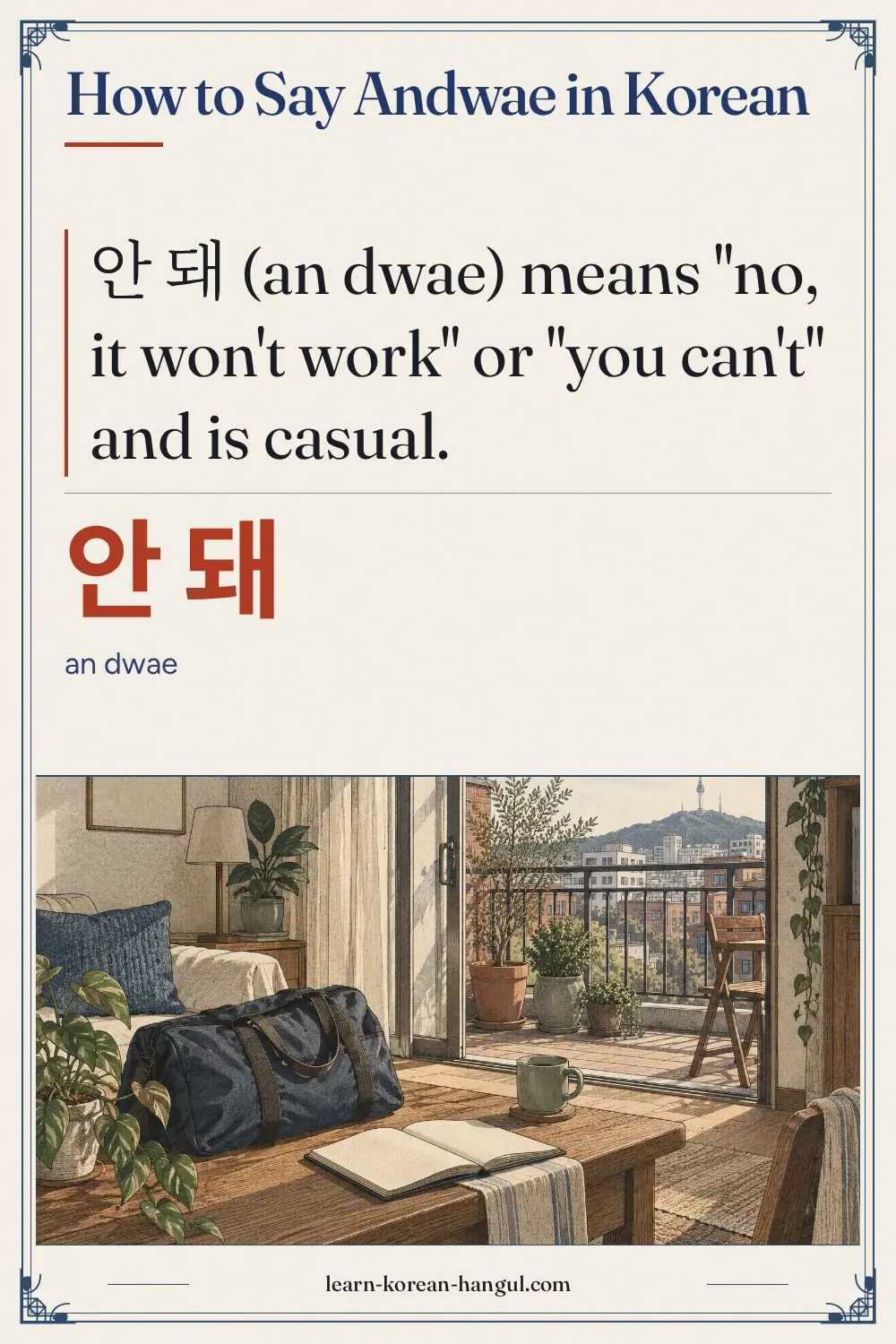
안 돼
안 돼
What you'll learn
- Say 안 돼 aloud and tell 돼 from 되 in writing.
- Choose between 안 돼, 안 돼요 and 안 됩니다 for a friend, an older person and a staff member.
- Build "you must not" with -(으)면 안 돼요.
- Avoid the spelling mistakes 안되요 and 안 되요.
Before you start: you need to read Hangul; romanization is shown as an aid and can be hidden. Time: about 10 minutes. Audio plays only when you press a button.
Key facts
- 하면 안 돼요 (hamyeon an dwaeyo) means "you must not do it", and it is the form used for rules.
- 안 돼요 is also the standard answer to the question ...어도 돼요? ("may I ...?").
How Do You Say Andwae in Korean?
Andwae in Korean is 안 돼. It combines 안 (not) with 돼, the casual form of the verb 되다 (to become, to be all right, to work). So the phrase literally says "it does not work" or "it is not all right", and in practice it means "no", "you can't" or "don't".
| Situation | What it means | Korean |
|---|---|---|
| A refusal | No, you can't | 안 돼 |
| A plea | No, don't do it | 안 돼! |
| A failed attempt | It doesn't work | 안 돼 |
| A rule | You must not | 하면 안 돼요 |
The verb 되다 is a very common one. You can find its other forms in the Korean speech levels guide. The next section shows each form in a sentence.
What Are the Formal, Polite and Casual Ways to Say Andwae?
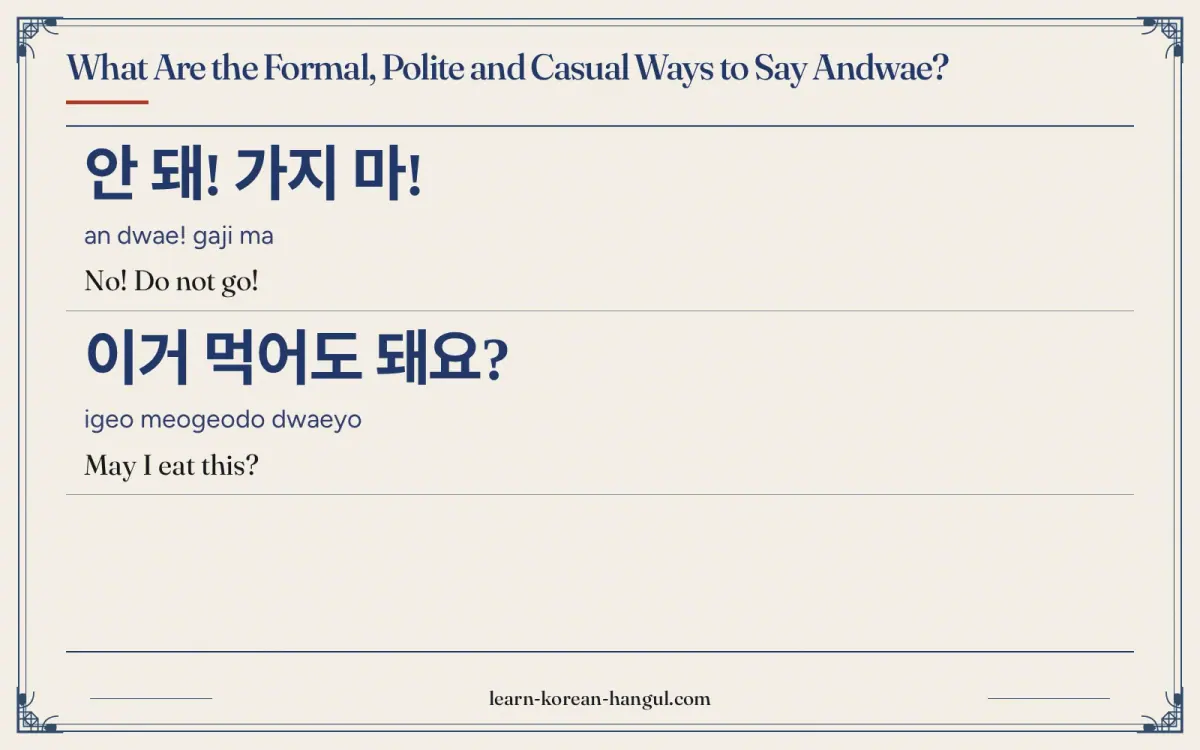
The word 안 stays the same, and the ending of 되다 changes with the listener. The sentence endings follow the Korean speech levels.
Casual: 안 돼 (an dwae)
Casual · 반말Use 안 돼 with friends, family and children. It is blunt, because it is a refusal with no softening. Said with a loud voice, it is also the line used for a dramatic "No, don't!".
안 돼! 가지 마!
an dwae! gaji ma
No! Do not go!
Polite: 안 돼요 (an dwaeyo)
Polite · 해요체안 돼요 is the safe form for strangers, older people and colleagues. It is a polite refusal, not a harsh one. Adding 죄송하지만 (I am sorry, but) in front makes it softer still.
안 돼요. 여기는 들어가면 안 돼요.
an dwaeyo. yeogineun deureogamyeon an dwaeyo
No. You must not go in here.
Formal: 안 됩니다 (an doemnida)
Formal · 합쇼체안 됩니다 is the formal form. Shop staff, officials and announcements use it. The formal ending is written 됩니다, not 돼습니다.
여기서 담배를 피우시면 안 됩니다.
yeogiseo dambaereul piusimyeon an doemnida
You must not smoke here.
Rules: 하면 안 돼요 (hamyeon an dwaeyo)
Polite · 해요체To say "you must not", put the verb in front with -(으)면 ("if") and then 안 돼요. The literal meaning is "if you do it, it is not all right". Change 하 to any verb: 찍으면 안 돼요 (you must not take photos).
여기서 사진 찍으면 안 돼요.
yeogiseo sajin jjigeumyeon an dwaeyo
You must not take photos here.
Asking Permission: -어도 돼요?
Polite · 해요체The question that calls for 안 돼요 is -(아/어)도 돼요? ("may I ...?"). A yes/no question like this usually ends with a rise. The answers are 네, 돼요 (yes) or 안 돼요 (no).
이거 먹어도 돼요?
igeo meogeodo dwaeyo
May I eat this?
The forms are set. Saying 안 돼 with a clean 돼 is the next step.
How Do You Pronounce 안 돼?
안 돼 is pronounced [안 돼], an dwae, in two syllables. 안 is a short "an", and 돼 starts with a soft d, then glides through a w to "ae", so it sounds like "dweh".
- 안 (an): an open "ah" and a closed ㄴ.
- 돼 (dwae): a soft d, then "wae", like the start of "wet".
돼 and 되 sound almost the same today, which is why they are confused in writing. Revised Romanization writes 돼 as dwae and 되 as doe.
Sound Changes to Listen For
안 돼 has no sound change. The formal form has one, and the spelling has a trap:
- ㅂ before ㄴ. In 안 됩니다, the ㅂ meets ㄴ and is said as ㅁ, so you hear [안 됨니다].
- Spelling, not sound. 돼 and 되 sound alike, so the choice is a spelling choice. Use 돼 when you could replace it with 해 (did, does).
- One sound everywhere. Unlike ㅢ, ㅙ keeps the same sound in every position.
The test is simple. Replace the verb with 하다: 안 해요 works, so 안 돼요 is right. 안 하요 does not exist, so 안 되요 is wrong. Knowing when to say 안 돼 matters more than the spelling, as the next section shows.
When Should You Use 안 돼, and When Should You Not?
Use 안 돼 when you refuse someone you know well, stop a child, or react in a dramatic moment. Use 안 돼요 as the default, and 안 됩니다 for rules and staff.
Situations Where It Fits
- A friend asks for something. 안 돼, 그건 내 거야 (No, that is mine).
- Stopping a child from danger. 안 돼! 뜨거워! (No! It is hot!)
- A dramatic reaction. In a film or drama, a character shouts 안 돼! to stop another.
Situations to Avoid
- An older person or a stranger. Use 안 돼요, or a softer phrase such as 어려울 것 같아요 ("it seems difficult").
- A customer. Staff say 안 됩니다 or 어렵습니다 ("it is difficult"), not the casual form.
- A written notice. Signs often use a noun such as 금지 ("prohibited"), for example 주차 금지.
These choices are easier to feel in real exchanges, so here are three.
What Does Andwae Sound Like in a Real Conversation?
The refusal is short, and a reason often follows it. Listen for the pattern.
Two Friends and a Snack
Mina
이거 먹어도 돼?
igeo meogeodo dwae
Can I eat this?
Jisu
안 돼, 그건 내 거야.
an dwae, geugeon nae geoya
No, that one is mine.
What to notice: the friends use the casual 안 돼 and 먹어도 돼? with no 요, and the reason comes right after.
Asking about Photos in a Shop
Customer
여기서 사진 찍어도 돼요?
yeogiseo sajin jjigeodo dwaeyo
May I take a photo here?
Staff
죄송하지만 안 돼요.
joesonghajiman an dwaeyo
I am sorry, but it is not allowed.
What to notice: the customer asks with -어도 돼요?, and the answer 안 돼요 is polite. The word 죄송하지만 softens it.
A Staff Member Gives a Formal Refusal
Staff
고객님, 여기서는 안 됩니다.
gogaengnim, yeogiseoneun an doemnida
Sir or madam, that is not allowed here.
Customer
아, 죄송합니다.
a, joesonghamnida
Oh, I am sorry.
What to notice: the staff member uses the formal 안 됩니다 and addresses the customer with 고객님. The customer apologises.
What Should You Know about the Culture behind Andwae?
A direct "no" can feel strong in Korean, so people soften it or give a reason. The form of 안 돼 you choose shows how close you are to the listener.
- Reasons follow refusals. 안 돼요, 지금 바빠서요 ("I can't, I am busy now") sounds kinder than a bare 안 돼요.
- Softer options. For a request that you want to decline politely, 어려울 것 같아요 ("it looks difficult") or 좀 곤란해요 ("it is a little awkward") are gentler.
- Rules on signs. Public rules often use 하면 안 됩니다 or a noun like 금지, so recognise both.
- Drama. Characters often shout 안 돼! to stop someone from leaving or doing something rash. It is the voice of pleading, not of a rule.
An expert insight: learners often think a flat 안 돼 is the standard Korean "no". Actually, it is a casual word for a request or a danger, and the standard answer to a stranger is 안 돼요 or a softer phrase. The mistakes below come from picking the wrong ending or spelling.
What Mistakes Do Learners Make with Andwae in Korean?
Most andwae mistakes come from spelling 돼, from the ending, or from tone.
| Mistake | Why it is a problem | Fix |
|---|---|---|
| Writing 안되요 or 안 되요 | 되어요 contracts to 돼요, not 되요 | Write 안 돼요 |
| Writing 안돼 as one word in formal text | The spaced form is the safe written form | Write 안 돼 |
| Saying 안 돼 to a teacher | Too blunt | Say 안 돼요 |
| Using 안 돼요 for "I don't want to" | 안 돼요 means not allowed or not possible | Say 싫어요 or 안 할래요 |
Learners often assume 안 돼 means "I don't want to". Actually, it says that something is not allowed or not possible. Dictionaries also list a closed form 안되다 with other meanings, so keep the space when you mean "it won't work".
Other Ways People Search for Andwae in Korean
People search for andwae in Korean in several spellings. The short answers below cover each one.
- Andwae meaning: "no, you can't" or "it won't work".
- Anddwae in Korean / andwe in Korean: the same phrase, 안 돼; the Revised Romanization is an dwae.
- No way: 말도 안 돼요 (maldo an dwaeyo), "that's impossible"; see the page on no way in Korean.
Reading the rules is one thing; producing the right ending on cue is another, so practise now.
Practice: Say It Aloud
Play the slow clip of 안 돼, repeat it three times, then try 안 돼요 and 안 됩니다. Then choose a form for each situation. Answers follow.
- A friend tries to take your last cookie.
- A stranger asks to sit on your reserved seat.
- You are a shop assistant, and a customer wants a photo of a display.
- Write "You must not be late."
Answers
- 안 돼!
- 죄송하지만 안 돼요.
- 죄송합니다, 안 됩니다.
- 늦으면 안 돼요.
Drill 안 돼 and the related phrases with the phrase flashcards, which include audio for each form.
Related Phrases to Learn Next
안 돼 is one of the short phrases heard in Korean dramas.
- K-drama phrases: the wider collection of lines heard on screen.
- No way in Korean: 말도 안 돼, a reaction of disbelief built on 안 돼.
This guide belongs to the K-drama phrases collection. What this page does not cover: the full conjugation of 되다 and the difference between 되다 and 하다 as verbs. Say 안 돼 to friends, 안 돼요 to others, and 안 됩니다 for rules, and you will use andwae in Korean naturally.
Frequently Asked Questions
How do you say andwae in Korean?
Say 안 돼 (an dwae) to mean "no, you can't" or "it won't work". It is the casual form. With older people and strangers say 안 돼요 (an dwaeyo), and in formal settings say 안 됩니다 (an doemnida). To say "you must not", put a verb in the -(으)면 form before it: 하면 안 돼요.
How do you pronounce 안 돼?
Say 안 돼 as two syllables: a short "an" and "dweh", with a soft d. 돼 is not "duh" and not "day". The formal form 안 됩니다 is said [안 됨니다], because ㅂ turns into ㅁ before ㄴ. Revised Romanization writes 안 돼 as an dwae.
What is the difference between 안 돼 and 안 돼요?
안 돼 is casual and blunt, so it fits friends, family and children. 안 돼요 adds the polite ending 요, so it fits strangers, older people and colleagues. The meaning is the same: not allowed or not possible. If you are unsure, 안 돼요 is always safe.
Is 안 돼 formal or casual?
It is casual. The polite version is 안 돼요, and the formal version is 안 됩니다. All three mean the same thing, and only the tone changes. In a dramatic scene, 안 돼! can sound urgent and not rude, because the speaker is pleading.
Can I use 안 돼 with friends, elders and strangers?
Use 안 돼 with friends and children. With elders and strangers, use 안 돼요, and add 죄송하지만 to soften it. With customers, staff use 안 됩니다. If you want to decline very gently, say 어려울 것 같아요 ("it seems difficult") instead of a plain refusal.
What is the most common mistake with andwae in Korean?
The most common mistake is writing 안되요 or 안 되요. The correct polite form is 안 돼요, because 되어요 contracts to 돼요. A quick test is to replace the verb with 하다: you would write 안 해요, not 안 하요, so write 돼. The second mistake is using the blunt 안 돼 with elders.