말도 안 돼요
말도 안 돼요
What you'll learn
- Say 말도 안 돼요, 설마요, 말도 안 돼 and 헐, and know how strong each one is.
- Tell apart "no way" as disbelief and "no way" as refusal.
- Pronounce 말도 안 돼요 and the tense ㄸ in 절대.
- Avoid the mistake of saying 안 돼요 alone to mean "no way!".
Before you start: the forms below depend on the listener, so a quick look at Korean speech levels helps. Time: about 10 minutes. Audio plays only when you press a button.
How Do You Say No Way in Korean?
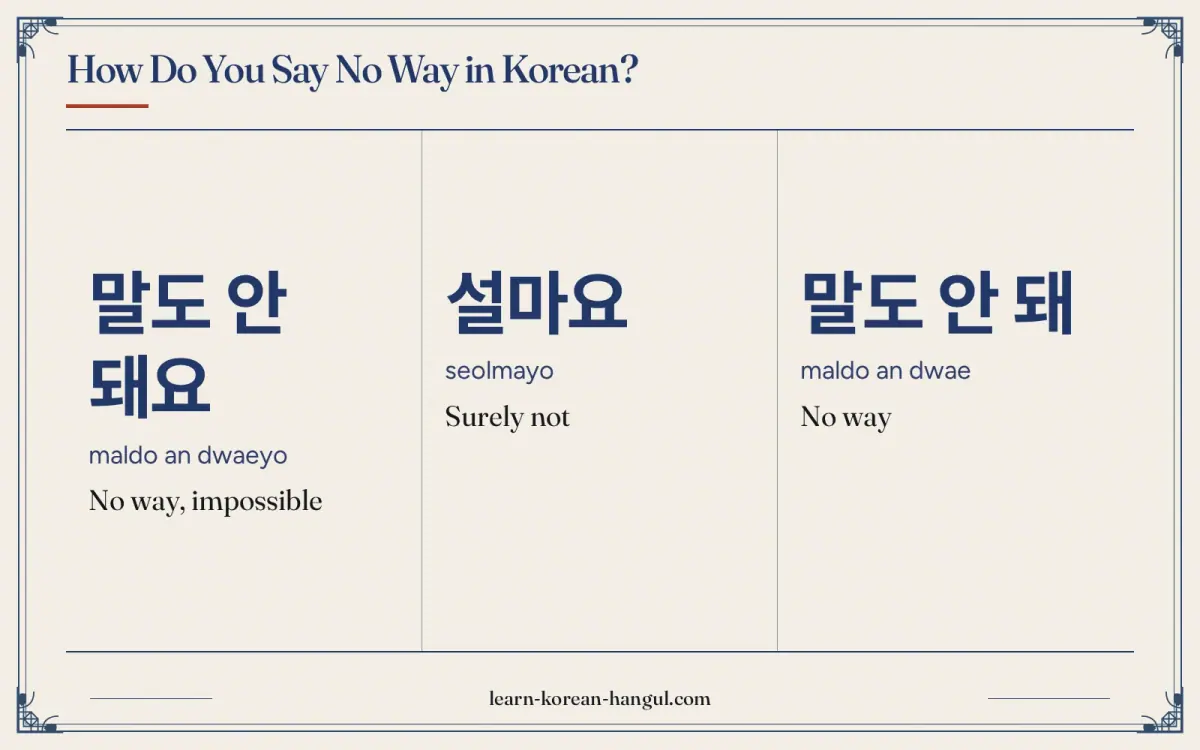
The standard answer is 말도 안 돼요. It is made of 말 (mal, "words, speech"), the particle 도 ("even") and 안 돼요 (an dwaeyo, "doesn't work, is not acceptable"). Literally it says "it doesn't even work as words", which means "that's absurd". It covers both shock ("I can't believe it") and protest ("that isn't fair").
| Korean | Romanization | Meaning | Style |
|---|---|---|---|
| 말도 안 돼요 | maldo an dwaeyo | No way, impossible | Polite |
| 설마요 | seolmayo | Surely not | Polite |
| 말도 안 돼 | maldo an dwae | No way | Casual |
| 헐 | heol | What? No way | Slang |
| 절대 안 돼요 | jeoldae an dwaeyo | No way, I won't allow it | Polite, refusal |
Revised Romanization (the South Korean government standard of 2000) is only a reading aid. Learn the Hangul first. The next section goes through each form.
What Are the Polite and Casual Ways to Say No Way?
The four reaction phrases differ in strength and in who can hear them. The refusal phrase comes at the end of the section.
Polite: 말도 안 돼요 (maldo an dwaeyo)
Polite · 해요체Use 말도 안 돼요 when you are shocked by news, an unfair rule or an impossible story. It is acceptable in polite speech, with colleagues, teachers and strangers, as long as your tone is not angry.
말도 안 돼요! 어제 산 휴대폰이 고장 났어요.
maldo an dwaeyo! eoje san hyudaeponi gojang nasseoyo
No way! The phone I bought yesterday is broken.
Polite: 설마요 (seolmayo)
Polite · 해요체설마 means "surely not" or "you can't mean that". With 요 it becomes a polite doubt: "surely not?". It is lighter than 말도 안 돼요 and does not complain. It also often asks a question.
설마요. 정말 그랬어요?
seolmayo. jeongmal geuraesseoyo
Surely not. Did that really happen?
Casual: 말도 안 돼 (maldo an dwae)
Casual · 반말Drop the 요 and you get the casual form for friends and family. The meaning is the same, but the tone is more open and sometimes louder.
말도 안 돼! 시험이 내일이야?
maldo an dwae! siheomi naeiriya
No way! The exam is tomorrow?
Casual: 헐 (heol)
Casual · 반말헐 is slang for "what!" or "no way". Young speakers say it in chats and in person, and it is often typed alone. Do not use it with seniors or in a formal setting. The page on heol in Korean covers it in detail.
헐, 진짜야?
heol, jinjjaya
Heol, is that for real?
The Other "No Way": 절대 안 돼요 (jeoldae an dwaeyo)
Polite · 해요체English "no way" can also mean "I won't allow it". Korean uses 절대 안 돼요 ("it absolutely won't do") for refusal. 절대 means "absolutely", and in this sense it comes with a negative. It is firm, so use it with care.
Now you know the forms. The sound of 안 돼요 and 절대 needs a short look.
How Do You Pronounce 말도 안 돼요?
말도 안 돼요 has five syllables: 말 (mal), 도 (do), 안 (an), 돼 (dwae) and 요 (yo). It is pronounced [말도 안 돼요]. Read it as two beats: "mal-do" and "an dwae-yo".
- 말: "mal", with a light ㄹ at the end.
- 도: a plain "do", soft and with little air.
- 안: "an", a closed ㄴ.
- 돼요: "dwae-yo". The vowel ㅙ is "wae", which most Seoul speakers pronounce like "weh".
Sound Changes to Listen For
- No tensing in 안 돼요. After 안, the ㄷ stays plain. Do not make it tense.
- 절대 → [절때]. In Sino-Korean words, ㄹ tenses a following ㄷ, ㅅ or ㅈ. So 절대 sounds like 절때. Revised Romanization writes jeoldae. See Korean tensification.
- 설마요. Say seol-ma-yo, with a light ㄹ. There is no sound change.
- 헐. The ㅓ is unrounded, and the final ㄹ is a light "l" with the tongue tip on the ridge behind the teeth: [헐].
- 거짓말 → [거진말]. The word 거짓말 ("lie") is also a strong way to say "no way!". The ㅅ sounds like ㄷ, and the ㄷ becomes ㄴ before ㅁ. RR writes geojinmal.
| Spelling | Sound |
|---|---|
| 말도 안 돼요 | [말도 안 돼요] |
| 절대 | [절때] |
| 거짓말 | [거진말] |
| 헐 | [헐] |
The sounds are manageable. The more important skill is choosing the right reaction.
When Should You Use 말도 안 돼요, and When Should You Not?
Use it for news and events that feel wrong, surprising or unfair. Do not use it for ordinary questions.
Situations Where It Fits
- Shocking news. A friend tells you something astonishing. 말도 안 돼요 or 말도 안 돼.
- Unfair rules or prices. 말도 안 돼요 shows protest without being rude.
- Doubtful claims. 설마요 keeps a polite distance.
- Chats with friends. 헐 in a message works well.
Situations to Avoid
- A senior or a client, with 헐. It is too casual.
- An angry tone. Even polite 말도 안 돼요 can sound like criticism if you raise your voice.
- A real refusal. Use 절대 안 돼요 or the gentler 어려울 것 같아요, not 말도 안 돼요.
- Plain disagreement. If you only disagree, say 저는 다르게 생각해요 ("I think differently").
Two short dialogues show the phrases at work.
What Does No Way Sound Like in a Real Conversation?
The first dialogue is between colleagues, and the second shows doubt about a rumour.
A Broken Phone
Ji-Hye
어제 산 휴대폰이 벌써 고장 났어요.
eoje san hyudaeponi beolsseo gojang nasseoyo
The phone I bought yesterday is already broken.
Dong-Hyun
말도 안 돼요! 어제 샀는데요?
maldo an dwaeyo! eoje sanneundeyo
No way! You bought it yesterday?
What to notice: 샀는데요 is pronounced [산는데요], because the final ㅆ sounds like ㄷ and then becomes ㄴ before ㄴ. The reaction comes with a falling or level tone, and the final question is a gentle yes/no echo.
No School Tomorrow
Min-Su
내일 학교에 안 가도 돼요.
naeil hakgyoe an gado dwaeyo
We don't have to go to school tomorrow.
Eun-Ji
설마요. 정말요?
seolmayo. jeongmaryo
Surely not. Really?
What to notice: 안 가도 돼요 means "you don't have to go" (literally "it is also okay not to go"). So 돼요 here means "okay", the positive side of the same word. 정말요 (jeongmaryo) is often said [정말료] in common speech, with a light ㄴ sound before 요 that turns into ㄹ. The cultural side of these reactions is next.
What Should You Know about the Culture behind No Way?
English "no way" blends two ideas, and Korean separates them.
- Disbelief and protest. 말도 안 돼요 reacts to something you cannot accept as true or fair. It is common in daily talk, news comments and dramas.
- Refusal. 절대 안 돼요 says that something will not be allowed. It is firm and often used by parents or authorities.
- Slang for younger speakers. 헐 is typed in chats and spoken among friends. Elders may not use it, and it should not be used with them.
- Doubt without insult. 설마요 allows you to question news without calling the speaker a liar. It is a safe, polite choice.
An expert insight: the Korean word 안 돼요 has two faces. Used for permission, it means "not allowed". Used with 말도, it means "unbelievable". Hearing the first word tells you which one you are in. The mistakes below show how learners mix them.
What Mistakes Do Learners Make with No Way in Korean?
The most common mistakes come from taking 안 돼요 as the whole phrase.
| Mistake | Why it is a problem | Fix |
|---|---|---|
| Saying only 안 돼요 for "no way!" | It means "it's not allowed" or "it won't work" | Say 말도 안 돼요 |
| Saying 말이 안 돼요 for the same | It means "it doesn't make sense" | Use 말도 안 돼요 for shock |
| Using 헐 with a boss | Too casual | Use 설마요 or 말도 안 돼요 |
| Using 말도 안 돼요 as a refusal | It expresses disbelief, not a ban | Use 절대 안 돼요 |
| Making 안 돼요 tense, [안 뙈요] | The ㄷ stays plain after 안 | Keep the ㄷ soft |
Learners often assume that 안 means "no" in every context. In fact, 안 is a negative marker and 돼요 means "works, is allowed", so the phrase depends on the whole combination. English words also split into different Korean words, as the next section shows.
Is It the Same as Unbelievable?
Close, but Korean has more precise words.
- Unbelievable in Korean: 믿을 수 없어요 (mideul su eopseoyo, "I can't believe it"), pronounced [미들쑤 업써요]. It is more formal and describes the news. 말도 안 돼요 expresses your reaction.
- Impossible in Korean: 불가능해요 (bulganeunghaeyo, "it is impossible") is a plain statement about whether something can be done. 말도 안 돼요 is emotional.
- You're kidding: 거짓말! (geojinmal, "a lie!") or 농담이죠? ("you're joking, right?").
- Really? Wow? OMG? See really in Korean, wow in Korean and OMG in Korean.
Now practise the reactions.
Practice: Say It Aloud
Play the slow clip and repeat 말도 안 돼요 three times, keeping the ㄷ in 돼요 plain. Then choose a reaction for each situation. Answers follow.
- A colleague tells you the office will close tomorrow, and you doubt it.
- A friend sends a shocking photo, and you reply in a chat.
- A shop wants a very high price, and you protest politely.
- Your child asks to stay out all night, and you refuse.
Answers
- 설마요.
- 헐.
- 말도 안 돼요.
- 절대 안 돼.
The phrase flashcards drill reaction phrases with audio.
Related Phrases to Learn Next
No way belongs to a group of reaction words.
- Really in Korean: the short way to ask "is that true?".
- Wow in Korean: the happy side of surprise.
- Michin in Korean: a stronger, riskier reaction.
This guide belongs to the Korean filler words collection. What this page does not cover: longer arguments in Korean, or the full range of slang for surprise. Pick the phrase that matches how strongly you doubt the news, and you can say no way in Korean without sounding rude.
Frequently Asked Questions
How do you say no way in Korean?
Say 말도 안 돼요 (maldo an dwaeyo) in polite speech or 말도 안 돼 with friends. For "surely not", use 설마요. For young slang, use 헐. If you mean "no way, I refuse", say 절대 안 돼요.
How do you pronounce 말도 안 돼요?
Say [말도 안 돼요], five syllables: mal-do an dwae-yo. Keep the ㄷ in 도 and 돼요 plain, and do not tense it. The vowel in 돼 sounds like "wae". Play the slow clip and repeat after it.
What is the difference between 말도 안 돼요 and 설마요?
말도 안 돼요 is a strong reaction to something shocking or unfair. 설마요 is a lighter doubt: "surely not?". Use the first to protest and the second to question news politely.
Is 말도 안 돼요 formal or casual?
It is polite because of the 요 ending. With friends use the casual 말도 안 돼. In a formal setting, a phrase such as 믿기 어렵습니다 ("it is hard to believe") is safer.
Can I use 말도 안 돼요 with friends, elders and strangers?
Yes with elders and strangers, as long as your tone is calm. With friends, 말도 안 돼 or 헐 is more natural. Do not use 헐 with seniors.
What is the most common mistake with no way in Korean?
The most common mistake is saying 안 돼요 alone for "no way!". It means "it's not allowed" or "it won't work". Add 말도 for disbelief, or use 절대 안 돼요 for refusal.