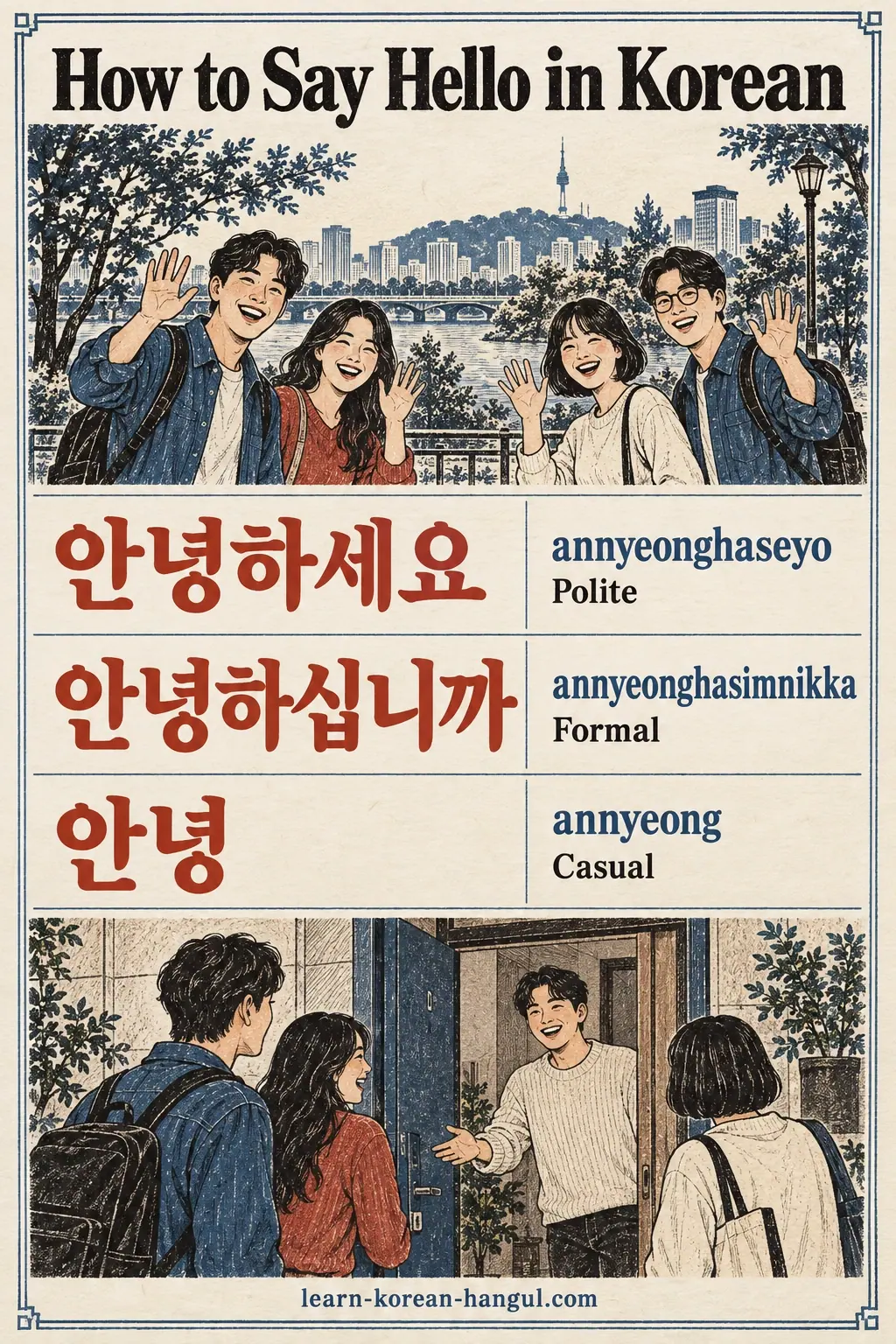
안녕하세요
안녕하세요
What you'll learn
- Say 안녕하세요 aloud with an even rhythm and a clear double n in 안녕.
- Choose between 안녕하세요, 안녕하십니까 and 안녕 for a stranger, a senior and a friend.
- Pronounce 안녕하십니까 with the ㅂ-to-ㅁ change, as [안녕하심니까].
- Avoid the three mistakes learners make most often with hello.
Before you start: you only need to recognise Hangul letters; romanization is shown as a learning aid and can be hidden with the toggle. Time: about 12 minutes. Audio plays only when you press a button.
How Do You Say Hello in Korean?
The everyday way to say hello in Korean is 안녕하세요 (annyeonghaseyo). If you learn only one greeting, learn this one, because it is polite enough for strangers and elders but not so stiff that it sounds odd with a coworker.
The word is built from 안녕 (安寧), a Sino-Korean noun meaning peace or well-being, plus the verb 하다 (to do, to be) and the polite honorific ending -세요. Literally, 안녕하세요 asks "Are you at peace?" In real use nobody hears the literal meaning, just as English speakers do not hear "God be with you" inside "goodbye".
| Form | Romanization | Register | Say it to |
|---|---|---|---|
| 안녕하세요 | annyeonghaseyo | Polite (해요체) | Almost everyone: staff, neighbours, coworkers, elders |
| 안녕하십니까 | annyeonghasimnikka | Formal (합쇼체) | An audience, an interviewer, customers in formal service |
| 안녕 | annyeong | Casual (반말) | Close friends your age, children, younger siblings |
The table answers the "which one" question in one line each. The next section shows each form in a real sentence so you can hear where it belongs.
What Are the Formal, Polite and Casual Ways to Say Hello?

Korean has three hello forms because Korean grammar marks politeness in the verb ending. The ending changes with the listener, a system called speech levels. The same idea runs through every phrase on this site, and the guide to Korean speech levels explains the whole system.
Polite: 안녕하세요 (annyeonghaseyo)
Polite · 해요체안녕하세요 is the default. It uses the polite style (해요체), the speech level most adults use with people they do not know well. The -시- inside -세요 adds respect for the listener, which is why it also fits teachers, older neighbours and your friend's parents.
선생님, 안녕하세요.
seonsaengnim, annyeonghaseyo
Hello, teacher.
Adding a title before the greeting, as in 선생님 (teacher) above, makes it warmer and more respectful. You can also greet a group with 여러분, 안녕하세요 (yeoreobun, annyeonghaseyo), "Hello, everyone."
Formal: 안녕하십니까 (annyeonghasimnikka)
Formal · 합쇼체안녕하십니까 uses the formal style (합쇼체), the highest everyday speech level. You hear it from news anchors, hotel and airline staff, soldiers, and job candidates entering an interview room. It sounds crisp and official.
여러분, 안녕하십니까? 저는 김민준입니다.
yeoreobun, annyeonghasimnikka? jeoneun gimminjunimnida
Hello, everyone. I am Kim Minjun.
Notice that 입니다 in the same sentence is also formal. Formal greetings usually travel with formal endings, so a speaker who opens with 안녕하십니까 keeps the -ㅂ니다 style for the rest of the introduction.
Casual: 안녕 (annyeong)
Casual · 반말안녕 is the casual style (반말), the speech level for close friends, children and people clearly younger than you. It is 안녕하세요 without the -하세요 part, so only the noun 안녕 (peace, well-being) is left. 안녕 also means "bye", so friends use it at both ends of a meeting.
지아야, 안녕.
jiaya, annyeong
Hi, Jia.
The -야 after the name 지아 is a casual calling ending. It belongs with 안녕 and would be rude with a stranger, which shows how casual speech changes more than one word.
Polite: 안녕하세요? as a Question
Polite · 해요체안녕하세요? with a question mark is the same greeting written to show its grammar. The ending -세요 can either state or ask, and the literal meaning ("Are you well?") is a question, so many writers add the question mark. Spoken, the pitch may rise slightly at the end, but nobody expects you to answer it.
안녕하세요? 처음 뵙겠습니다.
annyeonghaseyo? cheoeum boepgetseumnida
Hello. It is a pleasure to meet you for the first time.
The reply to 안녕하세요? is 안녕하세요 again, never "I am fine". With all four forms placed, the next step is to say the main one correctly.
How Do You Pronounce 안녕하세요?
안녕하세요 is pronounced as it is written: [안녕하세요], five syllables, an-nyeong-ha-se-yo. Korean has no word stress like English, so give each syllable about the same length and weight.
Say it in this order:
- 안 (an): a short "ahn" ending with the tongue touching the ridge behind the teeth.
- 녕 (nyeong): start from that same n, so the n sound is held a little longer. Then "yuh" and a final "ng" as in "sing".
- 하 (ha): a soft breathy h, then "ah".
- 세 (se): "seh", like the start of "set".
- 요 (yo): a short "yo", without a long "oh" glide at the end.
Sound Changes to Listen For
No spelling-based sound change applies to 안녕하세요, which makes it a good first phrase. Three things still separate a natural greeting from a textbook one:
- The double n. 안 ends in ㄴ and 녕 starts with ㄴ, so you hear one long n: "an-nyeong", not "a-nyeong".
- The light ㅎ. Between voiced sounds, the h in 하 is often weak in fast speech, so it can sound close to "annyeong-a-seyo". Keep a soft h when speaking slowly; a strong English h sounds heavy.
- The even ending. English speakers often stress the end ("an-yo-HA-say-OH"). Keep 요 short and level.
The formal form has one real sound change. In 안녕하십니까, the ㅂ at the end of 십 meets the ㄴ of 니 and becomes ㅁ, so you say [안녕하심니까], annyeonghasimnikka. This is called nasalization, and the ㅂ-to-ㅁ nasalization rule explains it with more examples. For a slower drill of every sound, see how to pronounce 안녕하세요.
Sound alone does not make a greeting fit, though. Choosing the right listener matters more than a perfect h.
When Should You Use 안녕하세요, and When Should You Not?

Use 안녕하세요 with anyone you would call by title or surname in English, and with any adult you do not know well. Avoid it only with close friends and children, where it sounds distant, and in the most formal settings, where 안녕하십니까 is expected.
Situations Where It Fits
- Walking into a small shop or café. Saying 안녕하세요 to the staff as you enter is normal and friendly.
- Meeting a friend's parents. 안녕하세요 with a bow is the safe, respectful choice.
- Your first day at work or class. Greet each coworker or classmate with 안녕하세요 until you agree to speak casually.
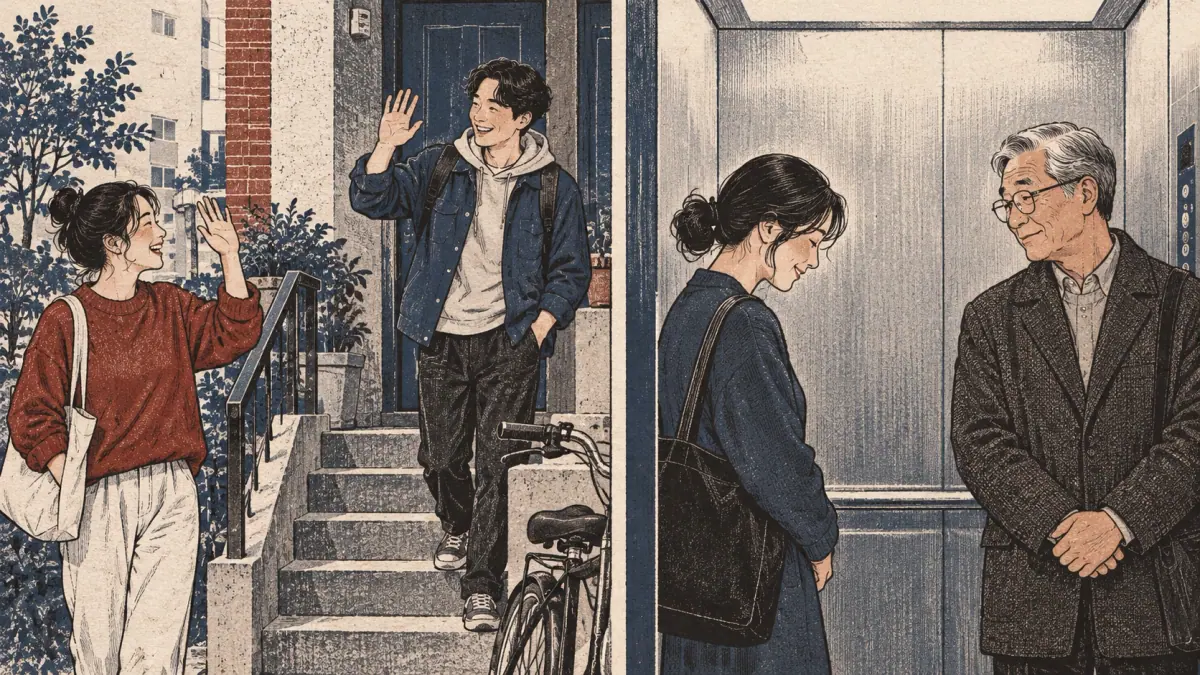
- A neighbour in the lift. A short 안녕하세요 and a nod is the standard exchange.
Situations to Avoid
- Close friends your age. 안녕하세요 to a best friend sounds cold or joking. Use 안녕.
- A formal speech or an interview. 안녕하세요 is not wrong, but 안녕하십니까 matches the setting better.
- Teachers, bosses and elders with 안녕. The casual form skips the respect they expect and can sound rude, even from a foreigner.
- Leaving a place. 안녕하세요 is not used for goodbye. Use 안녕히 가세요 or 안녕히 계세요, explained in goodbye in Korean.
These rules are easier to absorb when you hear them in a full exchange, so the next section has three short conversations.
What Does Hello Sound Like in a Real Conversation?

A Korean hello is usually followed by a second line that does the real work: a welcome, a name or a question. The three dialogues below show the polite, casual and formal patterns.
Entering a Café
Customer
안녕하세요.
annyeonghaseyo
Hello.
Staff
어서 오세요. 주문하시겠어요?
eoseo oseyo. jumunhasigesseoyo?
Welcome. Would you like to order?
Customer
네, 아이스 아메리카노 하나 주세요.
ne, aiseu amerikano hana juseyo
Yes, one iced Americano, please.
What to notice: staff answer 안녕하세요 with 어서 오세요 ("welcome"), not with another hello. You do not need to reply to the welcome.
Two Friends Meet
Minsu
지아야, 안녕.
jiaya, annyeong
Hi, Jia.
Jia
어, 민수야. 안녕.
eo, minsuya. annyeong
Oh, Minsu. Hi.
Minsu
밥 먹었어?
bap meogeosseo?
Have you eaten?
What to notice: 밥 먹었어? ("Have you eaten?") is a common friendly follow-up, not a lunch invitation.
A Job Interview
Candidate
안녕하십니까. 김민준입니다.
annyeonghasimnikka. gimminjunimnida
Good day. I am Kim Minjun.
Interviewer
네, 안녕하세요. 앉으세요.
ne, annyeonghaseyo. anjeuseyo
Hello. Please sit down.
What to notice: the candidate uses the formal form, while the interviewer answers with the ordinary polite one. The person with less status usually chooses the higher form. That status logic is part of the culture behind every greeting.
What Should You Know about the Culture behind Hello?

A Korean hello usually comes with a small bow. The bow and the words work together, and the bow often matters as much as the phrase.
- Bow depth follows the listener. A quick nod of the head suits a peer or a shop worker. A bow from the waist of roughly 15 to 30 degrees suits a teacher, a boss or an older relative. Deep bows are kept for formal occasions.
- The junior greets first. Students greet teachers and new staff greet seniors before being greeted. Waiting for an elder to say hello first can look impolite.
- One greeting a day. In offices and schools, people say 안녕하세요 at the first meeting of the day and then nod when they pass again.
- No time-of-day greeting. 안녕하세요 works at 7 a.m. and at 10 p.m. Phrases like 좋은 아침 (good morning) exist but sound casual or borrowed; see good morning in Korean for when they fit.
One expert insight: learners often worry about the bow more than they need to. A small, sincere nod with 안녕하세요 is always acceptable, while a deep bow to a café worker looks strange. Knowing the culture also helps you spot the mistakes in the next section.
What Mistakes Do Learners Make with Hello in Korean?

The mistakes below are the ones most likely to cause a bad first impression. Each comes with the fix.
| Mistake | Why it is a problem | Fix |
|---|---|---|
| Saying 안녕 to a teacher, boss or older stranger | 안녕 is casual and drops the respect ending | Use 안녕하세요, or 안녕하십니까 in formal settings |
| Answering 안녕하세요 with "I'm fine" | The greeting is not a real question | Answer 안녕하세요 back |
| Using 안녕하세요 when leaving | It is a meeting greeting only | Use 안녕히 가세요 or 안녕히 계세요 |
| Stressing the last syllable: "an-yo-ha-say-OH" | Korean has even syllable weight | Keep each syllable equal and 요 short |
| Dropping the double n: "a-nyeong" | 안 and 녕 both carry ㄴ | Hold the n slightly: an-nyeong |
Learners often assume that the formal 안녕하십니까 is always safer. Actually, it can sound stiff or comic with a neighbour or a café worker, because it belongs to speeches and service scripts. 안녕하세요 is the safer default in daily life.
Is It the Same as Hi?
No. "Hi" in Korean is 안녕 (annyeong), the casual form. 안녕하세요 is closer to a neutral "hello". The short answers below cover the other ways people search for this phrase.
- Hi in Korean: 안녕 (annyeong), for friends and children only.
- Hey in Korean: between friends, 야 (ya) works like "hey" to get attention, but it is blunt and rude with strangers. For "hey there" warmth, use 안녕.
- Say hello in Korean: "to say hello" is 인사하다 (insahada), as in 선생님께 인사하세요, "Say hello to the teacher."
- Hello formal in Korean: 안녕하십니까 (annyeonghasimnikka).
- Hello informal in Korean: 안녕 (annyeong).
- Hello romanized in Korean: annyeonghaseyo, following the Revised Romanization of Korean. Romanization is an aid only; the Hangul spelling is the real word.
- Hello on the phone: 여보세요 (yeoboseyo), explained in hello on the phone in Korean.
With the variants sorted, the best way to make 안녕하세요 automatic is to say it aloud with the right listener in mind.
Practice: Say It Aloud
Press play on the main clip, repeat after it three times, then try the slow clip and match its rhythm. Then answer these four questions. The answers follow the list.
- You meet your new manager at a Korean company on day one. What do you say?
- Your eight-year-old cousin runs up to you. What do you say?
- You open a speech at a formal ceremony. Which form fits?
- How is the syllable 십 pronounced in 안녕하십니까, and why?
Answers
- 안녕하세요, or 안녕하십니까 if the company is formal, with a bow.
- 안녕, because she is a child.
- 여러분, 안녕하십니까.
- As [심], because ㅂ becomes ㅁ before the ㄴ of 니 (nasalization).
For daily review, the phrase flashcards drill 안녕하세요 alongside the other greetings with audio.
Related Phrases to Learn Next
Hello is the first line of almost every exchange, so the next phrases are the ones that follow it.
- How are you in Korean: 잘 지내세요? and the other ways to ask after someone you already know.
- Nice to meet you in Korean: 반갑습니다 and 처음 뵙겠습니다 for first meetings.
- Goodbye in Korean: the two-way goodbye that depends on who is leaving.
- Good morning in Korean: when a time-of-day greeting fits.
This guide belongs to the Korean greetings collection, which lists every phrase in the cluster. What this page does not cover: regional dialect greetings, North Korean usage, and the full honorific system, which lives in the speech levels guide. Once you can greet the right person in the right way, you can say hello in Korean in any first meeting.
Frequently Asked Questions
What does 안녕하세요 literally mean?
안녕하세요 literally asks whether the listener is at peace or well. 안녕 (安寧) means peace or well-being, 하다 makes it a verb, -시- adds respect and -어요 makes it polite. Koreans hear it as a plain greeting, so the reply is simply 안녕하세요 back, not a report on how you feel.
Is 안녕하세요 a question?
Grammatically, yes. The ending -세요 can ask or state, and 안녕하세요 literally asks if you are well, so it is often written with a question mark. In practice it works as a greeting and needs no answer. Both 안녕하세요. and 안녕하세요? are common in writing, and both are correct.
How do you write hello in Hangul?
Hello is written 안녕하세요 in Hangul: five syllable blocks, 안, 녕, 하, 세 and 요. The first two blocks end in the consonants ㄴ and ㅇ. Write the blocks left to right with no spaces. The formal hello is 안녕하십니까, and the casual hi is the first two blocks only, 안녕.
Can I say 안녕하세요 more than once a day to the same person?
You can, but most people do not. Coworkers usually say 안녕하세요 at the first meeting of the day, then just nod or smile when they pass again. Repeating the full greeting every time can sound oddly formal. The rule of thumb is one spoken greeting per day, then a nod.
Is 안녕하세요 used on the phone?
Not as the first word. Korean phone calls usually open with 여보세요 (yeoboseyo), which works like hello on the phone, and the caller may add 안녕하세요 afterwards when talking to someone they respect. In shops and offices, staff answering a work line usually give the company name instead.