잘 안 들려요
잘 안 들려요
What you'll learn
- Say 잘 안 들려요, 소리가 안 들려요 and 조금 더 크게 말해 주세요 and choose between them.
- Explain why Korean uses 들려요 (the sound reaches me) and not 들어요 (I listen).
- Tell 잘 안 들려요 from 잘 못 들었어요 (I did not catch that).
- Say the long double ㄹ in 들려요 and the tensing in 못 들었어요.
Before you start: the lesson on Korean speech levels explains the endings used below. Time: about 12 minutes. Audio plays only when you press a button.
How Do You Say I Can't Hear You in Korean?
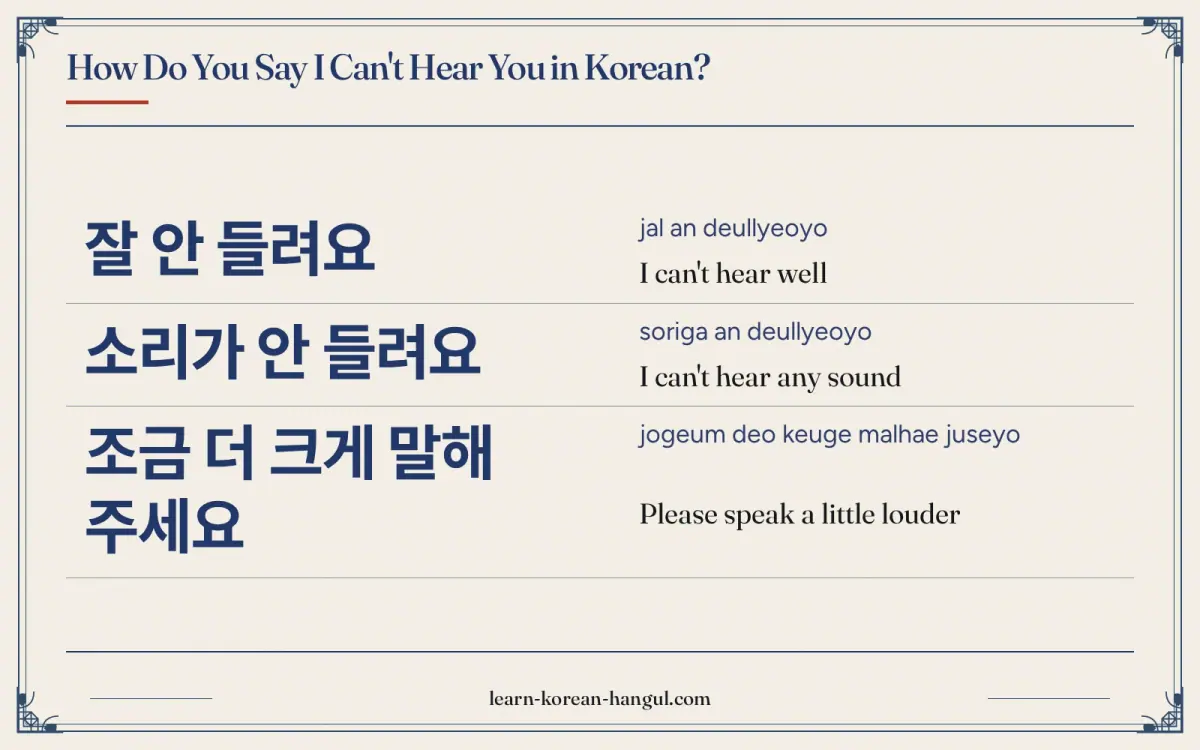
The standard way to say I can't hear you in Korean is 잘 안 들려요. The phrase has three parts: 잘 (well), 안 (not) and 들려요 (is heard). Notice that Korean does not say "I do not hear". It says that the sound is not reaching you.
| Situation | Korean | Romanization | Meaning |
|---|---|---|---|
| Noisy place, weak signal | 잘 안 들려요 | jal an deullyeoyo | I can't hear well |
| No sound at all | 소리가 안 들려요 | soriga an deullyeoyo | I can't hear any sound |
| Asking for volume | 조금 더 크게 말해 주세요 | jogeum deo keuge malhae juseyo | Please speak a little louder |
| Asking for a repeat | 다시 말해 주세요 | dasi malhae juseyo | Please say it again |
| Friend, casual | 잘 안 들려 | jal an deullyeo | I can't hear well |
Revised Romanization (the South Korean government standard of 2000) is only a reading aid here. Learn the Hangul first. The next section explains each form.
What Are the Polite Ways to Say I Can't Hear You?
Every polite form below ends in -요, so all of them are safe with strangers. What changes is the problem you describe: a weak sound, no sound, or a speaker who is too quiet.
Polite: 잘 안 들려요 (jal an deullyeoyo)
Polite · 해요체잘 안 들려요 is the all-purpose form. Use it on a crackling phone line, in a loud restaurant or when a speaker is far away. Add 죄송해요 (I'm sorry) first, because the polite habit in Korean is to apologise for the trouble. The subject is the sound, so you do not need 저는 (I).
죄송해요, 잘 안 들려요.
joesonghaeyo, jal an deullyeoyo
Sorry, I cannot hear you well.
Polite: 소리가 안 들려요 (soriga an deullyeoyo)
Polite · 해요체소리가 안 들려요 means that no sound reaches you. It suits a video call, a broken speaker or a muted microphone. The noun 소리 (sound) takes the subject particle 가, so the sentence reads "the sound is not heard".
화면은 보이는데 소리가 안 들려요.
hwamyeoneun boineunde soriga an deullyeoyo
I can see the screen, but I cannot hear any sound.
Polite: 조금 더 크게 말해 주세요 (jogeum deo keuge malhae juseyo)
Polite · 해요체This sentence asks the other person to help. 조금 더 means "a little more", 크게 means "loudly" (from 크다, to be big) and 말해 주세요 means "please say". It is a polite request with 주세요, so it also works with a teacher or a clerk. To ask for a repeat, say 다시 말해 주세요 (dasi malhae juseyo).
조금 더 크게 말해 주세요.
jogeum deo keuge malhae juseyo
Please speak a little louder.
Polite: 잘 못 들었어요 (jal mot deureosseoyo)
Polite · 해요체This form looks back at a moment that has passed. It means "I didn't hear that well", so you use it after someone has said something that you missed. It sounds natural at the start of a request to repeat. In contrast, 잘 안 들려요 describes the sound problem that is still going on.
잘 못 들었어요. 다시 말해 주세요.
jal mot deureosseoyo. dasi malhae juseyo
I did not catch that. Please say it again.
Casual: 잘 안 들려 (jal an deullyeo)
Casual · 반말Drop -요 for friends and family. With a stranger, keep it. For a formal setting such as a meeting, the sentence becomes 잘 들리지 않습니다 (jal deulliji anseumnida), which sounds like [잘 들리지 안씀니다].
The sounds in these phrases need some practice, so here they are one by one.
How Do You Pronounce 잘 안 들려요?
잘 안 들려요 is pronounced [잘 안 들려요], with five syllables: jal an deul-lyeo-yo. The key sound is the double ㄹ.
- 잘 (jal): a short syllable that ends in a light ㄹ.
- 안 (an): the vowel starts the syllable, and ㄴ closes it.
- 들 (deul): ㄷ, the unrounded vowel ㅡ, and a final ㄹ.
- 려 (lyeo): this syllable starts with ㄹ, so the final ㄹ of 들 and the ㄹ of 려 merge into one long lateral sound.
- 요 (yo): a short "yo".
Because the sentence is a statement, the pitch stays level or falls. If you ask 소리 들려요? (can you hear the sound?), the yes-or-no question rises at the end.
Sound Changes to Listen For
- Long ㄹ in 들려요. The final ㄹ of 들 and the first ㄹ of 려 form one long sound, [들려요]. RR writes it as deullyeoyo.
- Linking across 잘 안. Said as one phrase, the ㄹ of 잘 often links to 안, so 잘 안 들려요 can sound like [자란 들려요]. RR still writes the words separately: jal an deullyeoyo.
- Tensing in 못 들었어요. The final ㅅ of 못 sounds like ㄷ, and the ㄷ of 들 becomes tense, so 못 들었어요 is [몯뜨러써요]. RR does not show tensing caused by a neighbouring sound, so it writes mot deureosseoyo.
- Weak ㅎ in 말해. After ㄹ, the ㅎ is weak and often disappears in quick speech, so 말해 can sound like [마래].
- Liaison in 확인해. The ㄱ of 확 links to 인, so 확인 is [화긴]. In quick speech the ㅎ of 해 also weakens, so 확인해 can sound like [화기내].
- Tensing and a nasal sound in 않습니다. In the formal 들리지 않습니다, the ㅎ of ㄶ makes the following ㅅ tense, and ㅂ becomes ㅁ before ㄴ, so you hear [안씀니다].
The Korean tensification page explains why 들 sounds like 뜰 after 못. Say 들려요 slowly, then fast, and keep both ㄹ sounds joined. Knowing the sound is useful only if you also pick the right moment.
When Should You Use 잘 안 들려요, and When Should You Not?
Use 잘 안 들려요 whenever sound is the problem. Choose another phrase when the problem is meaning, not sound.
Situations Where It Fits
- A weak phone signal. 잘 안 들려요 tells the caller to repeat or call again.
- A noisy restaurant or street. 잘 안 들려요 asks them to come closer or speak up.
- A video call. 소리가 안 들려요 helps the host check the sound settings.
- A lecture or announcement. 조금 더 크게 말해 주세요 asks the teacher for volume.
Situations to Avoid
- When you heard the words but did not understand them. Say I don't understand in Korean instead.
- Using 안 들어요 for the sound problem. 안 들어요 means that you are not listening.
- A loud request on public transport. Raising your voice on the subway can bother others, so move or end the call.
Three short dialogues show these phrases in action.
What Does I Can't Hear You Sound Like in a Real Conversation?
Listen for the gentle apology at the start and the slow, clear repeat that follows.
A Phone Call
Caller
여보세요? 잘 안 들려요.
yeoboseyo? jal an deullyeoyo
Hello? I cannot hear you well.
Friend
죄송해요. 지금 지하철이에요.
joesonghaeyo. jigeum jihacheorieyo
Sorry. I am on the subway now.
What to notice: 지하철이에요 sounds like [지하처리에요], because the final ㄹ links to 이에요. A call like this often ends with 다시 전화할게요 (I'll call again). For more call lines, see Korean phone phrases.
A Video Call
Host
소리 들려요?
sori deullyeoyo
Can you hear the sound?
Guest
아니요, 소리가 안 들려요. 마이크 확인해 주세요.
aniyo, soriga an deullyeoyo. maikeu hwaginhae juseyo
No, I cannot hear any sound. Please check the microphone.
What to notice: the host's question rises, because it is a yes-or-no question. The guest names the problem, then asks for help with 확인해 주세요 (please check).
Friends in a Noisy Cafe
Ji-Ho
뭐라고? 잘 안 들려!
mworago? jal an deullyeo
What? I cannot hear you!
Se-Ra
여기 너무 시끄럽다. 밖에서 얘기하자.
yeogi neomu sikkeureopda. bakkeseo yaegihaja
It is so loud here. Let's talk outside.
What to notice: 밖에서 sounds like [바께서], and the casual -자 suggests a shared plan. The way people handle sound in public has a cultural side.
What Should You Know about the Culture behind I Can't Hear You?
Sound and manners are linked in everyday Korean life. Quiet public spaces are common, so people think about how their voices carry.
- Video-call checks. At the start of an online meeting, hosts often ask 소리 들려요? and guests reply 네, 잘 들려요 (yes, I can hear well). Saying 마이크 확인해 주세요 is a normal, polite request.
- Phones in public. Talking loudly on the phone on a bus or subway is widely seen as inconsiderate. Many people speak softly or text instead.
- Apology first. People usually say 죄송해요 or 죄송한데 before they ask someone to repeat. It softens the request and shows respect.
An expert insight: the verb 들리다 puts the sound in the subject slot, so Korean treats hearing as something that happens to you. The mistakes below come from translating "I can't hear" word for word.
What Mistakes Do Learners Make with I Can't Hear You in Korean?
Most mistakes come from choosing the wrong verb.
| Mistake | Why it is a problem | Fix |
|---|---|---|
| 안 들어요 for a bad line | 듣다 means to listen, so it says you are not listening | Say 안 들려요 |
| 잘 안 들었어요 for a current problem | It describes a past moment | Say 잘 안 들려요 |
| 나는 소리를 못 들려요 | 들리다 does not take an object like this | Say 소리가 안 들려요 |
| 들려요 with one short ㄹ | Loses the long ㄹ | Hold the ㄹ sound a little longer |
| Bare 크게 말해 to an elder | Sounds like an order | Add 주세요 |
Learners often think 못 means the same thing as 안. Actually, 잘 못 들었어요 is a normal way to say "I didn't catch that", while 안 들려요 describes a sound that does not arrive.
Is It the Same as Can't Hear, Speak Louder and Bad Connection?
Three nearby searches share this page, and each has a short answer.
- Can't hear in Korean: 안 들려요 (I can't hear) or 잘 안 들려요 (I can't hear well).
- Speak louder in Korean: 조금 더 크게 말해 주세요 (polite) or 좀 크게 말해 줘 (casual).
- Bad connection in Korean: 신호가 안 좋아요 (sinhoga an joayo), "the signal is bad", or 연결이 안 좋아요 (yeongyeori an joayo), "the connection is bad".
Practice: Say It Aloud
Play the slow clip and repeat 잘 안 들려요 three times, joining the two ㄹ sounds. Then choose the best phrase. Answers follow.
- A video call where you hear nothing.
- A noisy street and a friend's voice.
- You missed what the clerk just said.
- A teacher speaks too quietly.
Answers
- 소리가 안 들려요.
- 잘 안 들려.
- 잘 못 들었어요. 다시 말해 주세요.
- 조금 더 크게 말해 주세요.
The phrase flashcards drill these forms with audio.
Related Phrases to Learn Next
Hearing problems lead to a few other short requests.
- One moment please in Korean: asking a caller to wait.
- I don't understand in Korean: when the sound is clear but the meaning is not.
- Korean phone phrases: answering, holding and hanging up.
This guide belongs to the Korean phone phrases collection. What this page does not cover: technical vocabulary for devices and the full conjugation of 듣다. Name the problem, apologise first, and you can say I can't hear you in Korean politely and clearly.
Frequently Asked Questions
How do you say I can't hear you in Korean?
Say 잘 안 들려요 (jal an deullyeoyo) for "I can't hear well". If you hear nothing at all, say 소리가 안 들려요. To ask for more volume, say 조금 더 크게 말해 주세요. To ask for a repeat, say 다시 말해 주세요. With friends, drop the ending: 잘 안 들려.
How do you pronounce 잘 안 들려요?
Say jal an deul-lyeo-yo in five syllables. The final ㄹ of 들 and the ㄹ of 려 join into one long lateral sound. The vowel in 들 is the unrounded ㅡ, so keep your lips flat. The sentence is a statement, so the pitch stays level or falls at the end.
What is the difference between 잘 안 들려요 and 소리가 안 들려요?
잘 안 들려요 means the sound is weak, noisy or unclear, so you hear part of it. 소리가 안 들려요 means no sound reaches you, for example when a microphone is muted or a speaker is broken. Use the first in noisy places and the second on video calls or devices.
Can I use 잘 안 들려요 with friends, elders and strangers?
Yes. The polite -요 ending is safe with elders and strangers, and it helps to say 죄송해요 first. With close friends, you can say 잘 안 들려. In a formal setting, such as a meeting, say 잘 들리지 않습니다. Asking someone to speak louder needs 주세요 to stay polite.
What is the most common mistake with I can't hear you in Korean?
Using 안 들어요. The verb 듣다 means to listen, so 안 들어요 says that you are not listening. For sound that does not reach you, use the passive 들리다: 안 들려요. A second mistake is shortening the double ㄹ in 들려요, which makes the word sound unclear.