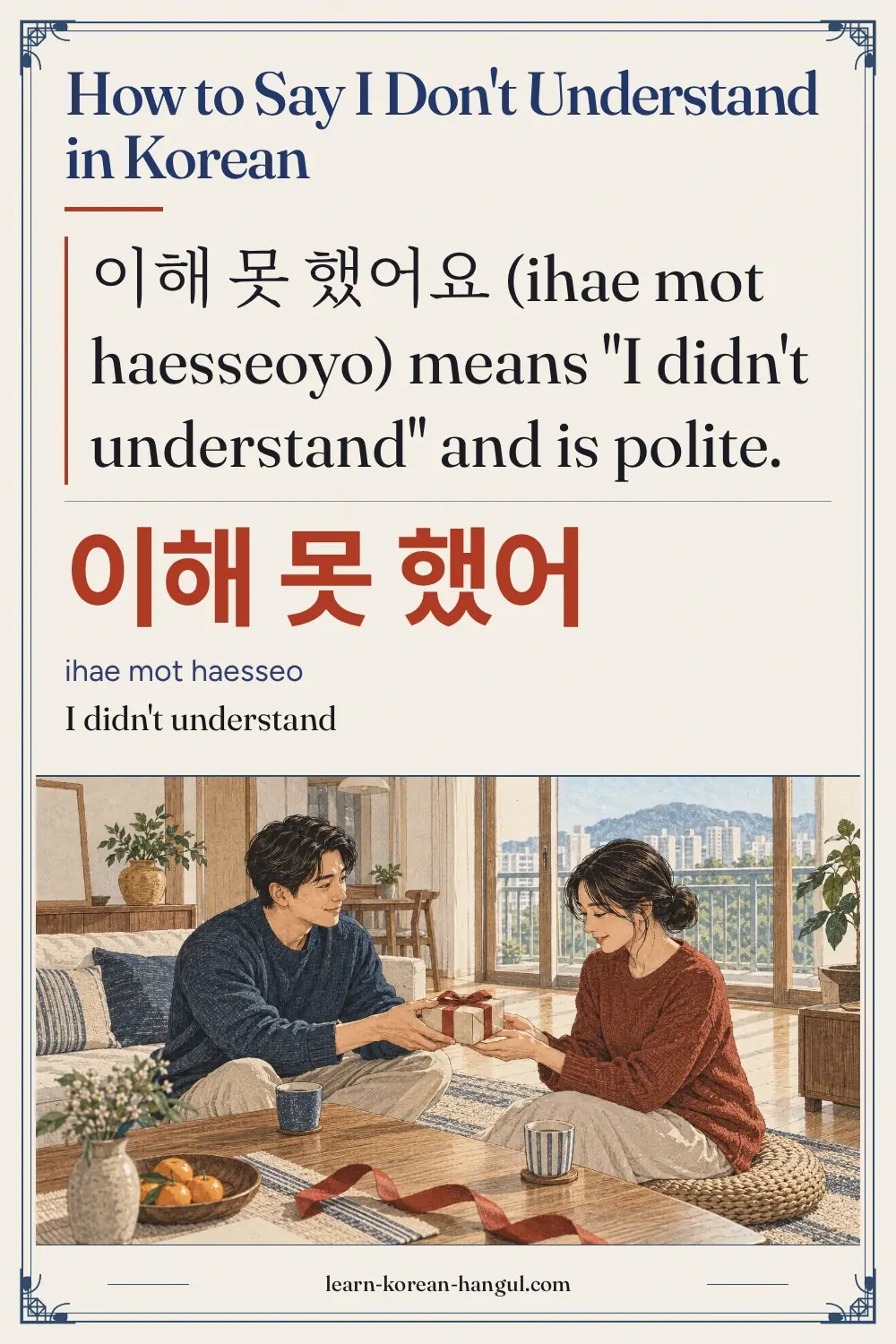
이해 못 했어요
이해 못 했어요
What you'll learn
- Say 이해 못 했어요, 이해가 안 돼요, 무슨 말인지 모르겠어요 and 잘 모르겠어요 and know what each one says.
- Tell apart "I didn't catch the words" and "I don't get the meaning".
- Pronounce 못 했어요 [모태써요] and 모르겠어요 [모르게써요].
- Avoid the blunt 몰라요 and the confusing 이해 안 했어요.
Before you start: the lesson on Korean speech levels explains the endings used below. Time: about 12 minutes. Audio plays only when you press a button.
How Do You Say I Don't Understand in Korean?
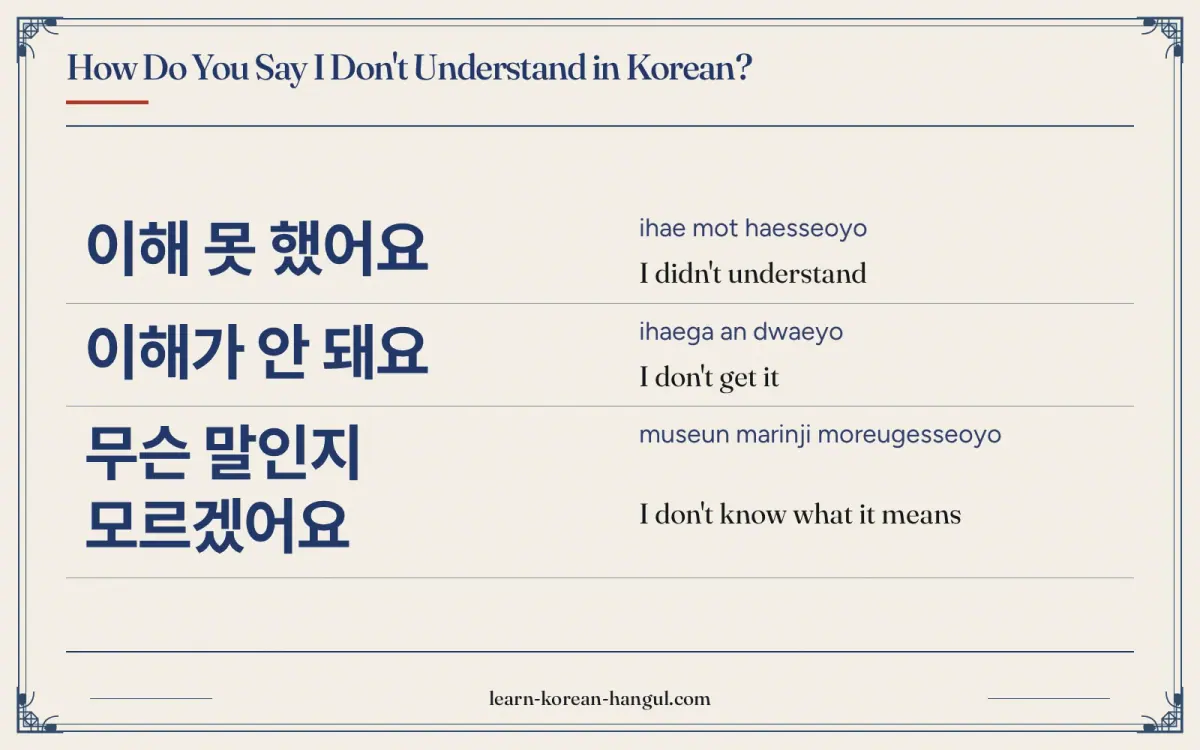
The standard way to say I don't understand in Korean is 이해 못 했어요. It has three parts: 이해 (understanding), 못 (cannot) and 했어요 (did). The sentence says that you were not able to understand, which sounds kind and honest, not rude.
| Problem | Korean | Romanization | Meaning |
|---|---|---|---|
| You did not understand | 이해 못 했어요 | ihae mot haesseoyo | I didn't understand |
| It does not make sense | 이해가 안 돼요 | ihaega an dwaeyo | I don't get it |
| You don't know the meaning | 무슨 말인지 모르겠어요 | museun marinji moreugesseoyo | I don't know what it means |
| You are unsure | 잘 모르겠어요 | jal moreugesseoyo | I'm not sure |
| Friend, casual | 이해 못 했어 | ihae mot haesseo | I didn't understand |
Revised Romanization (the South Korean government standard of 2000) is only a reading aid here. Learn the Hangul first. The next section explains each form.
What Are the Polite Ways to Say I Don't Understand?
Korean separates three problems: you did not catch the sound, you do not know the meaning, or you do not follow the logic. Each one has a natural sentence. All of them use polite endings, so they are safe in class and in public.
Polite: 이해 못 했어요 (ihae mot haesseoyo)
Polite · 해요체이해 못 했어요 looks back at an explanation and says that it did not reach you. 이해 is the noun "understanding", and 못 before the verb means "cannot". Add 죄송해요 (I'm sorry) and ask for more: 다시 설명해 주세요 (please explain again).
죄송해요, 이해 못 했어요. 다시 설명해 주세요.
joesonghaeyo, ihae mot haesseoyo. dasi seolmyeonghae juseyo
Sorry, I did not understand. Please explain again.
Polite: 이해가 안 돼요 (ihaega an dwaeyo)
Polite · 해요체이해가 안 돼요 means "understanding does not happen", so the meaning or logic does not make sense to you. Use it for a rule, a joke or an idea, not for a sound you missed. 안 돼요 comes from 되다 (to become), which gives 돼요.
이 문장은 이해가 안 돼요.
i munjangeun ihaega an dwaeyo
I do not get this sentence.
Polite: 무슨 말인지 모르겠어요 (museun marinji moreugesseoyo)
Polite · 해요체This sentence means "I don't know what is being said". 무슨 말 is "what words", -인지 turns the idea into an embedded question, and 모르겠어요 adds a soft "I can't tell". It fits when a word or a sentence is unknown. To ask directly, see what does it mean in Korean.
무슨 말인지 모르겠어요.
museun marinji moreugesseoyo
I do not know what you mean.
Polite: 잘 모르겠어요 (jal moreugesseoyo)
Polite · 해요체잘 모르겠어요 is the softest option. It means "I'm not sure" and leaves the door open for help. It is gentler than 몰라요 (I don't know), which can sound blunt. For the plain "I don't know", read I don't know in Korean.
잘 모르겠어요. 천천히 말해 주세요.
jal moreugesseoyo. cheoncheonhi malhae juseyo
I am not sure. Please speak slowly.
Casual: 이해 못 했어 (ihae mot haesseo)
Casual · 반말Drop -요 for friends and classmates: 이해 못 했어 or 이해가 안 돼. In formal settings, use 이해하지 못했습니다 (ihaehaji motaetseumnida). Next, the sounds.
How Do You Pronounce 이해 못 했어요?
이해 못 했어요 is pronounced [이해 모태써요], with six syllables: i-hae mo-tae-sseo-yo. The key change is in the middle.
- 이 (i): a clear "ee".
- 해 (hae): ㅐ sounds like "eh". The standard rules (Article 4) still list ㅐ and ㅔ as two vowels, but most Seoul speakers today pronounce them the same.
- 못 했 (mot hae): the final ㅅ of 못 sounds like ㄷ, and it joins the ㅎ of 했 into a ㅌ sound, so you hear 모-태.
- 어요 (eo-yo): ㅓ is unrounded, so keep your lips flat.
Sound Changes to Listen For
- Aspiration in 못 했어요. The sound ㄷ followed by ㅎ becomes ㅌ, so 못 했어요 is [모태써요]. Because 못 and 했어요 are separate words, RR romanizes each one on its own, with no sound change across the space: mot haesseoyo.
- Tense ㅆ in 했어요 and 모르겠어요. The ㅆ is always tense. 모르겠어요 sounds like [모르게써요].
- Liaison in 못 알아들었어요. The final ㅅ of 못 moves to the next syllable as ㄷ, so the phrase sounds like [모다라드러써요].
- Liaison in 말인지. The ㄹ of 말 moves to the next syllable, so 무슨 말인지 sounds like [무슨 마린지].
- Formal 못했습니다. The ㅆ is followed by ㅅ, so you hear [모태씀니다], and RR writes motaetseumnida.
The Korean tensification lesson explains the tense sounds. Say 못, then 못 했어요, and notice how the ㅅ disappears into ㅌ. Pronunciation is half the job, and the other half is picking the right sentence.
When Should You Use 이해 못 했어요, and When Should You Not?
Use 이해 못 했어요 after someone has explained something and you did not follow. Use a different phrase when the problem is the sound or a single word.
Situations Where It Fits
- In class. After 이해했어요? (did you understand?), answer honestly with 이해 못 했어요.
- At work. 이해가 안 돼요 asks a colleague to explain a rule.
- On the street. 잘 못 알아들었어요 asks someone to repeat what they just said.
- With a teacher. 잘 모르겠어요 shows you want help without sounding upset.
Situations to Avoid
- A blunt 몰라요 to an elder. It can sound uninterested. Use 잘 모르겠어요.
- 이해 안 했어요. With 안, it can mean you chose not to understand.
- When the sound was the problem. Use please say it again in Korean or 못 알아들었어요.
Three short dialogues show the phrases in context.
What Does I Don't Understand Sound Like in a Real Conversation?
Listen for the apology at the start and the polite request that follows.
In Class
Teacher
이해했어요?
ihaehaesseoyo
Did you understand?
Student
죄송해요, 이해 못 했어요. 다시 설명해 주세요.
joesonghaeyo, ihae mot haesseoyo. dasi seolmyeonghae juseyo
Sorry, I did not understand. Please explain again.
What to notice: the teacher's yes-or-no question rises at the end. The student begins with 죄송해요, which many Korean speakers use when they ask for extra help.
Asking a Stranger for Help
Visitor
죄송한데, 잘 못 알아들었어요. 한국어를 배우고 있어요.
joesonghande, jal mot aradeureosseoyo. hangugeoreul baeugo isseoyo
Sorry, I did not catch that. I am learning Korean.
Stranger
아, 천천히 말할게요.
a, cheoncheonhi malhalgeyo
Ah, I will speak slowly.
What to notice: 말할게요 sounds like [말할께요], with a tense ㄲ. The visitor adds 한국어를 배우고 있어요, which invites patience. See also I'm learning Korean in Korean.
Study Friends
Ye-Jin
이거 무슨 뜻인지 모르겠어.
igeo museun tteusinji moreugesseo
I do not know what this means.
Do-Hyeon
같이 사전 찾아보자.
gachi sajeon chajaboja
Let's look it up in a dictionary together.
What to notice: 뜻인지 sounds like [뜨신지], and 찾아보자 sounds like [차자보자]. The casual endings -어 and -자 match the friendship. How Koreans react to confusion also has a cultural side.
What Should You Know about the Culture behind I Don't Understand?
Admitting confusion takes a little courage in any culture, and a few habits help.
- A polite first line. Koreans often begin with 죄송한데 잘 못 알아들었어요 (sorry, I didn't catch that). The apology is a social cushion, not a sign of guilt.
- Learners get patience. Adding 한국어를 배우고 있어요 usually brings slower speech and simpler words.
- 네 is not always yes. In conversation 네 often means "I'm listening", not "I understand". Teachers who ask 이해했어요? want an honest answer, so say 이해 못 했어요 when you need to.
- Shy silence. Some students stay quiet out of shyness, so a short polite sentence is welcome.
An expert insight: Korean has separate sentences for not hearing, not knowing a word and not following an idea. Choosing the right one tells your helper exactly where to start. The mistakes below come from using only one all-purpose sentence.
What Mistakes Do Learners Make with I Don't Understand in Korean?
Most mistakes are about tone and meaning.
| Mistake | Why it is a problem | Fix |
|---|---|---|
| 몰라요 for "I don't understand" | Means "I don't know", and can sound blunt | Say 이해 못 했어요 or 잘 모르겠어요 |
| 이해 안 했어요 | 안 can mean you chose not to | Say 이해 못 했어요 |
| 이해 못 해요 for a past explanation | Sounds like you are unable in general | Use the past 이해 못 했어요 or 이해가 안 돼요 |
| 이해가 안 돼요 for a missed sound | It is about meaning, not hearing | Say 못 알아들었어요 |
| Writing 모태써요 | Spelling keeps the stem 못 했 | Write 못 했어요, say [모태써요] |
Learners often think one sentence covers every kind of confusion. Actually, Koreans choose between 이해 못 했어요, 이해가 안 돼요 and 못 알아들었어요, depending on what went wrong.
Is It the Same as Sorry I Don't Understand and Don't Understand?
Four nearby searches share this page, and each has a short answer.
- Sorry, I don't understand in Korean: say 죄송해요, 이해 못 했어요 or 죄송한데 이해가 안 돼요.
- I do not understand in Korean: the formal version is 이해하지 못했습니다.
- Don't understand in Korean: the short form is 이해가 안 돼요, or 이해가 안 돼 in casual speech.
- I dont understand in Korean: the same sentence, spelled without the apostrophe. Use 이해 못 했어요.
Practice: Say It Aloud
Play the slow clip and repeat 이해 못 했어요 three times, turning 못 했 into [모태]. Then choose the best sentence. Answers follow.
- A teacher asked 이해했어요? and you did not follow.
- A stranger spoke too fast and you missed the words.
- A grammar rule does not make sense to you.
- You want to say "I'm not sure" softly.
Answers
- 이해 못 했어요.
- 잘 못 알아들었어요.
- 이해가 안 돼요.
- 잘 모르겠어요.
The phrase flashcards drill these forms with audio.
Related Phrases to Learn Next
Confusion phrases belong with other classroom requests.
- Please say it again in Korean: asking for a repeat.
- What does it mean in Korean: asking about a word.
- I'm learning Korean in Korean: inviting patience.
This guide belongs to the Korean classroom phrases collection. What this page does not cover: grammar vocabulary for teachers and the full conjugation of 이해하다. Say where you got lost, and you can say I don't understand in Korean politely and get the help you need.
Frequently Asked Questions
How do you say I don't understand in Korean?
Say 이해 못 했어요 (ihae mot haesseoyo) for "I didn't understand". If the meaning does not make sense, say 이해가 안 돼요. If you did not catch the words, say 잘 못 알아들었어요. For "I'm not sure", say 잘 모르겠어요. With friends, drop the ending: 이해 못 했어.
How do you pronounce 이해 못 했어요?
Say i-hae mo-tae-sseo-yo in six syllables. The final ㅅ of 못 sounds like ㄷ and joins the ㅎ of 했 into a ㅌ sound, so you hear [모태]. The ㅆ is tense, and the ㅓ is unrounded. Most Seoul speakers pronounce ㅐ in 해 like ㅔ. Keep the pitch falling at the end.
What is the difference between 이해 못 했어요 and 이해가 안 돼요?
이해 못 했어요 says that you were unable to understand an explanation that just happened. 이해가 안 돼요 says that something does not make sense to you right now, such as a rule or an idea. Use the first after a lesson and the second when you are still puzzled.
Can I use 이해 못 했어요 with friends, elders and strangers?
Yes. The polite form is safe with teachers, elders and strangers, and 죄송해요 makes it warmer. With close friends, say 이해 못 했어 or 이해가 안 돼. In a formal setting, such as a meeting, use 이해하지 못했습니다. Avoid the blunt 몰라요 with seniors.
What is the most common mistake with I don't understand in Korean?
Using 몰라요 or 이해 안 했어요. 몰라요 means "I don't know" and can sound blunt. 이해 안 했어요 can suggest that you chose not to understand. Use 이해 못 했어요, 이해가 안 돼요 or 잘 모르겠어요 instead, and add 죄송해요 to keep the tone kind.