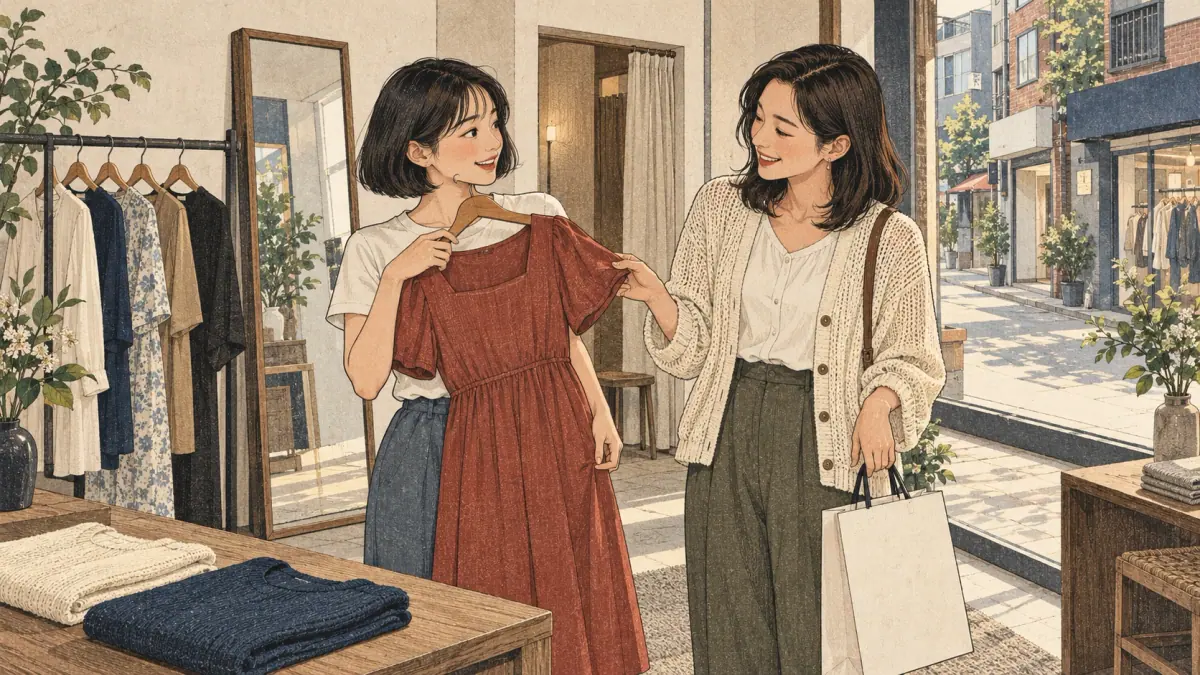
언니
언니
What you'll learn
- Say 언니 aloud with an open ㅓ vowel and a held double n.
- Choose between 언니, 누나 and a name based on your gender, age and closeness.
- Use 언니 with polite or casual sentences.
- Avoid calling strangers, staff or younger women 언니.
Before you start: you need to read Hangul; romanization is shown as an aid and can be hidden. Time: about 10 minutes. Audio plays only when you press a button.
What Does Unnie Mean in Korean?
Unnie means "older sister" in Korean, from a woman's point of view. Korean sibling words change with the speaker's gender, so the same older sister is 언니 to her sister and 누나 to her brother.
| Speaker | Older female | Older male |
|---|---|---|
| Woman | 언니 (eonni) | 오빠 (oppa) |
| Man | 누나 (nuna) | 형 (hyeong) |
These four words reach far beyond the family. Korean uses them for friends, classmates, coworkers and celebrities, which is why 언니 appears constantly in K-dramas, K-pop and daily talk. The full set of family words is in Korean family members, and the dictionary-style entry is in older sister female speaker in Korean.
The table shows who says what; the next section shows how each word works in a sentence.
Which Forms of Unnie Should You Know?
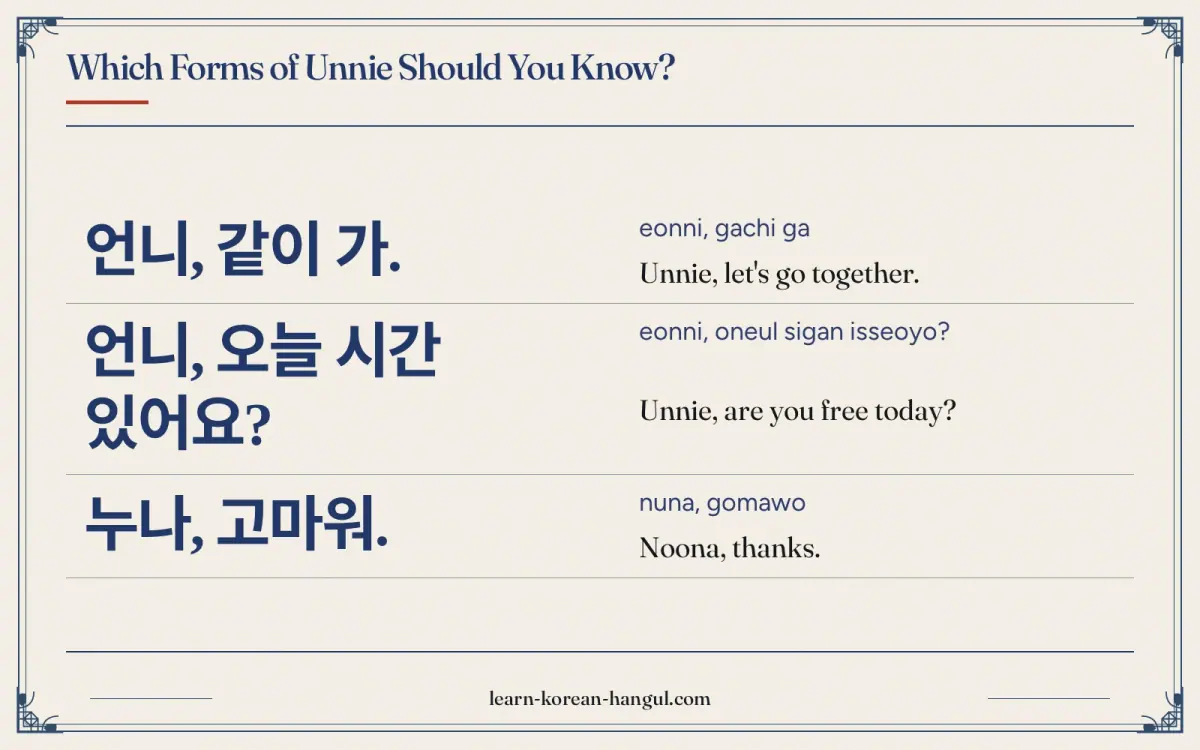
언니 does not change form for politeness the way verbs do. The sentence around it carries the politeness, and two related words cover a man speaking and an affectionate call.
Casual: 언니 (eonni)
Casual · 반말언니 is a family word, so it feels warm and close. A younger sister uses it with her sister, and a woman uses it with an older female friend. Put a name in front to make it specific: 지영 언니 (Jiyeong eonni).
언니, 같이 가.
eonni, gachi ga
Unnie, let's go together.
Polite Sentences with 언니
Polite · 해요체When two women are friendly but not yet close, the younger one often says 언니 with polite -요 endings. The title shows the relationship, and the -요 keeps a little respectful distance. Most pairs drop the -요 later, often after one asks 말 놓을까요? (Shall we speak casually?).
언니, 오늘 시간 있어요?
eonni, oneul sigan isseoyo?
Unnie, are you free today?
Casual: 누나 (nuna)
Casual · 반말누나 is what a man says where a woman would say 언니. Younger men use it for older sisters, cousins and close older female friends. The page on noona in Korean covers it in full.
누나, 고마워.
nuna, gomawo
Noona, thanks.
Casual: 언니야 (eonniya)
Casual · 반말언니야 adds the calling particle 야, used when you call out to someone. In Seoul speech, kinship words usually stand alone when calling, so 언니야 sounds affectionate, childlike or regional. Recognise it, and use plain 언니 yourself.
언니야, 빨리 와.
eonniya, ppalli wa
Unnie, come quickly.
The forms are set. Saying 언니 with the right vowel is the next step.
How Do You Pronounce 언니?
언니 is pronounced [언니], eonni, in two syllables. The first vowel is ㅓ, an open "uh" like the u in "but" said with the jaw a little lower, and the two n sounds are held across the syllable break.
- 언 (eon): open "uh", then the tongue touches behind the teeth for n.
- Hold the n for a moment.
- 니 (ni): release into a light "nee".
Sound Changes to Listen For
언니 has no sound change, because the spelling already shows how it sounds. The challenges are the vowel and the double n:
- ㅓ is not "oo". The fan spelling unnie suggests "oon", but ㅓ is open and unrounded. Saying "oon" moves the word toward 운 or 운니, which is not a word.
- The double n. ㄴ at the bottom of 언 meets ㄴ at the top of 니, so the n is longer than in 어니. Shortening it sounds slightly off.
- Plural 언니들. The plural marker -들 adds [들]: 언니들, eonnideul, as in "all my older sisters" or "the older members".
Revised Romanization, the official system for writing Korean in Latin letters, writes ㅓ as eo, giving eonni. K-pop fans more often write unnie or unni, an older habit closer to how ㅓ sounds to English ears. Choosing when to say 언니 at all matters more than the spelling, as the next section shows.
When Should You Call Someone Unnie, and When Should You Not?
Call someone 언니 only if you are female, she is older than you, and you know her personally. If any of those conditions fails, use her name with 씨, 누나 (if you are male), or a job title.
Situations Where It Fits
- Your own older sister or female cousin. 언니 is the normal word at any age.
- An older female friend, classmate or teammate. Usually with her name: 수빈 언니.
- Older female idols, as a fan. A standard fan habit among women.
- A senior woman in a club who has asked you to call her 언니. Many people invite this to show friendliness.
Situations to Avoid
- You are male. Use 누나.
- A woman younger than you. Use her name; 언니 must be older.
- Shop or restaurant staff you do not know. Say 저기요 (excuse me) to get attention; it is safer than 언니.
- A female boss or teacher. Use her title, such as 팀장님 or 선생님.
These rules are easier to feel in real exchanges, so here are three.
How Is Unnie Used in Real Conversations?
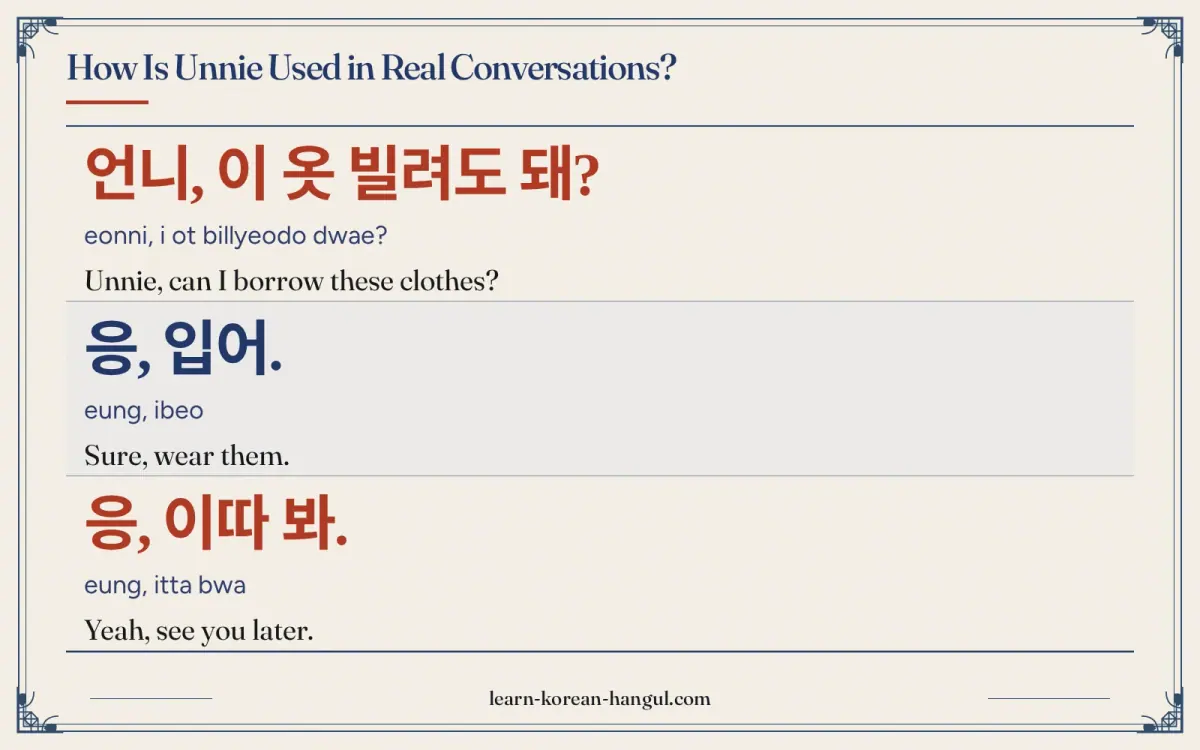
언니 often opens a sentence, the way English speakers start with a name. Listen to how the endings change with closeness.
A Younger Sister Borrows Clothes
Younger Sister
언니, 이 옷 빌려도 돼?
eonni, i ot billyeodo dwae?
Unnie, can I borrow these clothes?
Older Sister
응, 입어.
eung, ibeo
Sure, wear them.
What to notice: sisters use casual endings, and 언니 opens the request.
A First-Year Asks a Club Senior
Sua
지영 언니, 오늘 동아리 와요?
jiyeong eonni, oneul dongari wayo?
Jiyeong unnie, are you coming to the club today?
Jiyeong
응, 이따 봐.
eung, itta bwa
Yeah, see you later.
What to notice: Sua uses 언니 with a polite -요 ending, while the older Jiyeong answers casually.
The Youngest Member after a Performance
Youngest Member
언니들, 수고했어요.
eonnideul, sugohaesseoyo
Good work, unnies.
Leader
너도 수고했어.
neodo sugohaesseo
You too, good work.
What to notice: the plural 언니들 addresses all the older members at once. That group habit comes from a wider cultural pattern.
What Should You Know about the Culture behind Unnie?
Korean extends family words to people who are not relatives. Age decides who is the older sister, and closeness decides whether the family word is used at all.
- Age comes first. Koreans often ask age soon after meeting, because it decides whether someone is 언니, a friend (친구) or a younger sibling (동생).
- The same year means friends. Women born in the same year usually use names, not 언니, even if one birthday is months earlier.
- Groups and teams. In girl groups, sports teams and clubs, younger members call older ones 언니, and the youngest member is the 막내.
- Friendly invitation. An older woman saying 언니라고 불러 (call me unnie) is offering closeness.
An expert insight: learners often treat 언니 as a fan word for any woman they admire. Actually, its core is a real relationship: older, female and known to you. That is why a K-pop fan can call an idol 언니 at a concert, but the same fan would not call an older stranger on the bus 언니. The common mistakes below come from these rules.
What Mistakes Do Learners Make with Unnie in Korean?
Most unnie mistakes come from the speaker's gender, from age, or from the vowel ㅓ.
| Mistake | Why it is a problem | Fix |
|---|---|---|
| A man calling an older woman 언니 | 언니 is for female speakers | Say 누나 |
| Calling a younger woman 언니 | 언니 must be older | Use her name with 씨 |
| Calling an unknown waitress 언니 | Overfamiliar | Say 저기요 |
| Saying "oon-nee" | ㅓ is open, not "oo" | Open the jaw for [언] |
| Writing 어니 with one ㄴ | Drops the final ㄴ of 언 | Write 언니 |
Learners often assume that 언니 forces casual speech. Actually, 언니, 오늘 시간 있어요? is a normal sentence: the title shows the relationship, and the -요 ending keeps it polite.
Other Ways People Search for Unnie in Korean
People search for unnie in Korean in many spellings. The short answers below cover each one.
- Unni in Korean / eonni in Korean: the same word, 언니; eonni is the Revised Romanization, and unni and unnie are fan spellings. Romanization is an aid, not the real spelling.
- Unnie meaning / unni meaning: older sister, said by a woman; also an older female friend.
- What does unnie mean / what does unnie mean in Korean: the same answer, 언니.
- Unnie for men: men say 누나; the female-to-male counterpart is 오빠, covered in oppa in Korean.
Reading the rules is one thing; producing the right word on cue is another, so practise now.
Practice: Say It Aloud
Play the slow clip of 언니, repeat it three times, then try 언니들. Then choose a term for each situation. Answers follow.
- You are a woman, and you call your older sister to the phone.
- You are a man, and you thank an older female coworker you are close to.
- You are a woman, and you greet a female classmate born in the same year.
- You are a woman, and you want a café worker's attention.
Answers
- 언니, 전화 왔어 (Unnie, there's a call for you).
- 누나, 고마워요.
- Her name, not 언니.
- 저기요.
Drill 언니 and the related terms with the phrase flashcards, which include audio for each form.
Related Terms to Learn Next
언니 is one of four sibling words Koreans use with friends as well as family.
- Oppa in Korean: 오빠, a woman's word for an older man; learn it next.
- Noona in Korean: 누나, a man's word for an older woman.
- Hyung in Korean: 형, a man's word for an older man.
This guide belongs to the Korean terms of address collection. What this page does not cover: in-law terms, regional dialects in depth and the history of kinship terms. Use 언니 only as a woman, only for an older woman you know, and you will use unnie in Korean the way native speakers do.
Frequently Asked Questions
Can a man say unnie?
Not in standard use. Korean sibling words depend on the speaker's gender, so a man calls an older sister or an older female friend 누나, and only women say 언니. A man saying 언니 to a friend sounds like a joke. You may hear men use 언니 to some shop or restaurant staff, but many people find that habit overfamiliar.
Can I call a waitress or shop worker unnie?
Some customers do, especially women talking to young female staff, but it is overfamiliar and not everyone likes it. The safe way to get attention is 저기요 (excuse me). In small family restaurants, 사장님 (boss) is a polite way to address the owner. Use 언니 only for women you actually know.
Do you use 언니 with polite or casual speech?
Either, depending on closeness. A woman talks to her own 언니 casually. With a newer friend or a university senior, she often says 언니 with polite -요 endings, as in 언니, 시간 있어요? As they get closer, they may agree to drop the -요. The word 언니 stays the same at both levels.
Is someone born in the same year your unnie?
Usually not. Women born in the same year are 친구 (friends) and use names. 언니 is for someone older, even by one year. The 빠른 생일 case, someone born in January or February who started school a year early, can blur this, and groups agree case by case who counts as 언니.
How do you write unnie in Hangul?
Unnie is written 언니 in Hangul, two blocks. The first block is 언: silent ㅇ, the vowel ㅓ and ㄴ at the bottom. The second is 니: ㄴ with the vowel ㅣ. Unnie, unni and eonni are all Latin spellings of the same word; eonni is the official Revised Romanization.
What is the most common mistake with unnie in Korean?
The most common mistake is a male learner calling an older woman 언니; men say 누나. The second is calling a younger woman 언니, since 언니 must be older than the speaker. A third is saying "oon-nee" with an English u; the first vowel ㅓ is an open "uh".