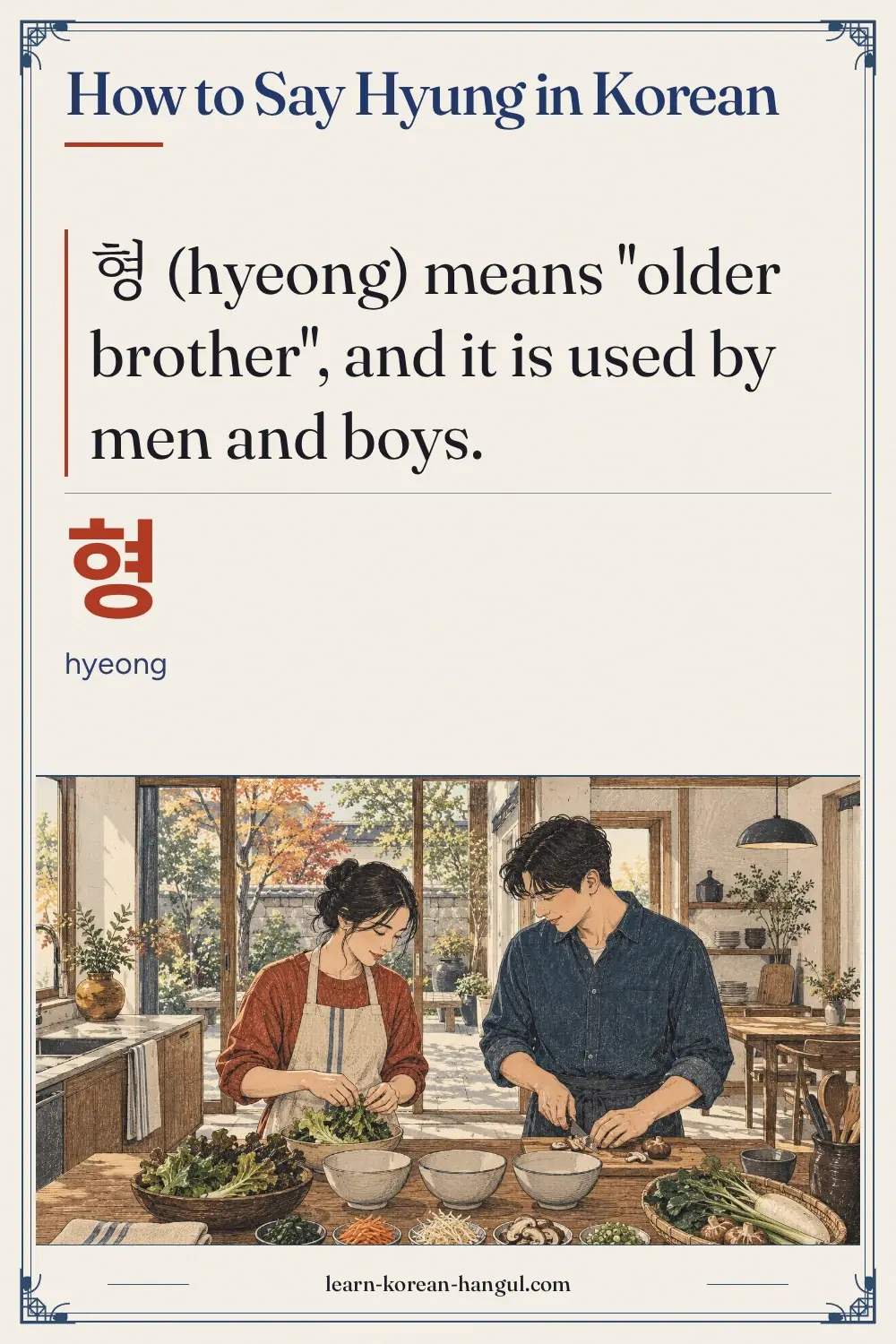
형
형
What you'll learn
- Say 형 aloud with the ㅕ glide and a final ng.
- Choose between 형, 형님 and 오빠 based on your gender, age and the setting.
- Use 형 with a name and with polite or casual sentences.
- Avoid calling a boss, a teacher or a younger man 형.
Before you start: you need to read Hangul; romanization is shown as an aid and can be hidden. Time: about 10 minutes.
What Does Hyung Mean in Korean?
Hyung means "older brother" in Korean, from a man's point of view. Korean sibling words change with the speaker's gender, so the same older brother is 형 to his brother and 오빠 to his sister.
| Speaker | Older male | Older female |
|---|---|---|
| Man | 형 (hyeong) | 누나 (nuna) |
| Woman | 오빠 (oppa) | 언니 (eonni) |
These four words reach well beyond the family. A young Korean man may call a dozen people 형: cousins, classmates, teammates, coworkers and friends of friends. The full family word set is in Korean family members, and the dictionary-style entry is in older brother in Korean.
The table shows who says what; the next section shows each form in a sentence. The endings around the word follow the Korean speech levels.
Which Forms of Hyung Should You Know?
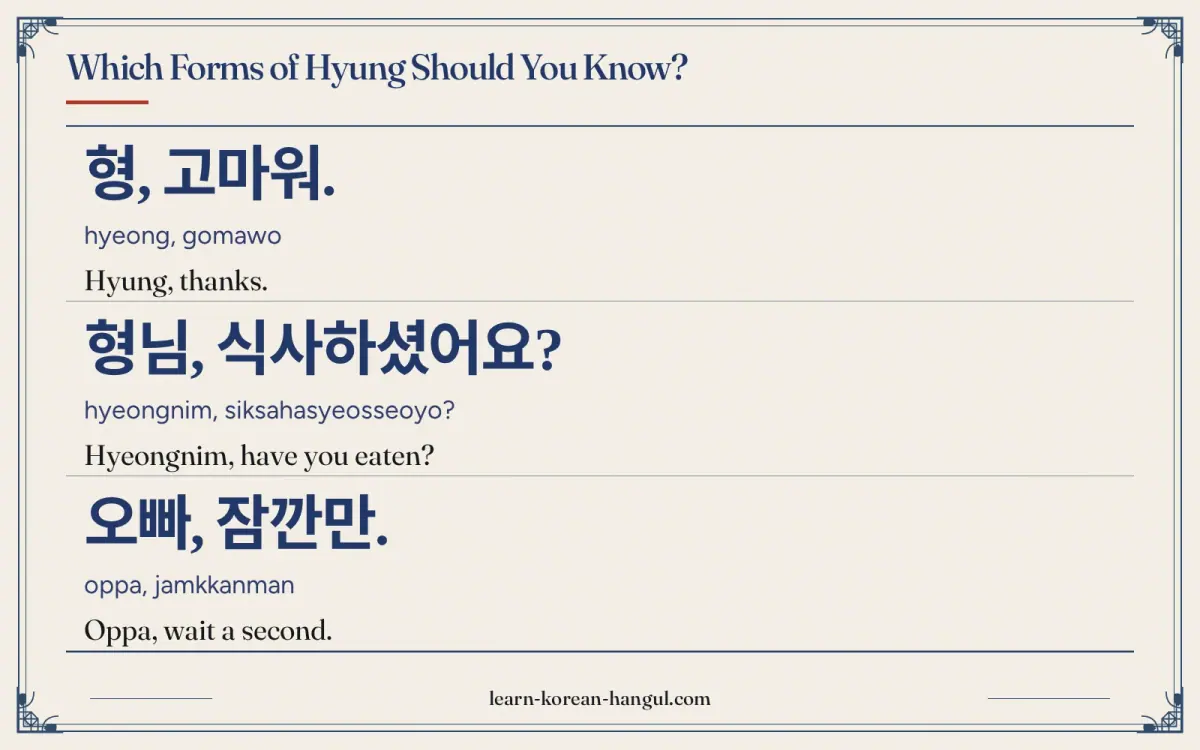
형 does not change for politeness the way verbs do. The sentence around it carries most of the politeness, and a few related words add respect or cover a woman speaking.
Casual: 형 (hyeong)
Casual · 반말형 is a family word, so it sounds warm and loyal. A younger brother uses it with his brother, and a man uses it with an older male friend. Put a name in front to make it specific: 민수 형 (Minsu hyeong).
형, 고마워.
hyeong, gomawo
Hyung, thanks.
Polite: 형님 (hyeongnim)
Polite · 해요체형님 adds the honorific suffix -님. Adult men use it for older men they respect, such as a friend's older brother, a senior in a club, or an older brother-in-law. It sounds mature and a little formal, so teenagers rarely use it with each other.
형님, 식사하셨어요?
hyeongnim, siksahasyeosseoyo?
Hyeongnim, have you eaten?
For Women: 오빠 (oppa)
Casual · 반말오빠 is what a woman says where a man would say 형. If you are female, this is the word you need. The page on oppa in Korean covers it in full, including its romantic use.
오빠, 잠깐만.
oppa, jamkkanman
Oppa, wait a second.
For Older Women: 누나 (nuna)
Casual · 반말누나 is a man's word for an older sister or older female friend, the female partner of 형. Men use the two words side by side every day. The page on noona in Korean explains it.
누나, 같이 가.
nuna, gachi ga
Noona, let's go together.
The forms are set. Saying 형 with the right vowel is the next step.
How Do You Pronounce 형?
형 is pronounced [형], hyeong, in a single syllable. It starts with a soft h, glides through y into the open vowel ㅓ, and ends with ng, the sound at the end of "sing".
- ㅎ (h): a light breath.
- ㅕ (yeo): a quick y glide into an open "uh", as in "yuck" with the jaw lower.
- ㅇ (ng): close off with the back of the tongue, without adding a g.
Sound Changes to Listen For
형 has no sound change of its own, but three points shape what you hear:
- ㅕ, not "u". The fan spelling hyung suggests "hung", but ㅕ is [jʌ]: y plus an open vowel. Without the y, the word drifts toward 헝, which is not the term.
- Final ng flows on. In 형님, the ng runs straight into 님 with no break: hyeong-nim. In 형이 (hyeong + subject particle), the ng stays at the end of the first syllable and does not move.
- 형아 for children. Small boys add the calling particle 아: 형아, said hyeong-a.
Revised Romanization, the official system for writing Korean in Latin letters, writes ㅕ as yeo, giving hyeong. Fans more often write hyung, an informal spelling. Choosing when to say 형 matters more than the spelling, as the next section shows.
When Should You Call Someone Hyung, and When Should You Not?
Call someone 형 only if you are male, he is older than you, and you are close to him. If any of those conditions fails, use his name with 씨, 오빠 (if you are female), or a job title.
Situations Where It Fits
- Your own older brother or male cousin. 형 is the normal word at any age.
- An older male friend, teammate or classmate. Usually with his name: 준호 형.
- An older male idol, as a male fan. A common fan habit.
- A respected older man, as an adult. 형님, when you know him well.
Situations to Avoid
- You are female. Use 오빠.
- A boss or teacher in a formal setting. Use a title, such as 팀장님, 부장님 or 선생님.
- A man younger than you. Use his name; 형 must be older.
- A stranger. It sounds overfamiliar; say 저기요 (excuse me).
These rules are easier to feel in real exchanges, so here are three.
How Is Hyung Used in Real Conversations?
형 often opens a sentence, the way English speakers start with a name. Listen to how the endings change with closeness and age.
A Younger Brother Wants to Play
Younger Brother
형, 게임 같이 할래?
hyeong, geim gachi hallae?
Hyung, want to play a game together?
Older Brother
숙제 다 했어?
sukje da haesseo?
Did you finish your homework?
What to notice: brothers use casual endings, and the older brother acts a little like a parent.
A New Player Asks an Older Teammate
Junho
민수 형, 오늘 연습 몇 시예요?
minsu hyeong, oneul yeonseup myeot siyeyo?
Minsu hyeong, what time is practice today?
Minsu
일곱 시. 늦지 마.
ilgop si. neutji ma
Seven. Don't be late.
What to notice: Junho uses 형 with a polite -요 ending, while the older Minsu answers casually.
Two Adult Men at a Family Dinner
Younger Man
형님, 한 잔 받으세요.
hyeongnim, han jan badeuseyo
Hyeongnim, please have a drink.
Older Man
그래, 고맙다.
geurae, gomapda
All right, thanks.
What to notice: 형님 and the honorific -으세요 show respect, while the older man answers in plain casual speech. These habits rest on a wider cultural pattern.
What Should You Know about the Culture behind Hyung?
Korean extends family words to men who are not relatives, and 형 is one of the most widely used. Age sets the order, and the relationship brings duties on both sides.
- Age decides. Even one year makes someone 형. Men born in the same year are 친구 (friends) and use names.
- Loyalty and duty. A 형 often pays for meals and gives advice, and the younger man shows respect and helps out. The bond can feel like a real brotherhood.
- Teams and groups. In sports teams, the army and boy groups, younger members call older ones 형, and the youngest is the 막내.
- Older male idols. Male fans call older idols 형, while female fans say 오빠.
An expert insight: learners often assume 형님 is just a more polite 형 to use with any older man. Actually, 형님 also carries a mature, sometimes tough image; films about gangsters use it heavily for bosses. Between ordinary friends in their twenties, 형 with polite -요 sentences is more natural than 형님. The common mistakes below come from these rules.
What Mistakes Do Learners Make with Hyung in Korean?
Most hyung mistakes come from the speaker's gender, from the setting, or from the vowel ㅕ.
| Mistake | Why it is a problem | Fix |
|---|---|---|
| A woman calling an older man 형 | 형 is for male speakers | Say 오빠 |
| Calling a boss 형 at work | Too casual for the office | Use 팀장님 or 부장님 |
| Calling a younger man 형 | 형 must be older | Use his name |
| Saying "hung" without the y | ㅕ is [jʌ] | Say [형], hyeong |
| Using 형님 with a close friend your age | 형님 is for older men | Use his name |
Learners often assume that 형 requires casual speech. Actually, 형, 오늘 연습 몇 시예요? is normal: the title shows the relationship, and the -요 ending keeps respect until the older man suggests dropping it.
Other Ways People Search for Hyung in Korean
People search for hyung in Korean in several spellings and forms. The short answers below cover each one.
- Hyeong in Korean: the same word, 형; hyeong is the Revised Romanization, and hyung is the common fan spelling. Romanization is an aid, not the real spelling.
- Hyung meaning / what does hyung mean: older brother, said by a man; also an older male friend.
- What does hyung mean in Korean: the same answer, 형.
- Hyung korean: 형, written in one Hangul block.
- Hyung for women: women say 오빠; the woman-to-woman counterpart is 언니, covered in unnie in Korean.
Reading the rules is one thing; producing the right word on cue is another, so practise now.
Practice: Say It Aloud
Play the slow clip of 형, repeat it three times, then try 형님 and 형아. Then choose a term for each situation. Answers follow.
- You are a man, and you ask your older brother to lend you a jacket.
- You are a woman, and you thank an older male classmate.
- You are a man, and you greet a team manager at the office.
- You are a man in your thirties, and you greet a respected older friend at his home.
Answers
- 형, 재킷 좀 빌려줘 (Hyung, lend me your jacket).
- 오빠, 고마워요.
- 팀장님, 안녕하세요.
- 형님, 안녕하세요.
Drill 형 and the related terms with the phrase flashcards, which include audio for each form.
Related Terms to Learn Next
형 is one of four sibling words Koreans use with friends as well as family.
- Oppa in Korean: 오빠, the word women use instead; learn it next.
- Noona in Korean: 누나, a man's word for an older woman.
- Unnie in Korean: 언니, a woman's word for an older woman.
This guide belongs to the Korean terms of address collection. What this page does not cover: in-law terms in detail, regional dialects and the history of kinship terms. Use 형 only as a man, only for an older man you know, and you will use hyung in Korean the way native speakers do.
Frequently Asked Questions
Can a woman call someone hyung?
In standard use, no. Korean sibling words depend on the speaker's gender, so a woman calls an older brother or older male friend 오빠, and only men say 형. A woman saying 형 to a man sounds unusual, although you may hear it as a joke or in some tight-knit teams where everyone copies the men's usage.
What is the difference between 형 and 형님?
Both mean older brother from a man's point of view. 형 is warm and everyday, used with real brothers and close older friends. 형님 adds the honorific -님, so it sounds respectful, mature and a little formal. Adult men use 형님 with older men they respect, and younger men may switch to it after military service or at work.
Can I call my boss hyung?
Not at work. In an office, use the job title with 님, such as 팀장님 or 부장님, even if he is only a little older. Some men call a close senior 형 after work or in private, but only when he has invited it. Using 형 in a meeting would sound unprofessional to everyone listening.
What does 형아 mean?
형아 is 형 plus the calling particle 아, a form small boys use for an older brother or an older boy. It sounds childlike and cute, so adults use it only as a joke or when talking to children, as in 형아한테 물어봐 (ask the big brother). Grown men simply say 형.
How do you write hyung in Hangul?
Hyung is written 형 in Hangul, one block. The consonant ㅎ sits at the top left, the vowel ㅕ to its right, and ㅇ at the bottom as the final ng sound. Hyung is a fan spelling; hyeong is the official Revised Romanization. 형님 adds a second block, 님.
What is the most common mistake with hyung in Korean?
The most common mistake is a female learner calling an older man 형; women say 오빠. The second is calling a boss or teacher 형 at work, where a title is expected. A third is saying the vowel like "hung" with an English u; ㅕ starts with a y glide, so say "hyuhng".