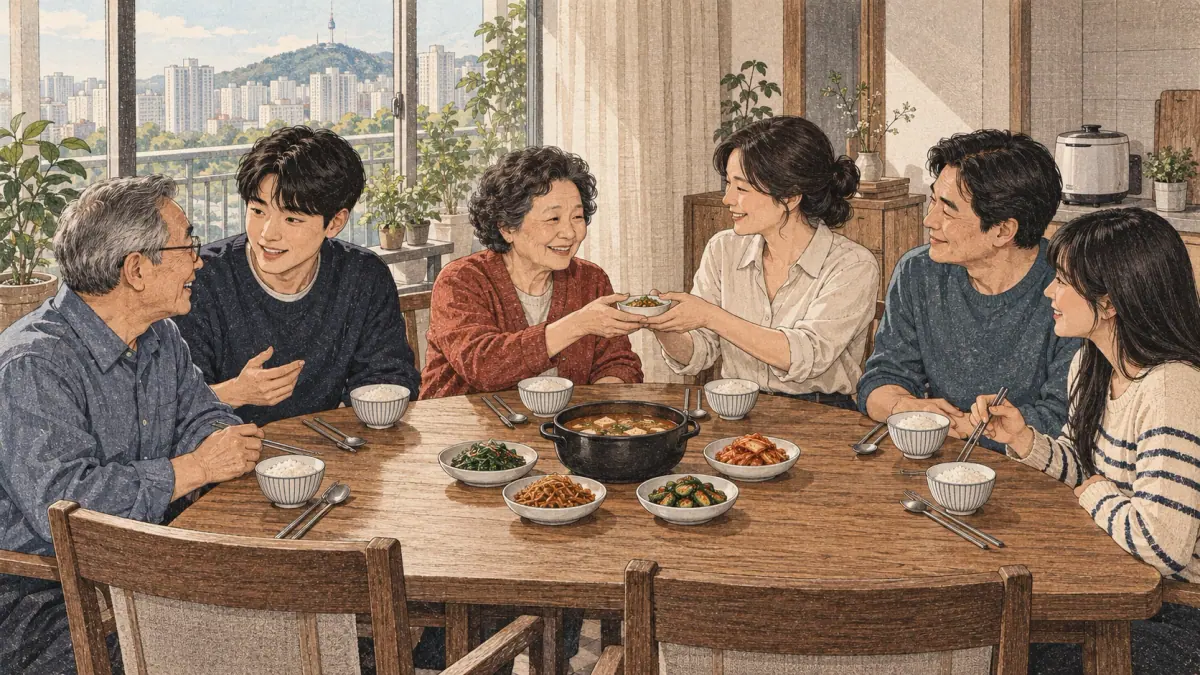
Korean Family Members at a Glance
This list has 40 words in five groups. It starts with the household, moves to grandparents, then siblings, then your own spouse and children, and ends with the wider family. It sits inside People and Relationships, next to Jobs and Occupations and Relationships and Titles.
| Group | Words | Use |
|---|---|---|
| Family and parents | 8 | Introducing your household and parents |
| Grandparents | 7 | Naming grandparents on either side |
| Siblings | 10 | Brothers, sisters and birth order |
| Spouse and children | 8 | Partners, children and grandchildren |
| Relatives | 7 | Aunts, uncles, cousins and the wider family |
English has one word for a mother's brother and a father's brother, "uncle". Korean has several, and the last group of this page shows why a single English gloss is never enough. The next section says which words to learn first.
Which Korean Family Words Should You Learn First?
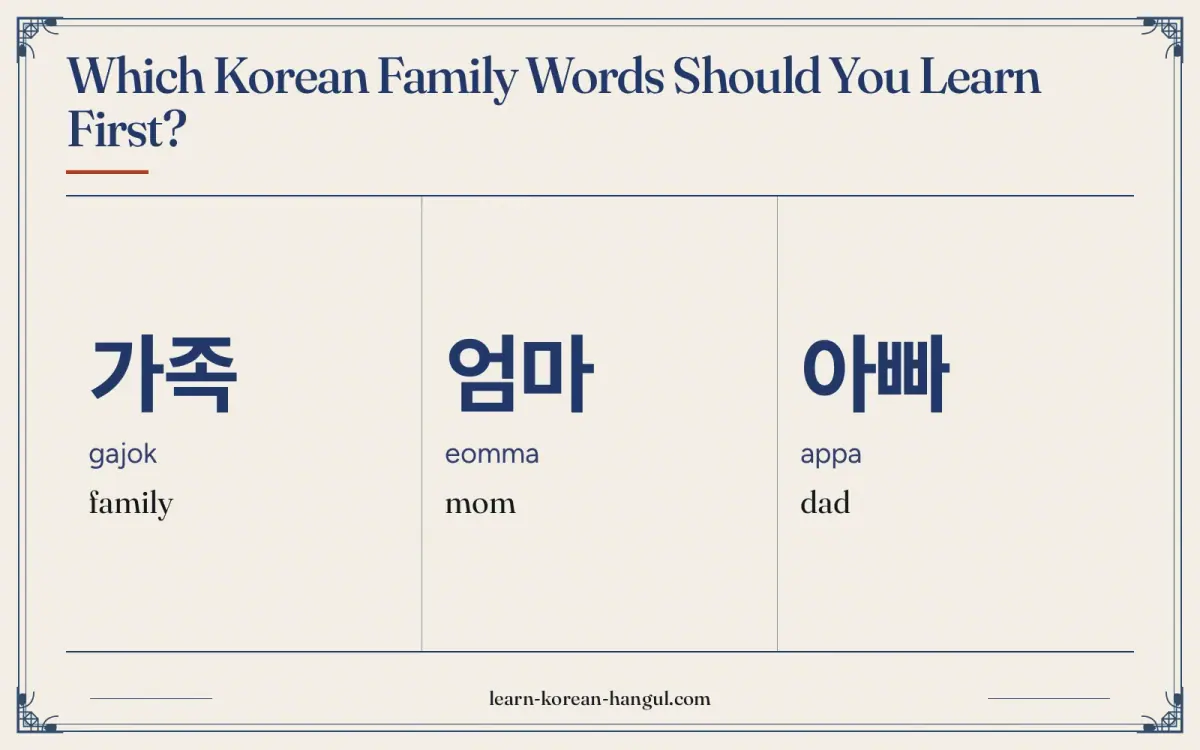
Learn 가족 (family), 엄마, 아빠 and the sibling words for the people you will actually talk about: 언니 or 누나 for an older sister, 오빠 or 형 for an older brother, and 동생 for a younger sibling. These words cover most self-introductions. Add 어머니 and 아버지 when you need to speak politely about your parents to a teacher, a boss or an older stranger.
- Words to say about yourself. 엄마, 아빠, 동생, 아들, 딸, 남편, 아내.
- Words to say politely to others. 어머니, 아버지, 부모님, 할머니, 할아버지.
- Words to recognise. 친척, 조카, 사촌 and the maternal and paternal labels such as 외할머니.
One habit surprises English speakers. Koreans usually say 우리 (our) where English says "my" for family and home, so a person calls their mother 우리 엄마, literally "our mom". The word 우리 marks the family as a group, not one person's property.
Word · 8
- 1
가족
gajok
family
- 2
엄마
eomma
mom
- 3
아빠
appa
dad
- 4
할머니
halmeoni
grandmother
- 5
할아버지
harabeoji
grandfather
- 6
언니
eonni
older sister (a woman's)
- 7
동생
dongsaeng
younger sibling
- 8
아들
adeul
son
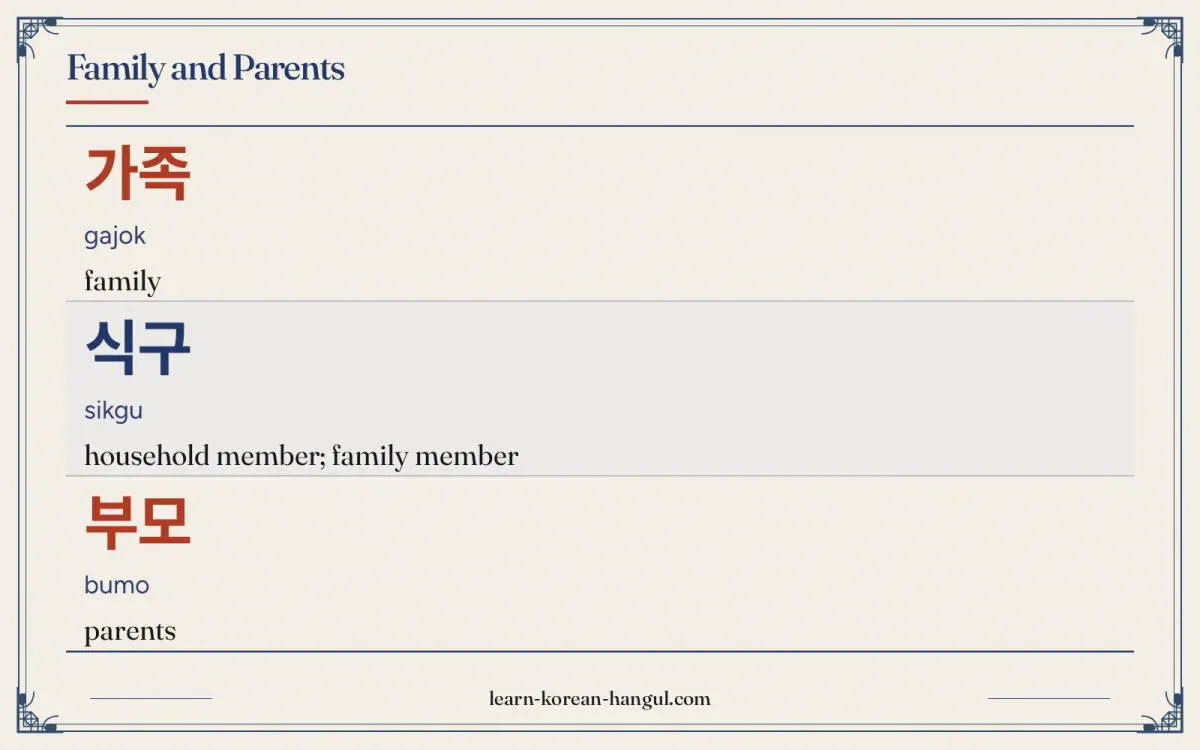
Family and Parents
Every conversation about family starts with the household itself. These eight words name the family as a unit and the two people at its centre, each in a casual and a formal form. Learn them as pairs, since the choice between them says how polite you are being.
| No. | Hangul | Revised Romanization | Meaning and note | Example sentence | Audio assetId |
|---|---|---|---|---|---|
| 1 | 가족 | gajok | family. 가 here is the Sino-Korean 家 (house) and 족 means clan or group. The standard word for family as a unit. | 우리 가족은 네 명이에요. (There are four people in my family.) | au-pg-vocabulary-people-family-1; example: au-pg-vocabulary-people-family-2 |
| 2 | 식구 | sikgu | household member; family member. Literally "mouth to feed". It counts the people who live and eat together, and counts with 명 or by itself. | 식구가 몇 명이에요? (How many people are in your household?) | au-pg-vocabulary-people-family-3; example: au-pg-vocabulary-people-family-4 |
| 3 | 부모 | bumo | parents. The plain written word. In speech people add the respectful ending and say 부모님. | 부모와 아이가 같이 와요. (Parent and child come together.) | au-pg-vocabulary-people-family-5; example: au-pg-vocabulary-people-family-6 |
| 4 | 부모님 | bumonim | parents (respectful). The honorific suffix 님 makes it polite. Use it for your own parents when talking to others. | 부모님은 서울에 사세요. (My parents live in Seoul.) | au-pg-vocabulary-people-family-7; example: au-pg-vocabulary-people-family-8 |
| 5 | 엄마 | eomma | mom. The warm everyday word. Adults still use it with friends and family. | 엄마는 지금 집에 있어요. (Mom is at home now.) | au-pg-vocabulary-people-family-9; example: au-pg-vocabulary-people-family-10 |
| 6 | 아빠 | appa | dad. The casual partner of 엄마. Fathers are rarely called this in formal speech. | 아빠가 요리해요. (Dad is cooking.) | au-pg-vocabulary-people-family-11; example: au-pg-vocabulary-people-family-12 |
| 7 | 어머니 | eomeoni | mother. The formal word. Use it when speaking about your mother to a teacher or a boss, or when addressing someone else's mother. | 어머니께서 오셨어요. (Your mother has come.) | au-pg-vocabulary-people-family-13; example: au-pg-vocabulary-people-family-14 |
| 8 | 아버지 | abeoji | father. The formal partner of 어머니. The honorific -시- in 다니세요 shows respect to the father. | 아버지는 회사에 다니세요. (My father works at a company.) | au-pg-vocabulary-people-family-15; example: au-pg-vocabulary-people-family-16 |
The pairs 엄마 and 아빠 against 어머니 and 아버지 are the clearest register contrast on the page. With friends, 엄마 and 아빠 are fine. In a self-introduction to someone older, say 어머니 and 아버지, or use the safe plural 부모님. To ask about someone else's mother politely, use 어머님, the more respectful form, with the verb ending 세요. For the other titles used outside the family, see terms of address.
Grandparents
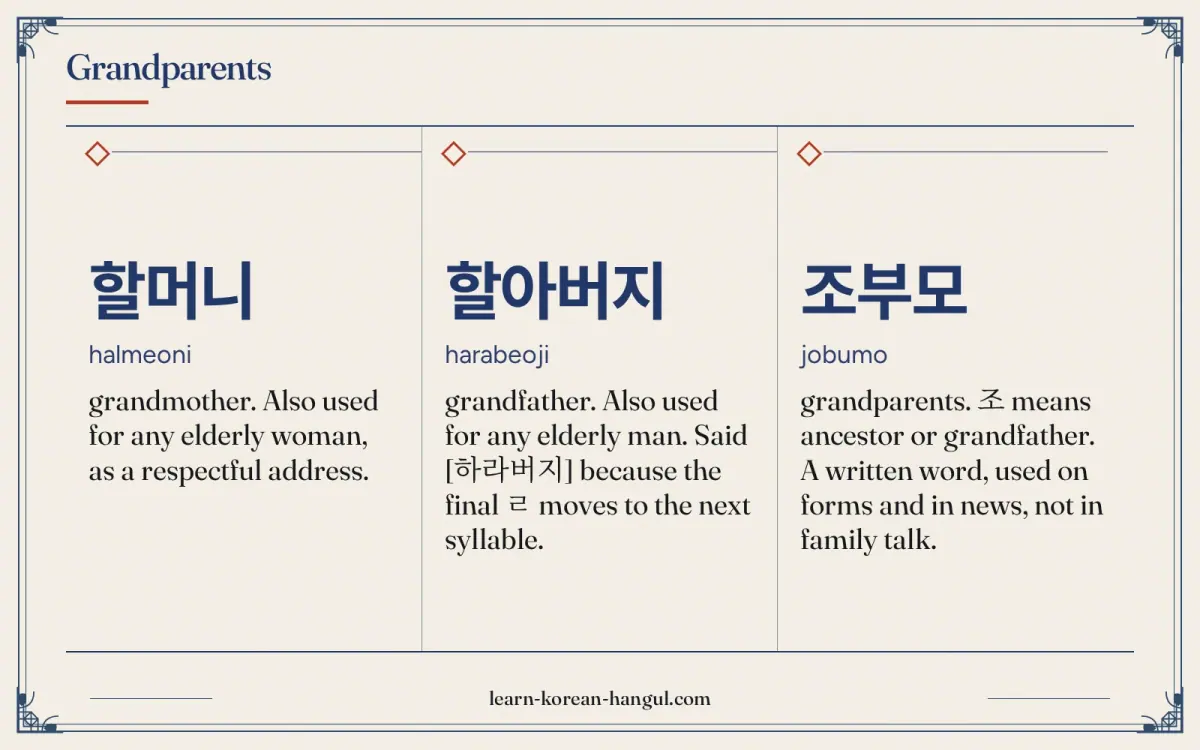
Korean splits grandparents by family side more often than English does. Seven words cover the basic pair, the written plural and the four side-specific terms, which you will hear when a speaker needs to say which grandmother they mean.
| No. | Hangul | Revised Romanization | Meaning and note | Example sentence | Audio assetId |
|---|---|---|---|---|---|
| 9 | 할머니 | halmeoni | grandmother. Also used for any elderly woman, as a respectful address. | 할머니는 시골에 사세요. (My grandmother lives in the countryside.) | au-pg-vocabulary-people-family-17; example: au-pg-vocabulary-people-family-18 |
| 10 | 할아버지 | harabeoji | grandfather. Also used for any elderly man. Said [하라버지] because the final ㄹ moves to the next syllable. | 할아버지가 신문을 읽으세요. (Grandfather is reading the newspaper.) | au-pg-vocabulary-people-family-19; example: au-pg-vocabulary-people-family-20 |
| 11 | 조부모 | jobumo | grandparents. 조 means ancestor or grandfather. A written word, used on forms and in news, not in family talk. | 조부모와 같이 살아요. (I live with my grandparents.) | au-pg-vocabulary-people-family-21; example: au-pg-vocabulary-people-family-22 |
| 12 | 친할머니 | chinhalmeoni | paternal grandmother. 친 marks the father's side. Many Koreans say this to be clear which grandmother they mean. | 친할머니는 부산에 계세요. (My paternal grandmother is in Busan.) | au-pg-vocabulary-people-family-23; example: au-pg-vocabulary-people-family-24 |
| 13 | 친할아버지 | chinharabeoji | paternal grandfather. The partner word on the father's side. | 친할아버지는 선생님이셨어요. (My paternal grandfather was a teacher.) | au-pg-vocabulary-people-family-25; example: au-pg-vocabulary-people-family-26 |
| 14 | 외할머니 | oehalmeoni | maternal grandmother. 외 marks the mother's side. The word means "outside grandmother", reflecting the old family-line system. | 외할머니가 김치를 보내 주셨어요. (My maternal grandmother sent me kimchi.) | au-pg-vocabulary-people-family-27; example: au-pg-vocabulary-people-family-28 |
| 15 | 외할아버지 | oeharabeoji | maternal grandfather. The partner word on the mother's side. | 외할아버지는 낚시를 좋아하세요. (My maternal grandfather likes fishing.) | au-pg-vocabulary-people-family-29; example: au-pg-vocabulary-people-family-30 |
The prefixes 친 and 외 do the work English leaves to a clause such as "my mother's father". Most families say 할머니 and 할아버지 alone and add the prefix only when both sets of grandparents are in the same conversation. The deeper set, with aunts and uncles on each side, is on the paternal and maternal relatives page.
Siblings
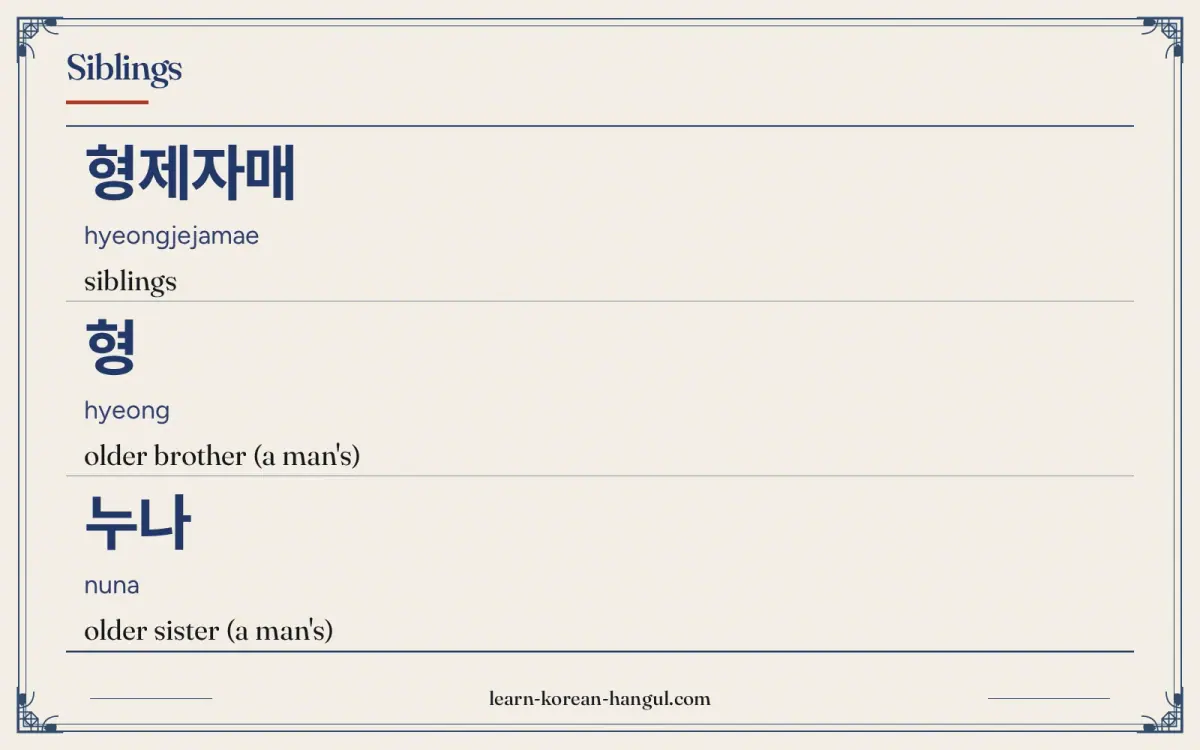
Sibling words carry more information than their English equivalents, because Korean always marks who is older and, for older siblings, who is speaking. Ten words cover the set, including birth-order labels for the youngest child and an only child.
| No. | Hangul | Revised Romanization | Meaning and note | Example sentence | Audio assetId |
|---|---|---|---|---|---|
| 16 | 형제자매 | hyeongjejamae | siblings. Literally "brothers and sisters". It is the formal word for the whole set of siblings. | 형제자매가 몇 명이에요? (How many siblings do you have?) | au-pg-vocabulary-people-family-31; example: au-pg-vocabulary-people-family-32 |
| 17 | 형 | hyeong | older brother (a man's). Used by a male speaker for an older brother or a close older male friend. | 형은 대학생이에요. (My older brother is a university student.) | au-pg-vocabulary-people-family-33; example: au-pg-vocabulary-people-family-34 |
| 18 | 누나 | nuna | older sister (a man's). Used by a male speaker for an older sister or a close older woman. | 누나가 전화했어요. (My older sister called.) | au-pg-vocabulary-people-family-35; example: au-pg-vocabulary-people-family-36 |
| 19 | 오빠 | oppa | older brother (a woman's). Used by a female speaker for an older brother or a close older man. | 오빠는 회사에 다녀요. (My older brother works at a company.) | au-pg-vocabulary-people-family-37; example: au-pg-vocabulary-people-family-38 |
| 20 | 언니 | eonni | older sister (a woman's). Used by a female speaker for an older sister or a close older woman. | 언니는 학교에 가요. (My older sister goes to school.) | au-pg-vocabulary-people-family-39; example: au-pg-vocabulary-people-family-40 |
| 21 | 동생 | dongsaeng | younger sibling. Neutral about gender and speaker. 남동생 and 여동생 add the sex. | 동생이 한 명 있어요. (I have one younger sibling.) | au-pg-vocabulary-people-family-41; example: au-pg-vocabulary-people-family-42 |
| 22 | 남동생 | namdongsaeng | younger brother. 남 means male. Sounds as written. | 남동생은 고등학생이에요. (My younger brother is a high school student.) | au-pg-vocabulary-people-family-43; example: au-pg-vocabulary-people-family-44 |
| 23 | 여동생 | yeodongsaeng | younger sister. 여 means female. Sounds as written. | 여동생이 노래를 잘해요. (My younger sister sings well.) | au-pg-vocabulary-people-family-45; example: au-pg-vocabulary-people-family-46 |
| 24 | 막내 | mangnae | youngest child. The youngest in a family or a group. Said [망내], so RR is mangnae (often spelled maknae in K-pop, following the letters). | 제가 막내예요. (I am the youngest.) | au-pg-vocabulary-people-family-47; example: au-pg-vocabulary-people-family-48 |
| 25 | 외동딸 | oedongttal | only daughter. 외동 means a single child; 외동아들 is the matching word for an only son. | 저는 외동딸이에요. (I am an only daughter.) | au-pg-vocabulary-people-family-49; example: au-pg-vocabulary-people-family-50 |
Use the table below to pick the right word. The word depends on who is speaking and on whether the sibling is older.
| Older brother | Older sister | Younger sibling | |
|---|---|---|---|
| A man says | 형 | 누나 | 동생 |
| A woman says | 오빠 | 언니 | 동생 |
Age decides the word. To say "my brother" in Korean, you first need to know whether he is older or younger. Older siblings do not call a younger sibling 동생 to their face; they use the name with 아 after a consonant or 야 after a vowel, as in 지현아 or 민수야.
Spouse and Children
These eight words name your own partner, your children and your grandchildren. They are plain, widely used words, and most of them also appear on forms and in the news.
| No. | Hangul | Revised Romanization | Meaning and note | Example sentence | Audio assetId |
|---|---|---|---|---|---|
| 26 | 남편 | nampyeon | husband. The plain word for a woman's own husband. | 남편은 의사예요. (My husband is a doctor.) | au-pg-vocabulary-people-family-51; example: au-pg-vocabulary-people-family-52 |
| 27 | 아내 | anae | wife. The plain, slightly formal word for a man's wife. 와이프 is a casual loanword. | 아내는 선생님이에요. (My wife is a teacher.) | au-pg-vocabulary-people-family-53; example: au-pg-vocabulary-people-family-54 |
| 28 | 부부 | bubu | married couple. Stands for both partners together. Does not distinguish who is who. | 두 사람은 부부예요. (The two of them are a married couple.) | au-pg-vocabulary-people-family-55; example: au-pg-vocabulary-people-family-56 |
| 29 | 아들 | adeul | son. The plain word for son. Counted with 명 like other people. | 아들이 두 명 있어요. (I have two sons.) | au-pg-vocabulary-people-family-57; example: au-pg-vocabulary-people-family-58 |
| 30 | 딸 | ttal | daughter. The plain word for daughter. A single, tense ㄸ sound. | 딸이 학교에 가요. (My daughter goes to school.) | au-pg-vocabulary-people-family-59; example: au-pg-vocabulary-people-family-60 |
| 31 | 자녀 | janyeo | children (sons and daughters). The formal written word for one's children, as on forms. | 자녀가 몇 명이세요? (How many children do you have?) | au-pg-vocabulary-people-family-61; example: au-pg-vocabulary-people-family-62 |
| 32 | 손자 | sonja | grandson. A grandson, whether through a son or a daughter. 손녀 is the female partner. | 손자가 놀러 왔어요. (My grandson came to visit.) | au-pg-vocabulary-people-family-63; example: au-pg-vocabulary-people-family-64 |
| 33 | 손녀 | sonnyeo | granddaughter. A granddaughter, whether through a son or a daughter. | 손녀는 피아노를 쳐요. (My granddaughter plays the piano.) | au-pg-vocabulary-people-family-65; example: au-pg-vocabulary-people-family-66 |
You can say 아들 and 딸 about people of any age. English speakers sometimes expect a word for "kid"; Korean uses 아이 for a child in general and 자녀 only for "one's children" on forms and in news. In-laws, such as a husband's parents, have their own titles on the in-law titles page.
Relatives
The last group names the wider family. Korean separates the father's side from the mother's side at this level, and the seven words below show the main distinctions.
| No. | Hangul | Revised Romanization | Meaning and note | Example sentence | Audio assetId |
|---|---|---|---|---|---|
| 34 | 친척 | chincheok | relatives. The general word for the wider family, including cousins and in-laws. Said [친척]. | 친척이 많아요. (I have many relatives.) | au-pg-vocabulary-people-family-67; example: au-pg-vocabulary-people-family-68 |
| 35 | 삼촌 | samchon | uncle (father's brother). The dictionary meaning is any brother of the father, used especially for an unmarried one; in practice it usually means the father's unmarried younger brother. Children also use it for a close adult male friend of the family. | 삼촌은 미국에 살아요. (My uncle lives in the United States.) | au-pg-vocabulary-people-family-69; example: au-pg-vocabulary-people-family-70 |
| 36 | 외삼촌 | oesamchon | uncle (mother's brother). The 외 prefix marks the mother's side, as in the grandparent words. | 외삼촌이 선물을 줬어요. (My uncle gave me a present.) | au-pg-vocabulary-people-family-71; example: au-pg-vocabulary-people-family-72 |
| 37 | 고모 | gomo | aunt (father's sister). The father's sister. English has no way to say this without a clause. | 고모는 제주도에 살아요. (My aunt lives on Jeju Island.) | au-pg-vocabulary-people-family-73; example: au-pg-vocabulary-people-family-74 |
| 38 | 이모 | imo | aunt (mother's sister). The mother's sister. Also a friendly way to call a woman who works in a restaurant. | 이모가 요리를 잘해요. (My aunt cooks well.) | au-pg-vocabulary-people-family-75; example: au-pg-vocabulary-people-family-76 |
| 39 | 사촌 | sachon | cousin. Literally "four degrees". Used for a first cousin on any side. | 사촌과 같이 놀았어요. (I played with my cousin.) | au-pg-vocabulary-people-family-77; example: au-pg-vocabulary-people-family-78 |
| 40 | 조카 | joka | nephew; niece. The child of your brother or sister. The same word covers both sexes. | 조카가 귀여워요. (My nephew is cute.) | au-pg-vocabulary-people-family-79; example: au-pg-vocabulary-people-family-80 |
Notice how the word shapes show the side of the family. 고모 is the father's sister and 이모 the mother's sister, and 삼촌 against 외삼촌 shows the same split for uncles. A cousin is just 사촌 on every side. The wide gap with English is why the dedicated page is worth reading; here the goal is to recognise the words.
Do Koreans Say 우리 가족 or 내 가족?
Koreans usually say 우리 가족 (our family), not 내 가족 (my family). 내 is a short form of 나의 (my), and it is not wrong, but it sounds as if the family belongs to one person. The group form 우리 matches how Korean treats the household as a unit. The same rule applies to places the speaker's group shares, such as 우리 집 (our house) and 우리 학교 (our school).
The habit is fixed in everyday speech. A person calls their mother 우리 엄마, their older brother 우리 형, and their company 우리 회사. In polite speech to an older person, use the humble form 저희 (our): 저희 어머니, 저희 가족. For one's own spouse, 제 남편 and 우리 남편 are both used, and 제 남편 is common with strangers.
When you point out someone else's family, use the honorific title, 어머님 or 부모님, and the honorific subject particle 께서. To speak politely about a friend's father, say 아버님. The pairs are shown above; the register difference is the only extra you need.
How Do You Count Family Members?
A family of three is 세 명 (se myeong) or 세 식구 (se sikgu). Both are natural. Use 명 (person, counter) after a native Korean number that shortens before a counter: 한 명, 두 명, 세 명, 네 명. To ask about someone's family politely, say 가족이 어떻게 되세요? (Who is in your family?). The honorific counter for people is 분. The counting people page lists the full set.
Example: 우리 가족은 네 명이에요. 아빠, 엄마, 형, 그리고 저예요. (There are four in my family: dad, mom, my older brother and me.) The sentence frame is ○○은/는 ○○예요/이에요, with topic marker 은 after a consonant and 는 after a vowel.
How Do You Use These Words in a Self-Introduction?
A short family introduction needs only a few of the words above. Try this frame: 저는 [name]이에요/예요. 우리 가족은 [number] 명이에요. [Relatives] 그리고 저예요. After it, you can add a second sentence about a sibling: 저는 오빠가 한 명 있어요 (I have one older brother). The introducing yourself page has the opening lines.
Two cautions. First, Korean needs no separate verb for "have" here: 있어요 means "there is", so 저는 동생이 있어요 literally says "as for me, a younger sibling exists". Second, the sibling word you choose depends on gender and age, so check the table in the siblings section before you speak.
How Do You Pronounce Korean Family Words?
A few of these words change sound when spoken. The Hangul shows the written form, and the Revised Romanization of Korean records the spelling, not every sound change. The standard pronunciation rules published by the National Institute of Korean Language (국립국어원) decide the spoken form.
| Spelling | Sounds like | What changes |
|---|---|---|
| 할아버지 | [하라버지] | The final ㄹ of 할 moves to the empty first slot of 아. |
| 식구 | [식꾸] | After a final ㄱ, the ㄱ of 구 becomes a tense [ㄲ]. |
| 막내 | [망내] | The final ㄱ becomes [ㅇ] before ㄴ. |
| 친척 | [친척] | The final ㄱ is said without release at the end of the word. |
| 외동딸 | [외동딸] | The tense ㄸ is said tight, with no puff of air. |
| 조카 | [조카] | The aspirated ㅋ has a puff of air, unlike the plain ㄱ. |
The tense sounds in 식구 and 딸 are the ones learners miss most. Compare 딸 (daughter) with 달 (moon): the first is tight, the second is soft. Say 딸 by pressing your tongue tip firmly behind your upper teeth and releasing without a puff of air.
Audio and Slow Playback
Each headword and each example sentence has its own audio clip. The clips below replay the trickiest words at a slower pace. Play one, repeat it aloud, then play it again and compare.
What Mistakes Do Learners Make with Family Words?
These five mistakes come up most in Korean family talk.
- Mixing the speaker's gender in sibling words. A woman who says 형 is using a man's word. A woman says 오빠 and 언니; a man says 형 and 누나.
- Using 엄마 and 아빠 in formal situations. They are warm and casual. In a job interview, say 어머니 and 아버지, or 부모님.
- Translating "my" as 나의 every time. Koreans say 우리 엄마 and 우리 가족. In polite speech, use the humble 저희 (저희 어머니).
- Calling every uncle 삼촌. 삼촌 is the father's brother, usually a younger, unmarried one. The mother's brother is 외삼촌, and the father's older brother has his own term, 큰아버지.
- Using 동생 as if it were an older sibling. 동생 is always younger. Older siblings use the gendered words in the table above.
If you remember only one, remember the sibling table, because it comes up in almost every introduction.
Practice: Flashcards and Worksheet
Study in three steps. First, run the flashcard deck in recognition mode until you know each of the 40 words. Second, switch to listening mode and answer from the audio alone. Third, take the quiz. The deck covers all 40 words with audio, and your progress stays in your browser. The vocabulary flashcard decks page lists the other decks.
Practice · 85
- 01가족
Show answer
headword 1: family
- 02우리 가족은 네 명이에요.
Show answer
example sentence for 가족: There are four people in my family.
- 03식구
Show answer
headword 2: household member; family member
- 04식구가 몇 명이에요?
Show answer
example sentence for 식구: How many people are in your household?
- 05부모
Show answer
headword 3: parents
- 06부모와 아이가 같이 와요.
Show answer
example sentence for 부모: Parent and child come together.
- 07부모님
Show answer
headword 4: parents (respectful)
- 08부모님은 서울에 사세요.
Show answer
example sentence for 부모님: My parents live in Seoul.
- 09엄마
Show answer
headword 5: mom
- 10엄마는 지금 집에 있어요.
Show answer
example sentence for 엄마: Mom is at home now.
- 11아빠
Show answer
headword 6: dad
- 12아빠가 요리해요.
Show answer
example sentence for 아빠: Dad is cooking.
- 13어머니
Show answer
headword 7: mother
- 14어머니께서 오셨어요.
Show answer
example sentence for 어머니: Your mother has come.
- 15아버지
Show answer
headword 8: father
- 16아버지는 회사에 다니세요.
Show answer
example sentence for 아버지: My father works at a company.
- 17할머니
Show answer
headword 9: grandmother
- 18할머니는 시골에 사세요.
Show answer
example sentence for 할머니: My grandmother lives in the countryside.
- 19할아버지
Show answer
headword 10: grandfather
- 20할아버지가 신문을 읽으세요.
Show answer
example sentence for 할아버지: Grandfather is reading the newspaper.
- 21조부모
Show answer
headword 11: grandparents
- 22조부모와 같이 살아요.
Show answer
example sentence for 조부모: I live with my grandparents.
- 23친할머니
Show answer
headword 12: paternal grandmother
- 24친할머니는 부산에 계세요.
Show answer
example sentence for 친할머니: My paternal grandmother is in Busan.
- 25친할아버지
Show answer
headword 13: paternal grandfather
- 26친할아버지는 선생님이셨어요.
Show answer
example sentence for 친할아버지: My paternal grandfather was a teacher.
- 27외할머니
Show answer
headword 14: maternal grandmother
- 28외할머니가 김치를 보내 주셨어요.
Show answer
example sentence for 외할머니: My maternal grandmother sent me kimchi.
- 29외할아버지
Show answer
headword 15: maternal grandfather
- 30외할아버지는 낚시를 좋아하세요.
Show answer
example sentence for 외할아버지: My maternal grandfather likes fishing.
- 31형제자매
Show answer
headword 16: siblings
- 32형제자매가 몇 명이에요?
Show answer
example sentence for 형제자매: How many siblings do you have?
- 33형
Show answer
headword 17: older brother (a man's)
- 34형은 대학생이에요.
Show answer
example sentence for 형: My older brother is a university student.
- 35누나
Show answer
headword 18: older sister (a man's)
- 36누나가 전화했어요.
Show answer
example sentence for 누나: My older sister called.
- 37오빠
Show answer
headword 19: older brother (a woman's)
- 38오빠는 회사에 다녀요.
Show answer
example sentence for 오빠: My older brother works at a company.
- 39언니
Show answer
headword 20: older sister (a woman's)
- 40언니는 학교에 가요.
Show answer
example sentence for 언니: My older sister goes to school.
- 41동생
Show answer
headword 21: younger sibling
- 42동생이 한 명 있어요.
Show answer
example sentence for 동생: I have one younger sibling.
- 43남동생
Show answer
headword 22: younger brother
- 44남동생은 고등학생이에요.
Show answer
example sentence for 남동생: My younger brother is a high school student.
- 45여동생
Show answer
headword 23: younger sister
- 46여동생이 노래를 잘해요.
Show answer
example sentence for 여동생: My younger sister sings well.
- 47막내
Show answer
headword 24: youngest child
- 48제가 막내예요.
Show answer
example sentence for 막내: I am the youngest.
- 49외동딸
Show answer
headword 25: only daughter
- 50저는 외동딸이에요.
Show answer
example sentence for 외동딸: I am an only daughter.
- 51남편
Show answer
headword 26: husband
- 52남편은 의사예요.
Show answer
example sentence for 남편: My husband is a doctor.
- 53아내
Show answer
headword 27: wife
- 54아내는 선생님이에요.
Show answer
example sentence for 아내: My wife is a teacher.
- 55부부
Show answer
headword 28: married couple
- 56두 사람은 부부예요.
Show answer
example sentence for 부부: The two of them are a married couple.
- 57아들
Show answer
headword 29: son
- 58아들이 두 명 있어요.
Show answer
example sentence for 아들: I have two sons.
- 59딸
Show answer
headword 30: daughter
- 60딸이 학교에 가요.
Show answer
example sentence for 딸: My daughter goes to school.
- 61자녀
Show answer
headword 31: children (sons and daughters)
- 62자녀가 몇 명이세요?
Show answer
example sentence for 자녀: How many children do you have?
- 63손자
Show answer
headword 32: grandson
- 64손자가 놀러 왔어요.
Show answer
example sentence for 손자: My grandson came to visit.
- 65손녀
Show answer
headword 33: granddaughter
- 66손녀는 피아노를 쳐요.
Show answer
example sentence for 손녀: My granddaughter plays the piano.
- 67친척
Show answer
headword 34: relatives
- 68친척이 많아요.
Show answer
example sentence for 친척: I have many relatives.
- 69삼촌
Show answer
headword 35: uncle (father's brother)
- 70삼촌은 미국에 살아요.
Show answer
example sentence for 삼촌: My uncle lives in the United States.
- 71외삼촌
Show answer
headword 36: uncle (mother's brother)
- 72외삼촌이 선물을 줬어요.
Show answer
example sentence for 외삼촌: My uncle gave me a present.
- 73고모
Show answer
headword 37: aunt (father's sister)
- 74고모는 제주도에 살아요.
Show answer
example sentence for 고모: My aunt lives on Jeju Island.
- 75이모
Show answer
headword 38: aunt (mother's sister)
- 76이모가 요리를 잘해요.
Show answer
example sentence for 이모: My aunt cooks well.
- 77사촌
Show answer
headword 39: cousin
- 78사촌과 같이 놀았어요.
Show answer
example sentence for 사촌: I played with my cousin.
- 79조카
Show answer
headword 40: nephew; niece
- 80조카가 귀여워요.
Show answer
example sentence for 조카: My nephew is cute.
- 81할아버지
Show answer
slow playback of 할아버지
- 82식구
Show answer
slow playback of 식구
- 83막내
Show answer
slow playback of 막내
- 84언니
Show answer
slow playback of 언니
- 85외할머니
Show answer
slow playback of 외할머니
Practice · 5
What does 언니 (eonni) mean?
Show answer
older sister (a woman's)
언니 means older sister (a woman's). Example: 언니는 학교에 가요. (My older sister goes to school.)
What does 고모 (gomo) mean?
Show answer
aunt (father's sister)
고모 means aunt (father's sister). Example: 고모는 제주도에 살아요. (My aunt lives on Jeju Island.)
What does 남편 (nampyeon) mean?
Show answer
husband
남편 means husband. Example: 남편은 의사예요. (My husband is a doctor.)
What does 외할머니 (oehalmeoni) mean?
Show answer
maternal grandmother
외할머니 means maternal grandmother. Example: 외할머니가 김치를 보내 주셨어요. (My maternal grandmother sent me kimchi.)
What does 친척 (chincheok) mean?
Show answer
relatives
친척 means relatives. Example: 친척이 많아요. (I have many relatives.)
Korean Family Members Vocabulary Worksheet (PDF)
A printable worksheet for these words (word list, matching, writing practice, fill-in-the-blank exercises and answer key) is available in A4 and US Letter from the download card on this page. For practice, copy the 40 words by hand and write the meaning next to each. Draw your own family tree and label each person in Korean; this is the fastest way to fix the words.
Where to Go Next
After this page, continue with the paternal and maternal relatives page, which separates the father's and mother's sides, or the in-law titles page. For the next list in the section, see Jobs and Occupations, and for titles used outside the family see Relationships and Titles. To move up a level, return to People and Relationships.
Frequently Asked Questions
How Do You Say Dad in Korean?
The casual word is 아빠 (appa), used at home and with friends. The formal word is 아버지 (abeoji), used in self-introductions and with elders. In a formal sentence, add the honorific ending: 아버지는 회사에 다니세요 (My father works at a company). The word for both parents is 부모님.
How Do You Say Cousin in Korean?
Cousin is 사촌 (sachon). It covers a first cousin from either the father's or the mother's side, and it does not mark male or female. To be exact, add 남 or 여: 남자 사촌 means male cousin. Said sa-chon, with an aspirated ㅊ.
How Do You Say Daughter in Korean?
Daughter is 딸 (ttal). The ㄸ is tense, so say it tight with no puff of air. The word for son is 아들 (adeul), and the formal word for children of either sex is 자녀 (janyeo).
How Do You Pronounce 사촌?
Say sa-chon. The word is said as written, with no sound change. The first syllable is 사, said like "sah", and the second is 촌, with an aspirated ㅊ followed by a clear [o] and the ending [n]. Use the audio button on this page for the normal and slow versions.
What Is the Difference between 형 and 오빠?
Both mean older brother. 형 (hyeong) is what a male speaker says, and 오빠 (oppa) is what a female speaker says. A man calls an older sister 누나, and a woman calls an older sister 언니. Choose the word by your own gender and by the sibling's age.
Is the Romanization on This Page Official?
It follows the Revised Romanization of Korean, which South Korea adopted on 7 July 2000 and whose rules the National Institute of Korean Language (국립국어원) publishes. It is a learning aid and does not mark every sound change, so rely on the Hangul and the audio.