The Gangwon dialect is the speech of north-eastern South Korea (Chuncheon, Gangneung, Sokcho), and the best way to understand it is as two speech areas split by the Taebaek Mountains: Yeongdong on the east coast and Yeongseo inland. Yeongseo speech is close to Seoul speech. Yeongdong speech has older features, such as pitch accent and endings like -드래요. This lesson teaches the split, two endings and a worked example, and it says plainly where the evidence is thin.
Key facts
- Research on Gangwon speech is more limited than on some other regions, so many details here are general.
- Standard Korean is the school language, and it is understood throughout the province.
Last updated: 2026-10-09.
What you'll learn
- Explain the east-west split in Gangwon speech and name the mountains behind it.
- Recognise two endings, 그랬드래요 and 머하니껴, and turn them back into Standard Korean.
- Say why this lesson is cautious, and why a regional lesson can be incomplete.
- Say why a learner studies the standard first and meets Gangwon speech as a listening skill.
Prerequisites: you know the polite -요 style, and you have read Standard Korean. Estimated time: 20 minutes.
What Is Gangwon Dialect?
Gangwon dialect is the regional speech of Gangwon province, called 강원도 사투리 (Gangwondo saturi, often spelled "satoori" in English; "Gangwon regional speech") in everyday Korean. The province is in the north-east of South Korea, with the East Sea on one side and mountains across much of the inland. Since June 2023 its official name has been 강원특별자치도 (Gangwon Special Self-Governing Province), and the older name 강원도 (Gangwon-do) is still the usual spoken form. This lesson covers only the South Korean province. North Korea has its own province of the same name, which is outside this lesson.
Three facts frame everything that follows. First, the grammar is the same as Standard Korean: the verb comes last and particles follow nouns. Second, the speech differs inside the province more than it differs from Seoul speech, because the mountains split the province into two areas. Third, Gangwon speech is described less fully than speech in some other regions, so a careful lesson says "older speakers" and "often described" instead of giving rules without exceptions.
A dialect here means a regional variety of Korean (a 방언, bangeon), not a lesser form of Korean.
Why English Speakers Struggle Here
English speakers struggle with Gangwon speech because there is no single Gangwon sound to learn. With Busan speech or Jeju speech a learner can listen for one strong cue. In Gangwon the cue depends on the side of the mountains, the town and the age of the speaker. A learner who has heard a Chuncheon speaker, and then hears someone from Gangneung, may think they are listening to two different dialects. In a sense they are.
There is also a problem with sources. Dramas and variety shows, which help learners with Gyeongsang speech, show Gangwon speech less often. It reads the written forms in a standard-style voice, so it shows how the words are built but not the pitch of an east-coast speaker. Treat it as an introduction, and listen to local speakers in interviews and documentaries. The next section shows where the two areas lie.
Where Is Gangwon Speech Used?
Gangwon speech is used across the province. The table names the two areas and example towns. The towns are examples only, and speech varies from town to town.
| Area | Korean | Meaning of the name | Example towns |
|---|---|---|---|
| Yeongdong | 영동 (Yeongdong) | east of the mountain pass | Gangneung, Sokcho, Donghae, Samcheok |
| Yeongseo | 영서 (Yeongseo) | west of the mountain pass | Chuncheon, Wonju, Hongcheon, Hoengseong |
The names come from the high ridge of the Taebaek Mountains (태백산맥, Taebaeksanmaek) and the pass called 대관령 (Daegwallyeong). 동 means "east" and 서 means "west", so 영동 is "east of the pass" and 영서 is "west of the pass". The ridge is a natural barrier, and over a long time it kept people on each side from mixing as much as people elsewhere. That is the usual explanation for the split.
A short map note helps. Picture the province as a tall shape with the sea on its right. The coast on the right is Yeongdong. The wide inland area on the left, which touches Gyeonggi and Seoul to the west, is Yeongseo. Because Yeongseo lies next to Gyeonggi, its speech is closer to Seoul speech. Yeongdong faces the East Sea, and in the south it lies next to North Gyeongsang. The next section compares the two sides.
What Are the Two Sides?
The two sides differ in how close they are to Seoul speech and in how much of the older sound system they keep. The table sets out the general picture.
| Feature | Yeongdong (east coast) | Yeongseo (inland) |
|---|---|---|
| Closeness to Seoul speech | further; more older features | closer; shares much with Gyeonggi |
| Pitch accent | described in older speech, as in Gyeongsang | not usually described |
| Endings | -드래요 and -니껴 are reported among older speakers | many speakers use endings close to the standard |
| Neighbours | East Sea, North Gyeongsang in the south | Gyeonggi, Chungcheong |
The word "described" matters. Dialect studies give these as general tendencies, based on older speakers, and they do not hold for every town or every person. If you meet a person from Sokcho who has no pitch accent, or one from Chuncheon who uses an older ending, that does not contradict the table. A table of tendencies is a guide for listening, not a rule for judging. The pitch accent of the east coast works in a similar way to the one described in Gyeongsang dialect, where the pitch of a syllable can change the meaning of a word. A beginner does not need to produce it. The next section looks at two endings.
What Endings Are Typical?
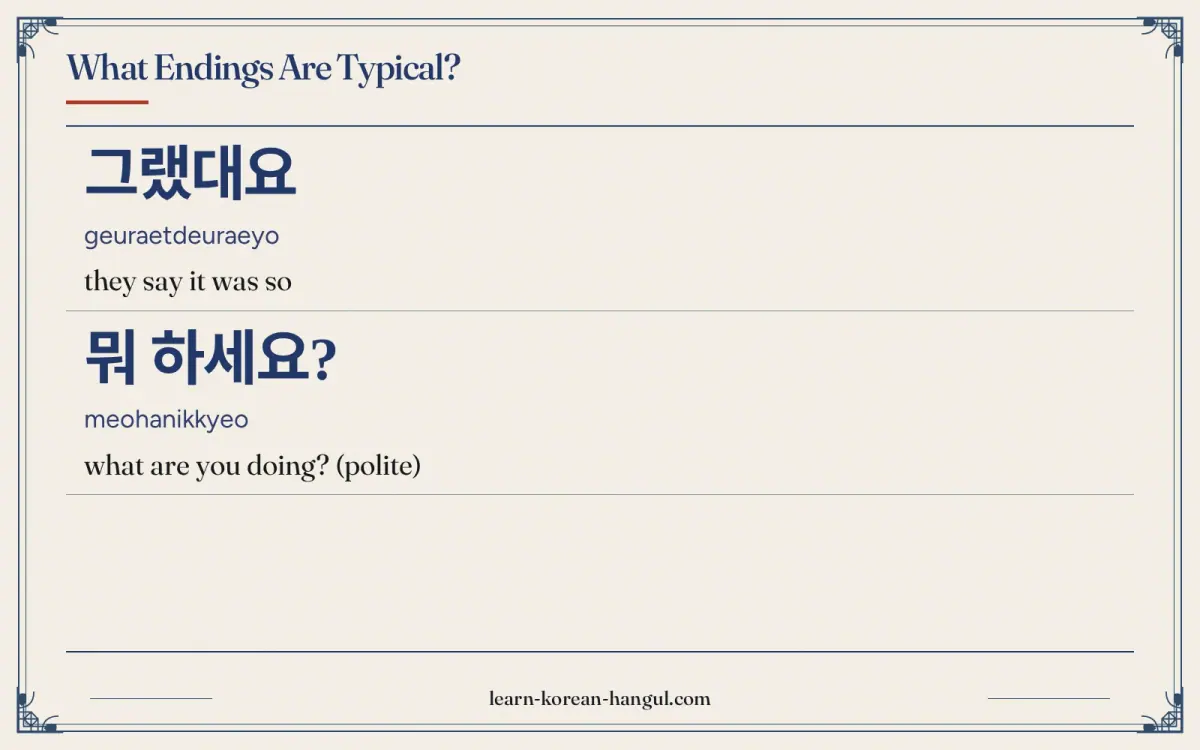
Two endings are worth recognising. Both are reported among older speakers, and both sound old-fashioned to most young people.
| Gangwon | Revised Romanization | Standard Korean | Meaning |
|---|---|---|---|
| 그랬드래요 [그랟뜨래요] | geuraetdeuraeyo | 그랬대요 | they say it was so |
| 머하니껴? | meohanikkyeo | 뭐 하세요? | what are you doing? (polite) |
The first ending is -드래요. In Standard Korean the form -더래요 reports what someone said they saw or experienced, so 그랬더래요 means "(they said) it was like that". In older Gangwon speech the vowel ㅓ in 더 is often pronounced as ㅡ, so the same ending is heard as -드래요. The spelling 그랬드래요 writes that sound. Note that the Standard Korean 그랬대요 is also common, and it is a plain report: "they say it was so".
The second ending is -니껴, a polite question ending. It is described in the speech of North Gyeongsang, and the south of the Yeongdong coast, which touches that province, is where a learner may hear it. In 머하니껴, 머 is a short form of 뭐 (what), 하 is the stem of 하다 (to do), and -니껴 makes the question polite. Standard Korean says 뭐 하세요? or 뭐 하십니까?. The question word 머 already marks a question, so the tone does not need to rise at the end.
Both examples come from general descriptions of older speech, so treat them as typical cases and not as a complete list.
How Common Is It?
Gangwon speech is less visible than some other regional speech, and that makes it harder to study as a learner.
Callout: how common. In the media, Gangwon speech is less often shown than Gyeongsang or Jeolla speech, as a general impression, and this lesson cites no count of programmes. Most young people in the province speak a standard-like Korean, as young people do across the country. Older speakers keep more of the local endings and sounds. Standard Korean is the school language, so a person from Gangwon reads, writes and takes exams in the standard.
Is Gangwon speech endangered? This lesson does not claim that it is. UNESCO's Atlas of the World's Languages in Danger has a well-known entry for Jejueo, which the Jeju dialect lesson explains. This lesson cites no source that lists Gangwon speech as endangered, and the difference between Gangwon speech and the standard is much smaller than the gap for Jejueo. What can be said is that the oldest local forms are probably used by fewer people with each generation, as with regional forms elsewhere.
Worked Example: 그랬드래요
The word 그랬드래요 shows how the older speech sits beside the standard. Follow these steps.
- Start from the standard. 그랬더래요 (geuraetdeoraeyo) is the form that reports a past event, "they said it was like that". It has five syllables: 그-랬-더-래-요.
- Change the vowel. The vowel ㅓ in 더 becomes ㅡ in 드. This is the older Gangwon sound, and it gives 그랬드래요.
- Check the sound. The syllable 랬 ends in ㅆ, which is pronounced as ㄷ before a consonant, and the next ㄷ is tensed to ㄸ. The whole word is [그랟뜨래요]. Revised Romanization writes the final ㅆ as t and does not show the tensing, so it is geuraetdeuraeyo.
- Compare with the plain report. Standard Korean 그랬대요 [그랟때요] says the same thing without the "I saw it" sense. The dialect form has one more syllable (드래 against 대).
- Note the use. Older speakers use it when telling a story, and it sounds warm and old-fashioned.
You will know it worked when you can say 그랬대요 and then 그랬드래요 and hear the extra syllable and the changed vowel. Both ㅓ and ㅡ are unrounded vowels, so the change between them is a change in tongue position and not in lip rounding.
그랬드래요.
geuraetdeuraeyo
They say it was like that. (older Gangwon speech)
그랬대요.
geuraetdaeyo
They say it was like that. (Standard Korean)
Common Learner Mistakes
Mistake 1: treating Gangwon speech as one dialect. Learners often expect the same sounds from Chuncheon and Gangneung. Actually the mountains split the province into two speech areas, and each differs from the other. Fix: ask which side of the mountains the speaker comes from.
Mistake 2: assuming it is the same as Gyeongsang speech. Learners often hear pitch accent on the east coast and decide it is Busan speech. Actually the east coast shares some features with Gyeongsang, but inland Gangwon speech is closer to Seoul speech. Fix: treat the likeness as partial.
Mistake 3: using -니껴 or -드래요 in conversation. Learners often copy the endings from this page. Actually they are older regional forms, and using them can sound like mimicry. Fix: use the standard -세요 and -대요, and recognise the regional endings by ear.
Mistake 4: believing that rare means unimportant. Learners often think that a dialect with few drama appearances has no features. Actually it has features, but fewer have been written down for learners. Fix: be careful with any claim about Gangwon speech, including the ones in this lesson.
Mistake 5: taking the audio as the sound of the east coast. Learners often treat the clips as real Gangwon speech. Fix: use it for the forms, and listen to local speakers for the pitch.
Practice and Answer Key
Answer in your own words, then check the key.
- What do the names 영동 and 영서 mean?
- Which side of the province is closer to Seoul speech?
- What is the Standard Korean form of 머하니껴?
- Why is this lesson cautious about Gangwon speech?
Answers.
- 영동 is "east of the pass" and 영서 is "west of the pass", named for the Taebaek ridge and the pass 대관령.
- Yeongseo, the inland side, which lies next to Gyeonggi.
- 뭐 하세요? (what are you doing?).
- Research and media coverage are limited, and the two endings come from general descriptions of older speech.
If you answered three or four correctly, you have the main points.
Practice · 4
What does 영동 mean?
Show answer
East of the mountain pass
동 means east, so 영동 is the area east of the pass, which is the east coast.
Which area of Gangwon is closer to Seoul speech?
Show answer
Yeongseo
Yeongseo is inland and borders Gyeonggi, so its speech is closer to Seoul speech.
What is the Standard Korean form of 머하니껴?
Show answer
뭐 하세요?
머하니껴 is a polite question meaning what are you doing, like 뭐 하세요?.
Which ending in older Gangwon speech matches the Standard Korean -더래요?
Show answer
-드래요
-드래요 is -더래요 with the vowel ㅓ pronounced as ㅡ.
Where to Go Next
The nearby lesson on Gyeongsang dialect explains pitch accent in more detail, and the next lesson is North Korean versus South Korean language. The standard for comparison is Standard Korean, and the section hub Korean accents and dialects lists all regional lessons.
This lesson does not teach the full sound system of Gangwon speech, the speech of each town or the pitch of the east coast. It teaches the east-west split and two endings. In short, the Gangwon dialect is the speech of a province split by the Taebaek Mountains, closer to Seoul speech inland and more archaic on the east coast, and it is described less fully than some other regional speech.
Frequently Asked Questions
Is Gangwon dialect like Gyeongsang? Partly. Older speech on the east coast is described as having pitch accent, a feature it shares with Gyeongsang speech, and the southern coast lies next to North Gyeongsang. Inland Gangwon speech is closer to Seoul speech, so the likeness depends on which side of the mountains the speaker comes from.
What is Yeongdong? Yeongdong (영동) is the eastern side of Gangwon, between the Taebaek Mountains and the East Sea. It includes towns such as Gangneung, Sokcho, Donghae and Samcheok. The name means "east of the mountain pass", and it contrasts with Yeongseo (영서), the inland side.
Does Chuncheon speak differently from Gangneung? Yes, in general. Chuncheon is in Yeongseo, inland, and its speech is closer to Seoul speech. Gangneung is in Yeongdong, on the east coast, and older speech there is described as keeping more older features, such as pitch accent. These are tendencies, and individual speakers vary.
Is it endangered? This lesson does not say so. Gangwon speech differs from the standard much less than Jejueo does, and most young people speak a standard-like Korean. The oldest local forms are used by fewer people with each generation, and research on Gangwon speech is limited, so any claim about its future is uncertain.