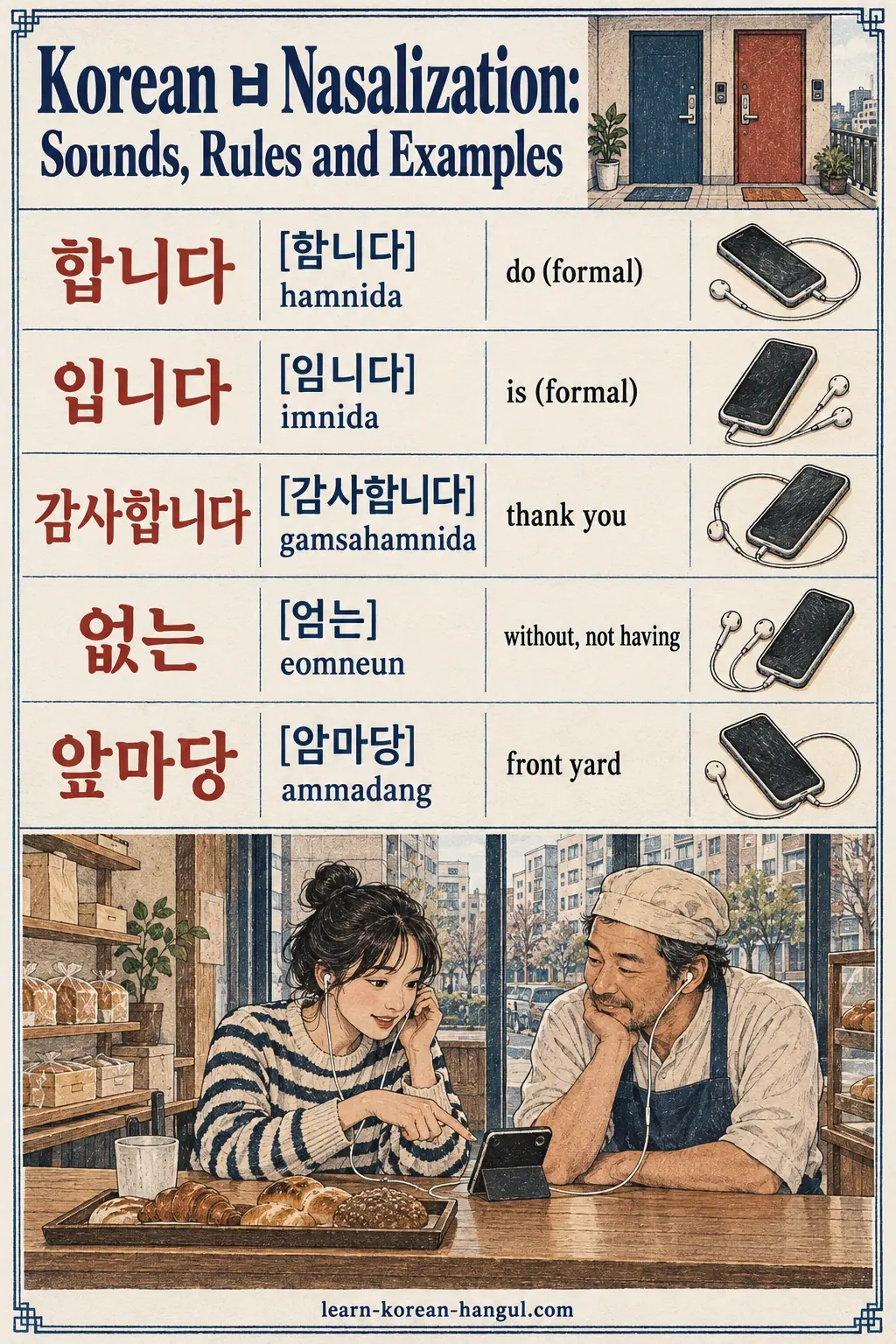
What you will learn
- Say 합니다, 입니다, 감사합니다, 없는 and 앞마당 with ㅁ in place of ㅂ.
- Explain in two sentences why 합니다 is pronounced [함니다].
- Name the four spellings of the final ㅂ sound and the two sounds that trigger the change.
- Predict the spoken form of a new word that has a ㅂ-type final before ㄴ or ㅁ.
Before you start: you can read a final ㅂ in a word such as 밥 and you have met the nasalization rules. Time: about 25 minutes with audio.
Key Facts
- The final sounds ㅂ, ㅍ, ㅄ and ㄿ are all pronounced [ㅂ] at the end of a syllable, and that [ㅂ] then becomes [ㅁ] before ㄴ or ㅁ.
- The direct trigger is a following ㄴ or ㅁ; a following ㄹ triggers it only indirectly, by first becoming ㄴ.
- Every -ㅂ니다 and -습니다 form has the change: 합니다 [함니다].
- 없는 is [엄는], where ㅄ goes to ㅂ and then to ㅁ.
- 앞마당 is [암마당], where ㅍ goes to ㅂ and then to ㅁ.
- The rule is in Article 18 of the Standard Pronunciation Rules (표준 발음법).
Last updated: 2026-10-08. The Korean text, romanization and audio scripts on this page are generated drafts that still await review by a Korean specialist.
What Is Korean ㅂ Nasalization?

Korean ㅂ nasalization is a sound change in which a lip-closing stop becomes a lip-closing nasal. A nasal is a consonant made with air flowing through the nose, such as ㅁ, ㄴ and the "ng" sound of ㅇ. A stop is a consonant made by fully blocking the air for a moment, such as ㅂ.
When a syllable ends in ㅂ and the next syllable starts with ㄴ or ㅁ, the ㅂ is spoken as ㅁ. The lips close in both sounds, so only the air path changes: it moves from blocked to the nose.
| Written | Spoken | Revised Romanization | Meaning |
|---|---|---|---|
| 합니다 | [함니다] | hamnida | do (formal) |
| 입니다 | [임니다] | imnida | is (formal) |
| 감사합니다 | [감사함니다] | gamsahamnida | thank you |
| 없는 | [엄는] | eomneun | without, not having |
| 앞마당 | [암마당] | ammadang | front yard |
Revised Romanization (RR) is the official Latin-letter system for Korean, and here it follows the spoken form: hamnida, not hapnida. It is a learning aid on this page, and the Hangul is the reference. The table gives the result, but English speakers need to know why they tend to miss it.
English Speakers and the "Hap-Nida" Habit

English speakers tend to read 합니다 letter by letter and say "hap-ni-da", with a puff of air on the p. The written ㅂ looks like a "b" or "p", and the habit is to say it. In Korean the final ㅂ is not released into a puff. It is a closed-lip sound with no air burst, so it is already close to ㅁ.
A second problem is spelling trust. The Hangul 합니다 is the standard spelling, and nobody writes 함니다. The change is in speech only, which makes it easy to read the word correctly and still say it wrongly.
The fix is to learn the sound of the lips: for these words, the lips stay closed and the air goes through the nose. The next section shows how that works.
What Does ㅂ Become before ㄴ or ㅁ?
Before ㄴ or ㅁ, the final ㅂ becomes ㅁ. The place stays the same (both sounds use the lips) and the manner changes from stop to nasal. This is called nasal assimilation, because the stop takes on the nasal quality of the sound after it.
Two other stops do the same thing in the same way: each keeps its place and gains nasality.
| Stop (final sound) | Becomes | Place in the mouth | Example |
|---|---|---|---|
| ㅂ | ㅁ | lips | 합니다 [함니다] |
| ㄷ | ㄴ | tongue tip | 닫는 [단는] |
| ㄱ | ㅇ (ng) | back of the tongue | 먹는 [멍는] |
Here is a quick body test. Say "mm" with your lips closed, then say the lip sound "p" with your lips closed and no puff. The mouth position is the same, and the only difference is the hum through the nose. Korean ㅂ nasalization is that hum, added in advance.
The three patterns share one idea, and the ㅂ pattern is the most common because of the formal ending. The lessons on ㄱ nasalization and ㄷ nasalization cover the other two.
Now the question behind the headline example: why does 합니다 sound the way it does?
Why Is 합니다 Pronounced 함니다?
합니다 is pronounced [함니다] because the final ㅂ of 합 meets the ㄴ of 니 and takes on its nasal quality. The word is the stem 하 (do) plus the formal ending -ㅂ니다, and the ㅂ sits at the bottom of the first block.
- Find the final. The block 합 ends in ㅂ.
- Find the next consonant. The block 니 starts with ㄴ, which is a nasal.
- Apply the rule. A final ㅂ before ㄴ or ㅁ becomes ㅁ.
- Say the result. 합 is spoken [함], and the word is [함니다].
You will know it worked when your lips close at the end of [함] and the sound hums through your nose before 니. A common mistake is to say the ㅂ with a small pop of air and then ㄴ, which gives [합니다] instead.
The rule does not depend on the word. Any formal ending written -ㅂ니다 and any verb stem that ends in ㅂ before ㄴ will behave the same way. The next section lists the endings where it appears.
Which Endings Show Korean ㅂ Nasalization?
The change appears in every formal polite ending written -ㅂ니다, -습니다, -ㅂ니까 and -습니까. The formal polite speech level is used in news, announcements, service counters and presentations. It is the first level that most beginners meet, so the sound is among the first they hear.
| Written | Spoken | Meaning |
|---|---|---|
| 합니다 | [함니다] | do (formal) |
| 갑니다 | [감니다] | go (formal) |
| 쉽니다 | [쉼니다] | is easy (formal) |
| 합니까 | [함니까] | do? (formal question) |
| 먹습니다 | [먹씀니다] | eat (formal) |
| 있습니다 | [읻씀니다] | there is (formal) |
The first four rows are straightforward. The last two have two changes. In 먹습니다, the ㅅ after ㄱ becomes tense [ㅆ], and then the ㅂ before ㄴ becomes [ㅁ], giving [먹씀니다]. In 있습니다, the final ㅆ is first pronounced [ㄷ], the same tense rule applies, and the ㅂ becomes ㅁ: [읻씀니다]. The tense part is the topic of the tensification lessons.
The formal ending is frequent, but the rule is not limited to it. The finals ㅍ and ㅄ also join in, with an extra step.
How Do ㅍ and ㅄ Behave?

The finals ㅍ, ㅄ and ㄿ first become [ㅂ] at the end of a syllable, and then the usual nasal change applies. The result is a two-step change, which can be written with arrows.
| Written | Step 1 | Step 2 | Spoken |
|---|---|---|---|
| 앞마당 | ㅍ → [ㅂ] | ㅂ → [ㅁ] | [암마당] |
| 없는 | ㅄ → [ㅂ] | ㅂ → [ㅁ] | [엄는] |
| 옆문 | ㅍ → [ㅂ] | ㅂ → [ㅁ] | [염문] |
| 읊는 | ㄿ → [ㅂ] | ㅂ → [ㅁ] | [음는] |
Step 1 is the final-sound rule, also called the batchim representative sound rule: at the end of a syllable, only seven sounds are possible. The lesson on ㅂ batchim explains it. Step 2 is the nasal change from this lesson.
The word 없는 is worth memorizing because it is frequent. It means "that has no" or "without", as in 시간이 없는 사람 (a person without time). You will meet it in everyday Korean much sooner than 읊는.
One more case joins ㅂ with the sound ㄹ.
ㅂ before ㄹ: a Two-Step Case
A final ㅂ before ㄹ also ends up as ㅁ, because ㄹ first turns into ㄴ. The word 십리 (ten ri, an old distance unit) is spoken [심니]. The word 협력 (cooperation) is spoken [혐녁].
The order is: ㄹ becomes ㄴ after a ㅂ (the liquid becomes a nasal), then ㅂ becomes ㅁ before that ㄴ. The first step is the ㄹ nasalization pattern, which has a separate lesson, and the second step is this one.
This case is rare in beginner speech, so treat it as a cross-reference and keep your focus on ㄴ and ㅁ. Whole sentences show how often the main pattern appears.
ㅂ Nasalization in Whole Sentences
In formal speech the change appears in almost every sentence, because the formal ending closes each one. Read the five sentences below slowly, mark each -ㅂ니다 or -ㅂ니까, and say the spoken form.
| Written | Spoken | Meaning |
|---|---|---|
| 저는 학생입니다. | [저는 학쌩임니다] | I am a student. |
| 한국어를 공부합니다. | [한구거를 공부함니다] | I study Korean. |
| 안녕하십니까? | [안녕하심니까] | Hello (very formal question). |
| 지금 갑니다. | [지금 감니다] | I am going now. |
| 정말 감사합니다. | [정말 감사함니다] | Thank you very much. |
The first two sentences also show other rules at work. In 학생입니다, the noun 학생 has a tense [ㅆ], and 입니다 has the ㅂ change. In 한국어를, liaison links the ㄱ to 어, as in the liaison rule lesson. Reading a full sentence this way trains the habit of checking every block boundary, not only the one in the formal ending.
Worked Example: 합니다

The word 합니다 means "do" in the formal polite style, and it is spoken [함니다]. It is the most common test of the rule.
- Break it into blocks: 합 / 니 / 다.
- Mark the final in the first block: 합 ends in ㅂ.
- Mark the next onset: 니 starts with ㄴ, which is a nasal.
- Apply the rule: ㅂ followed by ㄴ becomes ㅁ, so 합 becomes [함].
- Say it as one flow: [함니다].
- Check the Romanization: RR writes hamnida, which matches the spoken form.
You will know it worked when you can say 함니다 with your lips closed on the m and no puff of air. Now say the longer word 감사합니다 and notice that the same sound sits in the middle: [감사함니다].
The word 감사합니다 means "thank you" in the formal style. For its full pronunciation, including the first block 감, see the page on how to pronounce 감사합니다. Even a rule this regular goes wrong in predictable ways, so the common slips come next.
Common Learner Mistakes
Learners often rely on spelling when they speak. Each mistake below comes from letting the written ㅂ decide the sound.
- Mistake 1: releasing the ㅂ. Learners often say [합니다] with a small pop. Actually the lips close and the sound hums through the nose, because the nasal ㄴ is next.
- Mistake 2: writing the spoken form. Learners often write 함니다 in dictation. The spelling stays 합니다, because the change is in speech only.
- Mistake 3: stopping at step 1. Learners often say 없는 as [업는]. Actually the final goes on to [ㅁ], because ㅄ reaches [ㅂ] first and the nasal rule then applies.
- Mistake 4: trusting "ipnida". Learners often romanize 입니다 as ipnida. Actually RR writes imnida, because RR follows the spoken form.
- Mistake 5: missing the double change. Learners often forget that 먹습니다 has two changes, [먹씀니다]. Treat tensification and nasalization as separate steps, because each has its own trigger.
Expert tip: the nasal change is regressive, which means the later sound (ㄴ or ㅁ) changes the earlier one (ㅂ). Whenever a nasal consonant starts a block, check the block before it.
Rule of thumb: if a block ends in a stop and the next block starts with ㄴ or ㅁ, expect nasalization. Practice puts the habit in place.
Practice and Answer Key

Write the spoken form of each word in brackets. Say each one aloud first.
- 합니다
- 입니다
- 감사합니다
- 없는
- 앞마당
- 갑니다
- 십리
- 먹습니다
Answer key
- 합니다 → [함니다]
- 입니다 → [임니다]
- 감사합니다 → [감사함니다]
- 없는 → [엄는]
- 앞마당 → [암마당]
- 갑니다 → [감니다]
- 십리 → [심니]
- 먹습니다 → [먹씀니다] (two changes: tense ㅆ, then nasal ㅁ)
Six or more correct means the pattern is secure. If you missed number 4 or 5, review the two-step table. The next lesson in the series takes the same idea to the back of the mouth.
Where to Go Next
The next lesson, Korean ㄱ nasalization, applies the same idea to 먹는 and 한국말. Before it, read polite Korean phrases to hear the formal endings in context. The full set of nasalization lessons is in the Nasalization section.
This lesson does not teach the grammar of the formal ending or when to choose formal over everyday speech. It covers the sound of Korean ㅂ nasalization only. The ㄼ final, as in 밟는 [밤는], also follows Article 18, but it is rare and left to the reference page. The audio shows one standard Seoul pronunciation.
Frequently Asked Questions
How do you say 감사합니다? Say [감사함니다]. The ㅂ of 합 meets the ㄴ of 니 and becomes ㅁ, so the middle of the word is "ham", not "hap". Keep your lips closed at the end of 함 and let the sound hum through your nose. The dedicated page on how to pronounce 감사합니다 covers the whole word.
Is 입니다 imnida or ipnida? Revised Romanization writes imnida, because it follows the spoken form [임니다]. The spelling ipnida follows the letters of 입니다 and does not match the sound. If you see ipnida in a textbook, read the final ㅂ as an m sound. The Hangul spelling stays 입니다 either way.
Why does RR write hamnida? Revised Romanization is based on pronunciation, not on spelling, so it records the nasal change in 합니다 and writes hamnida. It does not record every sound change; for example, it leaves tense sounds unmarked. That is why this site shows Hangul and the bracketed spoken form next to every romanization.
Does ㅂ nasalize before ㄹ? Yes, but in two steps. After a ㅂ, the ㄹ first becomes ㄴ, and then the ㅂ becomes ㅁ because of that ㄴ. So 십리 is spoken [심니] and 협력 is [혐녁]. The pattern is rare in beginner speech, and the ㄹ nasalization lesson covers the first step.