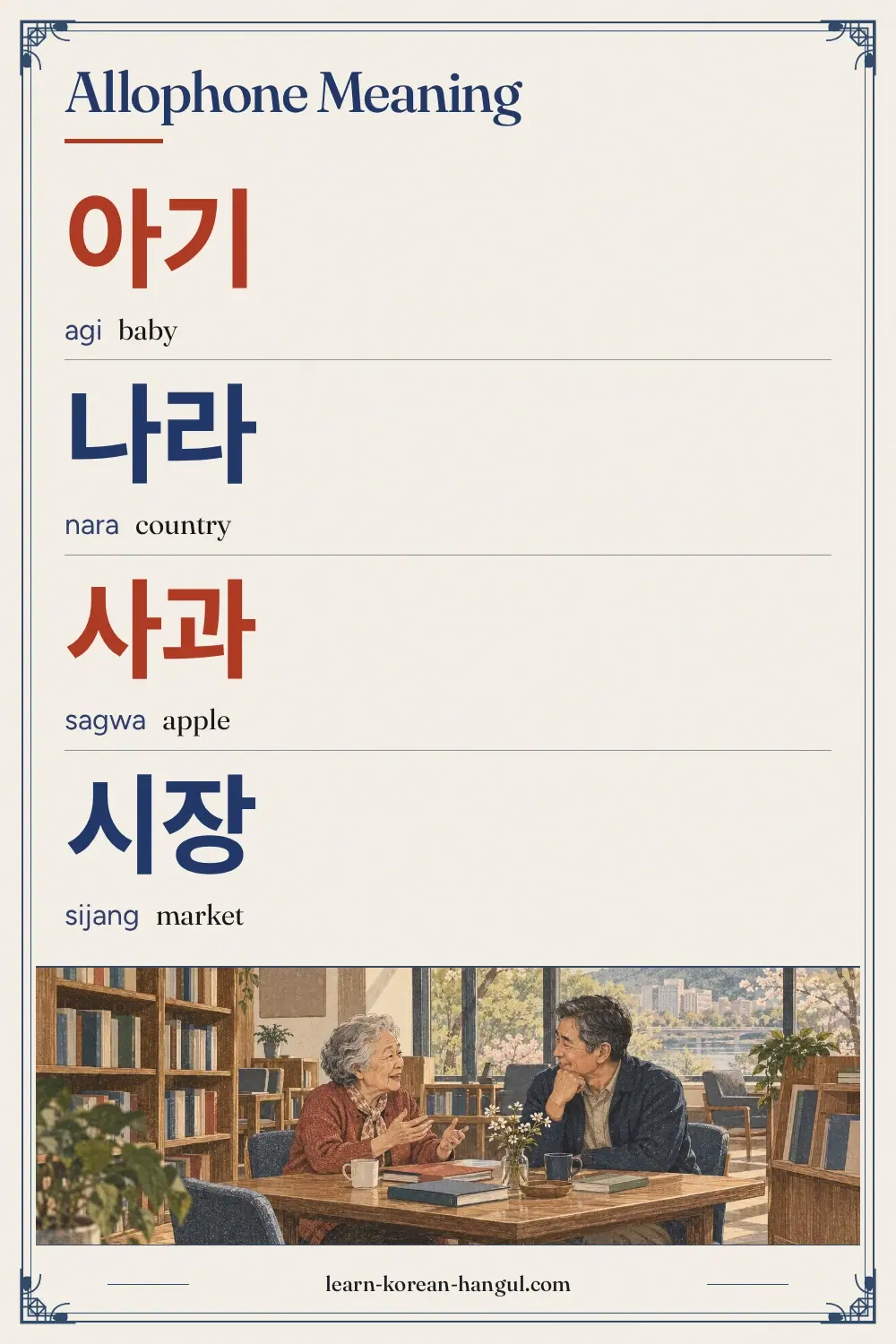
Allophone Meaning in Korean
Think of a phoneme as a family name and the allophones as members of the family. Each member looks a little different, but they all belong to the same family, and nobody mistakes one for another word.
English has the same thing. The "p" in "pin" has a puff of air and the "p" in "spin" does not. English speakers hear both as "p". Korean has its own sets, and three matter for beginners.
| Letter | Allophones | Where each appears | Example |
|---|---|---|---|
| ㄱ | [k] / [g] / [k̚] | start of a word / between voiced sounds / end of a syllable | 가다, 아기, 책 |
| ㄹ | [ɾ] / [l] | before a vowel / at the end of a syllable or doubled as ㄹㄹ | 나라, 물, 빨리 |
| ㅅ | [s] / [ɕ] | before most vowels / before ㅣ | 사과, 시장 |
The same pattern holds for ㄷ, ㅂ and ㅈ, which behave like ㄱ. In each case the position decides the version, and the speaker never chooses it.
Why Does Korean Not Write Allophones?
Hangul spells phonemes, not allophones. Because speakers cannot hear a difference in meaning, there is no reason to give them separate letters. A Korean reader sees ㄱ in 가다 and in 아기 as the same letter, because it is the same sound category. If the letters were split, spelling would become harder without making any word clearer.
This is also why Korean children never learn "g ㄱ" and "k ㄱ" as separate things. They learn one letter.
Revised Romanization, the official Latin spelling, is the one place where some allophones are written. It writes ㄱ as g before a vowel and k at the end of a syllable (아기 agi, 책 chaek). That is a spelling convenience for foreigners and not part of the Korean writing system. The lesson on consonant voicing shows the rule for stops.
Allophone Versus Phoneme
The contrast with phoneme is the heart of this page.
| Feature | Phoneme | Allophone |
|---|---|---|
| Changes the word | yes | no |
| Speakers notice | yes | rarely |
| Depends on position | no | yes |
| Written in Hangul | with its own letter | with the same letter |
| Example | 굴 / 꿀 (ㄱ versus ㄲ) | 가다 / 아기 (both ㄱ) |
A quick test: if swapping the sounds gives a different word, you have two phonemes. If the swap only sounds odd, you have two allophones.
What Are Examples of an Allophone?
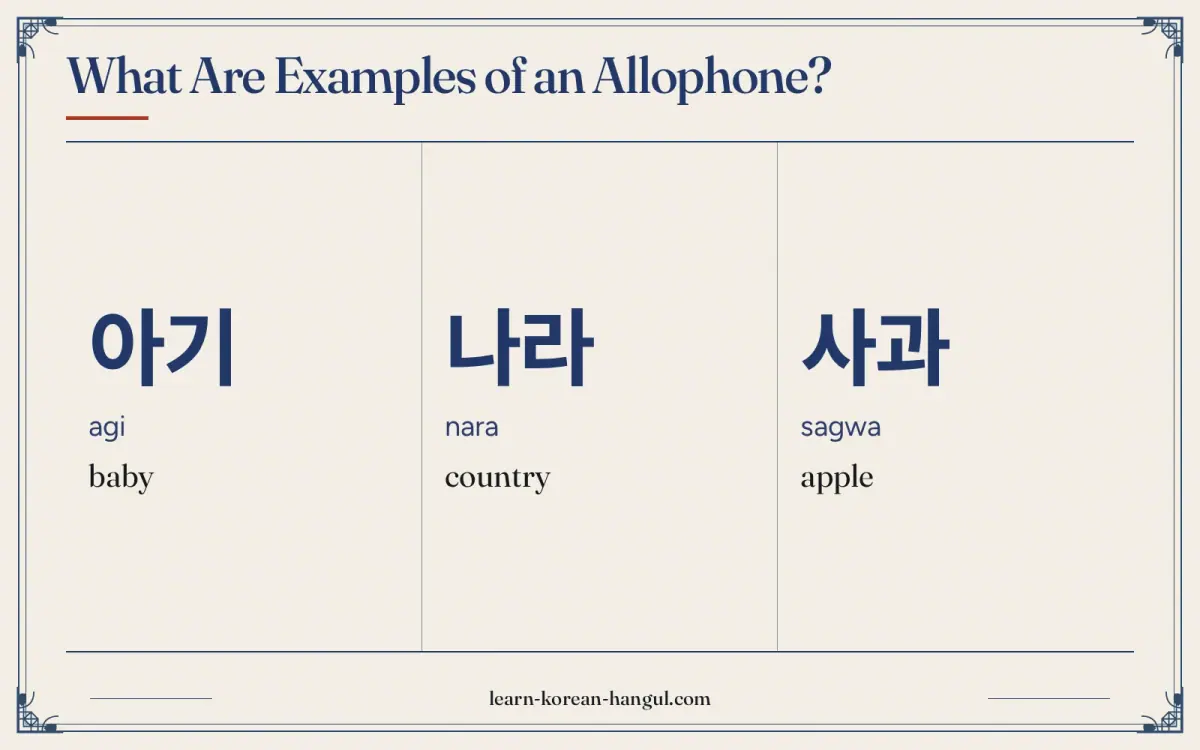
Four words show the three sets above.
아기
agi
baby
나라
nara
country
사과
sagwa
apple
시장
sijang
market
Notice the last two. The same letter ㅅ is [s] in 사과 and [ɕ] in 시장, and speakers hear one sound. The lateral version of ㄹ is covered under lateral and flap.
What Do Learners Get Wrong about Allophones?
Learners often assume that a letter has exactly one sound, so they expect ㄱ to be "g" everywhere or "k" everywhere. Others over-correct and think every variation needs a new rule.
- Believing the variants are errors. [g] in 아기 is correct. It is not a mistake for [k].
- Trying to hear the difference like a native. Speakers do not notice allophones, so you will hear them only after someone points them out.
- Assuming the English version is the same. English "p" and "b" are separate phonemes, but in Korean [p] and [b] are both allophones of the one phoneme ㅂ.
Whether a given variant counts as an allophone can change between textbooks. For example, all sources give the "sh"-like [ɕ] for ㅅ before ㅣ, but they differ on whether it also appears before ㅑ, ㅕ, ㅛ, ㅠ and ㅟ. This page gives only the case before ㅣ, which every description shares. For the ㄹ case in practice, see ㄹ versus l.
Frequently Asked Questions
What is an allophone? An allophone is one of the slightly different ways a single phoneme is pronounced. Position decides which one you hear, and swapping them never changes the word. The Korean letter ㄱ has three allophones, [k], [g] and an unreleased [k̚], and Korean speakers hear them as the same sound.
Is g an allophone of ㄱ? Yes. Between voiced sounds, as in 아기, ㄱ is spoken [g]. At the start of a word it is [k] and at the end of a syllable it is [k̚]. All three are one phoneme, since swapping them never makes a new word. Revised Romanization writes g before any vowel, even word-initially, and k at a syllable end.
Why does ㄹ change? ㄹ is a flap [ɾ] before a vowel, as in 나라, and a lateral [l] at the end of a syllable, as in 물, or when doubled, as in 빨리. The choice depends only on position. Korean has no word pair that depends on the difference, so speakers treat the two as one sound and the writing uses one letter.
Do speakers notice allophones? Rarely. Speakers hear allophones as the same sound, so they are not aware that ㄱ differs in 가다 and 아기 unless a phonetician points it out. Learners usually notice them first, because their own language treats the sounds as separate. That is why they feel odd to learn.
Related Terms and Lessons
Allophone meaning is the other half of phoneme. Two practical lessons are consonant voicing and ㄹ versus l, and the case study is lateral and flap. All terms are listed in the Korean Pronunciation Glossary.