
Lateral and Flap Meaning in Korean
Korean has one letter for these sounds, ㄹ, and two ways to say it. The choice depends on where the letter sits in the word.
A flap is a very quick tap of the tongue tip against the ridge behind the upper teeth. It lasts a few hundredths of a second. English speakers in North America already know it from the middle of "butter" or "water". Korean uses it when ㄹ stands before a vowel, as in 나라 (nara, country) and 라면 (ramyeon, instant noodles).
A lateral keeps the tongue tip pressed on the ridge while air flows around the sides of the tongue. It is the sound of English "l" in "full". Korean uses it when ㄹ closes a syllable, as in 물 (mul, water), and when two ㄹ stand together, as in 빨리 (ppalli, quickly).
Both are sonorants, so both are voiced. Korean linguists call ㄹ 유음 (yueum), usually translated "liquid".
Why Does ㄹ Change?
The change is predictable, and the pattern is the whole lesson.
| Where ㄹ stands | Sound | Symbol | Example | Romanization |
|---|---|---|---|---|
| between vowels | flap | [ɾ] | 나라 | nara |
| at the end of a syllable | lateral | [l] | 물 | mul |
| doubled (ㄹㄹ) | long lateral | [lː] | 빨리 | ppalli |
| start of a word (before a vowel) | flap | [ɾ] | 라면 | ramyeon |
Revised Romanization, the official Latin spelling, follows the position. It writes ㄹ as r before a vowel and as l otherwise, and it writes ㄹㄹ as ll. No second letter is needed because speakers never need to choose.
An English speaker who says 나라 with a full "l" or the English "r" sounds slightly foreign. Saying 물 with a quick tap, on the other hand, can make it sound unfinished. The lesson on ㄹ versus l gives drills for both.
Lateral Versus Flap
The two are different movements even though the tongue touches the same place.
| Feature | Lateral | Flap |
|---|---|---|
| Tongue tip | stays pressed | taps and leaves |
| Air | flows around the sides | stops for an instant |
| Length | can be held | cannot be held |
| Korean position | end of syllable, doubled ㄹㄹ | before a vowel |
| English anchor | "full" | "butter" |
The relationship between the two forms is the one defined in allophone: one sound category, two position-based variants.
What Are Examples of a Lateral and a Flap?
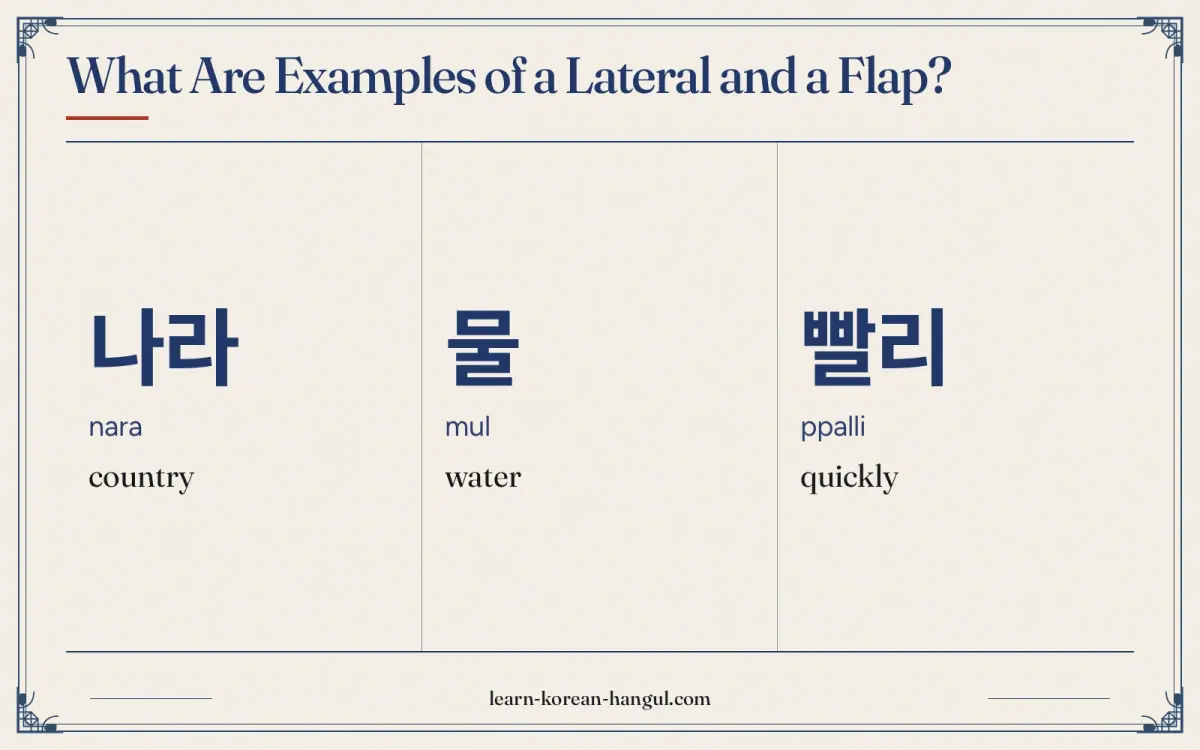
나라
nara
country
물
mul
water
빨리
ppalli
quickly
Notice that 빨리 has the same letters ㄹ and ㄹ across the syllable border, but they sound like one long "l", with no tap. Hear one more doubled ㄹ in 달리 (dalli, differently).
What Do Learners Get Wrong about Lateral and Flap?
The commonest error is using an English "r" for every ㄹ. The English r pulls or curls the tongue back without touching the ridge, while Korean ㄹ touches it. A second error is using the English "l" in 나라, where Korean uses the quick tap.
- Holding the tap. The flap cannot be prolonged. If you can hold it, it is a lateral.
- Ignoring the doubling. 빨리 must have a long "l", otherwise the doubled sound is lost.
- Adding a vowel after final ㄹ. Say 물 with the tongue still pressed, not "mulu".
This page does not discuss ㄹ in sound-change rules, such as ㄴ becoming ㄹ in 설날 [설랄], and it does not explain the ㄹ batchim lesson. For the latter, see ㄹ batchim.
Frequently Asked Questions
What is a lateral? A lateral is a sound made with the tongue tip pressed on the ridge behind the upper teeth while air flows around the sides of the tongue. The English "l" in "full" is a lateral. Korean ㄹ is a lateral at the end of a syllable, as in 물, and when doubled, as in 빨리.
What is a flap? A flap is a single quick tap of the tongue tip against the ridge behind the upper teeth. North American English uses it in the middle of "butter". Korean ㄹ is a flap between vowels, as in 나라, and at the start of a syllable before a vowel, as in 라면.
Why does ㄹ change? Korean has one ㄹ category, and the position decides which version you hear. Before a vowel it is a tap, at the end of a syllable it is a lateral, and doubled it is a long lateral. Speakers do not notice the change, because no word pair depends on it.
What is 유음? 유음 (yueum) is the Korean term for liquid sounds, the group that contains ㄹ. It covers both the flap and the lateral, because Korean speakers hear them as one sound. The lessons call the two forms by their English names.
Related Terms and Lessons
Lateral and flap meaning is an example of an allophone pattern. For practice, use the lesson on ㄹ versus l and the page on the ㄹ batchim. All terms are listed in the Korean Pronunciation Glossary.