Phoneme Meaning in Korean
A phoneme is a sound category that a language uses to tell words apart. A speaker may produce that category in several slightly different ways without ever noticing. The test for a phoneme is simple: swap one sound for another and see whether the word changes.
Linguists write phonemes between slashes, as /k/, and write the actual spoken sounds in square brackets, as [k]. This page keeps the slashes to a minimum.
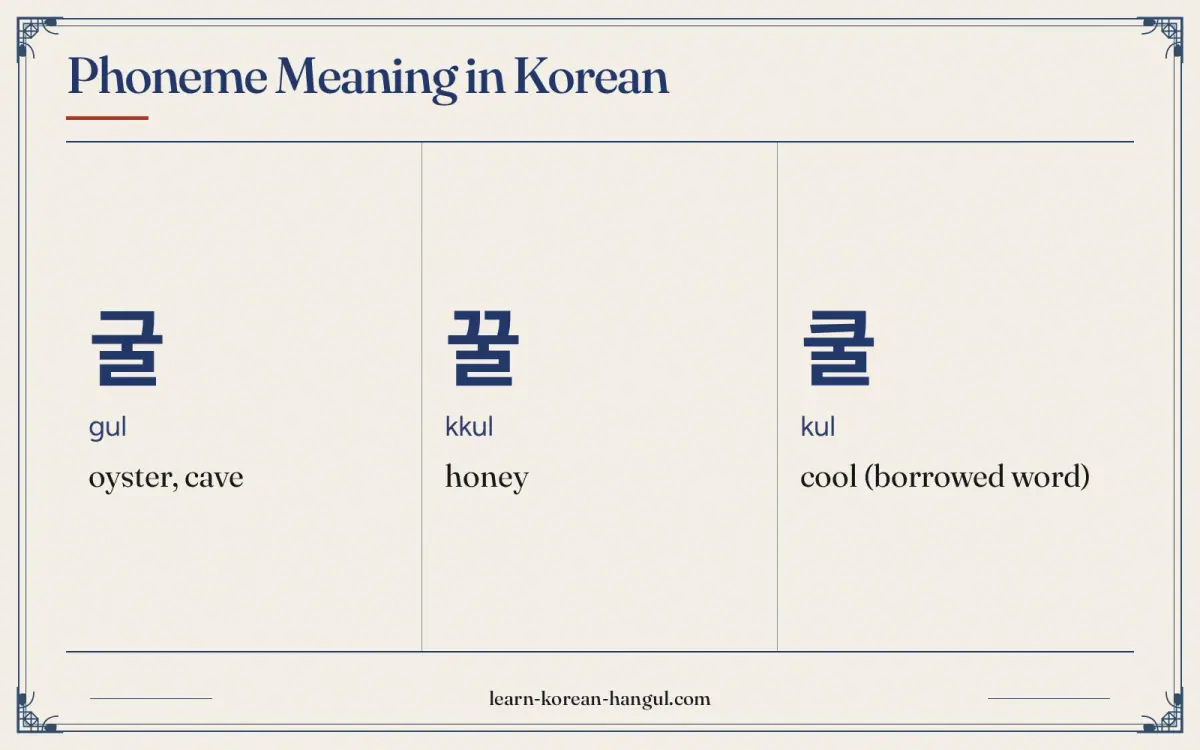
Korean gives a clean example. Say these three words and listen only to the first sound.
굴
gul
oyster, cave
꿀
kkul
honey
쿨
kul
cool (borrowed word)
Each word has a different meaning, so the three first sounds are three separate phonemes. That is why Hangul has three letters, ㄱ, ㄲ and ㅋ.
Why Do Phonemes Matter for Learners?
Phonemes tell you which differences to practice and which to ignore. If a difference changes meaning, as plain, tense and aspirated do, you must learn it. If a difference never changes meaning, as g versus k in ㄱ does, you can let your mouth handle it.
Consider the letter ㄱ. In 가다 (gada, to go) it is voiceless at the start of the word, and in 아기 (agi, baby) it is voiced in the middle. Both sounds belong to one phoneme, because swapping them never produces a new word. Each variant is called an allophone, and the lesson on consonant voicing shows when each appears.
Phoneme Versus Letter
The nearest confusable term is the letter. They are not the same, and the match between them is imperfect.
| Feature | Phoneme | Letter |
|---|---|---|
| What it is | a sound category | a written symbol |
| Written as | /k/ between slashes | ㄱ in Hangul |
| Changes meaning | yes | not by itself |
| Example of mismatch | one phoneme /l/ for ㄹ | ㄹ has two sounds, a tap and an l |
| Example of match | ㅋ is /kʰ/ | one letter, one phoneme |
Hangul is close to a phoneme writing system, which is why it is easy to learn. But it is not exact. ㄹ is one phoneme with two spoken forms, and ㅇ stands for nothing at the start of a syllable and for [ŋ] at the end.
What Are Examples of a Phoneme Change?
The best examples are pairs that differ by one phoneme. Such pairs are called minimal pairs.
- 달 (dal, moon) and 딸 (ttal, daughter) differ by plain /t/ and tense /t͈/.
- 불 (bul, fire) and 풀 (pul, grass) differ by plain /p/ and aspirated /pʰ/.
- 발 (bal, foot) and 팔 (pal, arm) show the same pair.
An example of a merger is also useful. The standard pronunciation rules (Article 4) still list ㅐ and ㅔ as two vowels, but most Seoul speakers today pronounce them the same. For those speakers the two vowel phonemes have merged into one, so 개 (dog) and 게 (crab) sound alike and context decides the word.
What Do Learners Get Wrong about Phonemes?
Learners usually equate a phoneme with a letter, and then wonder why Korean seems to have too many "k" letters. Others assume that every spoken difference matters. A phoneme is about meaning, not about audible difference.
- Treating g and k as two phonemes. In Korean they are one, so ㄱ is not "sometimes g and sometimes k" with different meanings.
- Ignoring the third category. English has two kinds of stop, voiced and voiceless. Korean has three, so a two-way habit hears only part of the contrast.
- Hunting for an exact count. The number of Korean phonemes depends on the analysis, for example on whether ㅐ and ㅔ are merged and whether glides count as separate. This page gives no single number. The Korean sound system page discusses the inventory.
This page leaves out the formal tests linguists use to prove a phoneme, such as complementary distribution. The simple swap test is enough for learners.
Frequently Asked Questions
What is a phoneme? A phoneme is the smallest sound category in a language that can change the meaning of a word. In Korean, 굴, 꿀 and 쿨 differ only in the first sound, so plain, tense and aspirated k are three phonemes. Variants that never change meaning, such as g and k in ㄱ, are not.
How many phonemes does Korean have? There is no single count, because it depends on the analysis. Some descriptions merge ㅐ and ㅔ, and some treat glides as separate. This site avoids a fixed number and teaches the contrasts that change meaning. The Korean sound system page describes the inventory and explains where analyses differ.
Is ㅐ/ㅔ one phoneme? The standard pronunciation rules (Article 4) still list ㅐ and ㅔ as two vowels, but most Seoul speakers today pronounce them the same. For those speakers they have merged into one phoneme, so 개 (dog) and 게 (crab) sound alike. Learners still write them as two letters and rely on context.
Are letters phonemes? Not exactly. Hangul letters are close to phonemes, which is why Hangul is easy to learn, but the match is not one to one. ㄹ is one phoneme with two spoken forms, and ㅇ stands for no sound at the start of a syllable and for [ŋ] at the end. A phoneme is a sound idea, not a symbol.
Related Terms and Lessons
Phoneme meaning is paired with allophone, which names the variants inside one phoneme. For the full system, see the Korean sound system, and for the voicing lesson see consonant voicing. All terms are listed in the Korean Pronunciation Glossary.