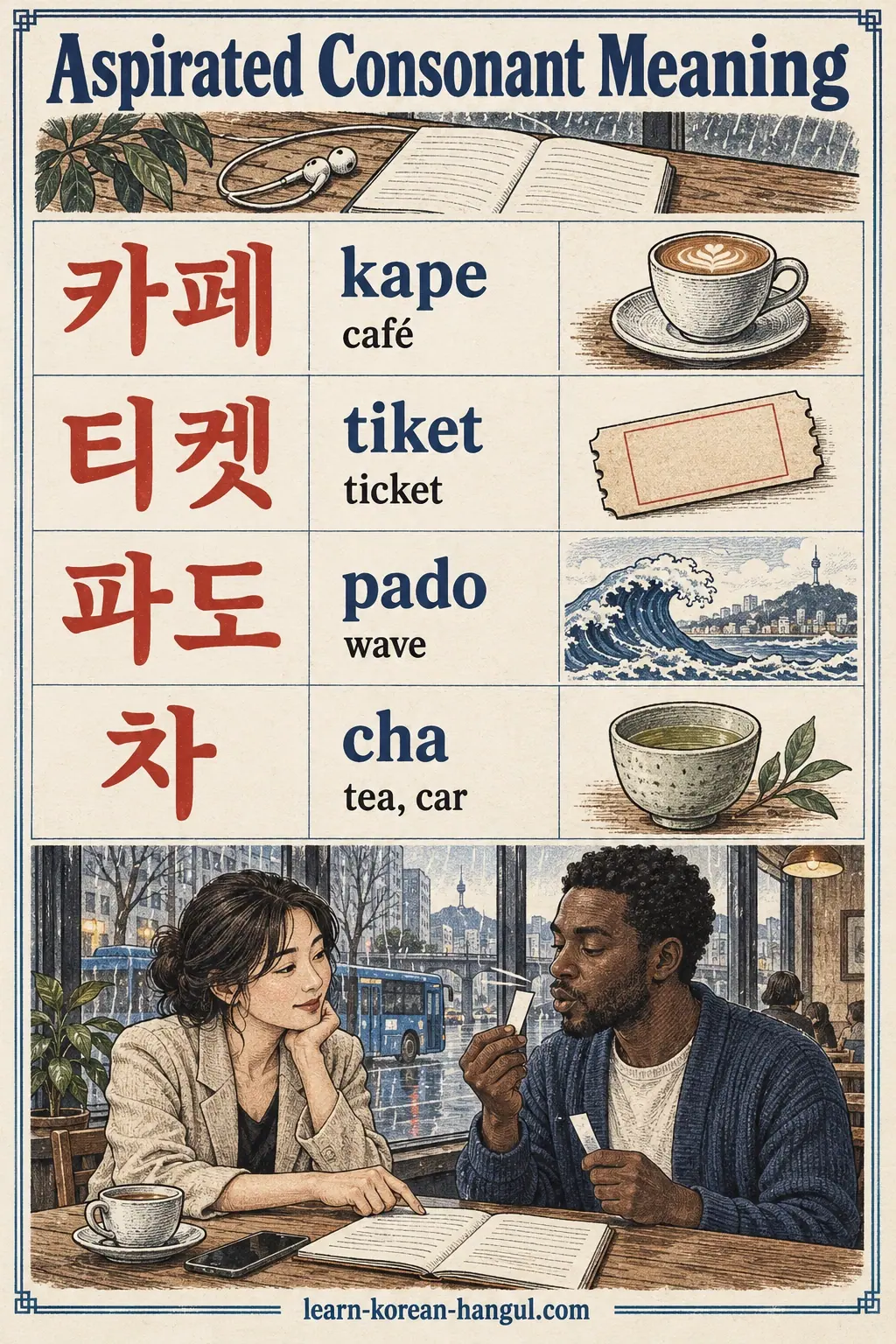
Key facts
- The Korean terms are 격음 (gyeogeum) and 거센소리 (geosensori); textbooks use them interchangeably.
- The puff can be felt with a hand or a paper strip held in front of the mouth.
Aspirated Consonant Meaning in Korean

Aspiration is the burst of air that follows the release of a stop or affricate, before the next sound starts. A stop is a consonant made by blocking the air completely and then releasing it; an affricate is a stop that ends in a hiss, like ㅊ. English speakers already make aspirated sounds: the p in "pin" has a puff, and the p in "spin" has almost none. Korean turns that difference into separate letters.
Korean has four aspirated consonants, and each has a plain partner made at the same place in the mouth.
| Aspirated letter | Plain partner | Where it is made | Aspirated word | Plain word |
|---|---|---|---|---|
| ㅋ (k) | ㄱ | back of the tongue | 카페 (kape, café) | 가게 (shop) |
| ㅌ (t) | ㄷ | tongue tip | 티켓 (tiket, ticket) | 다리 (leg) |
| ㅍ (p) | ㅂ | lips | 파도 (pado, wave) | 바다 (sea) |
| ㅊ (ch) | ㅈ | tongue against the palate | 차 (cha, tea or car) | 자 (ruler) |
You can check the puff yourself. Hold a strip of paper about five centimetres from your lips and say 파도. The paper flutters clearly. Say 바다 and it moves less. Say a tense word such as 빠르다 (fast) and it barely moves. Hear the aspirated start of 파도 below.
The same idea reaches across the alphabet through ㅎ. The letter ㅎ is not counted as aspirated, but when it meets ㄱ, ㄷ, ㅂ or ㅈ the two sounds merge into one aspirated sound: 좋다 is pronounced [조타] and 입학 is pronounced [이팍]. With the meaning clear, the next question is how aspirated sounds differ from their closest neighbour.
Aspirated Versus Tense Consonants

Aspirated and tense consonants are the two opposite ends of the Korean three-way set: aspirated sounds release a strong puff with a relaxed throat, while tense sounds release almost no air with a tight throat. Plain consonants sit between them. The table uses one place in the mouth, the tongue tip, to show the pattern.
| Feature | Plain ㄷ | Tense ㄸ | Aspirated ㅌ |
|---|---|---|---|
| Breath after release | light | almost none | strong puff |
| Throat | relaxed | tight | relaxed |
| Revised Romanization | d or t | tt | t |
| Example | 달 (moon) | 딸 (daughter) | 탈 (mask) |
Learners who hear only "d, tt, t" in romanization miss that the real difference is breath and tension, not voicing. The lessons on plain, tense and aspirated consonants train the full contrast. Next, here are four everyday words to practise.
What Are Examples of Aspirated Consonants?

Four common words show the four aspirated letters at the start of a word. Listen to each one, then say it with the puff.
카페
kape
café
티켓
tiket
ticket
파도
pado
wave
차
cha
tea, car
Aspirated consonants also appear inside words: 아파요 (apayo, it hurts) has a ㅍ between two vowels. The puff is clearest at the start of a word, so begin your practice there. These examples lead naturally to the mistakes that learners make with them.
What Do Learners Get Wrong about Aspirated Consonants?

Learners most often assume that Korean ㄱ is "g" and ㅋ is "k", so the pair differs by voicing as in English. In fact the pair differs by breath, because plain ㄱ at the start of a word is voiceless. A learner who says 가게 with an English hard "g" is understood, but a learner who says ㅋ with no puff may be heard as saying a plain ㄱ.
Two other errors are common:
- Adding a puff at the end of a syllable. Aspirated letters lose their puff when they close a syllable, so 부엌 (kitchen) is pronounced [부억] and 밭 (field) is pronounced [받]. This follows the Standard Pronunciation Rules (표준 발음법), Article 9.
- Treating breath as the only cue. In current Seoul speech, aspirated consonants also raise the pitch of the following vowel. Breath is the first cue to learn, but pitch helps your ear too.
Remember that the first goal is a clear puff on ㅋ ㅌ ㅍ ㅊ at the start of a word. Questions that come up next are answered below.
Frequently Asked Questions

What does aspirated mean? Aspirated means a consonant is followed by a short, strong puff of breath before the next vowel begins. English speakers make this puff in "pin", "tin" and "kin" without noticing it. Korean marks the puff with its own letters, ㅋ, ㅌ, ㅍ and ㅊ, so the puff changes which word you say.
Which Korean letters are aspirated? Four letters are aspirated: ㅋ (kieuk), ㅌ (tieut), ㅍ (pieup) and ㅊ (chieut). Revised Romanization writes them k, t, p and ch. They are the strong-breath partners of the plain letters ㄱ, ㄷ, ㅂ and ㅈ, and they sit in the same mouth positions as those partners.
How do I feel aspiration? Hold a hand or a thin strip of paper about five centimetres in front of your lips and say 파도 (wave). The paper should flutter clearly on the ㅍ. Then say 바다 (sea). The paper moves much less, because the plain ㅂ carries only a light breath. Repeat until you can control the difference.
Is aspirated the same as plain? No. Plain consonants such as ㄱ, ㄷ, ㅂ and ㅈ are released with a light breath at the start of a word, while aspirated ones are released with a strong puff. Korean listeners treat them as different sounds, so 달 (moon) and 탈 (mask) are different words even though only the opening consonant changes.
Related Terms and Lessons
Aspirated consonant meaning connects to two sibling terms: the tense consonant and the plain consonant. For the timing measure behind the contrast, read voice onset time; for why the puff vanishes at the end of a syllable, read final consonant neutralization. To train your ear, try the plain, tense and aspirated minimal pairs. All terms are listed in the Korean Pronunciation Glossary.