What you'll learn
- Identify the correct word in 18 audio sets with at least 80 percent accuracy (15 or more correct).
- Distinguish plain, tense and aspirated consonants at five places in the mouth.
- Say each word of a set so that a listener can tell them apart.
- Read your score and decide what to practise next.
Before you start: you should know the letters ㄷ, ㅂ, ㅈ, ㄱ and ㅅ and their doubled and aspirated partners. The session takes about 25 minutes. Audio plays only when you press a button.
Korean Minimal Pairs Plain Tense Aspirated: What Are They?

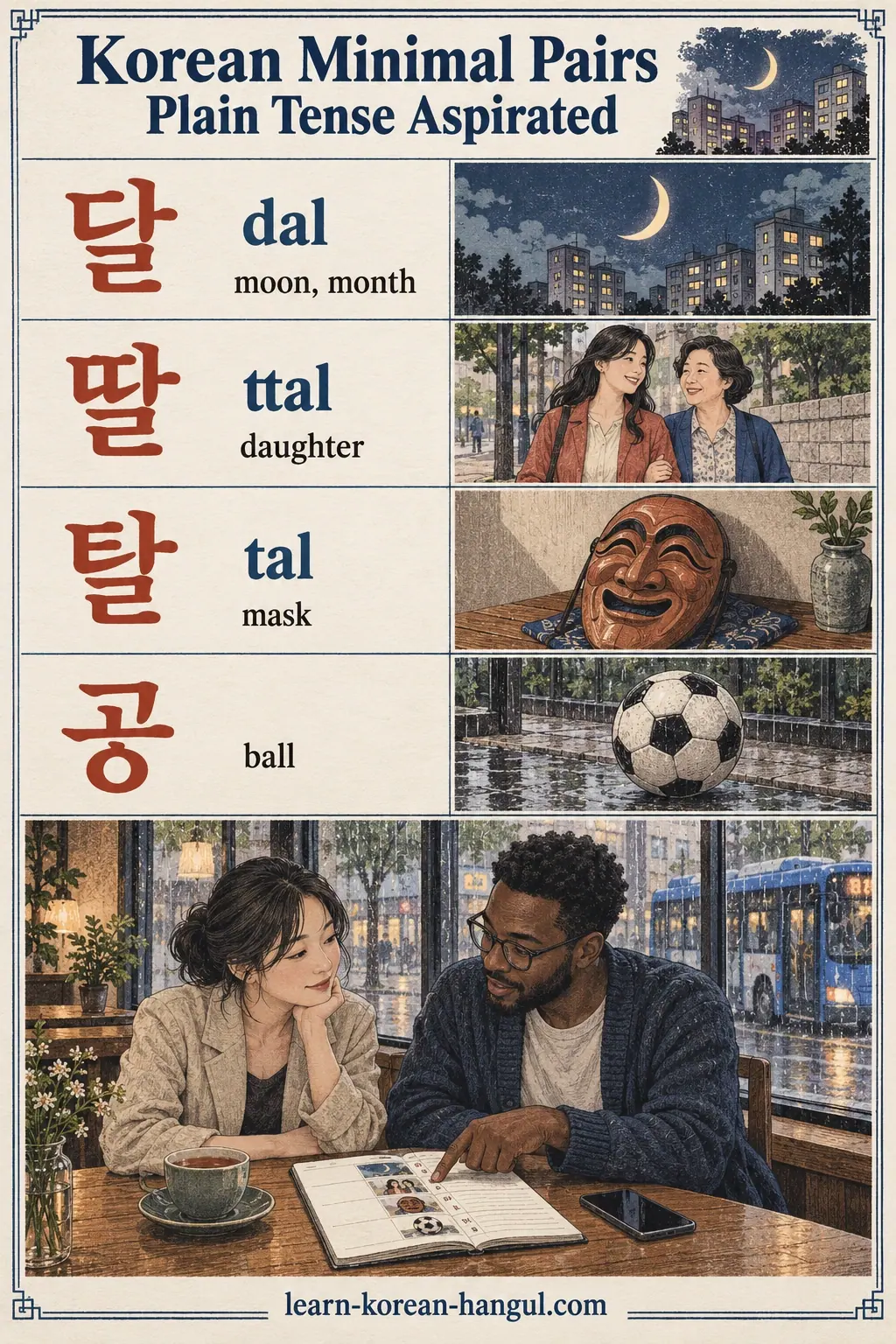
A minimal pair is two words that differ in exactly one sound, and a minimal triple adds a third word that differs in the same slot. In Korean the most useful triples change the opening consonant between plain, tense and aspirated versions made at the same place. Listen to the core triple, 달, 딸 and 탈.
The three words use ㄷ, ㄸ and ㅌ. Plain ㄷ is released with a light breath, tense ㄸ with a tight throat and almost no breath, and aspirated ㅌ with a strong puff. Read the definitions in the glossary entries for plain, tense and aspirated consonants if any term is new. The full explanation of the three sounds is in the lesson on plain, tense and aspirated sounds.
Now consider why this contrast is the hard one for English speakers.
Why English Speakers Struggle with This Contrast
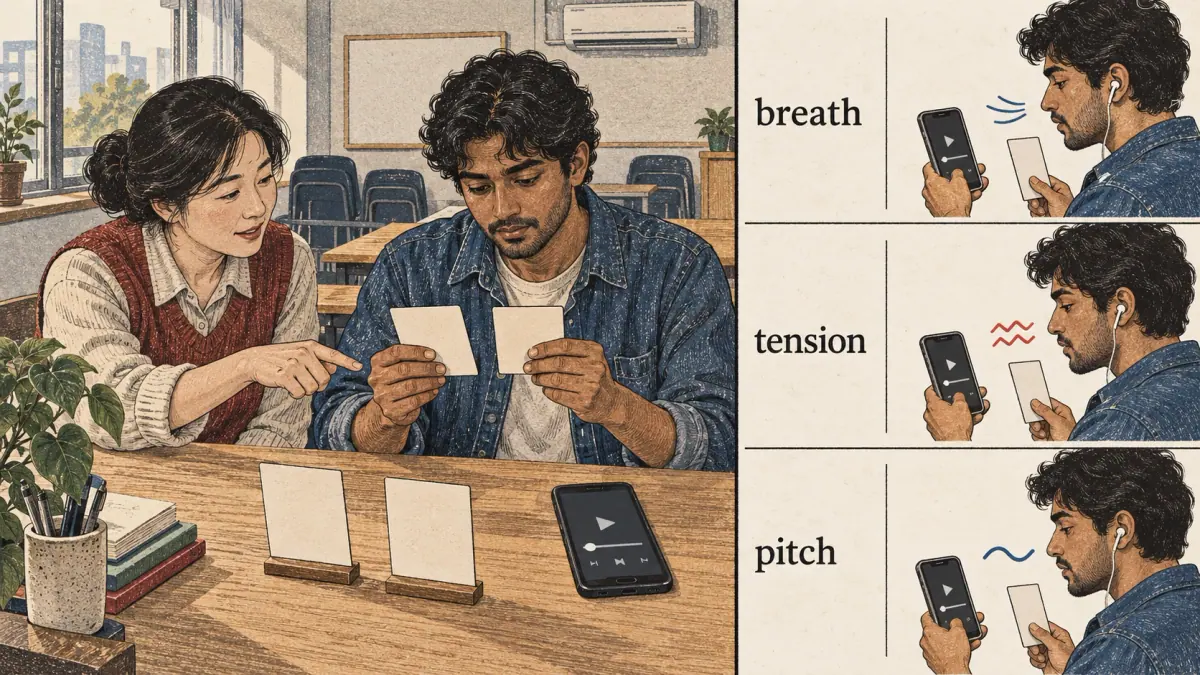
English speakers struggle because English separates stops by voicing (b/p, d/t, g/k), while Korean separates three voiceless stops by breath and tension. A learner who listens for voicing hears nothing useful, and the Korean listener's real cues are never noticed.
Three habits cause most errors:
- Voicing habit. English speakers map ㄷ to "d", ㅌ to "t" and have no category left for ㄸ.
- Aspiration habit. English "t" at the start of a word already has a puff, so English speakers often use it for both ㄸ and ㅌ.
- Pitch blind spot. In current Seoul speech, tense and aspirated consonants also start the following vowel on a higher pitch than plain ones do. Learners rarely listen for pitch, so they miss a cue that Korean listeners use.
The sets below let you train all three cues with real words. Next comes the full list.
Which Sets Are Included?

The 18 sets are grouped by place of articulation (velar, alveolar, bilabial), with the affricates and sibilants as two further groups, which makes the pattern visible: the same three-way contrast repeats at each place. Sibilants have only two members, because Korean has no aspirated ㅅ.
| Group | Plain | Tense | Aspirated | Meanings (plain / tense / aspirated) |
|---|---|---|---|---|
| Velar | 기 | 끼 | 키 | energy / meal / height |
| Velar | 굴 | 꿀 | – | oyster / honey |
| Velar | 공 | – | 콩 | ball / bean |
| Velar | 고리 | 꼬리 | – | ring / tail |
| Alveolar | 달 | 딸 | 탈 | moon / daughter / mask |
| Alveolar | 들 | 뜰 | 틀 | field / yard / frame |
| Alveolar | 담 | 땀 | – | wall / sweat |
| Bilabial | 불 | 뿔 | 풀 | fire / horn / grass |
| Bilabial | 비 | – | 피 | rain / blood |
| Bilabial | 방 | 빵 | – | room / bread |
| Bilabial | 부리 | 뿌리 | – | beak / root |
| Affricate | 자다 | 짜다 | 차다 | to sleep / to be salty / to be cold |
| Affricate | 지다 | 찌다 | 치다 | to lose / to steam / to hit |
| Affricate | 잠 | 짬 | 참 | sleep / spare time / truly |
| Affricate | 장 | – | 창 | chapter / window |
| Sibilant | 살 | 쌀 | – | flesh, age / uncooked rice |
| Sibilant | 사다 | 싸다 | – | to buy / to be cheap |
| Sibilant | 시 | 씨 | – | poem / seed, Mr. or Ms. |
Seven rows are full triples and eleven are pairs, each pairing two of the three types. The pairs matter as much as the triples, because a Korean listener meets them in the same way: as two real words that sound close. Next, the task itself.
How Do You Do the Task?
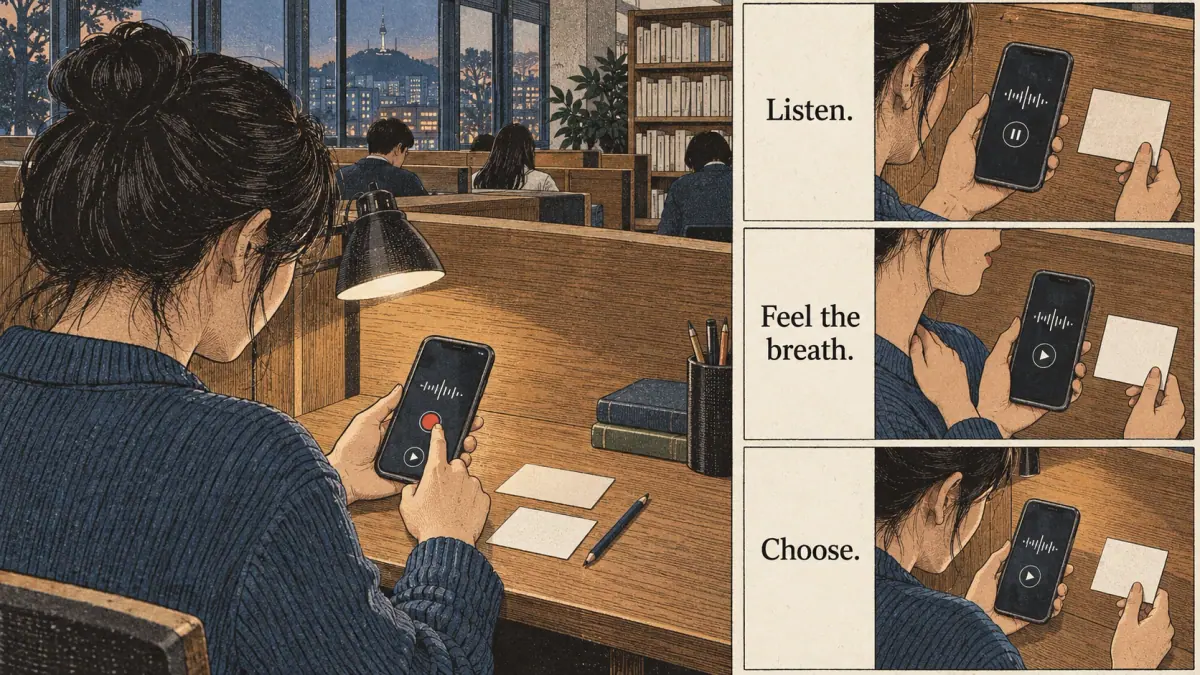
The task has two parts, a listening part and a speaking part, and you should do both for each set. Use this sequence.
- Read the set in the table and check the meanings.
- Play the first clip at normal speed and choose which word you heard.
- If you are unsure, play the slow clip, then the normal clip again.
- Submit and read the feedback. The answer key appears only after you submit.
- Say each word of the set aloud, holding a strip of paper in front of your lips. The paper should move most for the aspirated word and least for the tense word.
- Record yourself if you can, and compare your recording with the clips.
Do not play clips repeatedly before answering, because repetition trains your memory of the clip and not your ear. Use the slow clip only after a wrong answer. Next, what the score tells you.
Reading Your Score
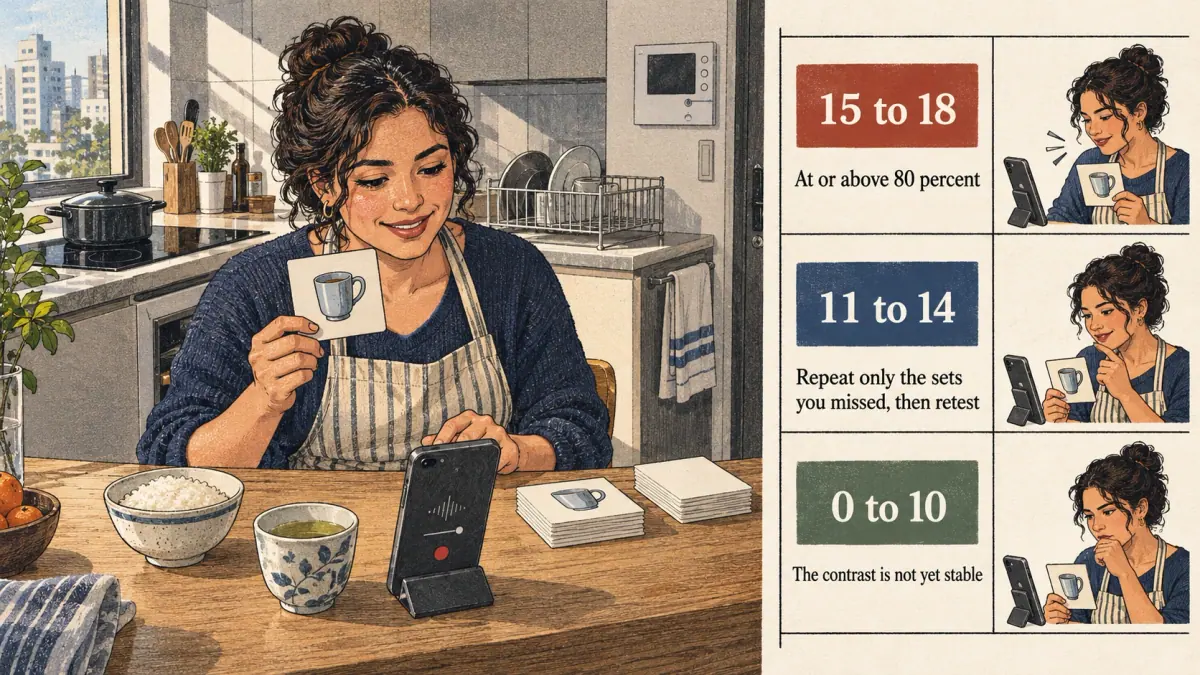
The score tells you which of three actions to take: move on, repeat selected sets, or go back to the sound lessons. The first table converts your score into an action, and the second maps your error pattern to a fix.
| Score out of 18 | Meaning | Next action |
|---|---|---|
| 15 to 18 | At or above 80 percent | Move on to the vowel minimal pairs |
| 11 to 14 | You hear most sets but not all | Repeat only the sets you missed, then retest |
| 0 to 10 | The contrast is not yet stable | Read the sound lesson and use the listening drill first |
| Most confused pair of types | What it usually means | Fix |
|---|---|---|
| Plain and tense | You listen for voicing, not tension | Tighten your throat and release without breath; use the paper test |
| Plain and aspirated | You miss the size of the puff | Exaggerate the puff on ㅌ ㅍ ㅊ ㅋ |
| Tense and aspirated | You treat every "strong" sound as one type | Compare breath (aspirated) with tightness (tense) |
Scores are a self-check, and the page does not judge your pronunciation. With the score understood, the next question is which sets are hardest.
Which Pairs Are Hardest?
The plain-versus-tense pairs are usually the hardest for English speakers, because English has no tense category to attach them to. The aspirated sounds are easiest to notice, since the puff is audible, and the tense sounds are easiest to produce once the throat tension is understood. This ranking is a typical pattern, not a measurement.
Start with 달/딸/탈 or 불/뿔/풀. The tongue tip and the lips are easy to feel, so the three-way contrast is easier to sense there than at the back of the mouth. Hear the lip triple 불, 뿔 and 풀.
The affricates 자다, 짜다 and 차다 come next, and the sibilants 살/쌀 and 사다/싸다 come last, because only a plain-versus-tense difference is available there.
Position also matters. Opening consonants in a word are easier than consonants between vowels, because the tense and aspirated cues are clearest at the start of a word. Take 달 as a worked example.
Worked Example: 달, 딸 and 탈
This worked example takes one triple through all the steps of the task.
- Listen. Play the three clips in order: 달, 딸, 탈.
달
dal
moon, month
딸
ttal
daughter
탈
tal
mask
- Feel the breath. Hold paper to your lips and say 탈. It moves strongly. Say 달 and it moves a little. Say 딸 and it barely moves.
- Feel the tension. Tighten your throat as if lifting something heavy, then say 딸. The word is short and sharp.
- Choose. A fourth clip plays one of the three. Choose which word you heard.
- Check. If you chose wrongly, ask which cue you missed: breath, tension or pitch.
Note that 달 also means "month", as in 한 달 (one month), so the same plain word carries two meanings. After the worked example, the common mistakes come into focus.
Common Learner Mistakes
Learners often assume that the difference is voicing, so they try to make ㄷ voiced and ㅌ voiceless. In fact all three letters are voiceless at the start of a word, and the difference is breath and tension. Three more mistakes follow a similar pattern.
- Learners often assume tense means loud. Actually tense describes a tight throat, not volume, and a tense consonant can be spoken quietly.
- Learners often assume Revised Romanization shows the difference. Actually the romanization "d, tt, t" is only a rough aid, and the spelling alone will not teach you the sound.
- Learners often practise syllables alone. Real words are better, because a listener uses meaning to decide which consonant was heard, and bare syllables such as 따 and 타 give no meaning to check against.
Practise the full sets with the interactive task below.
Practice and Answer Key
Use the listening task first, then the reading quiz. The listening task plays one word from a set at normal or slow speed and asks which word you heard.
Practice · Read
Show answer
달
dal
moon, month
Show answer
딸
ttal
daughter
Show answer
탈
tal
mask
The reading quiz tests spelling and meaning without audio. Choose the word that matches each meaning.
- Which word means "horn": 불, 뿔 or 풀?
- Which word means "daughter": 달, 딸 or 탈?
- Which word means "to be salty": 자다, 짜다 or 차다?
- Which word means "uncooked rice": 살 or 쌀?
- Which word means "bread": 방 or 빵?
- Which word means "to steam": 지다, 찌다 or 치다?
- Which word means "grass": 불, 뿔 or 풀?
- Which word means "mask": 달, 딸 or 탈?
Answer key: 1. 뿔. 2. 딸. 3. 짜다. 4. 쌀. 5. 빵. 6. 찌다. 7. 풀. 8. 탈.
Finally, a speaking task: pick any three sets, say each word twice, and record yourself. Compare your recording with the clips and check whether the paper moves in the right order. Common questions and a scope note follow.
Frequently Asked Questions
How many pairs are in the list? The list has 18 sets: seven triples, where plain, tense and aspirated versions all exist as real words, and eleven pairs, where only two of the three exist. In total the sets contain 43 words. Every word is a real, common Korean word, with no invented syllables, so the practice also builds vocabulary.
Can I do it without audio? Yes, in a limited way. The tables list every word with its meaning, and the reading quiz asks you to match spelling to meaning without sound. That trains spelling and vocabulary but not hearing. The contrast is a sound contrast, so use the audio buttons or the listening task for at least part of every session.
Is there a printable version? The tables on this page are plain text and print cleanly from any browser, so you can print the word list now. A PDF version of the same list is available in A4 and US Letter from the download card. Printing helps with the reading quiz but cannot replace the audio task.
What score means I am ready to move on? A score of 15 or more out of 18, which is at least 80 percent, on two separate days is a sensible sign. One good score can be luck or short-term memory of the clips. If you score lower, repeat only the sets you missed, then read the plain, tense and aspirated sound lessons before trying again.
Why are there no made-up syllables? Real words keep the task honest. Korean listeners decide which consonant they heard partly by asking which word makes sense, so isolated syllables such as 다, 따 and 타 are a different, less natural task. Real words also give a meaning to remember and avoid teaching sounds you will never meet in actual speech.
Where to Go Next
These Korean minimal pairs plain tense aspirated sets train one contrast only. They do not cover final consonants, vowel pairs or sentence-level listening, and they do not test pronunciation. For more practice, open the listening drill, and save the word list from the printables page in A4 or US Letter.
Plain, Tense and Aspirated Minimal Pairs (printable list)
Next in the series: Korean Vowel Minimal Pairs. To return to the full set of contrasts, see Korean Minimal Pairs.