Tense Consonant Meaning in Korean
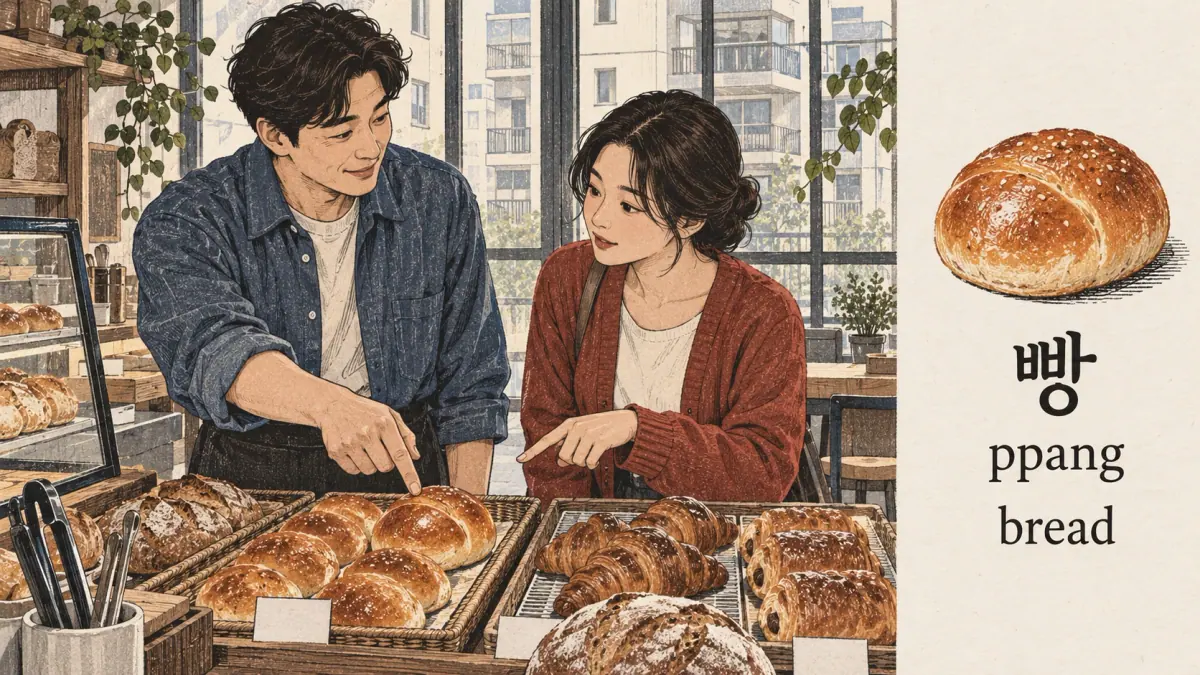
Tension is a way of making a consonant: the throat muscles tighten, the vocal cords stay stiff and almost no air escapes when the sound is released. The result is a short, sharp, unbreathy consonant. The word 경음 uses the characters for "hard" and "sound", and 된소리 uses 된, which carries the sense of "hard" or "stiff".
English has no separate tense consonants, but one bridge helps a little. The k in "sky" is not followed by a puff, unlike the k in "kite", so it is closer to Korean ㄲ and ㄱ than the k in "kite" is. The bridge has a limit. Korean tense sounds add tightness on top of the missing puff, and English "sky" does not.
Korean has five tense consonants, and each has a plain partner:
| Tense letter | Name | Plain partner | Example |
|---|---|---|---|
| ㄲ (kk) | 쌍기역 | ㄱ | 까치 (magpie) |
| ㄸ (tt) | 쌍디귿 | ㄷ | 딸 (daughter) |
| ㅃ (pp) | 쌍비읍 | ㅂ | 빵 (bread) |
| ㅆ (ss) | 쌍시옷 | ㅅ | 쌀 (rice) |
| ㅉ (jj) | 쌍지읒 | ㅈ | 짜다 (to be salty) |
The word 쌍 (ssang) means "pair" or "twin". The doubled letter marks one tense sound, not two sounds. Listen to the tense ㅃ in 빵 (bread).
Tense letters occur at the start of a syllable. At the end of a syllable only ㄲ and ㅆ can be written, and they lose their tension: 밖 (outside) is pronounced [박]. Next, the contrast with the other strong sound class.
Tense Versus Aspirated Consonants

Tense and aspirated consonants both sound "strong" to English ears, but they are opposites in the mouth: tense consonants keep the breath in and the throat tight, while aspirated consonants let a strong puff out through an open throat. The table compares one set made at the lips.
| Feature | Tense ㅃ | Aspirated ㅍ |
|---|---|---|
| Breath after release | almost none | strong puff |
| Throat | tight | open, with a breath |
| Revised Romanization | pp | p |
| Example | 뿔 (horn) | 풀 (grass) |
| Plain partner | ㅂ, as in 불 (fire) | ㅂ, as in 불 (fire) |
Both tense and aspirated sounds stand apart from the plain ㅂ in 불. Learning the three together is easier than learning each alone, which is why the lesson on how to pronounce tense consonants always compares them. Now the examples.
What Are Examples of Tense Consonants?

Three words show tense consonants as they are written, and one shows a tense sound that spelling does not show.
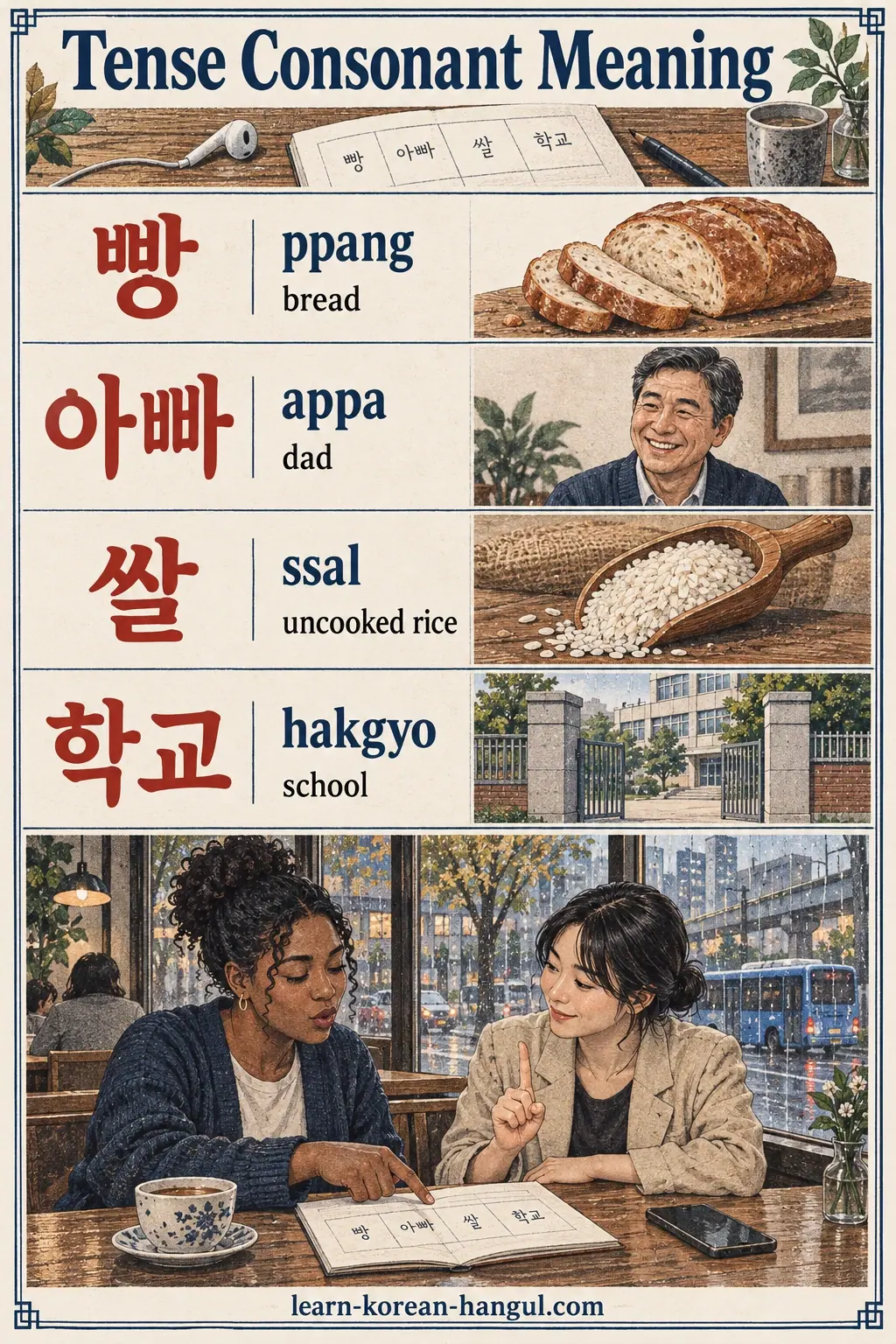
빵
ppang
bread
아빠
appa
dad
쌀
ssal
uncooked rice
학교
hakgyo
school
The fourth word, 학교, is written with plain ㄱ but spoken [학꾜]. Korean turns a plain consonant into a tense one after certain final sounds, a rule called Korean tensification. Some tense sounds are therefore invisible in the spelling, which leads to a common mistake.
What Do Learners Get Wrong about Tense Consonants?

Learners often assume that a doubled letter means a long or repeated sound, as in Italian or Japanese. In Korean the doubling only marks tension, so 빵 is said with one short, tight ㅃ. Holding the sound longer does not make it tense and can make it sound like a different word.
Two other errors are frequent:
- Substituting the aspirated sound. Many English speakers say 빵 with a puffed "p" because English "p" has a puff. Keep the lips closed a moment longer, tighten the throat and release without breath.
- Expecting spelling to show every tense sound. In 학교 the second syllable is spoken as ㄲ even though ㄱ is written. This always happens when a plain consonant follows the final stop sounds [ㄱ], [ㄷ] or [ㅂ].
Remember that tension, not length or loudness, is the key. The questions below cover what comes up next.
Frequently Asked Questions
What does tense mean in Korean? Tense means the consonant is made with a tight throat and almost no breath after the release. Korean calls this 경음 (gyeongeum) or 된소리 (doensori). The tension is the sound itself, not an extra loudness, so a tense consonant can be spoken quietly and still be tense.
Which letters are tense? Five letters are tense: ㄲ (ssanggiyeok), ㄸ (ssangdigeut), ㅃ (ssangbieup), ㅆ (ssangsiot) and ㅉ (ssangjieut). Revised Romanization writes them kk, tt, pp, ss and jj. Each one pairs with a plain letter made in the same place: ㄱ, ㄷ, ㅂ, ㅅ and ㅈ.
Why are tense consonants doubled? Hangul doubles a plain letter to show its tense version, a method the 1446 Hunminjeongeum Haerye describes as writing identical letters side by side. The doubled shape does not mean the sound lasts twice as long or is said twice. It marks one tense sound, so 빵 contains one ㅃ sound.
Is ㅆ tense? Yes. ㅆ is the tense partner of plain ㅅ, and it is the tense letter learners meet most often in grammar, as in the past-tense ending of 갔어요 [가써요]. Because Korean has no aspirated ㅅ, the plain-tense pair ㅅ and ㅆ is a two-way contrast, unlike the three-way sets.
Related Terms and Lessons
Tense consonant meaning pairs with the opposite term, the aspirated consonant, and with the middle term, the plain consonant. Find every sound term in the Korean Pronunciation Glossary, and practise the contrast in the plain, tense and aspirated minimal pairs.