Manner of Articulation Meaning in Korean
Place says where the mouth makes a consonant. Manner says what the mouth does with the air at that place. The manner can be a full stop and burst, a stop and slow release, a narrow gap, an exit through the nose or a flow around the tongue.
Korean consonants use five manners.
| Manner | What the air does | Korean letters | Korean term |
|---|---|---|---|
| stop | blocked, then released | ㄱ ㄲ ㅋ ㄷ ㄸ ㅌ ㅂ ㅃ ㅍ | 파열음 |
| affricate | blocked, then released slowly with friction | ㅈ ㅉ ㅊ | 파찰음 |
| fricative | squeezed through a narrow gap | ㅅ ㅆ ㅎ | 마찰음 |
| nasal | exits through the nose | ㄴ ㅁ ㅇ | 비음 |
| liquid | flows around or taps the tongue | ㄹ | 유음 |
The first three manners are the obstruent group. Nasals and the liquid belong to the sonorants.
Why Does Manner of Articulation Matter?
Manner explains the three-way contrast that defines Korean consonants. The stops and affricates each come in three versions: plain, tense and aspirated. The fricatives do not follow the same rule. ㅅ has a two-way contrast (plain ㅅ and tense ㅆ), and ㅎ has no partner. Nasals and ㄹ have no contrast at all.
| Manner | Plain | Tense | Aspirated |
|---|---|---|---|
| stop | ㄱ ㄷ ㅂ | ㄲ ㄸ ㅃ | ㅋ ㅌ ㅍ |
| affricate | ㅈ | ㅉ | ㅊ |
| fricative | ㅅ | ㅆ | none |
Knowing the manner also tells you which rules apply. Neutralization works on stops, affricates and fricatives. Nasalization turns stops into nasals. The lesson on Korean consonant sounds uses manner as the row label of its chart.
Manner of Articulation Versus Place
Manner is the "how", and place of articulation is the "where". The two together make each consonant unique.
| Letter | Place | Manner |
|---|---|---|
| ㅂ | lips | stop |
| ㅁ | lips | nasal |
| ㅈ | hard palate | affricate |
| ㅅ | tongue tip | fricative |
| ㅎ | throat | fricative |
Because ㅂ and ㅁ share a place, only manner separates them. That is why a learner who says 밥 with a nasal ending is making a manner error, not a place error.
What Are Examples of Manner of Articulation?
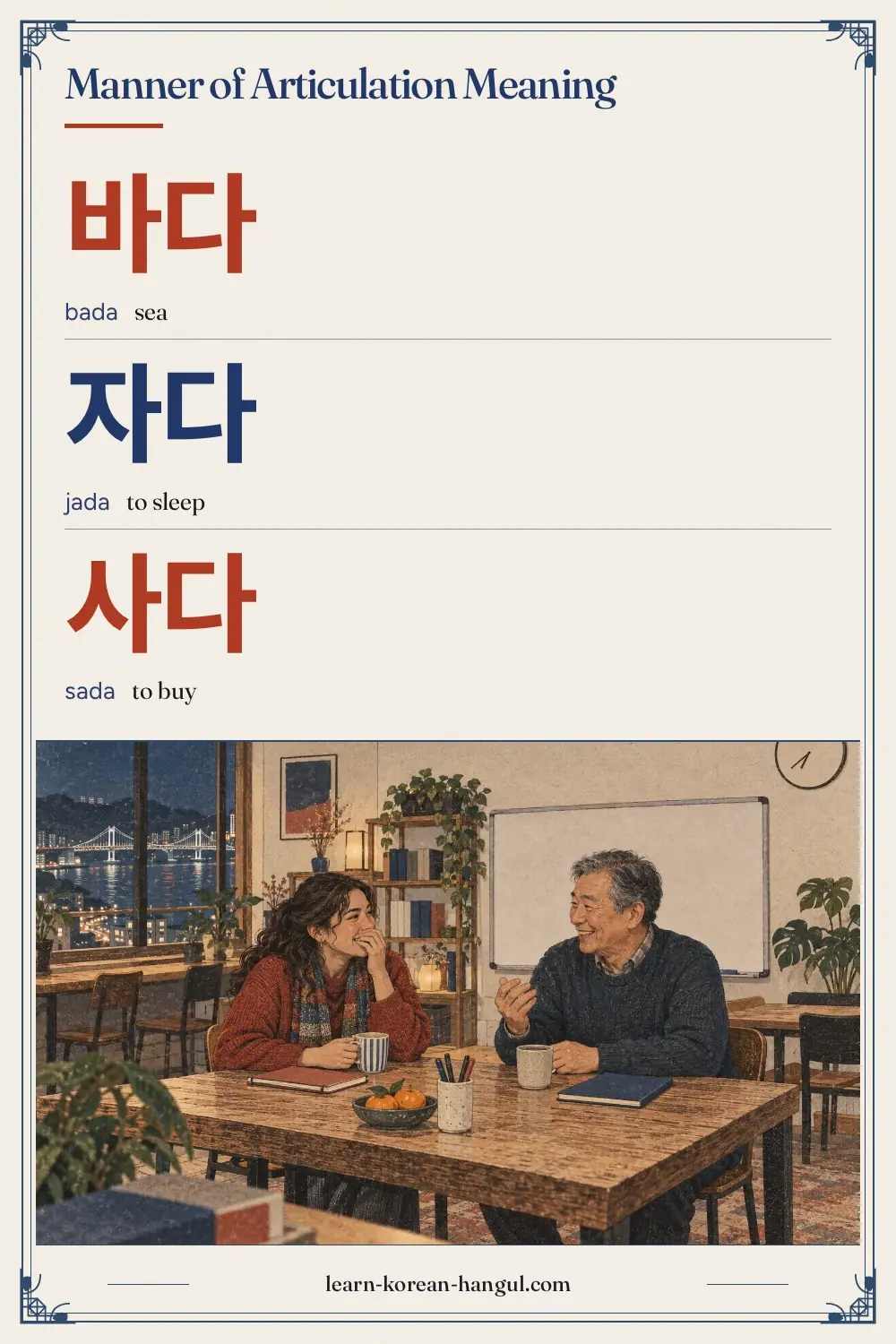
Four words begin with a different manner: a stop in 바다, an affricate in 자다, a fricative in 사다 and a nasal in 나라, whose second syllable adds the liquid ㄹ.
바다
bada
sea
자다
jada
to sleep
사다
sada
to buy
나라
nara
country
What Do Learners Get Wrong about Manner of Articulation?
Learners often ask whether ㅈ is a stop, since it begins with a closure. The answer is that it is an affricate: it starts as a stop and then releases slowly like a fricative. English "ch" and "j" are also affricates, so English speakers already have the manner.
Other points:
- ㅎ is a fricative, but a weak one. It is made at the throat with breath only, and Korean charts list it as a glottal fricative.
- ㅅ has only one extra version. There is no aspirated ㅅ letter. Plain ㅅ is itself said with some breath, and some phoneticians class it as aspirated rather than plain.
- Manner is not voicing. A stop can be voiced or voiceless depending on position, and the manner stays the same.
This page leaves out the details of vowel types, which are described by height and backness rather than by manner.
Frequently Asked Questions
What is manner of articulation? Manner of articulation is how the airflow is shaped or released when a consonant is made. The five Korean manners are stop, affricate, fricative, nasal and liquid. Place tells you where the mouth makes the sound, and manner tells you what the mouth does with the air at that place.
Is ㅈ a stop? Not exactly. ㅈ is an affricate: it starts with a stop-like closure and then releases slowly with friction, like English "j" in "judge". Korean groups ㅈ ㅉ ㅊ as affricates, the same way it groups ㄱ ㄷ ㅂ as stops. Both groups have the plain, tense and aspirated contrast.
What are the Korean terms? The usual Korean terms are 파열음 for stops, 파찰음 for affricates, 마찰음 for fricatives, 비음 for nasals and 유음 for liquids. The lessons use the English names, so learners can ignore the Korean terms until they read Korean textbooks. The terms are useful later, because Korean grammar books describe sound rules with them.
Is ㅎ a fricative? Yes, ㅎ is usually listed as a glottal fricative, made by breath passing through the open vocal cords at the throat. It is weak and has no tense or aspirated partner. Some descriptions call it a breathy sound instead. It behaves like an obstruent in sound-change rules.
Related Terms and Lessons
Manner of articulation meaning pairs with place of articulation. The group of stops, affricates and fricatives is defined under obstruent, and the grid is in the lesson on Korean consonant sounds. All terms are listed in the Korean Pronunciation Glossary.