Obstruent Meaning in Korean
The word comes from Latin for "block against". To make an obstruent, you block the air stream completely or squeeze it enough to make friction. The three kinds are stops, affricates and fricatives.
| Kind | How the air is blocked | Korean letters |
|---|---|---|
| stop | full closure, then release | ㄱ ㄲ ㅋ ㄷ ㄸ ㅌ ㅂ ㅃ ㅍ |
| affricate | closure, then slow release with friction | ㅈ ㅉ ㅊ |
| fricative | narrow gap, friction throughout | ㅅ ㅆ ㅎ |
That makes 15 obstruent letters at the start of a syllable, counting ㅎ. The nasals ㄴ ㅁ ㅇ and the liquid ㄹ are not obstruents. They belong to the opposite group, the sonorant sounds.
Korean linguists call obstruents 장애음 (jangaeeum).
Why Do Korean Sound Rules Mention Obstruents?
Obstruents behave as a team. Three rules are written for the whole group rather than for single letters.
- Neutralization. At the end of a syllable, any obstruent reduces to one of three unreleased sounds, [ㄱ], [ㄷ] or [ㅂ]. The letter ㅋ in 부엌 (kitchen) is spoken [부억].
- Tensification. After an obstruent at the end of a syllable, a plain ㄱ ㄷ ㅂ ㅅ ㅈ becomes tense. The word 학교 (school) is spoken [학꾜].
- Nasalization. An obstruent before a nasal becomes a nasal. The word 먹는 (eating) is spoken [멍는].
Writing the rule once for "obstruent" saves writing it for fifteen letters. See the lesson on Korean tensification for the second rule in detail.
Obstruent Versus Sonorant
The nearest confusable term is the sonorant, and the two together cover every Korean consonant.
| Feature | Obstruent | Sonorant |
|---|---|---|
| Airflow | blocked or squeezed | open and free |
| Letters | stops, affricates, ㅅ ㅆ ㅎ | ㄴ ㅁ ㅇ ㄹ (and vowels) |
| Final sounds | three: [ㄱ] [ㄷ] [ㅂ] | four: [ㄴ] [ㅁ] [ㅇ] [ㄹ] |
| Voicing | voiceless, or voiced only between voiced sounds | voiced |
| Example | 학교 (hakgyo) | 나라 (nara) |
The seven final sounds of Korean are the three obstruent ones plus the four sonorant ones. Sonorants keep their sound at the end of a syllable. Obstruents lose most of their distinctions there.
What Are Examples of an Obstruent?
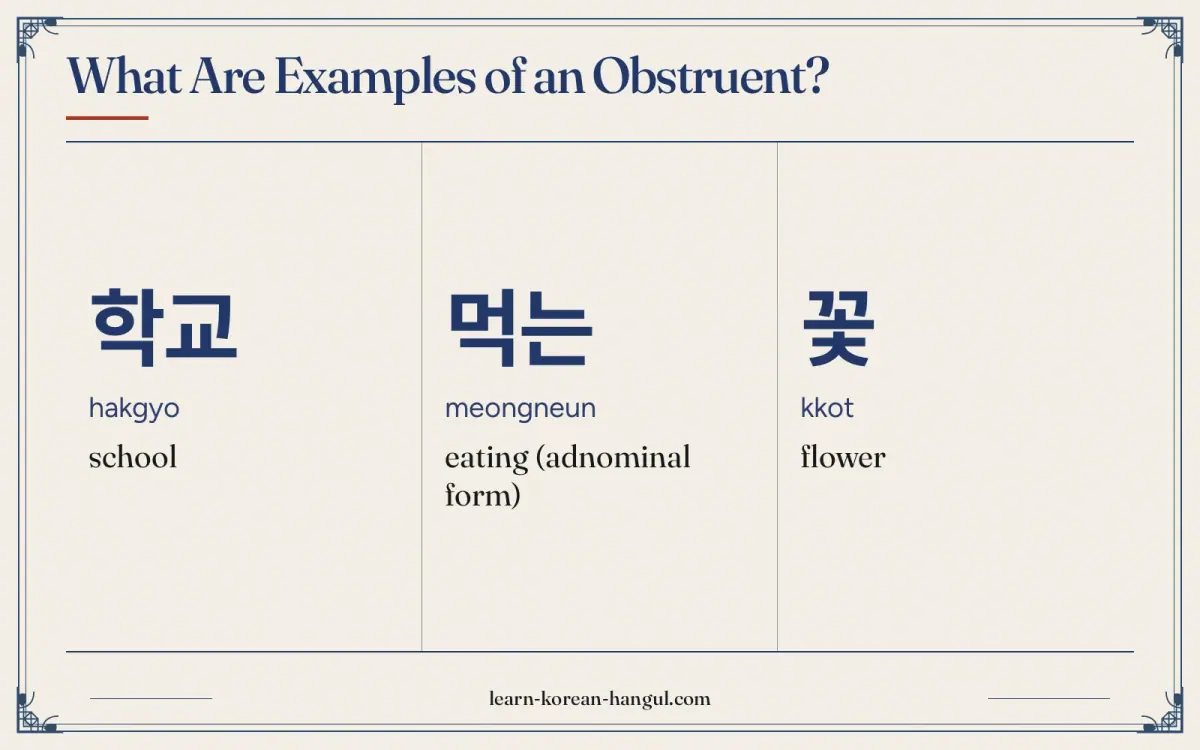
Two words show obstruents changing under the rules above.
학교
hakgyo
school
먹는
meongneun
eating (adnominal form)
A third word shows the group at the end of a word.
꽃
kkot
flower
What Do Learners Get Wrong about the Obstruent Group?
Learners often think of ㅎ as a separate, gentle sound that follows no rules. In sound-change rules ㅎ patterns with the obstruents. It is a fricative made with breath, and it is the only one made in the throat, but it still drops to [ㄷ] at the end of a word, as in 히읗 [히읃], and it merges with a neighbouring ㄱ ㄷ ㅈ to make aspirated sounds.
Two further points:
- Voiced does not mean sonorant. A plain stop can be voiced between vowels, as in 아기, and it is still an obstruent. The group is defined by airflow, not by voicing.
- The term is not a spelling label. Obstruent names a sound class. The letter ㄱ is an obstruent in 학교, but in 먹는 the rule turns its sound into the nasal [ㅇ].
This page does not cover the details of each rule. Those belong to the sound-change lessons. For an overview of all consonants, see Korean consonant sounds.
Frequently Asked Questions
What is an obstruent? An obstruent is a consonant made by blocking or tightly narrowing the airflow. Korean has three kinds: stops such as ㄱ ㄷ ㅂ, affricates ㅈ ㅉ ㅊ and fricatives ㅅ ㅆ ㅎ. The group matters because several Korean sound rules are written for obstruents as a whole.
Is ㅎ an obstruent? Yes, in the system used for sound rules. ㅎ is a fricative made with breath in the throat. It patterns with the obstruents because it reduces to [ㄷ] at the end of a word and combines with ㄱ ㄷ ㅈ to make aspirated sounds. Some descriptions treat it as a weaker, breathy case.
Why does it matter for rules? Rules written for obstruents cover many letters at once. After an obstruent final, plain ㄱ ㄷ ㅂ ㅅ ㅈ become tense. Before a nasal, an obstruent final becomes a nasal. At the end of a syllable, obstruents reduce to [ㄱ], [ㄷ] or [ㅂ]. Knowing the group lets you apply each rule to every letter.
What is 장애음? 장애음 (jangaeeum) is the Korean term usually given for obstruents. It literally means "obstruction sound". Its partner term for sonorants is 공명음 (gongmyeongeum). Korean textbooks use both words when they explain which letters follow the same sound rules. Learners can ignore the Korean terms and use the English word obstruent, as the lessons do.
Related Terms and Lessons
Obstruent meaning is half of a pair with sonorant. The group also appears when stops are classified by manner of articulation. For the rule that targets obstruents most visibly, see Korean tensification. All terms are listed in the Korean Pronunciation Glossary.