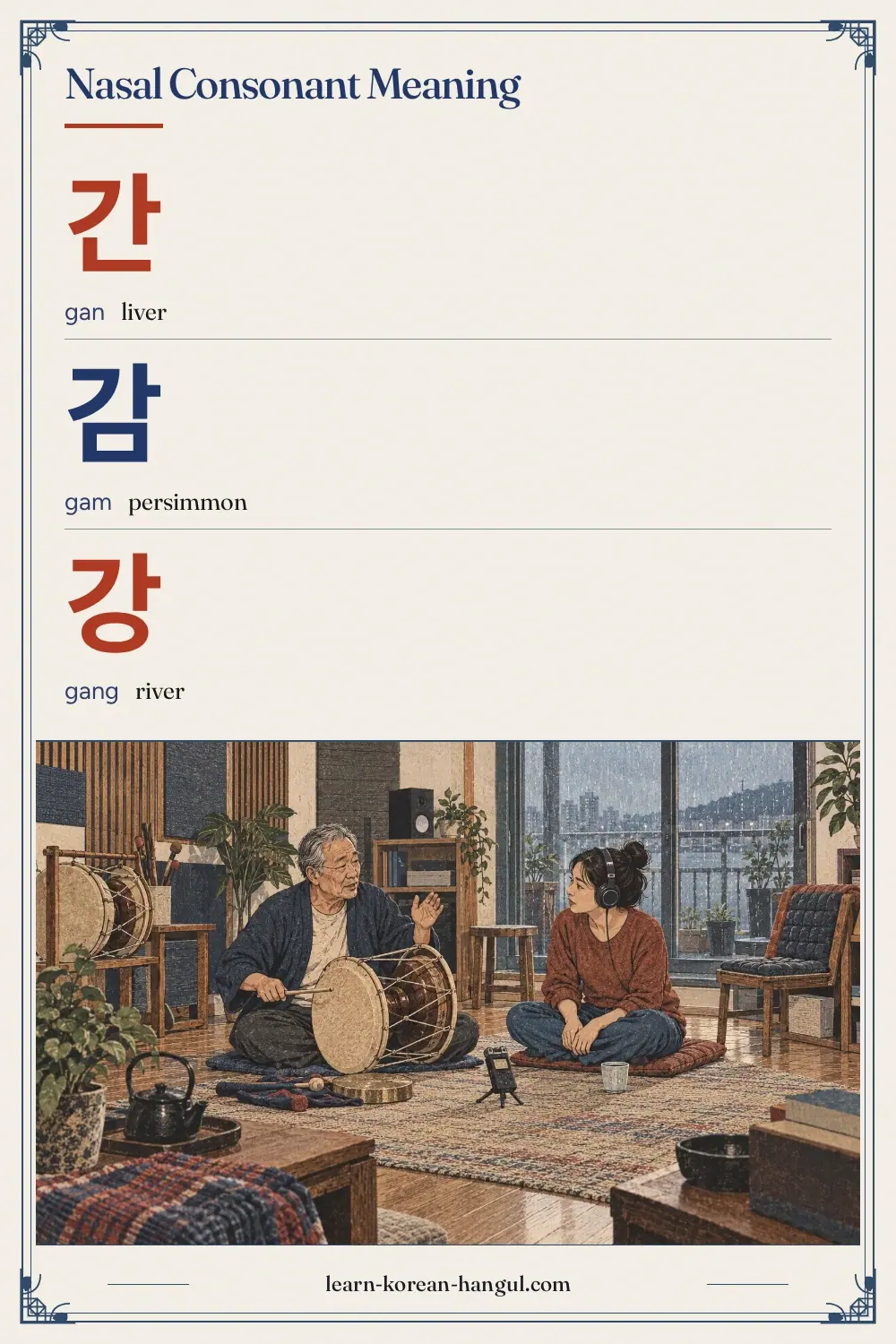
Nasal Consonant Meaning in Korean
To make a nasal, the mouth closes at one point while the soft palate, the soft flap at the back of the roof of the mouth, stays lowered. Air then escapes through the nose. Hold your nose and say "mmm". The sound stops or changes, which proves the nose is doing the work.
Korean has three nasal consonants, and each one closes the mouth in a different place.
| Letter | Mouth closes with | Sound | Korean name for the group |
|---|---|---|---|
| ㅁ | the lips | [m] | 비음 (bieum) |
| ㄴ | the tongue tip on the ridge behind the teeth | [n] | 비음 |
| ㅇ (final) | the back of the tongue on the soft palate | [ŋ], like the end of "sing" | 비음 |
The letter ㅇ is silent as an onset. It is a nasal only at the end of a syllable. That is why 아 begins with a vowel but 강 ends with [ŋ].
Why Do Nasal Consonants Matter in Korean?
Nasals matter for two reasons. First, they can close a syllable. The seven final sounds of Korean include all three nasals, [ㄴ] [ㅁ] [ㅇ], and they are held fully, unlike the unreleased stops. Second, they cause the sound change called nasalization. When a stop final meets a nasal onset, the stop turns into the nasal that matches its place of articulation.
- ㄱ before ㄴ or ㅁ becomes [ㅇ]: 먹는 (meongneun, eating) is spoken [멍는].
- ㄷ before ㄴ or ㅁ becomes [ㄴ]: 닫는 (danneun, closing) is spoken [단는].
- ㅂ before ㄴ or ㅁ becomes [ㅁ]: 밥만 (bamman, only rice) is spoken [밤만].
The lesson on Korean nasalization gives every case. For now, remember that the change is toward the nasal at the same place: back to back, tip to tip, lips to lips.
Nasal Consonant Versus Stop
The nearest confusable term is the stop, because nasals and stops are made in the same three places. Only one thing differs: where the air goes.
| Feature | Nasal | Stop |
|---|---|---|
| Soft palate | lowered | raised |
| Air exits through | the nose | the mouth, after a release |
| Voicing | always voiced | voiceless or voiced by position |
| Place trio | ㅁ ㄴ ㅇ | ㅂ ㄷ ㄱ |
| Example | 감 (gam) | 갑 (gap) |
Nasals belong to the larger group of sonorant sounds, which is why they are always voiced.
What Are Examples of a Nasal Consonant?
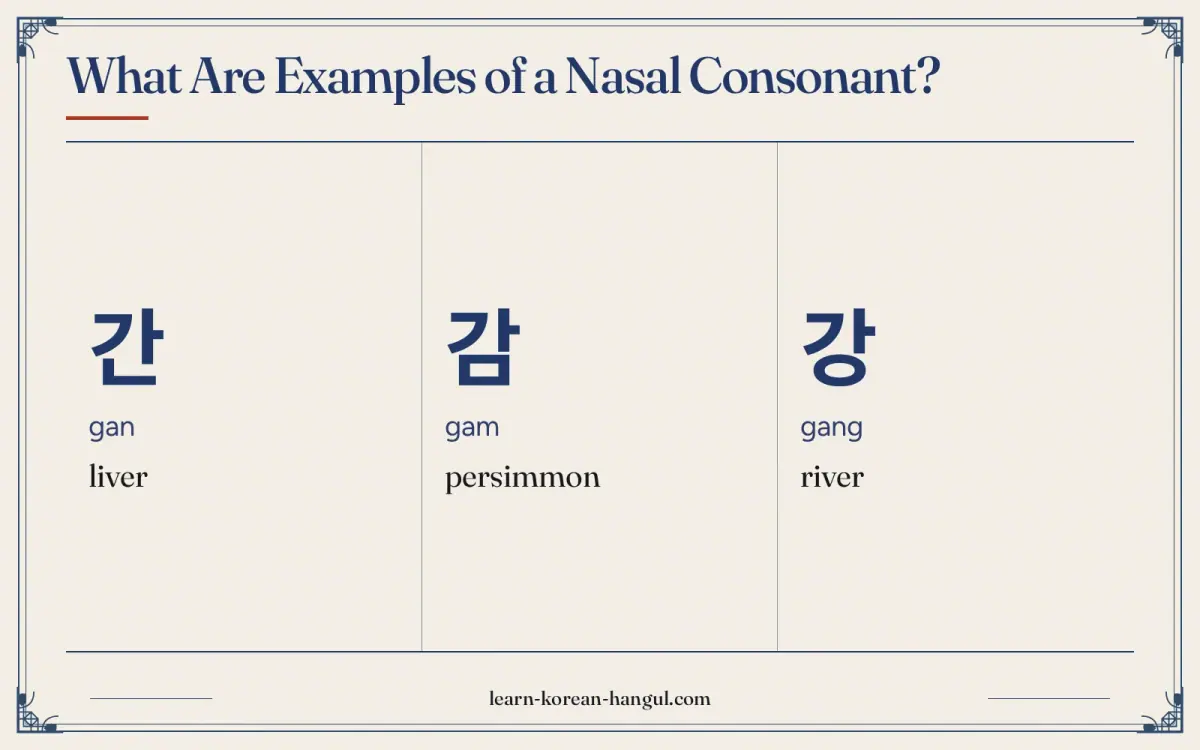
A trio of one-syllable words that differ only in the final consonant shows how much place matters.
간
gan
liver
감
gam
persimmon
강
gang
river
Each word is a different noun. Only the closure place changes. A fourth example shows nasalization at work.
국물
gungmul
broth, soup liquid
What Do Learners Get Wrong about Nasal Consonants?
English speakers rarely struggle with ㅁ and ㄴ. The error is usually the third nasal. Many learners read the final ㅇ as silent, or add a hard "g", so 강 comes out as "gahng-guh". Hold the back of the tongue up until the sound ends, with no release.
Other points:
- ㅇ is silent only at the start. At the end it is a full nasal.
- Nasal assimilation is not optional. In standard pronunciation 먹는 is [멍는]. The written form misleads, so learners who read letter by letter say "meok-neun".
- The minimal trio matters. If the final nasal is wrong, 간, 감 and 강 become one another.
For more drills, see the nasal and liquid minimal pairs. This page does not cover nasal vowels, which Korean does not have as separate sounds.
Frequently Asked Questions
What is a nasal consonant? A nasal consonant is a consonant made by closing the mouth at one point while the soft palate is lowered, so air flows out through the nose. English has m, n and the "ng" of "sing". Korean has the matching three: ㅁ, ㄴ and ㅇ at the end of a syllable.
Which Korean letters are nasal? ㄴ, ㅁ and ㅇ are the nasal letters. ㅇ is silent at the start of a syllable and is a nasal [ŋ] only at the end, as in 강 (river). After the sound change called nasalization, ㄱ ㄷ ㅂ can also be spoken as nasals when a nasal follows them.
How do nasals differ from stops? Nasals and stops close the mouth in the same three places, but the air leaves differently. For a nasal the soft palate is lowered and air exits through the nose. For a stop it is raised and air bursts out of the mouth. That is why 감 (gam) and 갑 (gap) are different words.
What is 비음? 비음 (bieum) is the Korean term for nasal sounds. The first syllable 비 means "nose" and 음 means "sound". Korean textbooks list ㄴ, ㅁ and ㅇ as the 비음. You will meet the word again in the nasalization rules, where it names the sounds that stops turn into. The lessons use the English word nasal.
Related Terms and Lessons
Nasal consonant meaning connects to the wider group in sonorant. The sound change that creates new nasals is explained in Korean nasalization, and the practice pairs are in the nasal and liquid minimal pairs. All terms are listed in the Korean Pronunciation Glossary.