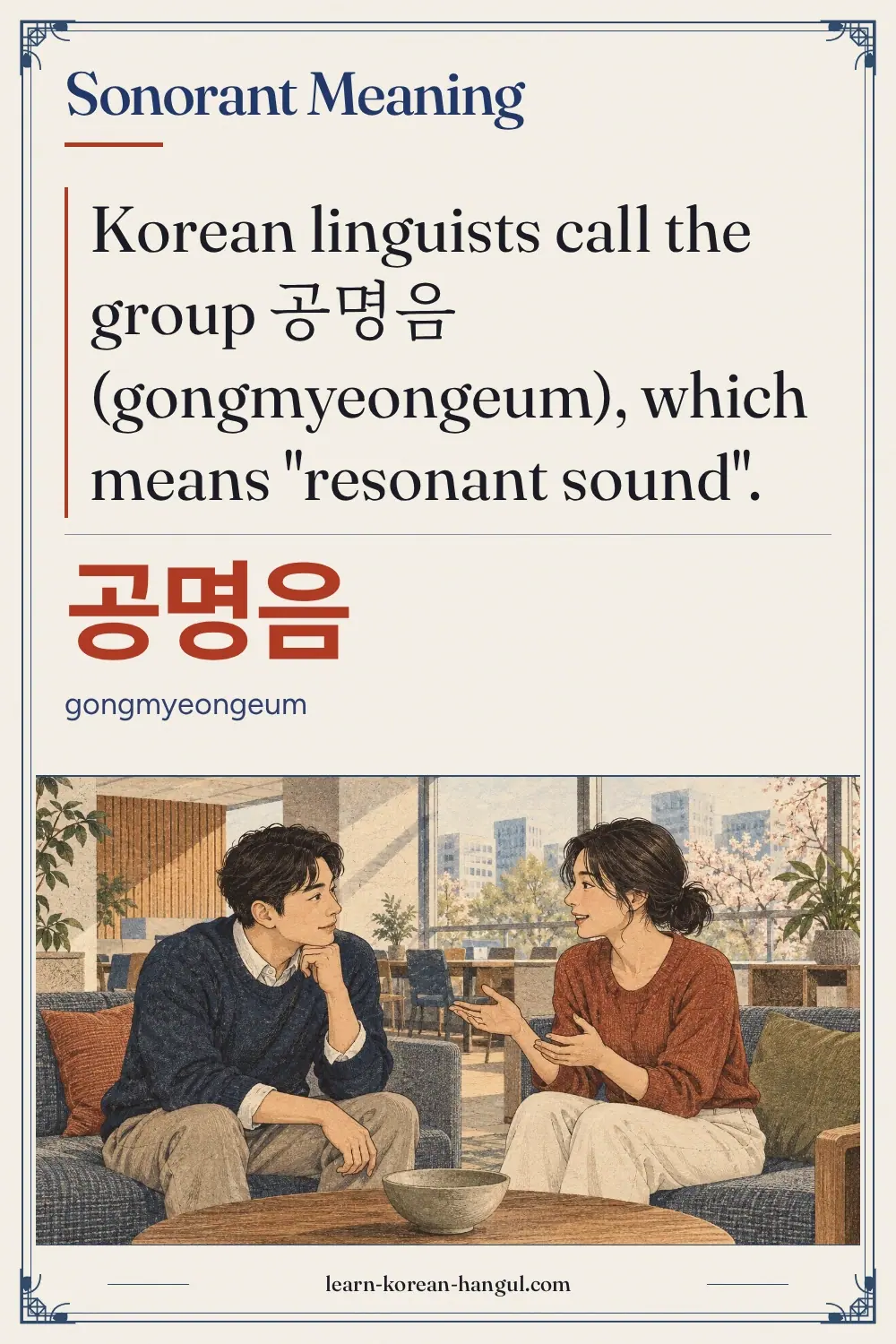
Sonorant Meaning in Korean
The key idea is open airflow. Air leaves the mouth or nose without being blocked or squeezed, so the vocal cords can keep buzzing. That is why sonorants carry a clear tone and can be sung or held, like a long "mmm".
Korean has these sonorants:
- All vowels, such as ㅏ ㅗ ㅣ.
- The nasals ㄴ ㅁ ㅇ, where air leaves through the nose.
- The liquid ㄹ, where air flows around the tongue or the tongue taps once.
Korean linguists call the group 공명음 (gongmyeongeum), which means "resonant sound".
Why Does the Sonorant Group Matter?
Three facts about Korean depend on this group.
- Sonorants are voiced. The consonants ㄴ ㅁ ㅇ ㄹ always buzz. The plain stops buzz only between voiced sounds: the second ㅂ in 바보 (babo, fool) sounds close to English "b", while the first does not. See nasal consonant for the three nasals.
- Sonorants survive at the end of a syllable. The final sound of 산 (san, mountain), 밤 (bam, night), 강 (gang, river) and 물 (mul, water) is spoken as written. Compare 부엌, whose ㅋ reduces to [ㄱ].
- ㅎ weakens near sonorants. Between sonorants, ㅎ is often so weak that it nearly disappears. The word 전화 (jeonhwa, telephone) is a good case, and the lesson on ㅎ weakening covers it.
The seven final sounds of Korean are four sonorants, [ㄴ] [ㅁ] [ㅇ] [ㄹ], and three obstruents, [ㄱ] [ㄷ] [ㅂ]. Seeing the split makes the list easier to remember.
Sonorant Versus Obstruent
The opposite group is the obstruent. The table compares them on the points that matter in Korean.
| Feature | Sonorant | Obstruent |
|---|---|---|
| Airflow | open | blocked or squeezed |
| Voicing | always voiced | voiceless, except that plain ㄱ ㄷ ㅂ ㅈ often turn voiced between voiced sounds |
| Final sounds | four, kept as written | three, all unreleased |
| Three-way contrast | none | plain, tense and aspirated |
| Example | 강 (gang) | 밥 (bap) |
Only obstruents have a plain, tense and aspirated version. There is no "tense ㅁ" or "aspirated ㄴ" in Korean.
What Are Examples of a Sonorant?
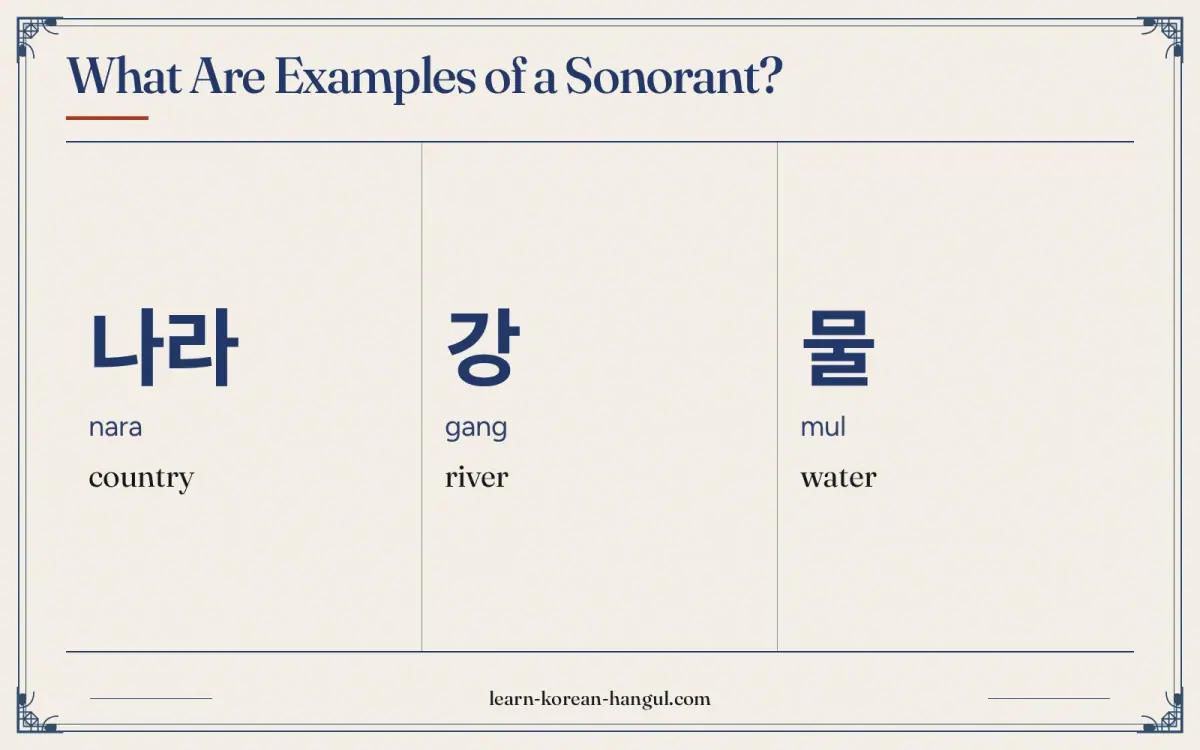
Three words show the sonorant consonants at work: ㄴ and a tapped ㄹ in 나라, final ㅇ [ŋ] in 강, and a lateral ㄹ in 물.
나라
nara
country
강
gang
river
물
mul
water
A short contrast pair makes the point sharper: 밤 (bam, night) ends in a sonorant and keeps its ㅁ, while 밥 (bap, rice) ends in an obstruent and closes with an unreleased ㅂ.
What Do Learners Get Wrong about Sonorants?
Learners tend to treat vowels and consonants as two separate worlds, while the sonorant label crosses that line. A vowel and a nasal share the property of open airflow, which is why a vowel before a nasal is nasalized slightly in many languages.
Two more points to watch:
- ㅇ is a sonorant only as a final. As an onset it is silent, so it is not a consonant sound at all. As a final it is [ŋ], a nasal.
- ㄹ is not an obstruent. English speakers sometimes hear Korean ㄹ as a kind of "d". It is a liquid and it is voiced like the other sonorants. See lateral and flap for its two forms.
This page leaves out the vowel lessons and the phonetic detail of each nasal. Those belong to separate pages.
Frequently Asked Questions
What is a sonorant? A sonorant is a speech sound made with open airflow, so the vocal cords can keep vibrating. Korean sonorants are the vowels, the nasals ㄴ ㅁ ㅇ and the liquid ㄹ. They stay voiced, and they keep their sound at the end of a syllable, unlike the obstruents.
Is ㄹ a sonorant? Yes. ㄹ is a liquid, which is a kind of sonorant. Between vowels it is a quick tap, like the middle of English "butter", and at the end of a syllable it is a lateral, with air flowing around the sides of the tongue. Both versions are voiced and have open airflow.
Why does ㅎ weaken near sonorants? ㅎ is made with breath only, so it has little force of its own. Between voiced sonorants, speakers often relax it until it is faint or lost, as in 전화 (jeonhwa). The weakening is common in ordinary speech and is not an error. The ㅎ weakening lesson gives the exact cases.
What is 공명음? 공명음 (gongmyeongeum) is the Korean term for sonorants, and it means roughly "resonant sound". Its partner is 장애음 (jangaeeum) for obstruents. Korean textbooks use the pair when they explain which letters follow which sound rules. You do not need them to follow the lessons, which use the English words.
Related Terms and Lessons
Sonorant meaning pairs with obstruent. The nasal members of the group are defined under nasal consonant, and the sound-change lesson is ㅎ weakening. All terms are listed in the Korean Pronunciation Glossary.