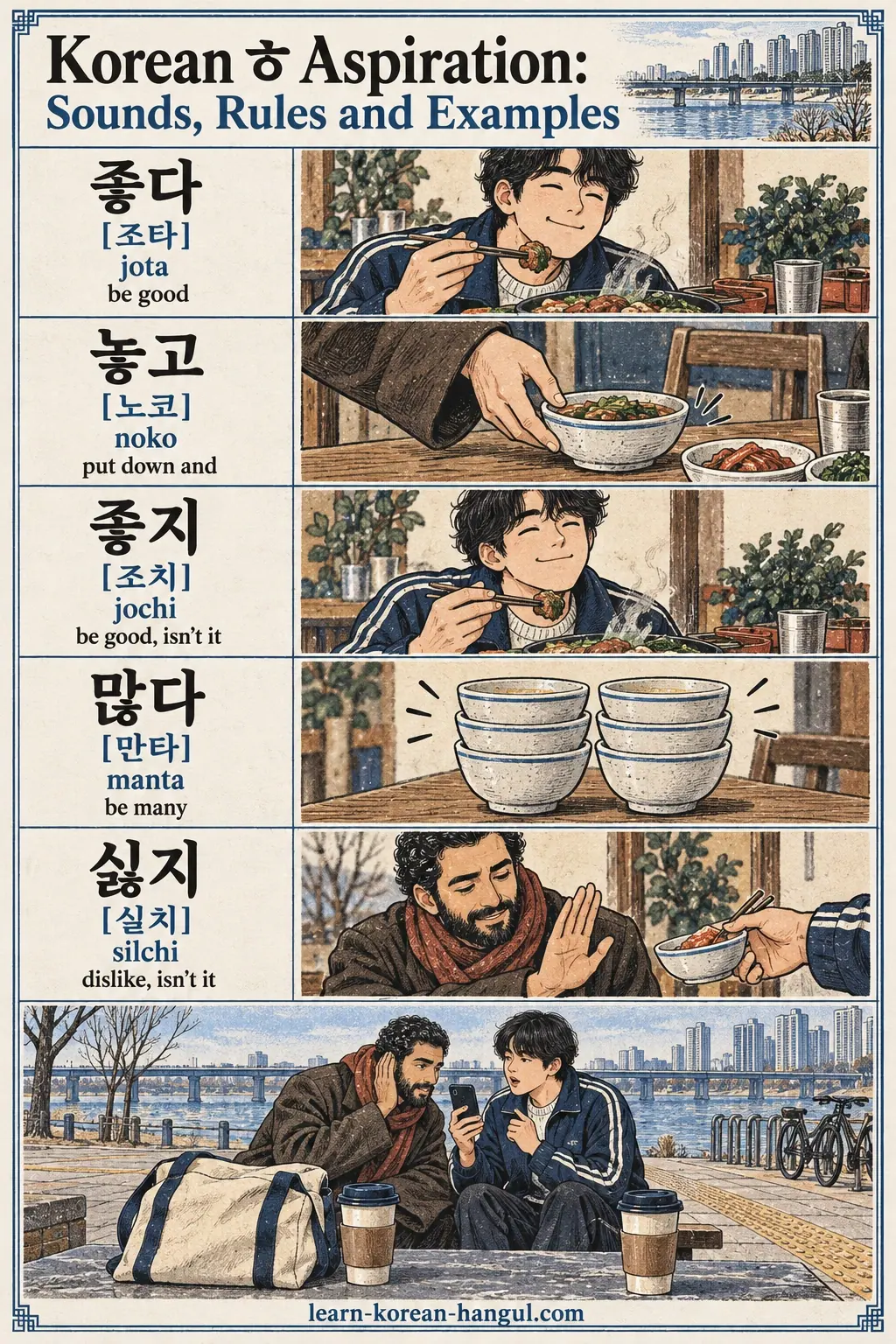
What you will learn
- Say 좋다, 놓고, 좋지, 많다, 싫지 and 닿소 correctly.
- Predict which aspirated sound (ㅋ, ㅌ or ㅊ) comes from ㅎ plus ㄱ, ㄷ or ㅈ.
- Explain what ㅎ does before ㅅ, before ㄴ and before a vowel.
- Pronounce the forms of the two commonest ㅎ adjectives, 좋다 and 많다.
Before you start: you can read a final ㅎ, as in 좋, and you have met the aspiration rules. Time: about 25 minutes with audio.
Key Facts
- A final ㅎ disappears and the next consonant becomes aspirated: ㄱ to ㅋ, ㄷ to ㅌ, ㅈ to ㅊ.
- Examples: 좋다 [조타], 놓다 [노타], 좋고 [조코], 좋지 [조치].
- The double finals ㄶ and ㅀ keep their ㄴ or ㄹ: 많다 is [만타] and 싫다 is [실타].
- ㅎ plus ㅅ gives a tense sound: 닿소 is [다쏘].
- ㅎ plus ㄴ gives ㄴ: 놓는 is [논는].
- The rule is in Article 12 of the Standard Pronunciation Rules (표준 발음법).
Last updated: 2026-10-08. The Korean text, romanization and audio scripts on this page are generated drafts that still await review by a Korean specialist.
What Is Korean ㅎ Aspiration?
Korean ㅎ aspiration is a sound change that merges a final ㅎ with the next consonant into one aspirated sound. An aspirated consonant is a stop released with a strong puff of air. Korean stops and the affricate ㅈ come in three kinds: plain (ㄱ, ㄷ, ㅈ), tense (ㄲ, ㄸ, ㅉ) and aspirated (ㅋ, ㅌ, ㅊ). The letter ㅎ is a breathy sound made in the throat, so when it meets a plain stop it adds that breath.
The merge is complete. Nobody says the ㅎ and then the stop in 좋다. They say one aspirated ㅌ, and the first syllable ends in a vowel.
| Written | Spoken | Revised Romanization | Meaning |
|---|---|---|---|
| 좋다 | [조타] | jota | be good |
| 놓고 | [노코] | noko | put down and |
| 좋지 | [조치] | jochi | be good, isn't it |
| 많다 | [만타] | manta | be many |
| 싫지 | [실치] | silchi | dislike, isn't it |
| 닿소 | [다쏘] | dasso | touch (old formal style) |
Revised Romanization (RR) writes the aspirated sound here, so jota shows a t. RR is a learning aid on this page, and the Hangul is the reference. The table shows the results, and the next section explains why English speakers tend to miss them.
English Speakers and the "Joh-Da" Habit

English speakers tend to read 좋다 as "joh-da", saying the ㅎ as an English "h" and the ㄷ as a soft "d". The spelling shows ㅎ at the bottom of the block and ㄷ at the top of the next, so the habit is to say each one. In Korean, they merge into a single puff of air on the ㅌ.
A second problem is the double final. In 많다, learners say the ㄴ and then drop it, or say the ㅎ and then a plain ㄷ. The correct spoken form keeps the ㄴ and puts the breath on the ㅌ: [만타]. The fix is to say each word as the result of one rule, which the next section lays out.
What Happens to ㅎ before ㄱ, ㄷ or ㅈ?
Before ㄱ, ㄷ or ㅈ, a final ㅎ merges with the consonant and makes it aspirated. The three results are one-to-one: ㄱ becomes ㅋ, ㄷ becomes ㅌ, and ㅈ becomes ㅊ. The ㅎ is gone, and the puff of air stays.
| ㅎ plus | Becomes | Example | Spoken |
|---|---|---|---|
| ㄱ | ㅋ | 놓고 | [노코] |
| ㄷ | ㅌ | 좋다 | [조타] |
| ㅈ | ㅊ | 좋지 | [조치] |
The process is a coalescence, which is a linguistic term for two sounds merging into a new one. Here, the breath of ㅎ is added to the plain stop, and the result is the aspirated stop with the same tongue position. To apply the rule:
- Find the final ㅎ. Look at the bottom of the block (좋, 놓, 많, 싫).
- Check the next consonant. It must be ㄱ, ㄷ or ㅈ at the start of the next block.
- Merge them. The ㅎ and the stop become the matching aspirated sound.
- Say it as one flow. 좋다 becomes 조 + 타, spoken [조타].
You will know it worked when there is no "h" heard in the middle of the word and a clear puff of air follows the vowel. Hold your hand in front of your mouth and say [조타]: you should feel a strong puff on the ㅌ.
A common mistake is to say a plain [조다], which leaves out the breath. The two most frequent ㅎ words are worth a closer look.
How Do 좋다 and 많다 Change?
The adjectives 좋다 ("be good") and 많다 ("be many") are two of the most frequent words with a final ㅎ. Each one changes differently depending on the ending, so a table of forms is the clearest way to see the rule.
| Form | 좋다 (be good) | 많다 (be many) |
|---|---|---|
| Dictionary form | 좋다 [조타] | 많다 [만타] |
| and (-고) | 좋고 [조코] | 많고 [만코] |
| isn't it (-지) | 좋지 [조치] | 많지 [만치] |
| polite (-아요/어요) | 좋아요 [조아요] | 많아요 [마나요] |
| I see (-네요) | 좋네요 [존네요] | 많네요 [만네요] |
| formal (-습니다) | 좋습니다 [조씀니다] | 많습니다 [만씀니다] |
Read down each column and the rule is visible. Endings that start with ㄱ, ㄷ or ㅈ give an aspirated sound. Endings that start with a vowel give silence. Endings that start with ㄴ give a nasal. Endings that start with ㅅ give a tense sound.
The adjective 많다 shows the double final at work: the ㄴ stays in every row except the vowel row, where it moves to the next syllable (마나요). The same table works for 싫다 ("dislike"), as in 싫고 [실코] and 싫지 [실치], where the ㄹ stays.
Aspiration is one of four things ㅎ can do, so the other three deserve their own sections.
What about ㅎ before ㅅ and ㄴ?
Before ㅅ, a final ㅎ makes the ㅅ tense, and before ㄴ it becomes ㄴ. These two cases look different from aspiration, but they follow from the same basic fact that the final ㅎ is not spoken on its own.
| ㅎ plus | Result | Example | Spoken |
|---|---|---|---|
| ㅅ | ㅆ (tense) | 닿소 | [다쏘] |
| ㅅ | ㅆ (tense) | 좋습니다 | [조씀니다] |
| ㄴ | ㄴ | 놓는 | [논는] |
| ㄴ | ㄴ | 좋네요 | [존네요] |
The word 닿소 is an older formal style form of "touch", and the more useful modern example is 좋습니다. The case of ㅎ plus ㄴ is a nasalization, and the ㄷ nasalization lesson covers it as part of the seven-letter group.
Fewer words show ㅎ plus ㅅ or ㄴ than ㅎ plus ㄱ, ㄷ or ㅈ, so aspiration should be your first priority. One more environment remains: a vowel.
What Happens before a Vowel?

Before a vowel, a final ㅎ is silent. The word 좋아요 is spoken [조아요], not [조하요], and 많아요 is [마나요]. The ㅎ does not move to the next block, and it does not add any breath.
| Written | Spoken | What happens |
|---|---|---|
| 좋아요 | [조아요] | ㅎ is silent |
| 낳은 | [나은] | ㅎ is silent |
| 많아요 | [마나요] | ㅎ is silent; ㄴ moves |
| 싫어요 | [시러요] | ㅎ is silent; ㄹ moves |
This is related to the pattern called ㅎ weakening, which is covered in the lesson on Korean H-weakening. The point for this lesson is the contrast: ㅎ before ㄱ, ㄷ or ㅈ gives breath, and ㅎ before a vowel gives nothing. For the double finals ㄶ and ㅀ, the lesson on ㄶ and ㅀ gives the full picture.
With the rule and its edges in view, the useful next step is to learn the words that carry it.
The ㅎ Words to Learn First
Ten common words carry much of the ㅎ aspiration that a beginner meets. The table pairs each one with the aspirated form of its dictionary spelling.
| Word | Spoken | Meaning |
|---|---|---|
| 좋다 | [조타] | be good, like |
| 많다 | [만타] | be many, much |
| 싫다 | [실타] | dislike |
| 놓다 | [노타] | put down |
| 넣다 | [너타] | put in |
| 낳다 | [나타] | give birth |
| 쌓다 | [싸타] | pile up |
| 닿다 | [다타] | touch, reach |
| 않다 | [안타] | not (auxiliary verb) |
| 괜찮다 | [괜찬타] | be all right |
Expert tip: the verbs 않다 and 괜찮다 contain ㄶ, so they keep a ㄴ in the sound. The word 괜찮다 is always [괜찬타] and is one of the most common everyday words, so it is worth saying aloud often.
Each of the ten words follows the same two steps, so a full worked example of the most frequent one pulls them together.
Worked Example: 좋다

The word 좋다 is the stem 좋 ("be good") plus the ending -다, and it is spoken [조타]. It is the most useful test of the rule.
- Break it into blocks: 좋 / 다.
- Mark the final of the first block: 좋 ends in ㅎ.
- Mark the next onset: 다 starts with ㄷ, a plain stop.
- Apply the rule: ㅎ plus ㄷ merges into ㅌ, so the second block starts with ㅌ.
- Say it as one flow: [조타].
- Check the Romanization: RR writes jota, which matches.
You will know it worked when the first syllable is a clean [조] with no "h" and no final consonant, and the second begins with a strong puff. If you hear [조다], the breath is missing, and if you hear [좋다] with a throat sound, the ㅎ was not merged. Replay the 좋다 clip at the top of the lesson to compare.
The same steps work for 놓고 [노코] and 좋지 [조치], and they also work for 많다 with the extra step of keeping the ㄴ. Several mistakes tend to cluster around the same few cases.
Common Learner Mistakes
Learners often let the written ㅎ decide the sound. The mistakes below come from that habit.
- Mistake 1: saying the ㅎ. Learners often say "joh-ta" with a throat sound. Actually the ㅎ disappears and the breath moves onto the next consonant, because the two sounds merge.
- Mistake 2: leaving the stop plain. Learners often say 좋다 as [조다]. Actually the stop becomes aspirated, because it receives the breath of ㅎ.
- Mistake 3: dropping the ㄴ in 많다. Learners often say [마타]. Actually the double final ㄶ keeps its ㄴ, so the spoken form is [만타].
- Mistake 4: aspirating before a vowel. Learners often say 좋아요 as [조하요]. Actually ㅎ is silent before a vowel, so the word is [조아요].
- Mistake 5: writing the spoken form. Learners often write 조타 for 좋다 in dictation. The spelling stays 좋다, because the change is in speech only.
Rule of thumb: ㅎ plus a plain stop gives the matching aspirated stop. If you hear a strong puff on ㅋ, ㅌ or ㅊ and the previous block has no final consonant, a ㅎ may be hiding in the spelling.
The practice set puts the rule to the test.
Practice and Answer Key

Write the spoken form of each word in brackets. Say each one aloud first.
- 좋다
- 놓고
- 좋지
- 많다
- 싫지
- 닿소
- 좋아요
- 놓는
Answer key
- 좋다 → [조타]
- 놓고 → [노코]
- 좋지 → [조치]
- 많다 → [만타]
- 싫지 → [실치]
- 닿소 → [다쏘]
- 좋아요 → [조아요] (no aspiration: a vowel follows, so ㅎ is silent)
- 놓는 → [논는] (ㅎ plus ㄴ gives ㄴ)
Seven or eight correct means the pattern is secure. Numbers 7 and 8 test the other ㅎ environments. The next lesson reverses the order.
Where to Go Next
The next lesson, Korean aspiration before ㅎ, covers the reverse order: a consonant followed by ㅎ, as in 입학 and 축하. To see how this rule behaves between separate words, read the lesson on sound changes between words. The full set of aspiration lessons is in the Aspiration section.
This lesson does not teach the grammar of the endings -고, -지 or -아요. It covers the sound of Korean ㅎ aspiration only, with ㅎ coming first. The reverse order, ㅎ coming second, has its own lesson. The audio shows one standard Seoul pronunciation, and speakers vary in speed.
Frequently Asked Questions
How do you say 좋아요 and 좋다? Say 좋다 as [조타], with a strong puff on the ㅌ, and 좋아요 as [조아요], with no h sound at all. The difference is the next sound: a consonant like ㄷ receives the breath of ㅎ, but a vowel gets nothing, so the ㅎ is silent. Revised Romanization writes jota and joayo.
Is 놓지 [노치]? Yes. The final ㅎ of 놓 merges with the ㅈ of 지 and makes ㅊ, so the spoken form is [노치]. Revised Romanization writes nochi. The same change gives 좋지 [조치] and 싫지 [실치], where the ㄹ of the double final ㅀ stays in the first syllable.
Does 낳다 aspirate? Yes. The ㅎ of 낳 merges with the ㄷ of 다 and makes ㅌ, so the dictionary form is spoken [나타]. With 고 it becomes [나코], and with a vowel ending such as 은, the ㅎ is silent and the word is [나은]. The spelling stays 낳다 in every case.
What about 않다? The verb 않다 has the double final ㄶ, so the ㄴ stays and the ㅎ aspirates the next stop: 않다 is [안타], 않고 is [안코] and 않지 is [안치]. Before a vowel, the ㅎ is silent and the ㄴ moves forward, so 않아요 is [아나요].