What you will learn
- Say 있는, 닫는, 옷만, 꽃말 and 좋네요 with ㄴ in place of the final consonant.
- Name the seven spellings that give the final ㄷ sound.
- Explain why ㅎ before ㄴ sounds different from ㅎ before ㄱ, ㄷ or ㅈ.
- Predict the spoken form of a new word with a ㄷ-type final before ㄴ or ㅁ.
Before you start: you know the final ㄷ sound from the ㄷ batchim lesson and have met the nasalization rules. Time: about 25 minutes with audio.
Key Facts
- Seven letters give the final ㄷ sound: ㄷ, ㅅ, ㅆ, ㅈ, ㅊ, ㅌ and ㅎ.
- The final is pronounced [ㄷ] first, and that [ㄷ] becomes [ㄴ] before ㄴ or ㅁ.
- Common examples: 있는 [인는], 닫는 [단는], 몇 명 [면명].
- ㅎ followed by ㄴ also gives ㄴ: 좋네요 is [존네요].
- The verb ending -는 is the commonest trigger.
- The rule is in Articles 12 and 18 of the Standard Pronunciation Rules (표준 발음법).
Last updated: 2026-10-08. The Korean text, romanization and audio scripts on this page are generated drafts that still await review by a Korean specialist.
What Is Korean ㄷ Nasalization?

Korean ㄷ nasalization is a sound change in which a tongue-tip stop becomes the tongue-tip nasal. A stop is a consonant that blocks the air fully for a moment. A nasal is a consonant that lets air out through the nose. The tongue-tip nasal is ㄴ, the same sound as the "n" in English "no".
When a block ends in a ㄷ-type sound and the next block starts with ㄴ or ㅁ, the final is spoken as ㄴ. The tongue touches the same spot behind the upper teeth, and the air moves to the nose.
| Written | Spoken | Revised Romanization | Meaning |
|---|---|---|---|
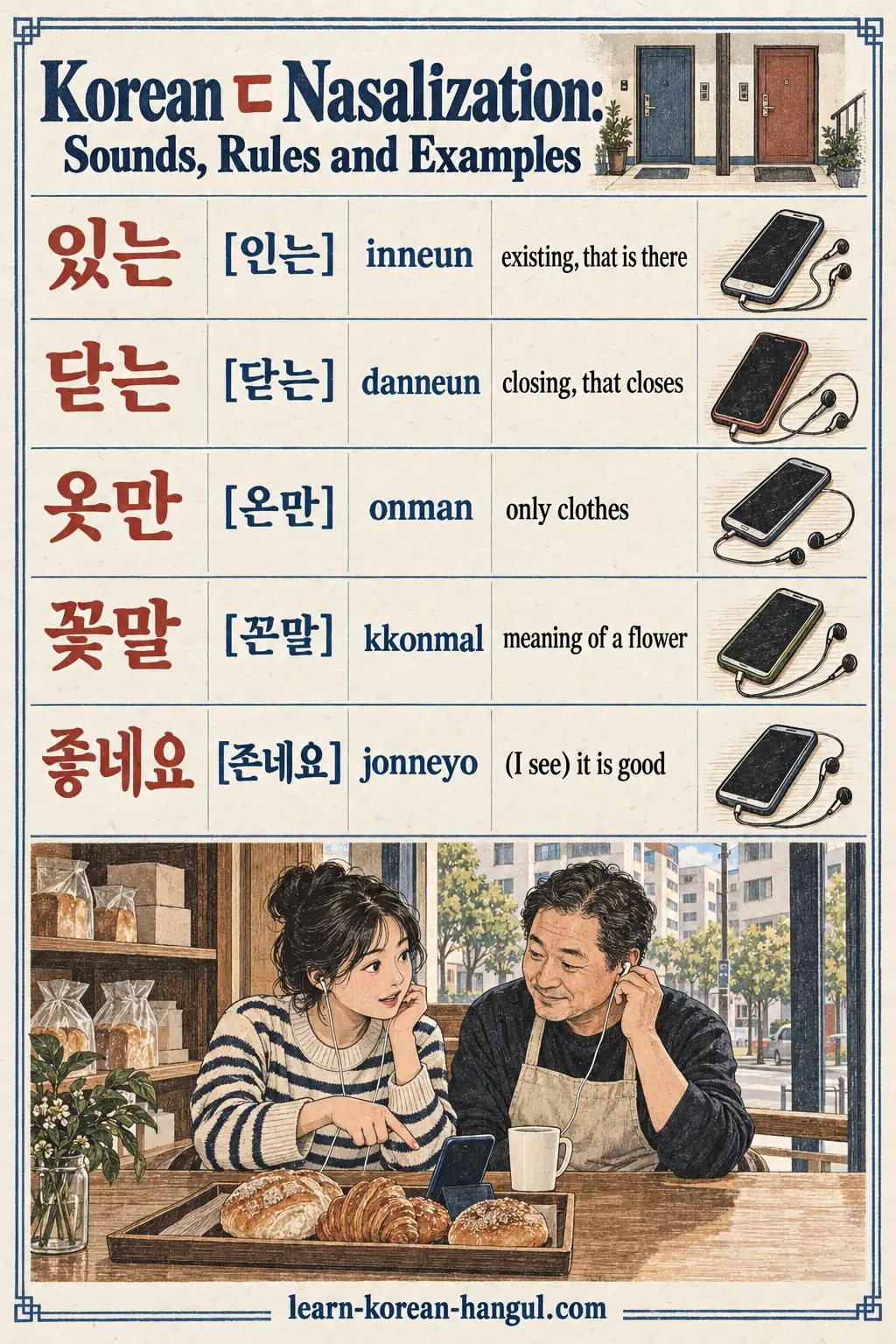
| 있는 | [인는] | inneun | existing, that is there |
| 닫는 | [단는] | danneun | closing, that closes |
| 옷만 | [온만] | onman | only clothes |
| 꽃말 | [꼰말] | kkonmal | meaning of a flower |
| 좋네요 | [존네요] | jonneyo | (I see) it is good |
Revised Romanization (RR) follows the spoken form here, so inneun shows the double n. RR is a learning aid on this page, and the Hangul is the reference. The table lists the results, and the next section covers the reason English speakers tend to miss them.
English Speakers and the "It-Neun" Habit

English speakers tend to read 있는 as "it-neun" or even "iss-neun", with a hissing or stopping sound at the end of the first block. The spelling has two ㅅ letters, so the habit is to say them. In Korean, the double ㅆ at the end of a block is just one closed [ㄷ] sound, and before ㄴ it becomes [ㄴ].
The seven letters make this lesson harder to remember than the others. A learner has to know that ㅅ, ㅈ, ㅊ, ㅌ and ㅎ all count, and the spelling gives no hint. The solution is the one rule that works on sight, which comes next.
What Does ㄷ Become before ㄴ or ㅁ?
Before ㄴ or ㅁ, a final ㄷ sound becomes ㄴ. The place stays the same, because both sounds use the tongue tip, and the manner changes from stop to nasal. This is nasal assimilation: the stop takes on the nasal quality of the sound after it.
| Stop (final sound) | Becomes | Place in the mouth | Example |
|---|---|---|---|
| ㄷ | ㄴ | tongue tip | 닫는 [단는] |
| ㄱ | ㅇ (ng) | back of the tongue | 먹는 [멍는] |
| ㅂ | ㅁ | lips | 합니다 [함니다] |
A body test helps. Say "no" and hold the first sound: the tip of your tongue touches the ridge behind your upper teeth and air hums through your nose. Now say [단] with the tongue in that position, then add 는. The only thing that changes between ㄷ and ㄴ is the nose.
Because the change depends only on what follows, the question is which spellings count as a ㄷ sound.
Which Seven Letters Make the Final ㄷ Sound?
Seven spellings give the final ㄷ sound: ㄷ, ㅅ, ㅆ, ㅈ, ㅊ, ㅌ and ㅎ. At the end of a syllable, Korean has only seven final sounds, and all seven of these letters fall into [ㄷ]. The table shows each spelling with a word.
| Spelling | Example | Spoken | Meaning |
|---|---|---|---|
| ㄷ | 닫는 | [단는] | closing |
| ㅅ | 웃는 | [운는] | smiling |
| ㅆ | 있는 | [인는] | existing |
| ㅈ | 낮말 | [난말] | daytime talk |
| ㅊ | 꽃말 | [꼰말] | flower meaning |
| ㅌ | 같네요 | [간네요] | (I see) it is the same |
| ㅎ | 좋네요 | [존네요] | (I see) it is good |
The ㅅ row shows the middle step. The letters first become [ㄷ] (the final-sound rule, covered in the ㄷ batchim lesson), and then the nasal change makes them [ㄴ]. The spoken result is [운는]. The middle step is a teaching device, and the speaker never says it aloud.
Expert tip: do not memorize the seven letters as a list. Instead, learn one test: does the block end in a tongue-tip sound or a letter that falls into one? If so, and ㄴ or ㅁ follows, expect [ㄴ].
The most frequent source of the pattern is a verb ending.
How Do Verbs with -는 Change?
The verb ending -는 triggers ㄷ nasalization more than any other pattern. The ending -는 marks a present action (닫는 문, "a door that closes"), and the stems 있- (be, exist) and 맞- (be correct) are among the commonest verbs in the language.
| Written | Spoken | Meaning |
|---|---|---|
| 있는 | [인는] | existing, that is there |
| 맞는 | [만는] | correct, that is right |
| 받는 | [반는] | receiving, that receives |
| 웃는 | [운는] | smiling, that smiles |
| 같네요 | [간네요] | (I see) it is the same |
| 끝나요 | [끈나요] | it ends |
Verbs built with -나다 work the same way: 끝나다 [끈나다], 빛나다 [빈나다] and 맛나다 [만나다]. The word 있는 is the best word to practise first, because 있다 is one of the most frequent verbs, and it appears in phrases like 시간이 있는 사람 (a person who has time).
The last two rows show that the trigger does not have to be a verb ending: 같네요 uses the ending -네요, and 끝나요 has ㄴ at the start of the next block of a verb stem. The consonant ㅎ behaves oddly enough to need its own section.
How Does ㅎ Behave?

The consonant ㅎ before ㄴ becomes ㄴ, and this differs from ㅎ before ㄱ, ㄷ or ㅈ, where it makes an aspirated sound. The word 좋네요 is spoken [존네요], while 좋다 is spoken [조타]. What follows the ㅎ decides the outcome.
| Following sound | Example | Spoken | What happens |
|---|---|---|---|
| ㄴ | 좋네요 | [존네요] | ㅎ becomes ㄴ (nasalization) |
| ㄷ | 좋다 | [조타] | ㅎ and ㄷ merge into ㅌ (aspiration) |
| vowel | 좋아요 | [조아요] | ㅎ is silent |
The three rows use the same adjective 좋다 ("good"), so the contrast is easy to hear. For the full set of aspiration cases, see the Aspiration section. The ㅎ forms are the odd member of the seven letters because they are also silent in other settings.
One more pattern does not come from a verb or a spelling cue at all.
Count Words: 몇 명 and 몇 마리
The question word 몇 ("how many") followed by a count word shows the rule in a place where the spelling gives no cue. In 몇 명 ("how many people"), the final ㅊ becomes [ㄷ] and then [ㄴ], so the spoken form is [면명]. In 몇 마리 ("how many animals"), the same change gives [면마리].
| Written | Spoken | Meaning |
|---|---|---|
| 몇 명 | [면명] | how many people |
| 몇 마리 | [면마리] | how many animals |
| 몇 년 | [면년] | how many years |
These phrases are common in everyday questions, so the change is heard in daily speech. A pause between the two words would stop the change, but in a normal question the phrase flows as one unit. Short sentences show the rule working across word boundaries.
ㄷ Nasalization in Short Sentences
Whole sentences train the habit of checking every block boundary. Read the three sentences below, mark each ㄷ-type final before ㄴ or ㅁ, and then say the spoken form.
| Written | Spoken | Meaning |
|---|---|---|
| 시간이 있는 사람 | [시가니 인는 사람] | a person who has time |
| 문을 닫는다. | [무늘 단는다] | I close the door. |
| 오늘은 날씨가 좋네요. | [오느른 날씨가 존네요] | The weather is good today. |
Each sentence mixes rules. The particles 이, 을 and 은 link by liaison, as taught in the lesson on liaison with particles, while the words 있는, 닫는 and 좋네요 take the nasal change. The skill is to ask the same question at every boundary: does a vowel or a nasal follow?
Worked Example: 있는

The word 있는 is the stem 있 (be, exist) plus the ending -는, and it is spoken [인는]. It is the highest-frequency case of the rule.
- Break it into blocks: 있 / 는.
- Mark the final of the first block: 있 ends in ㅆ, which is the sound [ㄷ].
- Mark the next onset: 는 starts with ㄴ, which is a nasal.
- Apply the rule: [ㄷ] before ㄴ becomes [ㄴ], so 있 is spoken [인].
- Say it as one flow: [인는].
- Check the Romanization: RR writes inneun, which matches.
You will know it worked when your tongue tip stays on the ridge through the whole word and the sound hums through your nose before the vowel of 는. If you hear a hiss or a click after 있, the final was released.
The word 있는 also appears inside longer forms such as 있는데 [인는데] and 있는지 [인는지]. Each time, the [ㄴ] carries over. The next section covers the slips that learners make.
Common Learner Mistakes
Learners often let the written final decide the sound. Each mistake below comes from that habit.
- Mistake 1: saying the ㅅ or ㅆ. Learners often say "iss-neun" with a hiss. Actually the final is a closed [ㄷ] sound, and it becomes [ㄴ] before ㄴ.
- Mistake 2: writing the spoken form. Learners often write 인는 in dictation. The spelling stays 있는, because the change is in speech only.
- Mistake 3: forgetting ㅎ. Learners often think 좋네요 is [조네요]. Actually the ㅎ becomes [ㄴ], because a following ㄴ turns it into a nasal.
- Mistake 4: treating ㅎ the same everywhere. Learners often carry the aspiration of 좋다 [조타] over to 좋네요. Actually ㅎ makes an aspirated sound only before ㄱ, ㄷ or ㅈ; before ㄴ it becomes [ㄴ].
- Mistake 5: changing before a vowel. Learners often nasalize 옷이. Actually a vowel next gives liaison, and 옷이 is [오시].
Rule of thumb: when ㄴ or ㅁ starts a block, look at the block before. If it ends in a tongue-tip sound or one of the seven letters, say [ㄴ].
The practice set puts the rule to the test.
Practice and Answer Key

Write the spoken form of each word in brackets. Say each one aloud first.
- 있는
- 닫는
- 옷만
- 꽃말
- 좋네요
- 몇 명
- 끝나요
- 옷이
Answer key
- 있는 → [인는]
- 닫는 → [단는]
- 옷만 → [온만]
- 꽃말 → [꼰말]
- 좋네요 → [존네요]
- 몇 명 → [면명]
- 끝나요 → [끈나요]
- 옷이 → [오시] (no nasalization: a vowel follows, so liaison applies)
Seven or eight correct means the pattern is secure. Number 8 is a trap, and getting it right shows that you can tell nasalization from liaison. The last nasalization lesson in this section covers ㄹ.
Where to Go Next
The next lesson, Korean ㄹ nasalization, covers the case where ㄹ turns into ㄴ, as in 심리 and 종로. Return to the Nasalization section to see all four patterns together.
This lesson does not teach the grammar of the endings -는 and -네요. It covers the sound of Korean ㄷ nasalization only. Other ㅎ cases, such as 놓고 [노코], belong to the aspiration lessons. The audio shows one standard Seoul pronunciation, and speakers vary in speed.
Frequently Asked Questions
How do you say 있는? Say [인는]. The final ㅆ of 있 is a closed [ㄷ] sound, and it becomes ㄴ before the ㄴ of 는, so the first syllable sounds like "in". Keep your tongue tip on the ridge behind your upper teeth and hum through your nose. Revised Romanization writes inneun.
Is 옷만 [온만]? Yes. The final ㅅ of 옷 is first pronounced [ㄷ], then becomes ㄴ before the ㅁ of 만, so the spoken form is [온만]. Revised Romanization writes onman. The rule triggers on either ㄴ or ㅁ, which is why 꽃말 is [꼰말] and 옷만 is [온만] in the same way.
Why is 좋네요 [존네요]? The final ㅎ of 좋 turns into ㄴ when the next block starts with ㄴ, so 좋네요 is spoken [존네요]. This differs from 좋다, where ㅎ and ㄷ merge into [ㅌ]. The Standard Pronunciation Rules (표준 발음법) list the ㅎ plus ㄴ case as its own item in Article 12, apart from the aspiration cases.
What about 몇 명? Say [면명]. The final ㅊ of 몇 is first a closed [ㄷ] sound, then it becomes ㄴ before the ㅁ of 명. The same change gives 몇 마리 [면마리] and 몇 년 [면년]. The spelling shows no hint of the change, so it is worth memorizing as a frequent question phrase.