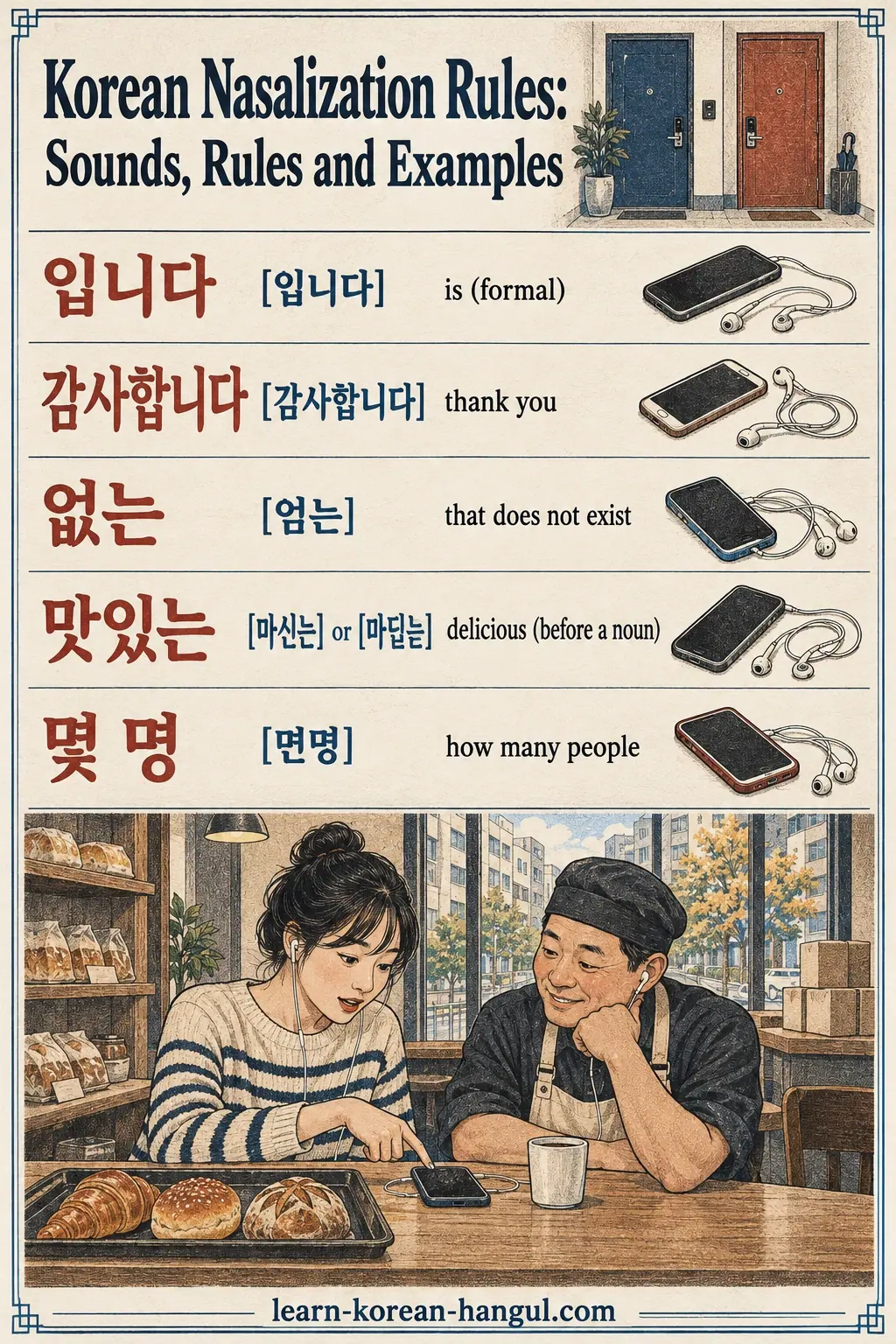
Korean nasalization rules (비음화) turn a final [ㄱ], [ㄷ] or [ㅂ] into the nasal [ㅇ], [ㄴ] or [ㅁ] before ㄴ or ㅁ, and turn ㄹ into [ㄴ] after ㅁ, ㅇ, ㄱ or ㅂ. Four patterns fit in one table, and with it you can predict the spoken form of words such as 먹는 [멍는], 닫는 [단는], 합니다 [함니다] and 심리 [심니].
What you'll learn
- State the trigger for each of the four nasalization patterns.
- Use a trigger-result table to predict the spoken form of 먹는, 닫는, 합니다 and 심리.
- Tell nasalization apart from lateralization in words such as 신라 [실라].
- Apply nasalization across a word boundary in phrases such as 밥 먹어요.
Prerequisites: Batchim Representative Sounds, because nasalization starts from the reduced final sound. Estimated time: 30 minutes.
What Are the Korean Nasalization Rules?

The Korean nasalization rules are two assimilation rules in which a consonant takes on the nasal quality of its neighbour. A nasal consonant is one where air flows out through the nose: Korean has three, ㄴ [n], ㅁ [m] and ㅇ [ng]. Article 18 of the Standard Pronunciation Rules (표준 발음법), published by the National Institute of Korean Language, covers stop finals before a nasal. Article 19 covers ㄹ after ㅁ, ㅇ, ㄱ and ㅂ.
The first rule is the common one: a final [ㄱ], [ㄷ] or [ㅂ] becomes nasal before ㄴ or ㅁ. The second rule changes ㄹ itself into [ㄴ]. The two rules can apply in the same word, one after the other.
Why Does a Stop Turn into a Nasal?
A stop turns into a nasal because each stop has a nasal partner made in exactly the same place in the mouth. [ㄱ] and [ㅇ] both use the back of the tongue against the soft palate. [ㄷ] and [ㄴ] both use the tongue tip behind the upper teeth. [ㅂ] and [ㅁ] both close the lips. The only difference is whether the passage to the nose is open.
Before ㄴ or ㅁ, the nose passage opens early, already during the final consonant. The mouth stays in the same position, so the stop becomes its nasal partner. That is why the results are never random: [ㄱ] always becomes [ㅇ], [ㄷ] always [ㄴ], [ㅂ] always [ㅁ].
Why Do English Speakers Struggle with Nasalization?
English speakers struggle because English keeps stops before nasals. "Pick me", "big news" and "top man" all keep a clear k, g or p. A learner who transfers this habit says 국물 as [국물], with a closed ㄱ and a small pause before ㅁ.
The written form adds to the problem. Korean spelling keeps the ㄱ in 국물 because 국 (soup) and 물 (water) are meaningful parts. The eye sees ㄱ, and the mouth follows the eye. The fix is to look at the next block before saying a final stop, which the trigger table below makes quick.
What Triggers Korean Nasalization?

Korean nasalization has two triggers: a following ㄴ or ㅁ, and a ㄹ that follows any consonant other than ㄴ or ㄹ.
- Trigger 1: ㄴ or ㅁ after a stop final. Reduce the batchim to its representative sound first. If the result is [ㄱ], [ㄷ] or [ㅂ] and the next syllable starts with ㄴ or ㅁ, the stop becomes [ㅇ], [ㄴ] or [ㅁ].
- Trigger 2: ㄹ after ㅁ, ㅇ, ㄱ or ㅂ. The ㄹ becomes [ㄴ]. If the consonant before it was a stop, that [ㄴ] then triggers rule 1 as well.
The batchim group matters, not the written letter. 있는 has ㅆ, but ㅆ belongs to the [ㄷ] group, so the result is [인는]. The groups are defined in the seven final sounds.
The Four Nasalization Patterns in One Table

The four nasalization patterns fit into one trigger-result table. Find the row for the final sound and the column for the next consonant.
| Final sound (letters) | + ㄴ | + ㅁ | + ㄹ |
|---|---|---|---|
| [ㄱ] (ㄱ ㅋ ㄲ ㄳ ㄺ) | [ㅇ] 먹는 [멍는] | [ㅇ] 국물 [궁물] | [ㅇ] + [ㄴ] 독립 [동닙] |
| [ㄷ] (ㄷ ㅅ ㅆ ㅈ ㅊ ㅌ ㅎ) | [ㄴ] 닫는 [단는] | [ㄴ] 꽃말 [꼰말] | rare in common words |
| [ㅂ] (ㅂ ㅍ ㄿ ㅄ, and ㄼ in 밟-) | [ㅁ] 합니다 [함니다] | [ㅁ] 밥물 [밤물] | [ㅁ] + [ㄴ] 협력 [혐녁] |
| [ㅁ] | no change | no change | ㄹ → [ㄴ] 심리 [심니] |
| [ㅇ] | no change | no change | ㄹ → [ㄴ] 종로 [종노] |
Rule
[ㄱ ㄷ ㅂ] + ㄴ/ㅁ → [ㅇ ㄴ ㅁ]; ㄹ after ㅁ ㅇ ㄱ ㅂ → [ㄴ]
Each of the four patterns below follows the same order: the change, three or more words, and the clue to spot it.
Pattern 1: the ㄱ Group Becomes [ㅇ]
The change: a final [ㄱ] becomes [ㅇ] before ㄴ or ㅁ. Words: 먹는 (eating) [멍는], 작년 (last year) [장년], 학년 (school year) [항년], 한국말 (Korean language) [한궁말], 읽는 (reading) [잉는]. The clue: a ㄱ, ㅋ, ㄲ or ㄺ batchim with ㄴ or ㅁ under the next vowel's consonant slot. More drills are in the ㄱ nasalization lesson.
Pattern 2: the ㄷ Group Becomes [ㄴ]
The change: a final [ㄷ] becomes [ㄴ] before ㄴ or ㅁ. Words: 닫는 (closing) [단는], 있는 (existing) [인는], 맞는 (correct) [만는], 옛날 (old days) [옌날], 거짓말 (lie) [거진말]. The clue: any of the seven [ㄷ]-group letters before ㄴ or ㅁ, which makes this the pattern with the most hidden spellings.
Pattern 3: the ㅂ Group Becomes [ㅁ]
The change: a final [ㅂ] becomes [ㅁ] before ㄴ or ㅁ. Words: 입니다 (is) [임니다], 감사합니다 (thank you) [감사함니다], 앞문 (front door) [암문], 없는 (not existing) [엄는], 십만 (one hundred thousand) [심만]. The clue: the formal endings -ㅂ니다 and -습니다, which contain this pattern every time. The ㅂ nasalization lesson drills them.
Pattern 4: ㄹ Becomes [ㄴ]
The change: ㄹ becomes [ㄴ] after ㅁ or ㅇ; after ㄱ or ㅂ, it becomes [ㄴ] and also turns the stop nasal. Words: 심리 (psychology) [심니], 종로 (Jongno, Seoul) [종노], 대통령 (president) [대통녕], 음료수 (soft drink) [음뇨수], 독립 (independence) [동닙], 협력 (cooperation) [혐녁]. The clue: ㄹ at the start of a syllable in a Sino-Korean word, after a consonant other than ㄴ or ㄹ.
How Does ㄹ Behave Next to ㄴ?

Next to ㄴ, ㄹ usually wins: both consonants become [ㄹ], a process called lateralization (유음화) rather than nasalization. 신라 (Silla, an ancient kingdom) is [실라], 칼날 (blade) is [칼랄] and 난로 (stove) is [날로]. This is Article 20 of the Standard Pronunciation Rules, and it is the main reason learners mix the two rules up.
A small set of Sino-Korean words goes the other way: the ㄹ becomes [ㄴ]. 의견란 (opinion column) is [의견난] and 생산량 (production volume) is [생산냥]. These words are compounds where ㄹ starts a separate element (란 "column", 량 "amount"). Treat them as exceptions to learn word by word; the lesson on ㄹ nasalization lists more.
| Word | Meeting point | Rule | Spoken |
|---|---|---|---|
| 신라 | ㄴ + ㄹ | lateralization | [실라] |
| 종로 | ㅇ + ㄹ | nasalization | [종노] |
| 생산량 | ㄴ + ㄹ (exception) | nasalization | [생산냥] |
Does Nasalization Apply across Spaces?

Yes. Nasalization applies across a space when the two words are spoken as one phrase without a pause. 밥 먹어요 (I eat a meal) is [밤머거요], 책 넣는다 (puts a book in) is [챙넌는다] and 한국 노래 (Korean song) is [한궁노래].
If the speaker pauses between the words, each word keeps its own reduced ending, so 밥, 먹어요 with a pause is [밥 머거요]. In normal conversation, short phrases like these are almost always linked.
Nasalization in Everyday Korean
Nasalization is one of the most frequent sound changes in beginner Korean, because the formal endings and the -는 ending trigger it constantly. The words below are worth saying aloud until the nasal form feels like the only form.
| Word | Meaning | Pattern | Spoken |
|---|---|---|---|
| 입니다 | is (formal) | [ㅂ] + ㄴ | [임니다] |
| 감사합니다 | thank you | [ㅂ] + ㄴ | [감사함니다] |
| 없는 | that does not exist | [ㅂ] + ㄴ | [엄는] |
| 맛있는 | delicious (before a noun) | [ㄷ] + ㄴ | [마신는] or [마딘는] |
| 몇 명 | how many people | [ㄷ] + ㅁ | [면명] |
| 작년 | last year | [ㄱ] + ㄴ | [장년] |
| 막내 | youngest child | [ㄱ] + ㄴ | [망내] |
| 정류장 | bus stop | ㅇ + ㄹ | [정뉴장] |
| 국립 | national (institution) | [ㄱ] + ㄹ | [궁닙] |
An expert tip: if you say -습니다 correctly as [슴니다], you already produce pattern 3 in every formal sentence you say. Use that ending as your anchor and transfer the same feeling of "lips closed, sound through the nose" to 앞문 [암문] and 밥물 [밤물].
Worked Example: 먹는 and 심리
먹는 (eating).
- Batchim of 먹: ㄱ. Representative sound: [ㄱ].
- Next consonant: ㄴ. Trigger 1 applies.
- Table row [ㄱ], column ㄴ: [ㅇ].
- Say [멍는]. Keep the back of the tongue raised for [ㅇ] and let the sound flow into ㄴ.
심리 (psychology).
- Batchim of 심: ㅁ, a nasal. Trigger 1 does not apply.
- Next consonant: ㄹ after ㅁ. Trigger 2 applies.
- Table row [ㅁ], column ㄹ: ㄹ → [ㄴ].
- Say [심니].
You'll know you have both when 먹는 rhymes with 멍는 and 심리 sounds the same as 심니.
What Does Nasalization Not Cover?
Nasalization does not cover vowels, the sonorant finals ㄴ ㄹ ㅁ ㅇ before ㄴ or ㅁ, or the insertion of a new [ㄴ] sound.
- Vowels. A vowel after a stop triggers liaison, not nasalization: 먹어요 is [머거요].
- Sonorant finals. 감나무 (persimmon tree) and 문만 already have nasals, so nothing changes.
- ㄴ insertion. In 색연필 (colored pencil) [생년필], a new [ㄴ] is inserted first, and only then does nasalization turn [ㄱ] into [ㅇ]. The insertion is a separate rule with its own lesson.
- Spelling. Revised Romanization already records nasalization, so 합니다 is hamnida and 종로 is Jongno. That makes romanized place names a handy check.
Common Mistakes with Korean Nasalization
Keeping the stop. Learners often say 국물 with a closed ㄱ; actually the ㄱ becomes [ㅇ]: [궁물]. Fix: hum through the nose as you move from 국 to 물.
Changing to the wrong nasal. Learners sometimes say 있는 as [임는]; actually [ㄷ]-group finals become [ㄴ], the tongue-tip nasal: [인는].
Nasalizing before a vowel. Learners who have just learned the rule say 먹어요 as [멍어요]; actually a vowel causes liaison: [머거요].
Confusing ㄹ rules. Learners often say 신라 as [신나]; actually ㄴ + ㄹ is lateralization: [실라].
Practice: Predict Eight Spoken Forms
Exercise 1. Use the table to write the spoken form.
- 작년
- 옛날
- 앞문
- 대통령
- 협력
- 반갑습니다
Exercise 2. Nasalization, lateralization or neither?
- 난로
- 먹어요
Exercise 3. Say each phrase as one unit and write the spoken form.
- 몇 명이에요? (How many people?)
- 책 많이 읽어요. (I read a lot of books.)
Answers.
Exercise 1: 1 [장년]. 2 [옌날]. 3 [암문]. 4 [대통녕]. 5 [혐녁]. 6 [반갑씀니다]: tensification on 습, then nasalization on the final ㅂ.
Exercise 2: 1 lateralization, [날로]. 2 neither; liaison gives [머거요].
Exercise 3: 1 [면명이에요]: 몇 reduces to [멷], then [ㄷ] + ㅁ gives [ㄴ]. 2 [챙마니 일거요]: nasalization across the space in 책 많이, then liaison in 읽어요.
Where to Go Next
Continue with Korean ㅂ Nasalization, which drills the formal endings you will use most often. The ㄱ, ㄷ and ㄹ patterns each have their own lesson in the Nasalization section.
This lesson does not cover ㄴ insertion, the full list of lateralization exceptions, or casual-speech place assimilation such as 신문 sometimes said [심문]. Those are separate rules or non-standard variants.
In short, the Korean nasalization rules match a stop to the nasal made in the same place, [ㄱ] to [ㅇ], [ㄷ] to [ㄴ] and [ㅂ] to [ㅁ], whenever ㄴ or ㅁ follows, and turn ㄹ into [ㄴ] after ㅁ, ㅇ, ㄱ or ㅂ.
Frequently Asked Questions
Is 먹는 pronounced 멍는? Yes. 먹는 (eating) has a final ㄱ before ㄴ. Korean turns the ㄱ into the nasal made in the same place, [ㅇ], so the standard pronunciation is [멍는]. Saying [먹는] with a closed ㄱ sounds careful and foreign. The same change gives 먹물 (ink) [멍물] and 막내 (youngest child) [망내].
Is nasalization optional in Korean? No. Nasalization is obligatory in standard Korean at every speaking speed. Native speakers do not choose it; they apply it automatically, even in slow, careful speech. Pronouncing 합니다 with a clear [ㅂ] is understood, but it sounds like spelling the word out letter by letter rather than saying it.
Why is 십리 pronounced 심니? 십리 (ten ri, an old distance unit) shows two changes. First, ㄹ after ㅂ becomes [ㄴ]: 십니. Second, the new [ㄴ] nasalizes the ㅂ before it into [ㅁ]: [심니]. The Seoul place name 왕십리 follows the same path to [왕심니], which is why its romanization is Wangsimni.
What is 비음화? 비음화 (bieumhwa) is the Korean term for nasalization, literally 'becoming a nasal sound'. 비음 means nasal sound: ㄴ, ㅁ and ㅇ. Korean grammar books use 비음화 for both the stop-to-nasal change in 국물 [궁물] and, often, for ㄹ becoming [ㄴ] in 종로 [종노].
Which nasalization pattern do beginners meet first? Beginners usually meet the ㅂ pattern first, in the formal endings -ㅂ니다 and -습니다. 입니다 [임니다], 감사합니다 [감사함니다] and 반갑습니다 [반갑씀니다] appear in the first lessons of most courses. The ㄷ pattern follows quickly through the -는 ending: 있는 [인는], 맛있는 [마신는].