What you will learn
- Link 책을, 밥을, 사람은, 집에서 and 학생이에요 to their particles and say each one aloud.
- Name the particles that start with a vowel and so trigger liaison.
- Explain why particles after a consonant noun nearly always link.
- Spot nouns ending in ㅇ, where no link happens.
Before you start: you know the basic Korean liaison rule. Time: about 25 minutes with audio.
Key Facts
- Liaison applies to the vowel-first particles 이, 을, 은, 에, 에서 and 으로 and to the copula forms of 이다 (이에요, 이야).
- A final ㅇ does not link: 강이 is [강이].
- Tense and aspirated finals move with their own sound: 부엌에 is [부어케].
- Particles that start with a consonant, such as 를, 는 and 도, do not link to a noun.
- Revised Romanization shows the linked sound: 책을 is chaegeul.
- The rule is Articles 13 and 14 of the Standard Pronunciation Rules (표준 발음법).
Last updated: 2026-10-08. The Korean text, romanization and audio scripts on this page are generated drafts that still await review by a Korean specialist.
What Is Korean Liaison with Particles?

Korean liaison with particles is the use of the liaison rule where a noun meets a particle. A particle (조사, josa) is a short word attached to a noun that shows its role in the sentence, such as subject, object or place. Because most particles are only one syllable, their first sound is easy to hear and easy to get wrong.
When the noun ends in a consonant and the particle starts with a vowel, the consonant moves forward into the particle. The written particle still starts with a silent ㅇ, but that empty seat is now filled.
| Written | Noun + particle | Spoken | Revised Romanization |
|---|---|---|---|
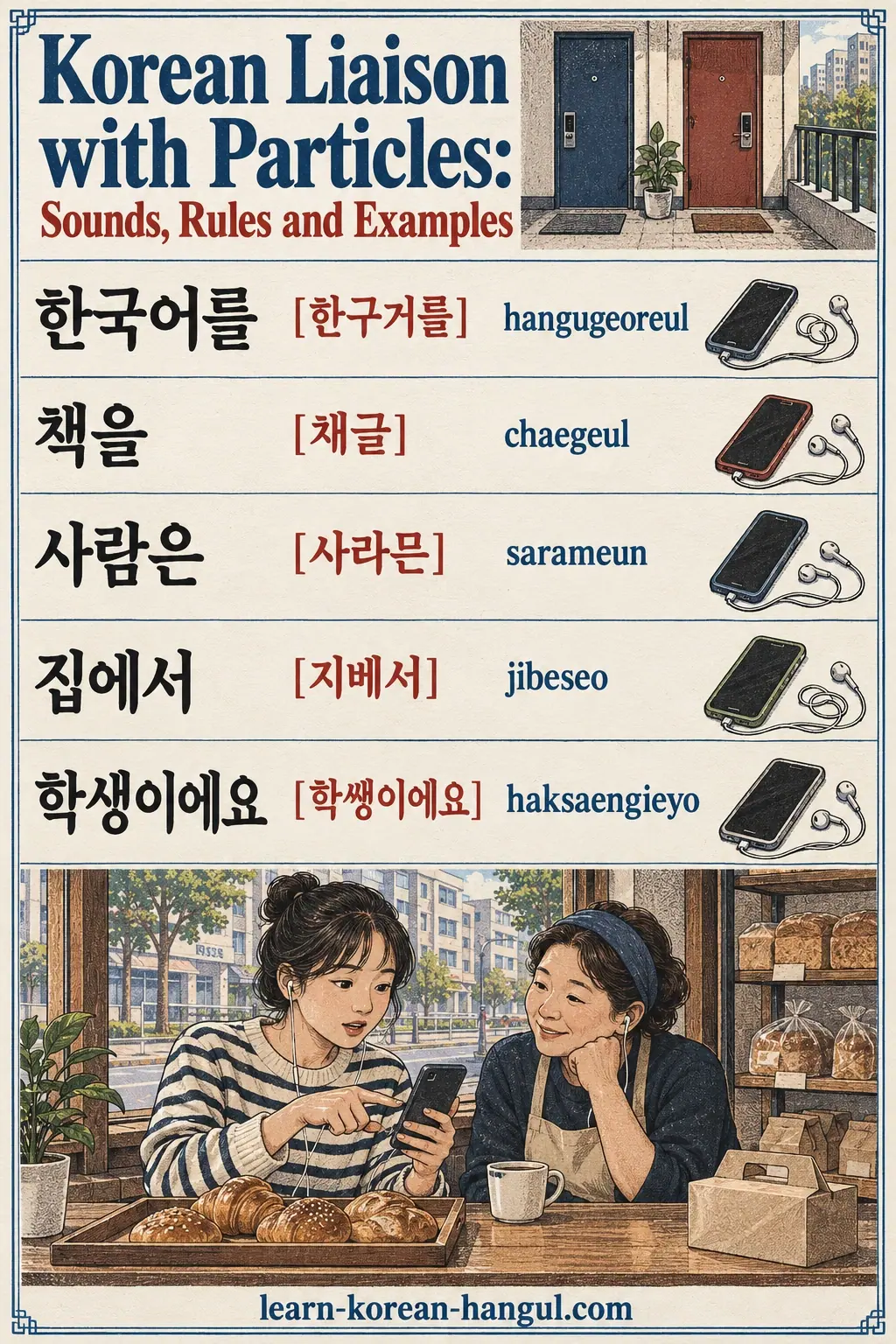
| 한국어를 | 한국어 + 를 (link inside 한국어; 를 itself does not link) | [한구거를] | hangugeoreul |
| 책을 | 책 + 을 | [채글] | chaegeul |
| 사람은 | 사람 + 은 | [사라믄] | sarameun |
| 집에서 | 집 + 에서 | [지베서] | jibeseo |
| 학생이에요 | 학생 + 이에요 | [학쌩이에요] | haksaengieyo |
In each row the written noun looks complete and separate, but the spoken noun is missing its last consonant until the particle arrives. The table shows that the pattern is regular, so the next question is why it comes up so often.
The Vowel-First Particle Forms behind Most Links
Most Korean particles come in pairs, and the form used after a consonant is the one that starts with a vowel. The subject particle is 이 after a consonant and 가 after a vowel. The object particle is 을 after a consonant and 를 after a vowel. The topic particle is 은 after a consonant and 는 after a vowel.
This means that a noun ending in a consonant always meets the vowel-first form of these three particles. Liaison is not an occasional extra on top of grammar. It is the normal sound of the consonant-final half of every pair.
| Particle pair | After a consonant | After a vowel |
|---|---|---|
| Subject | 이 (책이 [채기]) | 가 (의자가) |
| Object | 을 (책을 [채글]) | 를 (의자를) |
| Topic | 은 (책은 [채근]) | 는 (의자는) |
Expert tip: the choice of 이, 을 or 은 is a grammar rule, and the link is a sound rule that follows from it. If you choose the correct particle for a consonant-final noun, the sound link almost never needs separate thought, because the particle's empty ㅇ is already waiting.
For the grammar side of each pair, see the pages on the subject particle 이/가, the object particle 을/를 and the topic particle 은/는. The next section lists the full set of particles that link.
Which Particles Trigger Liaison?

Any particle that starts with ㅇ plus a vowel triggers liaison after a noun that ends in a consonant. That includes the subject, object and topic particles, the place particles 에 and 에서, the direction particle 으로, and the copula 이다.
| Particle | Role | Example | Spoken |
|---|---|---|---|
| 이 | subject | 책이 | [채기] |
| 을 | object | 책을 | [채글] |
| 은 | topic | 사람은 | [사라믄] |
| 에 | at, to | 책에 | [채게] |
| 에서 | at, from | 집에서 | [지베서] |
| 으로 | toward, by | 집으로 | [지브로] |
| 이랑 | and, with | 책이랑 | [채기랑] |
| 이에요 | is (polite) | 집이에요 | [지비에요] |
Each of these examples can be tested against the basic rule: the noun ends in a consonant, and the particle starts with the silent ㅇ. Particles that start with a consonant, such as 를, 는, 도 and 만, do not link, and they set off other sound changes instead. For example, 밥만 is spoken [밤만], which is a nasalization case and has its own lesson.
Knowing which particles link is half the skill. The other half is the move itself.
How Do You Link a Noun and a Particle?
To link a noun and a particle, check the last consonant of the noun, check the first sound of the particle, and move the consonant if the particle starts with a vowel. The steps take a few seconds once they become a habit.
- Find the last block of the noun. In 밥 the last block is 밥, and its final consonant is ㅂ.
- Look at the particle. The particle 을 starts with ㅇ and the vowel ㅡ.
- Move the consonant. Take ㅂ out of 밥 and put it in front of ㅡ. The blocks become 바 + 블.
- Say it as one word. The result is [바블], with no pause.
You will know it worked when the noun and particle sound like one two-syllable word. A common mistake is to say the noun with its final consonant and then add the particle, which gives a choppy [밥 을].
The same noun with three different particles shows the pattern clearly.
| Noun + particle | Spoken | Particle used |
|---|---|---|
| 밥이 | [바비] | 이 (subject) |
| 밥을 | [바블] | 을 (object) |
| 밥은 | [바븐] | 은 (topic) |
In all three words the ㅂ of 밥 lands on the particle, and the noun part is always [바]. The pattern also holds for tense and aspirated finals: 부엌에 is [부어케] and 꽃이 is [꼬치]. Not every final consonant moves, though, and the most important exception is ㅇ.
What If the Noun Ends in ㅇ?
When a noun ends in ㅇ, no link happens. The final ㅇ is the "ng" sound, which is a full consonant that stays in its own block. The word 강이 is spoken [강이], not [가이], and 방에 is [방에].
| Written | Spoken | Why |
|---|---|---|
| 강이 | [강이] | final ㅇ stays |
| 방에 | [방에] | final ㅇ stays |
| 공항에서 | [공항에서] | final ㅇ stays |
The reason is the sound of the letter. At the end of a block, ㅇ is [ŋ], like the end of the English word "sing". It does not move into the empty seat, so the particle starts with a clean vowel. Learners who confuse the initial and final ㅇ will either drop the "ng" or push it forward, so listen to the pair 강이 and 가이 to hear the difference.
After nouns ending in ㅇ, the particle sounds separate. That makes the copula, which looks like a particle but acts like a verb, worth its own look.
How Does 이에요 Link?
The copula 이에요 (is, polite) links like any other vowel-first ending. After a noun ending in a consonant, 이 takes that consonant: 집이에요 is [지비에요], and 책이에요 is [채기에요]. The word 이다 is a verb "to be" that attaches to nouns, and 이에요 is its polite form.
The word 학생이에요 needs one extra step because the noun itself has a sound change inside it. In 학생, the ㄱ of 학 is followed by ㅅ, and the ㅅ becomes tense [ㅆ], so the noun is spoken [학쌩]. The final ㅇ of 생 does not move, so 이에요 stays separate: [학쌩이에요].
| Written | Spoken | Note |
|---|---|---|
| 집이에요 | [지비에요] | ㅂ moves to 이 |
| 책이에요 | [채기에요] | ㄱ moves to 이 |
| 학생이에요 | [학쌩이에요] | final ㅇ stays; 학생 has an inner tense sound |
After a noun ending in a vowel, 이에요 becomes 예요, as in 의사예요. This form has no consonant to move, so liaison does not apply. The same pattern works for the casual form 이야 and the formal form 입니다, but 입니다 also triggers nasalization, which is covered in its own lesson.
Romanization gives a quick check on all of these forms.
Liaison with Particles in Romanization

Revised Romanization writes the linked sound, so it follows the spoken form. The noun 책 and the particle 을 become chaegeul, not "chaekeul", and 한국어를 becomes hangugeoreul. A learner who reads the Romanization aloud will therefore link naturally.
Romanization still has limits. RR hides the tense sound of 학생: it writes haksaeng, which suggests [학생] with a plain ㅅ. Hangul with a bracketed spoken form is a safer guide than RR alone, which is why this site uses all three. The page on Korean romanization explains the system.
One full example brings the particle and the sound change together.
Worked Example: 한국어를

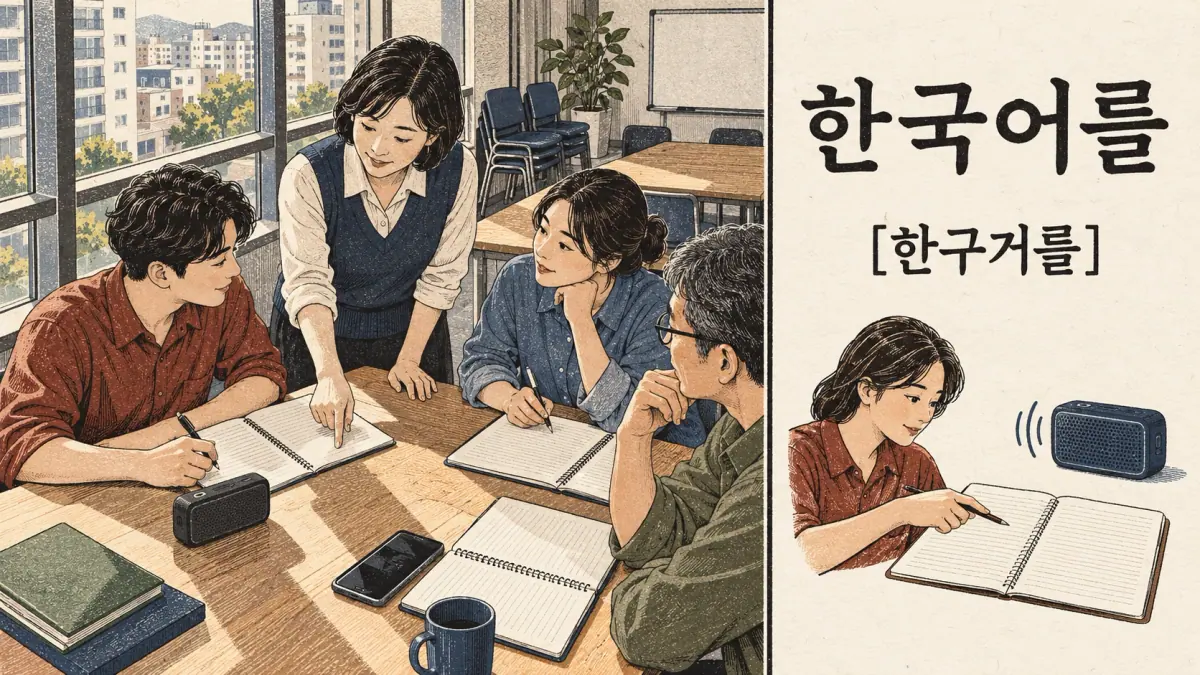
The word 한국어를 is 한국어 (the Korean language) plus the object particle 를, and it is spoken [한구거를]. It is worth studying because it contains a link and a non-link side by side.
- Split the blocks: 한 / 국 / 어 / 를.
- Look for empty ㅇ. The block 어 starts with ㅇ and the vowel ㅓ. The block before it, 국, ends in ㄱ.
- Move ㄱ. The ㄱ leaves 국 and replaces the silent ㅇ in 어. The result is 한 / 구 / 거.
- Look at the particle. The particle 를 starts with ㄹ, not ㅇ, so nothing moves into it.
- Say it as one flow: [한구거를].
You will know it worked when you say four clean syllables with no pause and no [k] sound before the vowel of 거. Compare this with 책을, where the particle itself starts with the empty ㅇ.
The word 책을 is two syllables [채글], while 한국어를 is four [한구거를], and both follow the same logic: only a vowel-first piece receives a moved consonant. Several mistakes tend to cluster around this logic, so they come next.
Common Learner Mistakes
Learners often treat a particle as a separate word that happens to sit next to the noun. In speech, the particle is part of the noun's sound.
- Mistake 1: pausing before the particle. Learners often say 사람... 은. Actually the speaker says [사라믄] in one breath, because the final ㅁ moves forward.
- Mistake 2: moving a final ㅇ. Learners often assume that 강이 is [가이]. Actually the "ng" stays in the noun, because a final ㅇ is a real consonant.
- Mistake 3: linking consonant-first particles. Learners often try to link 를 or 는 to a noun. Actually only vowel-first particles accept a moved consonant, because a ㄹ or ㄴ already fills the seat.
- Mistake 4: writing the spoken form. Learners often write 채글 for 책을 in dictation. The spelling keeps the noun and particle apart, because Korean spelling follows word parts.
- Mistake 5: reading 의 as always 의. The possessive particle 의 is often pronounced [에], and a noun before it still links: 집의 can be spoken [지베].
Rule of thumb: if you can hear a consonant at the start of the particle that is not written there, the noun's final consonant has moved.
The practice set below tests all five patterns.
Practice and Answer Key
Write the spoken form of each word in brackets. Say each one aloud first.
- 밥을
- 사람은
- 집에서
- 학생이에요
- 강이
- 책이랑
- 옷을
- 한국어를
Answer key
- 밥을 → [바블]
- 사람은 → [사라믄]
- 집에서 → [지베서]
- 학생이에요 → [학쌩이에요]
- 강이 → [강이] (final ㅇ stays)
- 책이랑 → [채기랑]
- 옷을 → [오슬]
- 한국어를 → [한구거를]
Seven or eight correct means the pattern is secure. If you missed number 5, return to the section on nouns ending in ㅇ. After this drill, the next step covers the finals that need extra care.
Where to Go Next
The next lesson, liaison with tense and aspirated finals, covers 부엌이, 앞에, 옷이, 꽃이 and 밖에, where the moved consonant keeps its own sound. Return to the Liaison (Resyllabification) section to see all five liaison lessons in order, or study the grammar of particles in Korean grammar.
This lesson does not teach the meaning or use of each particle. Those lessons live in the grammar section, and Korean liaison with particles is only the sound side. It also does not cover particles that start with consonants, which bring other sound changes. The audio shows one standard Seoul pronunciation, and speakers vary in speed.
Frequently Asked Questions
Is 사람은 pronounced 사라믄? Yes. The final ㅁ of 사람 moves onto the empty ㅇ of 은, so the word is spoken [사라믄] and written sarameun in Revised Romanization. Say it in one breath. Pausing between 사람 and 은 gives a learner accent, because the particle belongs to the noun in speech.
Why is 책을 chaegeul? The final ㄱ of 책 moves onto the empty ㅇ of 을 under the liaison rule, so the spoken form is [채글]. Revised Romanization writes the sound you hear, which is chaegeul, not chaekeul. The g letter shows the moved ㄱ at the start of the second syllable, where it sounds voiced between vowels.
Do all particles link? No. Only particles that start with ㅇ plus a vowel receive a moved consonant, such as 이, 을, 은, 에, 에서 and 으로. Particles that start with a consonant, such as 를, 는, 도 and 만, do not link. Nouns ending in ㅇ also never link, so 강이 stays [강이].
How do I pronounce 학생이에요? Say it as [학쌩이에요]. The noun 학생 has a tense ㅆ sound inside it, spoken [학쌩], and its final ㅇ does not move into 이에요. The result is five syllables with a clear "ng" before 이. Compare 집이에요, where ㅂ does move and gives [지비에요].