How Do You Use This Korean Listening Practice Tool?
Start with one contrast and a short session. The current tool supports visual study; public listening recordings are unavailable, so a visual answer cannot show that you heard a sound correctly. Learner-owned recordings can support private practice, with results kept separate.
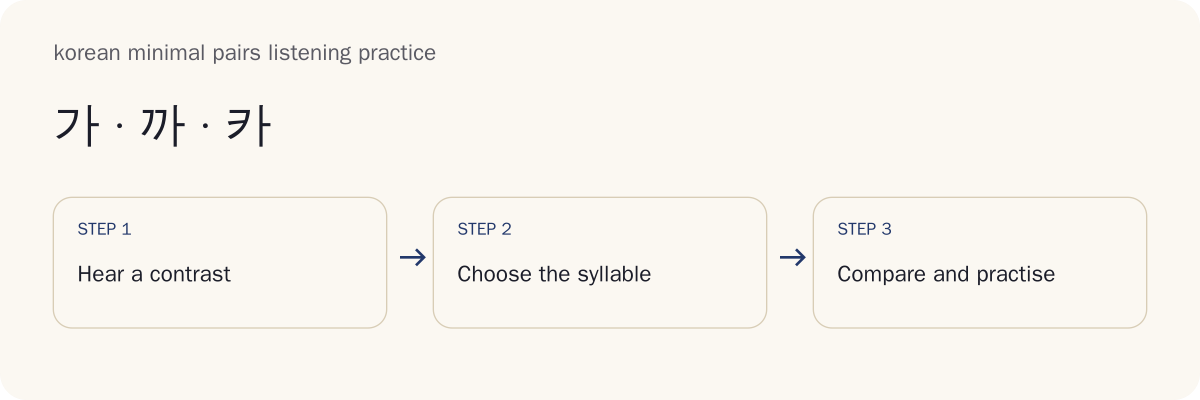
- Choose a contrast. Pick one consonant family or vowel pair rather than every available set. Notice whether the items are words, syllables or spelling exercises.
- Choose an activity and length. Use visual matching or flashcards to become familiar with the labels. A shorter assignment makes it easier to inspect each mistake.
- Check the media state. Listen only when a playable recording is present. Silence is a missing input, not a question you should guess at.
- Select an answer and inspect feedback. Compare the selected label with the answer. In word practice, connect the spelling with the stated meaning.
- Repeat with a purpose. Revisit the contrast you confused, then try again without looking at the answer. Keep reading practice and private audio practice in their separate result categories.
Before choosing a set, understand what makes a pair useful.
What Are Korean Minimal Pairs?
Korean minimal pairs are two words that differ by one sound in the same position and have different meanings. The contrast isolates a small change that listeners use to distinguish words. A minimal set extends this comparison to three or more words.
The words 달 and 딸 mean moon and daughter in the linked lesson. Their vowel and final consonant stay the same; the initial consonant changes. Comparing the entire words helps you focus on that initial difference rather than guessing from an unrelated vocabulary item.
A pair is defined by pronunciation, not simply by two different spellings. Different letters can represent the same sound in a particular position. Conversely, an unfamiliar written word may contain a clear spoken contrast even if you do not know its meaning yet.
Use the word lists for Korean minimal pairs to connect a contrast with its vocabulary context. Meanings help you remember the words, but a meaning revealed before a listening question can also give away the answer. Separate learning the word from testing your ear.
The tool therefore distinguishes word comparisons from syllable exercises.
Words, Triples and Syllable Exercises
The set 달, 딸 and 탈 compares moon, daughter and mask. All three are words in the linked site list, and the initial consonants make the contrast. A syllable exercise instead uses a deliberately limited sound pattern; its purpose is comparison, not a promise that every item is a dictionary word.
Syllable practice can reduce the amount you must remember at once. Word practice then adds meaning and normal pronunciation context. Neither format should be judged by appearance alone: read its label before treating a displayed syllable as vocabulary. The same distinction applies across the consonant families below.
Korean Minimal Pairs Listening Practice: Consonants
The main three-way consonant families compare plain, tense and aspirated sounds. Plain names the ordinary member of the family; tense names its doubled-letter counterpart; aspirated means a sound with a stronger release of breath. These terms describe Korean contrasts, rather than three versions of an English letter.
| Family | Plain | Tense | Aspirated | What Stays Comparable |
|---|---|---|---|---|
| Back-of-tongue stops | ㄱ | ㄲ | ㅋ | Place of closure |
| Tongue-front stops | ㄷ | ㄸ | ㅌ | Place of closure |
| Lip stops | ㅂ | ㅃ | ㅍ | Lip closure |
| Affricates | ㅈ | ㅉ | ㅊ | Closure followed by friction |
| Fricatives | ㅅ | ㅆ | No third member | Friction-based comparison |
An affricate begins with a closure and releases into friction. A fricative makes friction without the same initial stop pattern. You do not need to memorize these labels before practicing, but they explain why the last row is a pair rather than a triple.
Keep the vowel and word position consistent while learning one family. Switching both the consonant and vowel adds another possible reason for a different sound. Compare the opening of the recording, then listen to the following vowel too.
The ㄱ, ㄲ and ㅋ articulation cues connect the letter labels with mouth movement. Romanization can help locate a word, but it cannot reproduce the full three-way distinction. Useful cues also change with context.
Why Do Plain, Tense and Aspirated Sounds Overlap?
Plain, tense and aspirated sounds overlap because speakers and word positions affect the clues a learner hears. Airflow is useful, but one universal rule such as “plain always has no air” cannot identify every recording correctly.
The linked consonant lesson notes that plain ㄱ changes with position, including a more voiced quality between vowels. Voicing means vibration of the vocal folds. A sound learned at the start of a word may therefore differ from the same letter inside a word.
Listen across the release and into the vowel rather than searching for one tiny noise. Pitch is how high or low a voice sounds; it can be another clue in a recording, but it is not a fixed label that makes every high sound tense or aspirated. A speaker's habitual voice height also affects what you hear.
A common mistake is memorizing one voice instead of the contrast. Use several suitable recordings when available, and compare like positions before drawing a conclusion. Vowel choices require the same care.
Vowel and Glide Contrasts to Hear
Vowel practice changes the middle of the syllable while keeping other sounds as similar as possible. The pairs ㅓ/ㅗ and ㅡ/ㅜ are useful starting points because the written distinction connects to a spoken contrast, rather than only a spelling task.
For ㅓ and ㅗ, the linked lesson uses 선 and 손: line and hand. The initial and final consonants stay the same. The lesson describes relaxed lips for ㅓ and rounded lips for ㅗ. Mouth position is a way to explore the contrast while speaking; in listening, you still need the actual recording.
Read eo as the romanization label for ㅓ, not as two English vowels to pronounce separately. The English words that come to mind from a spelling can pull your attention away from the Korean sound. Hangul is the more consistent label to use alongside playback.
A glide is a short movement into another vowel sound. In glide practice, attend to the beginning and the direction of that movement, not just the sustained end of the vowel. Keep a glide exercise separate from a simple vowel comparison until the task is clear.
Some vowel spellings need context rather than isolated listening.
Can You Hear Every ㅐ and ㅔ Spelling Difference?
No: every ㅐ and ㅔ spelling difference is not reliably audible in contemporary Seoul speech. The linked minimal-pairs lesson explains that many speakers pronounce these vowels alike. An isolated recording cannot supply a difference that the speaker does not make.
The words 개 and 게 mean dog and crab in that lesson. Their spellings remain distinct even when their vowels sound the same. A fair task can ask you to choose the spelling from meaning or sentence context; it should identify that task as context or spelling practice.
Do not interpret a merged pronunciation as a native speaker making an error. Do not treat repeated guessing as ear training either. Learn the spellings by sight and use context to decide which word is intended. If a recording does preserve a distinction, that says something about that speaker and recording, not every Korean voice.
Position also determines which final consonant differences survive.
Final Sounds, Nasals and Liquids
Final consonants need their own comparisons because an initial contrast does not automatically remain distinct at the end of a syllable. The seven final categories represented here are ㄱ, ㄴ, ㄷ, ㄹ, ㅁ, ㅂ and ㅇ. Several written consonants can belong to the same final sound category.
The linked hub compares 밥, 밭 and 박 as final-stop examples. A stop blocks airflow; an unreleased final stop ends with the closure rather than a clearly audible burst. Adding an English-style release can create a sound that was absent from the recording.
The hub also compares 산, 삼 and 상 as final-nasal examples. Nasal sounds allow air through the nose, and these endings differ in where the mouth closes. Listen through the vowel into the ending instead of stopping your attention after the first consonant.
A liquid is the broader sound category that includes the r-like and l-like realizations associated with ㄹ. Keep initial and final practice labeled by position. Distinct final sounds can support listening choices; neutralized spellings require a different task.
Worked cases show how to separate these goals.
Worked Examples with Answers
The cases below explain how to interpret an exercise. They are teaching examples, not claims that the public tool currently contains playable clips of these words.
Case 1: An Initial Consonant. Suppose a supplied recording is labeled 딸 and the choices are 딸 and 탈. Selecting 탈 changes the tense initial to the aspirated initial. The answer is 딸, daughter. Compare the start of the two suitable recordings, then repeat the question without the written answer visible. Reading the correct label is useful feedback, but it is not another independent listening success.
Case 2: A Vowel. Suppose the supplied target is 손 and the choices are 손 and 선. The answer is 손, hand; 선 is line. The differing vowel is ㅗ versus ㅓ. After checking the answer, use the lip shape for ㅓ and ㅗ lesson to connect listening with a controlled speaking comparison. Then return to ordinary playback.
Case 3: A Final Nasal. Compare the written endings in 산, 삼 and 상. The opening stays the same and the final category changes. In visual mode, identifying ㅁ as the ending in 삼 is a spelling result. With a suitable recording, choosing 삼 asks a separate listening question. Keep those outcomes apart even when the same word appears in both tasks.
Case 4: A Merged Vowel. A context prompt about a dog selects 개 rather than 게. The answer comes from meaning, not proof that an isolated vowel was distinguishable. Record that success as a context or spelling outcome.
These examples lead to a more useful reading of results.
How Do the Practice and Transfer Scores Differ?
Practice results describe what happened under the conditions of a session. Transfer results ask whether you can use the contrast under a changed condition, such as another speaker. The current absence of a public recording corpus means the tool cannot establish public listening transfer from visual answers.
For an ordinary accuracy fraction, the numerator is the number of correct eligible answers and the denominator is the number of eligible answered questions. Eight correct answers out of ten eligible questions means eight divided by ten, or 80 percent. The fraction matters because eight out of ten is less evidence than eighty out of one hundred.
Separate first attempts from answers made after help. A replay gives another opportunity to inspect the signal; revealing the answer changes the task even more. Visual practice and private audio results also belong in separate categories.
A percentage is not a fluency level, pronunciation diagnosis or language exam score. Inspect the conditions before comparing two sessions.
Training, Recall and a New Speaker
Training lets you compare examples and use feedback. Recall practice returns to material you have already met. A new-speaker check changes the voice, so remembering one recording is less helpful. These are different learning situations even when the displayed words remain identical.
A useful personal record names the confusion: for example, “selected aspirated when the target was tense.” That is more actionable than “bad at consonants.” Look for repeated direction of error before changing your study plan.
Assignment seeds make an order reproducible; they do not make the answers independent or prove a scientific testing standard. New words and new speakers also test different kinds of transfer. With no public transfer corpus available, use those distinctions to plan future listening rather than infer a result from a visual session.
Native Recordings and Reliable Listening Examples
A native recording provides a real spoken example, but the label “native” alone does not guarantee that a clip is suitable for a contrast exercise. The words, recording position and audible choices must fit the question. Public listening recordings are currently unavailable on this tool.
Suitable teaching audio needs permission for its intended use and clear identification of the speaker and item. Background noise, clipping and edits near a consonant release can obscure the very cue the learner is trying to hear. A recording can sound pleasant overall and still be unsuitable for one narrow comparison.
Human listeners should be able to identify the intended answer under the stated conditions. A word meaning should also match the sense being taught. Where a contrast has merged, changing the answer label cannot make the difference audible.
For private audio, use recordings you have permission to keep and practice with. Preserve enough context to understand what the clip contains. An imported recording remains private practice material; importing it does not make it a public reference recording.
Playback choices can further change the listening task.
When Should You Avoid Slower Playback?
Avoid slower playback when you want to check recognition at ordinary speed. Slowing a clip can help locate a difficult transition during study, but an assisted answer does not demonstrate the same task as an ordinary-speed answer.
If a playback control offers 0.8× speed, use it as a comparison aid and then return to normal speed. Browser handling of pitch preservation varies, and a slowed clip can change the timing relationships you attend to. Do not build a rule from one altered release.
A deliberately slower spoken recording also differs from stretching an existing recording. Keep the type of help clear when recording your results. The reference table below organizes the choices before you begin another session.
Reference Table for Consonants and Vowels
Use this table to choose the kind of question you want to answer. A contrast inventory describes possible study categories; it does not mean every category currently has public recordings.
Start with a row whose labels you can read. In visual practice, compare letters and syllable positions. In private listening practice, check that your recording actually represents the selected item and preserves the intended contrast.
Spelling and context rows serve a different purpose from sound-choice rows. A pair of different spellings can be worth learning even when isolated pronunciation cannot identify which spelling is intended. The task should make that distinction clear before you answer.
For each row, keep one change under examination. Once you can explain the question and interpret the answer, use assignment and export options to make the practice repeatable.
| Contrast | Example type | Practice focus |
|---|---|---|
| ㄱ/ㄲ/ㅋ · ㄷ/ㄸ/ㅌ · ㅂ/ㅃ/ㅍ · ㅈ/ㅉ/ㅊ | Syllables and words | Three labels, subject to recording audibility |
| ㅅ/ㅆ | Words and syllables | Two labels; no third aspirated counterpart |
| ㅓ/ㅗ · ㅡ/ㅜ | Words and syllables | Vowel contrasts |
| Nasal and liquid initials/finals | Syllables and words | Position-specific comparisons |
| Final ㄱ/ㄴ/ㄷ/ㄹ/ㅁ/ㅂ/ㅇ | Syllables and words | Seven final classes |
| ㅐ/ㅔ · neutralized final spellings | Spelling and context | No isolated listening score when merged |
Assignments, Downloads and Private Progress
An assignment link preserves the selected contrasts, activity, length, seed and content version in its fragment. Copy it from More to reproduce the setup without attaching your personal results. Matching settings do not supply missing audio.
Progress is local to the browser when storage is available. Export JSON before changing devices, then import it where you want to continue. TSV word-list downloads support other study workflows, and a printed reference or answer key supports reading practice.
Private audio import and original-media export apply to learner-supplied material. A private offline pack must contain the actual recordings you intend to use; a settings link alone is not a media download. Check playback before relying on it away from a connection.
Why Is the Audio Silent or Unavailable Offline?
Public listening audio is unavailable because this tool has no published listening recording corpus. The page can still support visual study, but silence cannot be interpreted as a pronunciation example or scored as a wrong answer.
For an imported private recording, first check device volume, the selected output and whether the file plays. Offline use requires the media to be present locally, not merely a saved page or assignment link. Browser storage can be cleared, so keep an export of material you need. The practical questions below cover the remaining device and sharing details.
Frequently Asked Questions
The answers below explain the conditions for audio, assignment links, local storage and printed material. Keep the activity label with any result you share so a reading exercise is not mistaken for a listening test.
Do I need headphones for these exercises?
Headphones can make quiet details easier to hear, especially when background noise competes with a recording. Visual practice needs no audio. Listening practice requires a playable recording and is unavailable until recordings are added. Headphones improve the listening conditions; they cannot provide missing media or turn a visual exercise into a listening test.
Can a teacher reproduce the same question order?
Yes. Copy an assignment link from More. The fragment preserves the seed, selected contrasts, activity, length and content version without sending personal results. Another learner can open the same setup, but playable media must still be available separately. The link reproduces the exercise settings rather than sharing your local scores or private audio.
Will changing phones erase my progress?
Progress is saved in this browser when storage is available. Export a progress file and import it on another device before you rely on the new phone for study. Automatic cross-device synchronization is unavailable. Clearing browser data can also remove local progress, so keep a saved export if your session history matters to you.
Can I print a useful practice sheet without the audio?
Yes. Print the reference and answer key, or download the word list for another study format. A printed sheet supports reading and spelling; it cannot measure listening without recordings. Cover the answer key while working, then use it to check the written choices. Keep those results separate from any audio-based exercise you complete later.
Can I report one recording without sharing my results?
Copy the recording report from More. It includes the contrast, recording ID when available, seed and content version. It excludes your local scores and private notes. Those details identify the item and exercise setup without sharing your complete study history. Describe the playback problem clearly if you send the report through a correction channel.
Next Steps after Korean Minimal Pairs Listening Practice
Choose the next activity from the mistake you want to address. If a label or word is unfamiliar, return to the word lists for Korean minimal pairs and compare the meanings with the written forms. If the vocabulary is familiar but an available recording remains difficult, study one contrast in isolation before adding more choices.
Visual matching, flashcards and printable sheets build recognition of written material. Listening discrimination asks which sound was heard. Dictation adds the task of producing written text from a recording. A good result in one activity is useful evidence about that activity, rather than a substitute for all the others.
For Korean minimal pairs listening practice, use a short repeatable sequence: identify one confusion, inspect the explanation, practice with clear labels, and return to an unassisted question when suitable audio is available. Record the conditions as well as the answer. This makes the next session respond to a specific need instead of repeating every set.