What you'll learn
- Read a 14-sentence story about a weekend away, aloud.
- Tell what you did with past action verbs, and what it was like with past description verbs.
- Tell action verbs from description verbs, and form 예뻤어요 from 예쁘다.
- Use 와 for "with" and 에 or 로 for a destination.
Before you start: You should know the basic past ending -았/었어요. If it is new, read Korean past tense first. The story takes about 20 minutes. If you keep a journal, the diary writing in Korean page shows how to turn a weekend like this into your own entry.
What Happens in This Easy Korean Story about a Trip to Busan?
In this easy Korean story about a trip to Busan, the speaker and a friend take a train, arrive after three hours, visit the beach at Haeundae, eat raw fish at Jagalchi Market, rest at a hotel and return to Seoul on Sunday. The speaker ends by saying the trip was fun. Play the narration once, then read along with the table.
지난 주말에 저는 친구와 부산에 갔어요. 우리는 기차를 탔어요. 세 시간 후에 부산에 도착했어요. 먼저 해운대 바다에 갔어요. 바다가 정말 예뻤어요. 우리는 사진을 많이 찍었어요. 그다음에 자갈치시장에 갔어요. 시장에서 회를 먹었어요. 회가 아주 신선했어요. 시장에는 사람이 많았어요. 밤에는 호텔에서 쉬었어요. 일요일에 서울로 돌아왔어요. 조금 피곤했어요. 하지만 부산 여행은 정말 즐거웠어요.
| # | Korean | Meaning |
|---|---|---|
| 1 | 지난 주말에 저는 친구와 부산에 갔어요. | Last weekend I went to Busan with a friend. |
| 2 | 우리는 기차를 탔어요. | We took the train. |
| 3 | 세 시간 후에 부산에 도착했어요. | After three hours we arrived in Busan. |
| 4 | 먼저 해운대 바다에 갔어요. | First we went to the sea at Haeundae. |
| 5 | 바다가 정말 예뻤어요. | The sea was really beautiful. |
| 6 | 우리는 사진을 많이 찍었어요. | We took many photos. |
| 7 | 그다음에 자갈치시장에 갔어요. | Next we went to Jagalchi Market. |
| 8 | 시장에서 회를 먹었어요. | At the market we ate raw fish. |
| 9 | 회가 아주 신선했어요. | The raw fish was very fresh. |
| 10 | 시장에는 사람이 많았어요. | There were many people in the market. |
| 11 | 밤에는 호텔에서 쉬었어요. | At night we rested at the hotel. |
| 12 | 일요일에 서울로 돌아왔어요. | On Sunday we came back to Seoul. |
| 13 | 조금 피곤했어요. | We were a little tired. |
| 14 | 하지만 부산 여행은 정말 즐거웠어요. | But the Busan trip was really fun. |
The three-hour train ride is a story detail, not a timetable. Haeundae is a well-known beach in Busan and Jagalchi is a well-known fish market there, but the story gives no prices or opening times, so check those before you travel. The next section shows what makes the text easy or hard.
What Makes This Story Easy or Hard to Read?
The story is easy because almost every sentence is "who + where + past verb". It is harder in three places: it uses two kinds of past verb, it has several sound changes at once, and one description verb changes its stem.
| Feature | In the story | Note |
|---|---|---|
| Action verbs | 갔어요, 탔어요, 먹었어요 | Something happened; often has an object or destination |
| Description verbs | 예뻤어요, 신선했어요, 즐거웠어요 | Says what something was like |
| Stem change | 예쁘다 → 예뻤어요 | ㅡ drops before the past ending |
| Liaison | 주말에 [주마레], 먹었어요 [머거써요] | A final consonant moves to the next block |
| Aspiration | 도착했어요 [도차캐써요] | ㄱ + ㅎ sounds like ㅋ |
| Contrast marker | 시장에는, 밤에는 | 는 sets one scene against another |
The action versus description contrast is the main learning point. An action verb answers "what did you do?". A description verb answers "what was it like?". Both take the same past ending. Only a few stems change before it, as the worked example shows with 예쁘다.
Which New Words Should You Preview?
Preview these words before you read. They carry most of the meaning, and several have a sound change.
| Word | Revised Romanization | Meaning | Sentence |
|---|---|---|---|
| 지난 주말 | jinan jumal | last weekend | 1 |
| 기차 | gicha | train | 2 |
| 도착했어요 | dochakaesseoyo | arrived | 3 |
| 먼저 | meonjeo | first | 4 |
| 바다 | bada | sea | 4, 5 |
| 예뻤어요 | yeppeosseoyo | was beautiful | 5 |
| 찍었어요 | jjigeosseoyo | took (a photo) | 6 |
| 그다음에 | geudaeume | next, after that | 7 |
| 시장 | sijang | market | 7, 8, 10 |
| 회 | hoe | raw fish | 8, 9 |
| 신선했어요 | sinseonhaesseoyo | was fresh | 9 |
| 쉬었어요 | swieosseoyo | rested | 11 |
| 돌아왔어요 | dorawasseoyo | came back | 12 |
| 피곤했어요 | pigonhaesseoyo | was tired | 13 |
| 즐거웠어요 | jeulgeowosseoyo | was fun | 14 |
Romanization is only a reading aid here. Note that 회 means raw fish in this story, and 도착했어요 is written with ㄱ and ㅎ but said with a single ㅋ sound. Hear two of the harder words before you start.
Read the Story in Three Passes
Read the story three times, each pass with one job.
- Pass 1: read silently for the route. Find the three places the friends visit (바다, 시장, 호텔). Do not look anything up.
- Pass 2: sort the verbs. Use two colours. Mark action verbs (갔어요, 탔어요, 먹었어요) in one colour and description verbs (예뻤어요, 신선했어요, 즐거웠어요) in the other.
- Pass 3: read aloud. Read the whole story at an even pace, and say the sound changes shown in brackets in the feature table above.
Try one action sentence and one description sentence with the audio and then without it.
Use them as a model, then read along. The extensive reading page explains why finishing easy texts and re-reading them works.
Comprehension Questions
Answer from the text.
- Who did the speaker go to Busan with? (a) a friend (b) family (c) alone
- How did they travel to Busan? (a) by bus (b) by train (c) by plane
- What did they eat at the market? (a) raw fish (b) noodles (c) rice cakes
- Which sentence is a description, not an action? (a) 우리는 기차를 탔어요. (b) 바다가 정말 예뻤어요. (c) 사진을 많이 찍었어요.
- When did they come back to Seoul? (a) Saturday (b) Sunday (c) Monday
Answers
- 1 (a). Sentence 1: 친구와 means with a friend.
- 2 (b). Sentence 2: 기차를 탔어요.
- 3 (a). Sentence 8: 회를 먹었어요.
- 4 (b). Sentence 5 says what the sea was like. The other two say what the friends did.
- 5 (b). Sentence 12: 일요일에 서울로 돌아왔어요.
If you missed question 4, sort the verbs again as in pass 2. The test is simple: can you ask "what did you do?" or "what was it like?" about the sentence?
What Grammar Appears in the Story?
Seven patterns carry the story.
| Pattern | Example | What it does |
|---|---|---|
| Past -았/었어요 | 갔어요, 먹었어요 | a finished event |
| 하다 verbs: -했어요 | 도착했어요, 피곤했어요 | past of verbs and adjectives ending in 하다 |
| Noun + 와/과 | 친구와 | with (와 after a vowel, 과 after a consonant) |
| Place + 에 or 에서 | 부산에, 호텔에서 | 에 for a goal, 에서 for where an action happens |
| Place + 로 | 서울로 | toward a place |
| Object + 을/를 | 기차를, 회를 | marks the object |
| Noun + 는 (contrast) | 시장에는, 밤에는 | sets this scene against another |
The ending 했어요 is the past of 하다, so the stem 도착하- becomes 도착했어요. The word for "with" is 와 here because 친구 ends in a vowel. After a consonant you would use 과, as in 가족과 (with family). See the Korean past tense page for the full pattern.
Worked Example: an Action Verb and a Description Verb
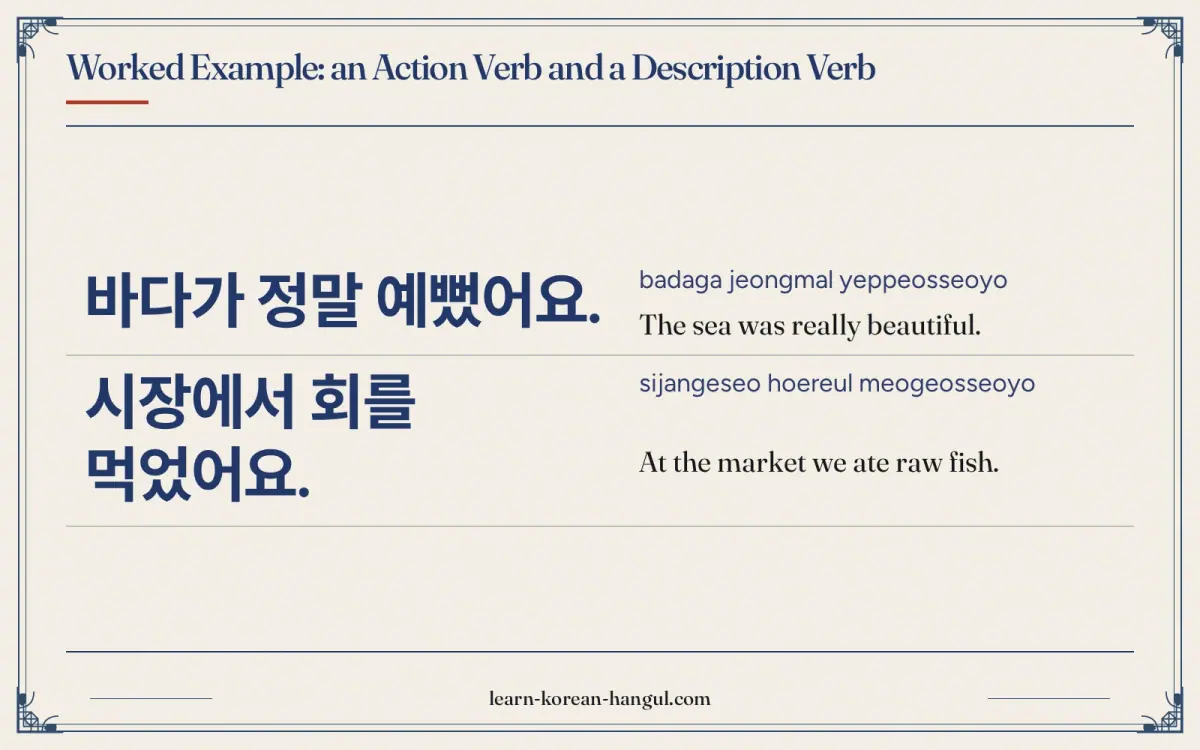
Compare sentences 5 and 8 to see an action verb and a description verb side by side.
- 먹었어요 (ate): the stem is 먹-. The last vowel is ㅓ, so the past ending is -었어요: 먹었어요, said [머거써요].
- 예뻤어요 (was beautiful): the dictionary form is 예쁘다, with the stem 예쁘-.
- The vowel ㅡ drops before an ending that starts with a vowel: 예쁘 becomes 예ㅃ.
- The vowel before the dropped ㅡ is ㅖ, so the ending takes -었: 예ㅃ + 었 = 예뻤. The full form is 예뻤어요.
- Compare 즐겁다: ㅂ turns to 우 before a vowel, giving 즐거웠어요.
바다가 정말 예뻤어요.
badaga jeongmal yeppeosseoyo
The sea was really beautiful.
시장에서 회를 먹었어요.
sijangeseo hoereul meogeosseoyo
At the market we ate raw fish.
To make your own pair, name a place and say what you did, then say what it was like: 공원에 갔어요. 공원이 조용했어요. (I went to the park. The park was quiet.) One action and one description make a complete mini-report of a trip.
What Mistakes Do Learners Make Here?
Learners often make four mistakes with this text.
| Learners often assume | Actually | Because |
|---|---|---|
| The past of 예쁘다 is 예쁘었어요 | It is 예뻤어요 | ㅡ drops before the past ending |
| 주말에 is said [주말에] | It is said [주마레] | The final ㄹ moves to the next block |
| Say 친구를 부산에 갔어요 for "went with a friend" | Say 친구와 부산에 갔어요 | 와 means "with"; 를 would mark the friend as an object, not as a companion |
| Description verbs need a different tense | They take the same past endings | 예뻤어요 and 갔어요 both end in -ㅆ어요 |
The first error is the most common, because the stem of 예쁘다 looks regular. The ㅡ rule also applies to 기쁘다 (기뻤어요) and 바쁘다 (바빴어요), so it is worth learning once.
Practice and Answer Key
Part A: choose the past form.
- 가다 → ___
- 예쁘다 → ___
- 먹다 → ___
Part B: speak. Say aloud two sentences about a trip you took: one action sentence and one description sentence.
Part C: fill the blank. 저는 친구___ 부산에 갔어요. (Choose 와 or 과.)
Answers
- Part A: 1 갔어요, 2 예뻤어요, 3 먹었어요.
- Part B: for example 제주도에 갔어요. 바다가 정말 예뻤어요.
- Part C: 와, because 친구 ends in a vowel.
Where to Go Next
Continue with Easy Korean Story About a Rainy Day, which joins reasons and results. To write your own weekend report, try diary writing in Korean. Browse the rest of Graded Korean Stories, or see the Korean short stories for beginners overview. The Korean culture section has more on food and travel.
This easy Korean story about a trip to Busan covers the past tense of everyday action and description verbs. It does not teach how to book trains or order at a fish market. Re-reading it after a week is a good way to lock in the two verb types.
Frequently Asked Questions
What Is the Difference between 갔어요 and 예뻤어요?
갔어요 is an action verb in the past: the speaker went somewhere. 예뻤어요 is a description verb in the past: something was beautiful. Both use the same past ending, -았/었어요. The difference is meaning. Ask "what did you do?" for action verbs and "what was it like?" for description verbs.
Why Is 예쁘다 in the past 예뻤어요?
The stem 예쁘- ends in ㅡ. Before the past ending, ㅡ drops, leaving 예ㅃ. The vowel before it is ㅖ, which is not ㅏ or ㅗ, so the ending is -었어요, and the result is 예뻤어요. The same rule gives 기뻤어요 (was glad) from 기쁘다.
Why Is 주말에 Said [주마레]?
When a block ends in a consonant and the next block starts with the silent ㅇ, the consonant moves across. So the ㄹ of 말 joins the 에, and the phrase sounds like 주마레. The same movement happens in 일요일에 [이료이레], so reading aloud trains it.
What Does 회 Mean in This Story?
회 means raw fish, usually sliced and eaten with sauces and side dishes. It is a popular dish in Korean port cities. The same syllable can also mean a meeting or a round, so context decides. In a market sentence such as 시장에서 회를 먹었어요, it is the food.
When Do I Use 와 and When 과?
Use 와 after a noun that ends in a vowel, such as 친구와, and 과 after a noun that ends in a consonant, such as 가족과. Both mean "with" or "and". In speech, (이)랑 and 하고 are common casual alternatives. This story uses 와 because the noun is 친구.