What you will learn
- Write the date line of a Korean diary: year, month, day, weekday and weather.
- Turn a polite -요 sentence into a plain -다 sentence.
- Write a four-line entry: date and weather, event, feeling, plan.
- Check an entry with a short checklist.
Before you start: you should know the past tense (-았어요/-었어요) and the future ending -(으)ㄹ 거예요. Time: about 25 minutes, then five minutes a day.
Key Facts
- Diary sentences end in the plain written style (한다체), for example 만났다, not 만났어요.
- An entry starts with a date line in the order year, month, day: 2026년 5월 12일 화요일 맑음.
- Past tense gives 맑았다 [말갇따] and 좋았다 [조앋따], and action verbs in the present take -ㄴ다/-는다, as in 먹는다.
- A four-line entry has date and weather, one event, one feeling and one plan.
- The five models cover a normal day, a trip, weather, a meal and a feeling.
*Last updated: 2026-10-09. The Korean text, romanization and audio on this page are AI-assisted drafts.
What Is Korean Diary Writing?
Korean diary writing is writing a private record of your own day, in sentences that talk to no one. The plain written style (한다체, handache) fits this job. It is the style of essays, news articles and books, so it also prepares you for reading and for exam writing.
The polite -요 style speaks to a listener. A diary has no listener, so the endings change: 만났어요 becomes 만났다, and 좋아요 becomes 좋다. The sentence pattern does not change, so everything you learned about particles and word order still applies. The sources for the forms are the Hangul Orthography (한글 맞춤법) and the Standard Pronunciation Rules (표준 발음법), and the explanation of speech styles is in Korean speech levels. Next, see why this is hard for English speakers.
Why Is This Hard for English Speakers?
English speakers find Korean diary writing hard because they learn -요 first and then meet a second set of endings. English diaries use the same verbs as speech, so nothing changes. Korean diaries change the ending, and the change depends on the word class.
Three differences cause the errors:
- Verbs and adjectives behave differently. An action verb needs -ㄴ다/-는다 in the present (먹는다), but an adjective keeps its dictionary form (좋다).
- The past is the easy part. 만났어요 loses its 어요 and gains 다, giving 만났다.
- The date runs from large to small. Korean writes the year first, then the month, then the day.
The set trains these three points in short entries. The next section shows how the set is built.
How Does the Writing Set Work?
The set has a template, five model entries, a conversion table, a checklist and a seven-day plan. You write an entry from the template, compare it with a model, and run the checklist. The table shows the order.
| Step | What you do | Where on this page |
|---|---|---|
| 1 | Learn the date line | Tasks and prompts |
| 2 | Fill the four-line template | Tasks and prompts |
| 3 | Read five models with RR and spoken forms | Model answers |
| 4 | Convert polite sentences to -다 | Tasks and prompts |
| 5 | Check your entry | The self-check checklist |
| 6 | Write one line a day for a week | What should you do after comparing? |
The tasks come first.
What Are the Tasks and Prompts?
Each task has a model answer in the next section, and the template is the main task.
Task 1: Write the Date Line
A diary date line has five parts. Write the year, month and day with the unit words 년, 월 and 일, then the weekday, then a one-word weather note. Put a space between the parts but none between a number and its unit word.
| Part | Example | Meaning |
|---|---|---|
| Year | 2026년 | 2026 |
| Month | 5월 | May |
| Day | 12일 | the 12th |
| Weekday | 화요일 | Tuesday |
| Weather | 맑음 | clear |
The full line reads 2026년 5월 12일 화요일 맑음. After the first entry in a notebook you can drop the year. The month and day words are read with Sino-Korean numbers: 5월 is 오월 (owol) and 12일 is 십이 일 (sibi il).
Weather words for the date line, and the matching sentence in the past tense:
| Date-line word | Sentence | RR and spoken form |
|---|---|---|
| 맑음 (clear) | 날씨가 맑았다. | nalssiga malgatda [날씨가 말갇따] |
| 흐림 (cloudy) | 날씨가 흐렸다. | nalssiga heuryeotda [날씨가 흐렫따] |
| 비 (rain) | 비가 왔다. | biga watda [비가 왇따] |
| 눈 (snow) | 눈이 왔다. | nuni watda [누니 왇따] |
| 더움 (hot) | 날씨가 더웠다. | nalssiga deowotda [날씨가 더웓따] |
| 추움 (cold) | 날씨가 추웠다. | nalssiga chuwotda [날씨가 추웓따] |
Task 2: Fill the Four-Line Template
Write four lines. The first is the date line, and the other three are sentences.
| Line | Role | Pattern to fill |
|---|---|---|
| 1 | Date and weather | ○년 ○월 ○일 ○요일 ○○ |
| 2 | Event | 오늘은 ○○을/를 ○○았다/었다. |
| 3 | Feeling | 기분이 ○○았다/었다. |
| 4 | Plan | 내일은 ○○을/를 ○○ 것이다. |
For line 3 use a feeling word such as 좋았다 (was good), 피곤했다 (was tired) or 즐거웠다 (was fun). For line 4 you can also write a wish with -고 싶다, as in 다음에 또 가고 싶다.
Task 3: Convert Polite Sentences to Diary Sentences
Change each sentence from the polite style to the diary style. The rules are in the table.
| Polite style | Diary style | Rule |
|---|---|---|
| 만났어요 | 만났다 | Past: replace 어요 with 다. |
| 좋았어요 | 좋았다 | Past of an adjective works the same way. |
| 먹어요 | 먹는다 | Present action verb with a final consonant: stem + 는다. |
| 가요 | 간다 | Present action verb with no final consonant: stem + ㄴ다. |
| 좋아요 | 좋다 | Adjective: use the dictionary form. |
| 학생이에요 | 학생이다 | 이에요 becomes 이다. |
| 갈 거예요 | 갈 것이다 | Future: -(으)ㄹ 거예요 becomes -(으)ㄹ 것이다. |
| 가고 싶어요 | 가고 싶다 | Wish: 싶어요 becomes 싶다. |
Convert these four sentences: (a) 오늘은 학교에 갔어요. (b) 날씨가 흐려요. (c) 저는 커피를 마셔요. (d) 내일 친구를 만날 거예요. The answers are in the practice section at the end.
What Do the Model Answers Look Like?
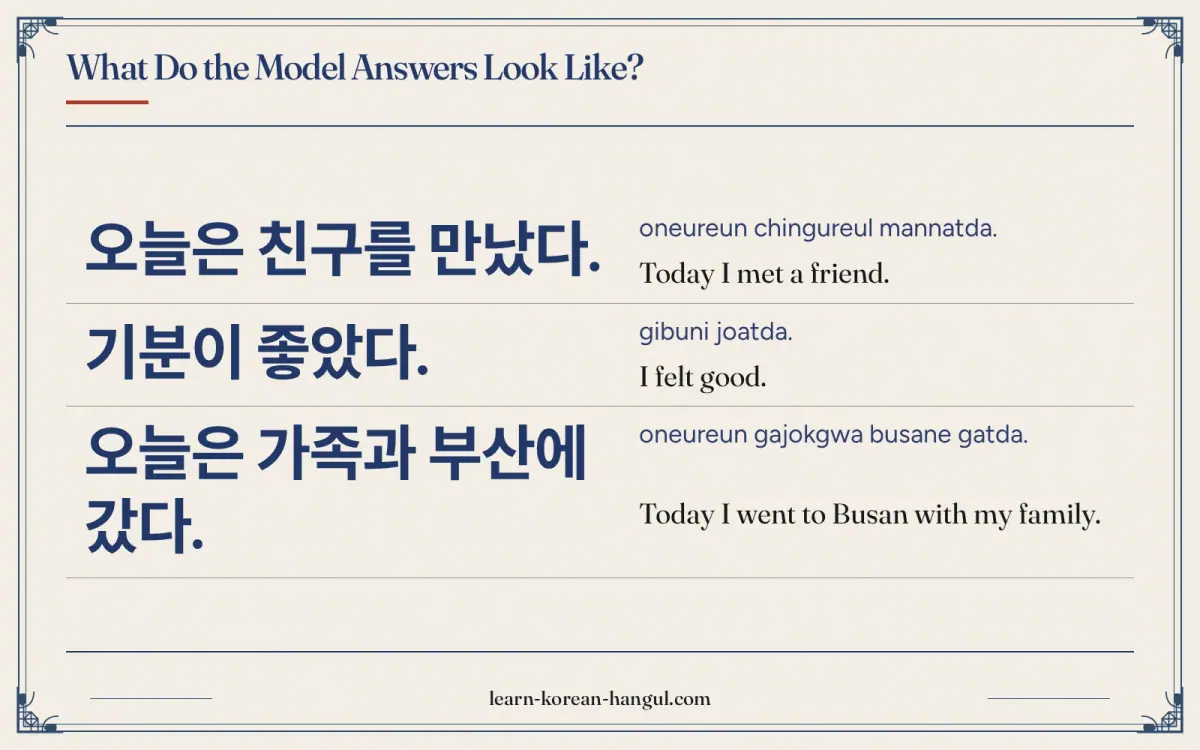
The five entries each have a date line and four sentences. They are one line longer than the four-line template because each adds a detail sentence. The tables give the Revised Romanization (RR) and the spoken form in brackets. RR is a learning aid and follows the letters, so it writes a past ending such as 만났다 as mannatda and does not show the tensing of the 다.
Entry 1: a Normal Day
| Line | RR | Spoken form |
|---|---|---|
| 5월 12일 화요일 맑음 | owol sibi il hwayoil malgeum | [오월 시비일 화요일 말금] |
| 오늘은 친구를 만났다. | oneureun chingureul mannatda. | [오느른 친구를 만낟따] |
| 우리는 카페에서 커피를 마셨다. | urineun kapeeseo keopireul masyeotda. | [우리는 카페에서 커피를 마셛따] |
| 기분이 좋았다. | gibuni joatda. | [기부니 조앋따] |
| 내일은 학교에 갈 것이다. | naeireun hakgyoe gal geosida. | [내이른 학꾜에 갈꺼시다] |
오늘은 친구를 만났다.
oneureun chingureul mannatda.
Today I met a friend.
기분이 좋았다.
gibuni joatda.
I felt good.
Entry 2: a Trip
| Line | RR | Spoken form |
|---|---|---|
| 9월 19일 토요일 맑음 | guwol sipgu il toyoil malgeum | [구월 십꾸일 토요일 말금] |
| 오늘은 가족과 부산에 갔다. | oneureun gajokgwa busane gatda. | [오느른 가족꽈 부사네 갇따] |
| 기차를 타고 두 시간 반 걸렸다. | gichareul tago du sigan ban geollyeotda. | [기차를 타고 두 시간 반 걸렫따] |
| 바다가 정말 예뻤다. | badaga jeongmal yeppeotda. | [바다가 정말 예뻗따] |
| 다음에 또 가고 싶다. | daeume tto gago sipda. | [다으메 또 가고 십따] |
오늘은 가족과 부산에 갔다.
oneureun gajokgwa busane gatda.
Today I went to Busan with my family.
For a longer trip story, read A Weekend Trip to Busan and note which sentences you could turn into diary lines.
Entry 3: Weather
| Line | RR | Spoken form |
|---|---|---|
| 6월 14일 일요일 맑음 | yuwol sipsa il iryoil malgeum | [유월 십싸일 이료일 말금] |
| 날씨가 맑았다. | nalssiga malgatda. | [날씨가 말갇따] |
| 하늘이 파랗고 바람이 시원했다. | haneuri parako barami siwonhaetda. | [하느리 파라코 바라미 시원핻따] |
| 오후에 공원에서 산책했다. | ohue gongwoneseo sanchaekaetda. | [오후에 공워네서 산채캗따] |
| 내일도 산책할 것이다. | naeildo sanchaekal geosida. | [내일도 산채칼꺼시다] |
날씨가 맑았다.
nalssiga malgatda.
The weather was clear.
The spoken form of 맑았다 is [말갇따]: the ㄺ splits so that ㄹ stays and ㄱ moves to the vowel of 았, and the final ㅆ then sounds like ㄷ and makes the 다 tense.
Entry 4: a Meal
| Line | RR | Spoken form |
|---|---|---|
| 3월 10일 화요일 흐림 | samwol sibil hwayoil heurim | [사뭘 시빌 화요일 흐림] |
| 점심에 친구와 김치찌개를 먹었다. | jeomsime chinguwa gimchijjigaereul meogeotda. | [점시메 친구와 김치찌개를 머걷따] |
| 김치찌개가 조금 매웠다. | gimchijjigaega jogeum maewotda. | [김치찌개가 조금 매웓따] |
| 그래도 정말 맛있었다. | geuraedo jeongmal masisseotda. | [그래도 정말 마시썯따] |
| 다음에는 비빔밥을 먹고 싶다. | daeumeneun bibimbabeul meokgo sipda. | [다으메는 비빔빠블 먹꼬 십따] |
Entry 5: a Feeling
| Line | RR | Spoken form |
|---|---|---|
| 5월 20일 수요일 비 | owol isibil suyoil bi | [오월 이시빌 수요일 비] |
| 오늘은 하루 종일 피곤했다. | oneureun haru jongil pigonhaetda. | [오느른 하루 종일 피곤핻따] |
| 아침에 일찍 일어났다. | achime iljjik ireonatda. | [아치메 일찍 이러낟따] |
| 그리고 숙제를 많이 했다. | geurigo sukjereul mani haetda. | [그리고 숙쩨를 마니 핻따] |
| 내일은 일찍 잘 것이다. | naeireun iljjik jal geosida. | [내이른 일찍 잘꺼시다] |
오늘은 하루 종일 피곤했다.
oneureun haru jongil pigonhaetda.
Today I was tired all day.
Notice how each entry keeps the same shape: a date, a fact, a detail, a feeling or a result, and a plan or wish. The checklist makes that shape visible.
How Do You Check Your Own Writing?
The self-check checklist for a diary entry has five yes/no questions. Read your entry once for each question.
- Does the first line follow year, month, day, weekday, weather?
- Does every sentence end in -다? Search for 요. A single 요 means you slipped into the polite style.
- Do action verbs in the present use -ㄴ다/-는다, and do adjectives keep the dictionary form? 먹는다 is right and 먹다 is wrong as a sentence; 좋다 is right.
- Are the particles right and attached? The topic 오늘은, the object 친구를, the place 카페에서.
- Is the entry the right size? Four lines is enough to start.
Then run the shared checks for Korean spelling rules and Korean spacing rules: a particle has no space before it, and each sentence ends with a period. Next, decide what to do with the result.
What Should You Do after Comparing?
After comparing with the models, find your most common error, fix the entry, and keep writing one line a day. A short habit builds the endings faster than one long entry. This seven-day plan grows the entry one line at a time.
| Day | What to write | Example |
|---|---|---|
| 1 | The date line only | 5월 12일 화요일 맑음 |
| 2 | Add a weather sentence | 날씨가 맑았다. |
| 3 | Add a feeling | 기분이 좋았다. |
| 4 | Add one event | 오늘은 친구를 만났다. |
| 5 | Add a plan | 내일은 학교에 갈 것이다. |
| 6 | Write the full four-line entry | Use the template |
| 7 | Write five lines and read the week aloud | Add one detail sentence |
If you keep making the same mistake, study it: for the polite and plain styles, read Korean speech levels; for dates, read dates in Korean. The worked example below shows the conversion on one sentence.
Worked Example: 오늘은 친구를 만났다.
Turning the polite sentence 오늘 친구를 만났어요 into a diary sentence takes five steps.
- Start from the polite sentence. 오늘 친구를 만났어요 (I met a friend today).
- Find the ending. 만났어요 is the past tense of 만나다 plus the polite 요.
- Make the ending plain. Replace 어요 with 다: 만났다.
- Add the topic particle to the time word. Diaries often write 오늘은, which sets today as the topic.
- Run the checklist. Past tense, no 요, particle 를 attached, one period.
The result is 오늘은 친구를 만났다. The spoken form is [오느른 친구를 만낟따]. The RR is oneureun chingureul mannatda.
You will know it worked when no sentence in your entry ends in 요. Several errors recur, so the next section lists them.
What Mistakes Do Learners Make Here?
Learners repeat five mistakes in diary writing. Each one has a cause.
- Mistake 1: mixing -요 and -다. Learners often finish an entry in the polite style by habit. Actually a diary keeps one style from the first line to the last, because the style signals who is listening.
- Mistake 2: writing 먹다 for "I eat". Learners often use the dictionary form as a present sentence. Actually action verbs take -는다 or -ㄴ다 (먹는다, 간다), and only adjectives and 이다 use the plain dictionary form.
- Mistake 3: starting every line with 저는. Learners often copy the polite habit. Actually a diary drops the subject, or uses 오늘은 and 나는, because 저 is the humble word for speaking to someone.
- Mistake 4: writing the date in English order. Learners often write the day first. Actually Korean goes year, month, day: 2026년 5월 12일.
- Mistake 5: spacing the number and its unit. Learners often write 5 월. Actually the number touches 월 and 일, and spaces fall between the parts: 5월 12일.
Expert tip: read your entry aloud once. The -다 endings sound flat compared with -요, and that flat sound is the signal you are in the right style. Test the conversion now.
Practice and Answer Key
Convert each sentence to the diary style, and write your answers before you open the key.
- 오늘은 학교에 갔어요.
- 날씨가 흐려요.
- 저는 커피를 마셔요.
- 내일 친구를 만날 거예요.
Answer key
- 오늘은 학교에 갔다. (Today I went to school.) RR: oneureun hakgyoe gatda.
- 날씨가 흐리다. (The weather is cloudy.) 흐리다 is an adjective, so it keeps the dictionary form. RR: nalssiga heurida.
- 나는 커피를 마신다. (I drink coffee.) 마시다 ends in a vowel, so the present is 마신다, and 저는 becomes 나는. RR: naneun keopireul masinda.
- 내일 친구를 만날 것이다. (I will meet a friend tomorrow.) RR: naeil chingureul mannal geosida.
Three or four correct means you can start the seven-day plan. The last section shows where to continue.
Where to Go Next
After Korean diary writing, continue with Write About Yourself in Korean, which uses a ten-sentence template in the polite style. If the sentences themselves feel slow, return to Korean Sentence Writing Practice first. More tasks are in the Korean writing prompts section.
This set covers the plain written style in the present, past and future, with short entries. It does not cover the casual speech style, the formal -ㅂ니다 style, connectors that join entries into paragraphs or honorific forms.
Frequently Asked Questions
Why do diaries end in -다? The -다 ending is the plain written style, the default for text that talks to no particular listener, such as essays, news and diaries. The polite -요 ending speaks to a person. A diary has no listener, so the sentences end in -다. A personal diary can use -요 if you prefer, but -다 is the written convention.
How do I write the date? Write the year, the month and the day in that order, each with its unit word and no space between the number and the word: 2026년 5월 12일. Then add the weekday and a one-word weather note, as in 화요일 맑음. The year can be dropped after the first page of a notebook.
What if I only know -요? Write the sentence in the -요 style first, then convert it with the table in Task 3. Past endings change by dropping 어요 and adding 다. Present action verbs take -는다 or -ㄴ다. Adjectives keep the dictionary form. After a week of conversions the plain endings come without the extra step.
How long should an entry be? Start with the four-line template: a date line and three sentences. That takes about five minutes and keeps the habit easy. When four lines feel comfortable, add one detail sentence, as in the five models. Five to eight lines is a good size for an entry once the endings are automatic.