
Key facts
- The past marker -았/었- is an infix: it sits between the stem and the ending and stays the same at every speech level.
- The rule has three parts: 았 after the vowels ㅏ and ㅗ, 었 after other vowels, and 했 for 하다 verbs.
- The past of 이다 is 이었어요 after a consonant and 였어요 after a vowel.
- This set contains 4 lessons at level A1.
Listen to the simplest past sentence.
The next section defines the topic and shows the pattern at four speech levels.
What Is the Korean past Tense?

The Korean past tense marks an action or state that happened before the moment of speaking. It is built by adding -았/었- to the verb stem, then adding the ending you need. Korean has no separate past helper word, so the infix is the whole marker.
Take 먹다 ("to eat"). The stem is 먹, the last vowel is ㅓ, and the past infix is therefore 었.
| Level | Past form | Spoken | Meaning |
|---|---|---|---|
| Polite | 먹었어요 | [머거써요] | I ate. |
| Formal | 먹었습니다 | [머걷씀니다] | I ate. |
| Casual | 먹었어 | [머거써] | I ate. |
| Plain (written) | 먹었다 | [머걷따] | I ate. |
Pronunciation: the double ㅆ in 었 is spoken as a doubled s sound before a vowel, as in 먹었어요, and as ㄷ before a consonant, as in 먹었다. The infix is the same in all four rows, so one rule serves every speech level. The levels themselves are explained in Korean speech levels.
Two groups take different forms. The verb 이다 ("to be") becomes 이었어요 or 였어요, as in 학생이었어요 ("I was a student"). Irregular stems change before the infix, as in 듣다 to 들었어요 ("I listened") and 춥다 to 추웠어요 ("it was cold"). For the wider area, see Korean tenses. The next section gives a route through the lessons.
Where Should You Start with Korean past Tense?

Start with the regular infix, then learn the past of 이다, then the irregular stems, then the plain written past. Four stages cover the whole set.
- Stage 1: the infix. Read past tense -았/었-, which teaches the vowel rule and the polite past.
- Stage 2: the past of 이다. Read 이었어요/였어요 past of 이다 for "was" and "were" after a noun.
- Stage 3: irregular stems. Read past tense irregular verbs in the verbs hub, where the irregular classes are tabulated.
- Stage 4: the written past. Read plain past -았다/었다 for diaries, news and books.
Who can skip ahead? A learner who already forms 갔어요, 먹었어요 and 했어요 correctly can start at stage 2. A learner who has not studied the polite ending should first read 해요체 polite speech -아요/어요, because the past infix attaches before that ending. The next section describes each lesson.
Browse by Topic

Each published lesson below has a short description, one example sentence with Revised Romanization (RR, the official Latin spelling, shown only as an aid) and audio.
Past Tense -았/었-
This lesson teaches the infix -았/었-, the vowel rule, the contraction of vowel-final stems such as 가+았 to 갔 and the difference from -았었-. Example: 어제 영화를 봤어요. (eoje yeonghwareul bwasseoyo.) "I watched a movie yesterday." Spoken [어제 영화를 봐써요].
이었어요/였어요 past of 이다
This lesson teaches how "was" and "were" are said after a noun, the choice between 이었 and 였, and the negative 아니었어요. Example: 어제는 휴일이었어요. (eojeneun hyuirieosseoyo.) "Yesterday was a holiday." Spoken [어제는 휴이리어써요].
Past Tense Irregular Verbs
This lesson in the verbs hub teaches the stems that change before -았/었-, such as ㄷ, ㅂ, 르 and ㅡ verbs, with a full table. Example: 음악을 들었어요. (eumageul deureosseoyo.) "I listened to music." Spoken [으마글 드러써요].
Plain past -았다/었다
This lesson teaches the plain written style that ends in 다, used in diaries, news articles and books. It shows how the same infix gives 먹었다 and 갔다. Example: 나는 밥을 먹었다. (naneun babeul meogeotda.) "I ate a meal." Spoken [나는 바블 머걷따].
The next section helps you choose a lesson for your own sentence.
Which Lesson Fits Your Sentence?
Match the sentence you want to say to the lesson in the table.
| If you want to say... | Open | Why |
|---|---|---|
| "I ate" or "I went" | past tense -았/었- | the infix goes on any verb stem |
| "I was a student" | 이었어요/였어요 past of 이다 | 이다 has its own past forms |
| "I listened" or "it was cold" | past tense irregular verbs | the stem changes before the infix |
| "I ate" in a diary or article | plain past -았다/었다 | the written style ends in 다 |
The next section shows the most useful contrast in the set.
How Do You Tell -았/었- from -았었- and -고 있었다?
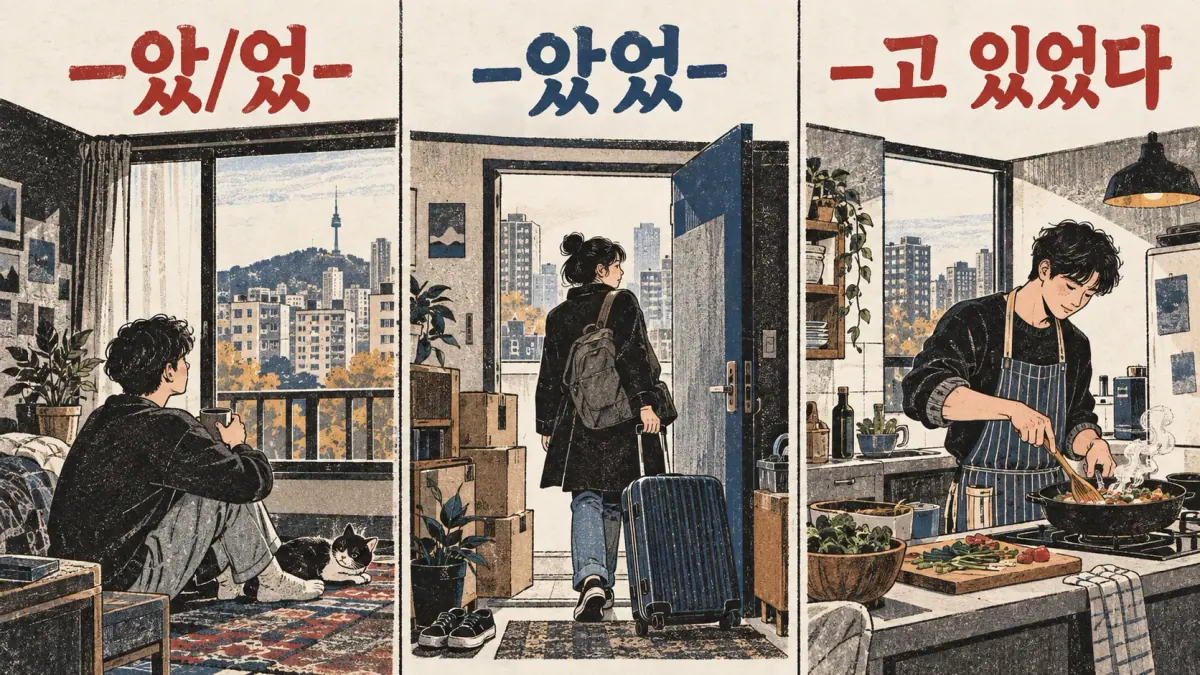
-았/었- reports a finished event, -았었- reports a past felt as cut off from now, and -고 있었다 reports an action in progress at a past time. All three refer to the past, but they describe different shapes of the event.
| Form | Example | Meaning |
|---|---|---|
| -았/었- | 서울에 살았어요. | I lived in Seoul. |
| -았었- | 서울에 살았었어요. | I used to live in Seoul (and no longer do). |
| -고 있었다 | 서울에 살고 있었어요. | I was living in Seoul (at that time). |
Pronunciation: 살았어요 is [사라써요] (sarasseoyo), 살았었어요 is [사라써써요] (sarasseosseoyo), and 살고 있었어요 is [살고 이써써요] (salgo isseosseoyo). Beginners should use -았/었- first, because it covers most past sentences. The other two are taught in Korean aspect and Korean progressive tense. The next section lists the mistakes to avoid first.
Mistakes to Avoid First
Four mistakes appear in most beginner sentences in this area.
- Using 았 after a stem with ㅓ. 먹았어요 is wrong, because the last vowel of 먹 is ㅓ. Say 먹었어요.
- Forgetting the double ㅆ. 갓어요 and 먹엇어요 are wrong. The infix is spelled with ㅆ: 갔어요, 먹었어요.
- Using the present with a past time word. 어제 가요 mixes "yesterday" with a present ending. Say 어제 갔어요.
- Leaving an irregular stem unchanged. 듣었어요 is wrong. The stem 듣 changes to 들, so the form is 들었어요.
Each lesson in the set explains these in detail. The next section shows what the set leaves out.
Scope of This Set
The Korean past tense set covers the past infix, the past of 이다, irregular past stems and the plain written past. It does not cover the future tense, the progressive or the experience form, which belong to Korean tenses. The present tense, which is the base for all past forms, is taught in the present tense set of the tenses hub.
All Korean text, spoken forms and audio on this page were machine-generated and reviewed and signed off by Min-ji Park on 15 October 2026. The next section shows how to practise.
How Do You Practise Korean past Tense?

Practise Korean past tense by turning present sentences into past sentences and checking the infix. A short routine works well across a week.
- Read one lesson and say its model sentences aloud with the audio.
- Write five sentences about yesterday, using verbs with ㅏ, ㅓ and 하다.
- Take the grammar quizzes to check the pattern.
- Review the forms with the grammar flashcard decks.
- Print a grammar worksheet and fill it in by hand.
- Check how a verb changes with the Korean verb conjugator.
Each published lesson ends with a practice set and an answer key, so you can check your work immediately. After finishing the set, continue to the other lessons in Korean tenses.
Frequently Asked Questions
How Do You Make the past Tense in Korean?
Add -았/었- between the verb stem and the final ending. Use 았 after the vowels ㅏ and ㅗ, 었 after other vowels, and 했 for 하다 verbs: 가다 becomes 갔어요, 먹다 becomes 먹었어요, and 공부하다 becomes 공부했어요. The same infix works with every speech level, so one rule covers them all.
What Is the past of 이다 in Korean?
The past of 이다 ("to be") is 이었어요 after a consonant and 였어요 after a vowel: 학생이었어요 means "I was a student", and 의사였어요 means "I was a doctor". The negative past is 아니었어요. A separate lesson covers these forms with practice and audio examples.
Are There Irregular past Forms in Korean?
Yes. Some stems change before the infix, such as 듣다 to 들었어요, 춥다 to 추웠어요, 모르다 to 몰랐어요 and 쓰다 to 썼어요. After the stem changes, the usual -았/었- rule applies. The lesson on past tense conjugation lists the irregular classes in a table so you can look up a verb quickly.
What Is the Difference between 먹었어요 and 먹었다?
Both are the past tense of 먹다. 먹었어요 is the polite spoken style, and 먹었다 is the plain style used in writing, such as diaries, news articles and books. The infix 었 is the same in both; only the final ending changes. Use 먹었어요 when you speak to someone.