What you'll learn
- Read a 14-sentence story that mixes narration and quoted speech.
- Give a friend's name and one shared hobby in the past and the present.
- Tell 만났어요 (met) from 만나요 (meet or will meet).
- Swap in five hobby words with the right particle.
Before you start: You should know the polite style and the basic past ending. For meeting-someone phrases, see introduce yourself in Korean. The story takes about 20 minutes. If you want a casual script for first meetings, the Korean small talk page has useful follow-up questions.
What Happens in This Easy Korean Story about a New Friend?
In this easy Korean story about a new friend, the speaker meets a classmate named 민수 at school. They greet each other, eat lunch, ask about hobbies and find that both like movies. On Saturday they watch a film together, and they plan to meet again tomorrow. Play the narration once, then read along with the table.
지난주에 저는 학교에서 새 친구를 만났어요. 친구의 이름은 민수예요. 민수가 먼저 인사했어요. "안녕하세요? 저는 민수예요." 저도 인사했어요. "안녕하세요? 만나서 반갑습니다." 우리는 같이 점심을 먹었어요. 제가 물어봤어요. "취미가 뭐예요?" 민수가 대답했어요. "저는 영화를 좋아해요." 저도 말했어요. "저도 영화를 좋아해요!" 우리는 취미가 비슷해요. 토요일에 우리는 같이 영화를 봤어요. 영화가 정말 재미있었어요. 내일 우리는 또 만나요. 민수는 이제 제 좋은 친구예요. 새 친구가 생겨서 정말 기뻐요.
| # | Korean | Meaning |
|---|---|---|
| 1 | 지난주에 저는 학교에서 새 친구를 만났어요. | Last week I met a new friend at school. |
| 2 | 친구의 이름은 민수예요. | My friend's name is Minsu. |
| 3 | 민수가 먼저 인사했어요. "안녕하세요? 저는 민수예요." | Minsu greeted me first. "Hello? I am Minsu." |
| 4 | 저도 인사했어요. "안녕하세요? 만나서 반갑습니다." | I greeted Minsu too. "Hello? Nice to meet you." |
| 5 | 우리는 같이 점심을 먹었어요. | We ate lunch together. |
| 6 | 제가 물어봤어요. "취미가 뭐예요?" | I asked, "What is your hobby?" |
| 7 | 민수가 대답했어요. "저는 영화를 좋아해요." | Minsu answered, "I like movies." |
| 8 | 저도 말했어요. "저도 영화를 좋아해요!" | I said, "I like movies too!" |
| 9 | 우리는 취미가 비슷해요. | Our hobbies are similar. |
| 10 | 토요일에 우리는 같이 영화를 봤어요. | On Saturday we watched a movie together. |
| 11 | 영화가 정말 재미있었어요. | The movie was really fun. |
| 12 | 내일 우리는 또 만나요. | Tomorrow we will meet again. |
| 13 | 민수는 이제 제 좋은 친구예요. | Minsu is now my good friend. |
| 14 | 새 친구가 생겨서 정말 기뻐요. | I am really happy that I made a new friend. |
The classmate, the school and the film are story details. Notice that the text uses both 안녕하세요 and 만나서 반갑습니다 inside quotation marks, and that the narration around them stays in the polite 해요 style. The next section shows what is easy and hard.
What Makes This Story Easy or Hard to Read?
The story is easy because every narration sentence is short and the quotes repeat the same words. It is harder in four places: quotation marks, the contrast between past and present of one verb, a possessive that speech often drops, and one sound change.
| Feature | In the story | Note |
|---|---|---|
| Quoted speech | "취미가 뭐예요?" | The line is set off with quotation marks, then comes the verb of speaking |
| Past and present | 만났어요 / 만나요 | Met, and meet or will meet |
| Possessive 의 | 친구의 이름 | Often dropped in speech: 친구 이름 |
| Sound change | 비슷해요 [비스태요] | ㅅ becomes ㄷ, then ㄷ + ㅎ becomes ㅌ |
| Name + 예요 | 민수예요 | 예요 after a vowel, 이에요 after a consonant |
| Wh-question | 취미가 뭐예요? | Weight on 뭐; not a sharp rise |
The quotation marks are the new skill. In the narration, the speaker names who spoke and how (먼저 인사했어요, 물어봤어요, 대답했어요), then writes what was said inside "…". You can read the narration lines for the plot and the quoted lines for the conversation.
Which New Words Should You Preview?
Preview these words before you read. Several of them are useful in your own first conversations.
| Word | Revised Romanization | Meaning | Sentence |
|---|---|---|---|
| 새 친구 | sae chingu | new friend | 1, 14 |
| 만났어요 | mannasseoyo | met | 1 |
| 이름 | ireum | name | 2 |
| 먼저 | meonjeo | first, before | 3 |
| 인사했어요 | insahaesseoyo | greeted | 3, 4 |
| 만나서 반갑습니다 | mannaseo bangapseumnida | nice to meet you | 4 |
| 같이 | gachi | together | 5, 10 |
| 점심 | jeomsim | lunch | 5 |
| 취미 | chwimi | hobby | 6, 9 |
| 좋아해요 | joahaeyo | like | 7, 8 |
| 비슷해요 | biseutaeyo | are similar | 9 |
| 봤어요 | bwasseoyo | watched, saw | 10 |
| 재미있었어요 | jaemiisseosseoyo | was fun, was interesting | 11 |
| 내일 | naeil | tomorrow | 12 |
| 생겨서 | saenggyeoseo | because (I) got | 14 |
Romanization is only a reading aid here. The phrase 만나서 반갑습니다 is a fixed greeting, so learn it whole. Hear two of the harder words before you start.
Read the Story in Three Passes
Read the story three times, each pass with one job.
- Pass 1: read silently for the plot. Find the name (민수), the hobby (영화) and the day they watched it (토요일).
- Pass 2: read the quotes only. Read just the five quoted lines, and check that they form a short conversation.
- Pass 3: read aloud as two voices. Give Minsu one voice and the speaker another, and read the narration in a neutral voice.
Try the question and its answer with the audio and then without it.
In 취미가 뭐예요?, put the weight on 뭐 and let the pitch fall or dip at the end. The extensive reading page explains why finishing easy texts and re-reading them works.
Comprehension Questions
Answer from the text.
- Where did the speaker meet the new friend? (a) at school (b) at a cafe (c) on the subway
- What is the friend's name? (a) 민수 (b) 지수 (c) 준호
- What hobby do they share? (a) movies (b) music (c) cooking
- When did they watch a movie? (a) Saturday (b) Sunday (c) tomorrow
- Which sentence is about the future or the next meeting? (a) 토요일에 우리는 같이 영화를 봤어요. (b) 내일 우리는 또 만나요. (c) 지난주에 저는 새 친구를 만났어요.
Answers
- 1 (a). Sentence 1: 학교에서 means at school.
- 2 (a). Sentence 2: 친구의 이름은 민수예요.
- 3 (a). Sentences 7 and 8: both say 영화를 좋아해요.
- 4 (a). Sentence 10: 토요일에 … 영화를 봤어요.
- 5 (b). Sentence 12 uses 내일 (tomorrow) with the present form 만나요.
If you missed question 5, compare 만났어요 in sentence 1 with 만나요 in sentence 12. The time word 지난주에 points back, and 내일 points forward.
What Grammar Appears in the Story?
Seven patterns carry the story.
| Pattern | Example | What it does |
|---|---|---|
| Name + 예요 | 저는 민수예요 | says who someone is |
| Noun + 의 + noun | 친구의 이름 | possessive: the friend's name |
| Topic 은/는 | 이름은, 민수는 | sets the topic of the sentence |
| Object 을/를 | 친구를, 영화를 | marks the thing acted on |
| Past -았/었어요 | 만났어요, 봤어요 | a finished event |
| Present 해요 | 좋아해요, 비슷해요 | a habit or a state |
| Reason -아서/어서 | 생겨서 기뻐요 | because; the cause first |
The ending 예요 is used after a vowel (민수예요), and 이에요 after a consonant (학생이에요). The possessive 의 is written in careful text but often left out in speech: 친구의 이름 and 친구 이름 mean the same. For the past forms see Korean past tense, and for first-meeting lines see introduce yourself in Korean.
Worked Example: the Hobby Exchange
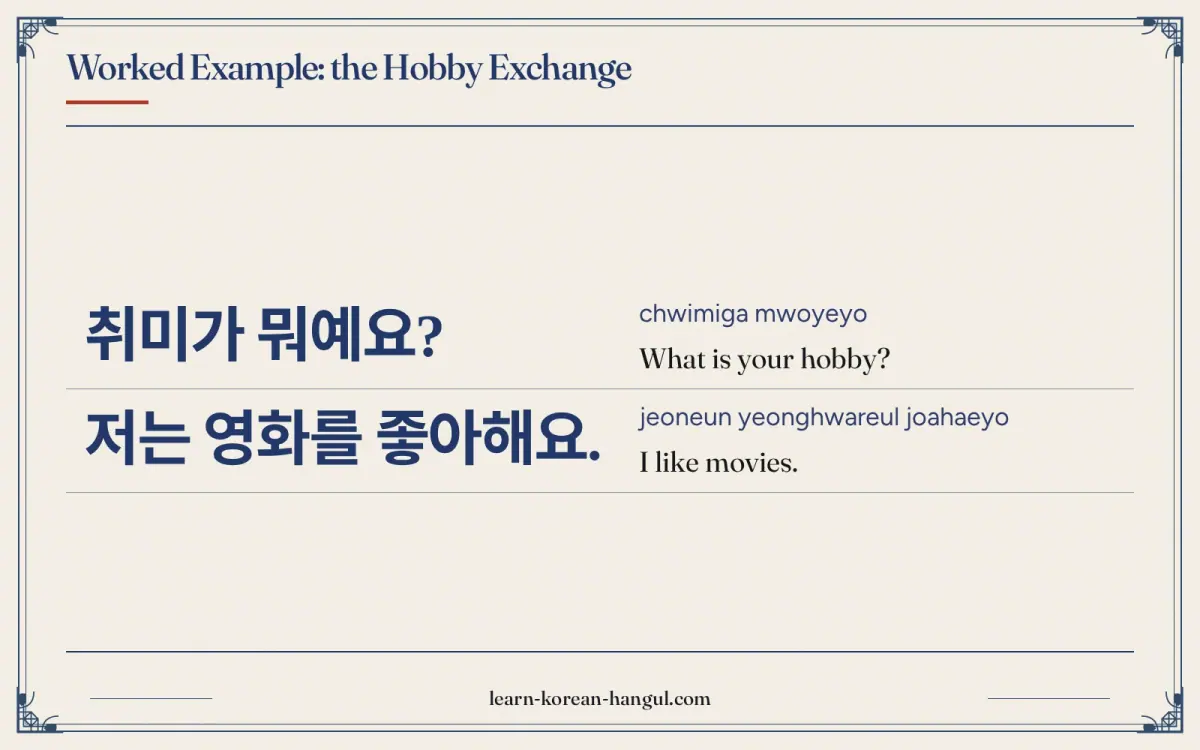
Read sentences 6 to 8 as a short conversation. It is the simplest "what is your hobby?" exchange in the story.
- 취미가 뭐예요?: What is your hobby? 취미 (hobby) + 가 (subject) + 뭐예요 (what is it).
- 저는 영화를 좋아해요: I like movies. 저는 (as for me) + 영화를 (movies) + 좋아해요 (like).
- 저도 영화를 좋아해요!: I like movies too. 도 replaces 는 and means "also".
- Swap the noun to give your own hobby: 음악을 좋아해요, 운동을 좋아해요, 요리를 좋아해요.
- Choose 을 after a consonant (음악을) and 를 after a vowel (영화를, 요리를).
취미가 뭐예요?
chwimiga mwoyeyo
What is your hobby?
저는 영화를 좋아해요.
jeoneun yeonghwareul joahaeyo
I like movies.
You can also use the past tense for the shared experience: 어제 같이 영화를 봤어요 (we watched a movie together yesterday). The hobby is a present habit (좋아해요), and the film is a past event (봤어요). That is the pairing this story is built to teach.
What Mistakes Do Learners Make Here?
Learners often make four mistakes with this text.
| Learners often assume | Actually | Because |
|---|---|---|
| 만났어요 and 만나요 are the same | The first is "met"; the second is "meet" or "will meet" | The tense, and the time word, tell you which |
| 친구의 is always spoken | 의 is often dropped in speech | Written Korean keeps it, spoken Korean often does not |
| 비슷해요 is said [비슷해요] | It is said [비스태요] | ㅅ + ㅎ joins into one ㅌ sound |
| 취미가 뭐예요? ends with a sharp rise | Weight on 뭐, then a fall or dip | It is a question-word question |
The last error is easy to make because English questions often rise. A question word carries the weight already, and a sharp rise at the end can turn 뭐 into "something".
Practice and Answer Key
Part A: choose 을 or 를.
- 음악___ 좋아해요.
- 운동___ 좋아해요.
- 요리___ 좋아해요.
Part B: speak. Introduce yourself in Korean with your name and one hobby: 저는 ___예요/이에요. ___을/를 좋아해요.
Part C: past or future. Say whether each means "met" or "will meet": 1. 어제 만났어요. 2. 내일 만나요.
Answers
- Part A: 1 을, 2 을, 3 를.
- Part B: for example 저는 안나예요. 음악을 좋아해요.
- Part C: 1 met, 2 will meet.
Where to Go Next
Continue with Korean Story the Letter, the first B1 story. To build on what you read, try Korean conversation practice and Korean small talk. Browse the rest of Graded Korean Stories, or see the Korean short stories for beginners overview.
This easy Korean story about a new friend covers a first meeting and one shared hobby. It does not teach how to ask for a phone number or arrange a time in detail, and the formal greeting 반갑습니다 is for recognition. Re-reading it a week later, with the quotes only, is a good way to make the conversation frames stick.
Frequently Asked Questions
What Is the Difference between 만났어요 and 만나요?
만났어요 is the past: "met". 만나요 is the present or future: "meet" or "will meet". A time word usually settles which. 어제 만났어요 means "I met someone yesterday", and 내일 만나요 means "we will meet tomorrow". The stem is 만나- in both, and the past adds -ㅆ어요.
Why Is 비슷해요 Said [비스태요]?
The final ㅅ in 슷 sounds like ㄷ. When ㄷ is followed by ㅎ, the two join into one ㅌ sound. So 비슷해요 sounds like 비스태요. Romanization shows this as biseutaeyo. The same thing happens in 좋다 [조타] and in 따뜻한 [따뜨탄].
Do I Have to Say 의 in 친구의 이름?
No. In careful writing, 친구의 이름 is standard, but in speech people often drop 의 and say 친구 이름. When 의 is spoken, it may sound like [의] or [에]. Both are accepted. In this story, 의 is written once so you can see the possessive pattern.
When Do I Use 예요 and When 이에요?
Use 예요 after a vowel, as in 민수예요 and 의사예요, and 이에요 after a consonant, as in 학생이에요. The sound of the two is almost the same, and 예요 is the contraction of 이에요 after a vowel. Say 예요 as [예요]; many speakers say it like 에요.
Why Does the Story Use Quotation Marks?
Korean prose uses double quotation marks around spoken lines, as English does. The narration names who spoke (민수가 대답했어요) and the quote follows. This story uses double marks for every spoken line.