
What Are the Most Useful Korean Small Talk Questions to Learn First?
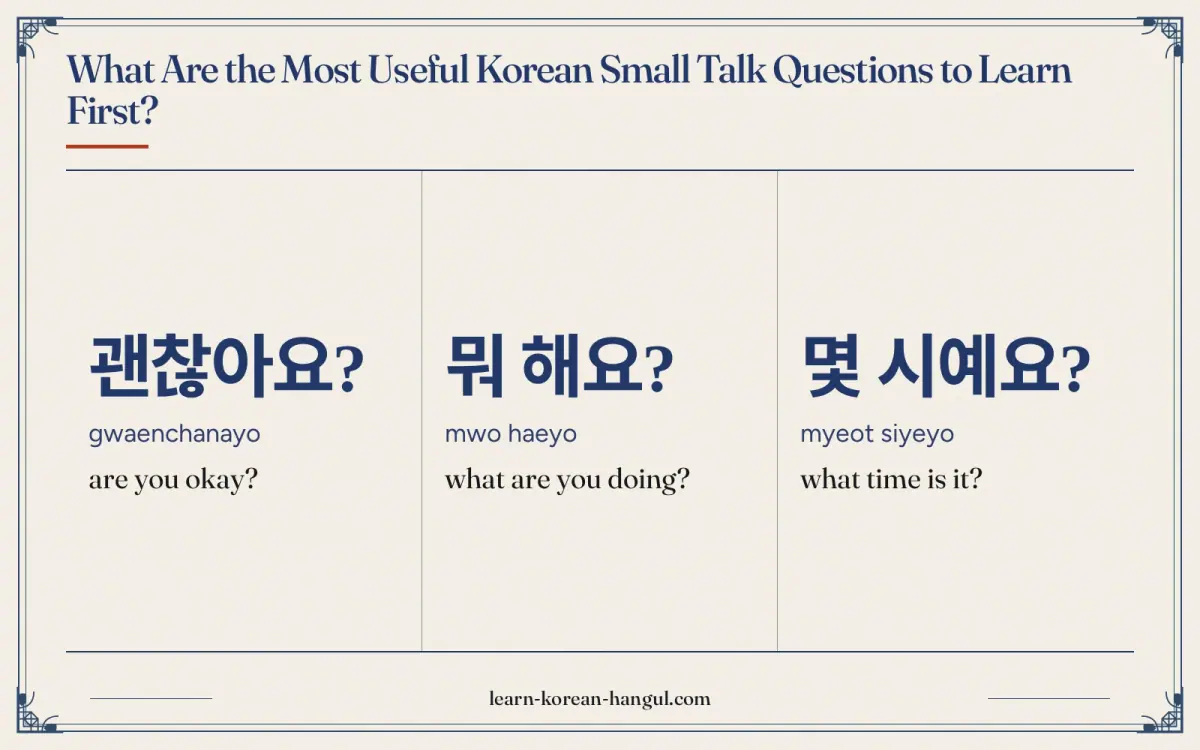
Learn six questions first: how someone is, what they are doing, the time, where they are going, whether they are free, and whether they have eaten. They cover the first minute of almost every chat with a classmate, a neighbour or a coworker.
| Korean | Revised Romanization | Meaning | Guide |
|---|---|---|---|
| 괜찮아요? | gwaenchanayo | are you okay? | are you okay in korean |
| 뭐 해요? | mwo haeyo | what are you doing? | what are you doing in korean |
| 몇 시예요? | myeot siyeyo | what time is it? | what time is it in korean |
| 어디 가요? | eodi gayo | where are you going? | where are you going in korean |
| 시간 있어요? | sigan isseoyo | are you free? | are you free in korean |
| 밥 먹었어요? | bap meogeosseoyo | did you eat? | did you eat in korean |
Each question ends in the polite 요 style, so you can ask it of a person you have just met. The table gives the lead form of each guide, and the cards below cover ten more. Revised Romanization (the South Korean government system of 2000) is a reading aid only. Play the sample exchange to hear the rhythm of a question and its answer.
Once you know the questions, the next step is picking the right style for the person.
How Do You Choose between Formal, Polite and Casual Korean Small Talk?
Use the polite style (해요체) with anyone you have just met, the honorific forms with elders, and the casual style (반말) only with people who have agreed to it. The page on Korean speech levels explains the three styles. The table shows one question in each.
| Question | Honorific or formal (elders, service) | Polite (safe default) | Casual (friends) |
|---|---|---|---|
| What are you doing? | 뭐 하세요? (mwo haseyo) | 뭐 해요? (mwo haeyo) | 뭐 해? (mwo hae) |
| Did you eat? | 진지 드셨어요? (jinji deusyeosseoyo) | 밥 먹었어요? (bap meogeosseoyo) | 밥 먹었어? (bap meogeosseo) |
| Are you free? | 시간 있으세요? (sigan isseuseyo) | 시간 있어요? (sigan isseoyo) | 시간 있어? (sigan isseo) |
| Where are you going? | 어디 가세요? (eodi gaseyo) | 어디 가요? (eodi gayo) | 어디 가? (eodi ga) |
Which Topics Are Safe with New People?
Food, weather, plans and hobbies are the safest openers, because anyone can answer them without sharing private details. 취미가 뭐예요? ("What's your hobby?") works in a language exchange, and 오늘 날씨 어때요? works in a lift. Questions about salary or marriage belong to closer friendships. Age comes early in Korea because it sets the speech style, so answer it plainly when it comes.
Why Is 어디 가요? a Greeting and Not a Nosy Question?
Koreans use 어디 가요? and 밥 먹었어요? as greetings that show care, not as requests for facts. A short answer such as 친구 만나러 가요 (chingu mannareo gayo, "I'm going to meet a friend") or 네, 먹었어요 is enough. You do not have to say where you are really going, and a vague reply is never rude.
Suggesting Plans with -(으)ㄹ까요
The ending -(으)ㄹ까요 means "shall we?" and is the plain way to suggest a plan. After a stem that ends in a vowel, add -ㄹ까요, as in 만날까요 ("shall we meet?"). After a stem that ends in a consonant, add -을까요, as in 먹을까요 ("shall we eat?"). The two guides on meals and meeting times show it in full.
The cards below list every guide in the cluster.
All Korean Small Talk Guides
The list has all 16 guides, each with its lead question and an audio clip. Read the four starter guides first, then use the alphabetical list for the rest. Every published guide has a quick answer, a register table, pronunciation with audio, usage scenes, short dialogues and common mistakes. The Korean conversation hub holds the other conversation clusters.
Start Here
Are You Okay
The lead phrase is 괜찮아요? (gwaenchanayo), which means "are you okay?" It checks on someone who looks tired, hurt or upset, and the same word answers with a falling tone: 괜찮아요 means "I'm fine". The ㅎ drops out in speech, so the sound is [괜차나요].
What Are You Doing
The lead phrase is 뭐 해요? (mwo haeyo), which means "what are you doing?" It asks what someone is doing now, and it also opens a phone call or a text. The page shows how to answer with the -고 있어요 pattern and the casual 뭐 해?
What Time Is It
The lead phrase is 몇 시예요? (myeot siyeyo), which means "what time is it?" It asks the time and sounds like [멷씨예요], because the ㅊ becomes [ㄷ] and the 시 turns tense. The page also shows the answer pattern with native Korean hour numbers.
Where Are You Going
The lead phrase is 어디 가요? (eodi gayo), which means "where are you going?" It is a greeting as much as a question, so a vague answer is fine. The page gives short replies and the honorific 어디 가세요?
More Phrases
The other 12 guides are in alphabetical order.
Are You Free
The key phrase is 시간 있어요? (sigan isseoyo), which means "are you free?" It asks if someone has time, usually before an invitation.
Did You Eat
The key phrase is 밥 먹었어요? (bap meogeosseoyo), which means "did you eat?" It literally asks about rice, and Koreans use it as a warm greeting.
How Was Your Day
The key phrase is 오늘 어땠어요? (oneul eottaesseoyo), which means "how was your day?" It invites a short story about the day and fits the end of a work day or class.
How's the Weather
The key phrase is 오늘 날씨 어때요? (oneul nalssi eottaeyo), which means "how's the weather today?" It is the classic safe opener with a stranger.
I Want to Go to Korea
The key phrase is 한국에 가고 싶어요 (hanguge gago sipeoyo), which means "I want to go to Korea." It states a wish with the pattern -고 싶어요 (want to).
Let's Eat Together
The key phrase is 같이 먹어요 (gachi meogeoyo), which means "let's eat together." It invites someone to share a meal, and it sounds like [가치 머거요].
What Do You Mean
The key phrase is 무슨 뜻이에요? (museun tteusieyo), which means "what does that mean?" It asks for the meaning of a word and keeps a conversation moving when you do not understand.
What Happened
The key phrase is 무슨 일이에요? (museun irieyo), which means "what's the matter?" It asks what is going on when something looks wrong.
What Should We Eat
The key phrase is 뭐 먹을까요? (mwo meogeulkkayo), which means "what shall we eat?" It uses -(으)ㄹ까요, the "shall we" ending, to decide a meal together.
What's the Date
The key phrase is 오늘 며칠이에요? (oneul myeochirieyo), which means "what's the date today?" It asks for the day of the month, and 며칠 is read [며칠] before the ending links it to [며치리에요].
What's Your Hobby
The key phrase is 취미가 뭐예요? (chwimiga mwoyeyo), which means "what's your hobby?" It is the friendly way to learn what someone likes to do.
When Shall We Meet
The key phrase is 언제 만날까요? (eonje mannalkkayo), which means "when shall we meet?" It proposes a plan with -(으)ㄹ까요 and pairs with a place question.
How Do You Practise Korean Small Talk?
Small talk improves fastest when you ask and answer in pairs of lines. Use this routine for ten minutes:
- Play the sample exchange above and repeat both speakers.
- Choose three questions from the cards and write one true answer for each.
- Ask the question aloud, pause, then say your answer.
- Switch the style: say each question in the polite form, then in the casual form.
- Review the full cluster with the phrase flashcards, which pair each phrase with audio.
Short answers said fast are worth more than long answers read slowly. After practice, check yourself against the mistakes below.
What Mistakes Do Learners Make with Korean Small Talk?
Learners most often answer a greeting-question as if it were a real request for details. Four mistakes appear again and again:
- Giving a long answer to 밥 먹었어요? The question is a greeting. Fix: answer 네 or 아직요 (not yet), then move on.
- Using casual forms with a new acquaintance. 뭐 해? sounds too close. Fix: keep the 요 until the other person drops it first.
- Treating 어디 가요? as an interview. Fix: reply with a general answer such as 잠깐 나가요 ("I'm stepping out for a bit").
- Skipping the question after your answer. Fix: return the question with 그쪽은요? or 지금 뭐 해요? to keep the chat going.
Each fix comes from treating small talk as a shared ritual, not a request for information, which is the most useful rule for Korean small talk. The questions below cover details that the cards do not.
Frequently Asked Questions
These answers add details about Korean small talk beyond the guides above.
What is polite small talk in Korean?
Polite small talk uses the 요 style with short, low-risk questions about food, weather, plans and hobbies, such as 밥 먹었어요? or 오늘 날씨 어때요? Add 네 and a short answer, then return the question. Keep to the polite style until the other person uses casual forms with you first.
Is it rude to ask about age in Korean?
Not usually. Age decides which speech style each person uses, so the question helps both sides choose polite or casual endings. Ask politely with 나이가 어떻게 되세요? and answer plainly when asked. If you are unsure, wait for the other person to ask first, then ask in return.
How do I make plans in Korean?
Use -(으)ㄹ까요 for suggestions: 언제 만날까요? ("when shall we meet?") and 뭐 먹을까요? ("what shall we eat?"). Start with 시간 있어요? to check if the person is free. Reply with a time and place, such as 일곱 시에 역 앞에서 만나요 ("let's meet at seven in front of the station").
How do I answer what are you doing in Korean?
Answer with a verb in the -고 있어요 pattern, such as 공부하고 있어요 ("I'm studying") or 밥 먹고 있어요 ("I'm eating"). A shorter form, 공부해요, also works. If you are free, add 심심해요 ("I'm bored") or 시간 있어요 as an opening for the other person to suggest something.
What is the best first question to ask a new Korean friend?
Start with a food or weather question, because both are safe and easy to answer. 오늘 날씨 어때요? or 점심 먹었어요? usually gets a friendly reply. After that, ask 취미가 뭐예요? to learn something personal. Avoid questions about money, and listen for the other person's style so you can match it.