What you'll learn
- Read a full Korean address and name each part.
- Know the suffixes 시, 구, 동, 로 and 길 and what each one marks.
- Read an apartment address with 동 and 호.
- Paste a Hangul address into a map app and find the place.
Before you start: you should read Hangul blocks, as covered in how to read Hangul, and know the Sino-Korean numbers, as covered in Sino-Korean numbers. Time: about 30 minutes. Audio plays only when you press a button.
Key Facts
- Addresses go from large to small: city, district, road, building number.
- Suffixes show type: 시 city, 구 district, 동 neighbourhood, 로 and 길 road.
- Postal codes have five digits.
- Apartments add 동 (block) and 호 (unit).
- Map apps show names in Korean first.
What Are Korean Addresses and Maps?
Korean addresses and maps work together. The address is a line of Hangul words that names a place from the biggest area down to the front door. The map is the tool that turns that line into a pin you can walk or ride to. Most addresses you meet today use the road-name system: a road, then a number along the road.
Here is a full example: 서울특별시 강남구 테헤란로 152. Read from left to right, it says Seoul Special City, then Gangnam District, then Teheran Road, then building number 152. Each part ends with a short suffix that tells you what kind of place it is: 시 for city, 구 for district and 로 for road.
| Part | Korean | Meaning | Suffix |
|---|---|---|---|
| City | 서울특별시 | Seoul Special City | 특별시 |
| District | 강남구 | Gangnam District | 구 |
| Road | 테헤란로 | Teheran Road | 로 |
| Building number | 152 | number 152 | none |
The road-name system replaced the older lot-number system as the official address in the 2010s. For the current rules and for looking up a Korean address, the official source is the road-name address site run by the Ministry of the Interior and Safety (juso.go.kr). The older style still appears on some documents, so this page covers both.
Why Do English Speakers Struggle with Korean Addresses?
English speakers struggle because Korean addresses run in the opposite order and use suffixes instead of separate words. In English, you write the house number first and the country last. In Korean, you write the largest place first and the number last. A learner who reads the number first finds nothing.
| English habit | Korean reality | What to do |
|---|---|---|
| House number first | Building number last | Read from left to right, large to small |
| "Street" and "Avenue" are separate words | 로 and 길 are attached to the name | Look for the suffix on the name |
| One idea of "district" | Different suffixes at each level | Learn 시, 구, 동 and 로 |
| Addresses use commas | Addresses use spaces | Split at each suffix |
Here is how the same address looks in both orders.
| Order | Address |
|---|---|
| Korean | 서울특별시 강남구 테헤란로 152 |
| English | 152 Teheran-ro, Gangnam-gu, Seoul |
In the English line, the number moves to the front and the other parts reverse. Learn to read the Korean line from the left and the English reversal takes care of itself.
What Order Is an Address In?
A Korean road-name address goes in this order: province or city, city or district, road, building number, and then any building details. The order never reverses.
| Step | Level | Example | Notes |
|---|---|---|---|
| 1 | Special or metropolitan city, or province | 서울특별시, 부산광역시, 경기도 | The largest area |
| 2 | City or county | 성남시, 수원시 | Used inside a province |
| 3 | District | 강남구, 분당구 | Used inside a large city |
| 4 | Road | 테헤란로, 예시로 | The road name |
| 5 | Building number | 152, 7 | A number, no counter |
| 6 | Details | 101동 1203호, 3층 | Block, unit, floor |
| 7 | Neighbourhood (in brackets) | (역삼동) | For reference |
Two examples show the range. A big-city address skips the province level: 서울특별시 강남구 테헤란로 152. A city inside a province adds one level: 경기도 성남시 분당구 예시로 7. Both are written without commas, and the building number is read as a plain Sino-Korean number (백오십이, 칠).
The number 152 is read 백오십이 [배고시비]. The ㄱ of 백 and the ㅂ of 십 both move on to the next vowel. Say each one in order, then say the whole address aloud once. The example 예시로 is an invented road name, used here only for practice.
What Do the Suffixes Mean?
The suffix at the end of each word tells you the type of place. Learn these ten and you can read almost any address.
| Suffix | Revised Romanization | Meaning | Example |
|---|---|---|---|
| 특별시 | teukbyeolsi | special city (Seoul) | 서울특별시 |
| 광역시 | gwangyeoksi | metropolitan city | 부산광역시 |
| 도 | do | province | 경기도 |
| 시 | si | city | 성남시 |
| 군 | gun | county | 예시군 |
| 구 | gu | district | 강남구 |
| 동 | dong | neighbourhood | 역삼동 |
| 대로 | daero | wide avenue | 예시대로 |
| 로 | ro | road | 테헤란로 |
| 길 | gil | street, lane | 예시길 |
Revised Romanization is a reading aid. On street signs in Korea, the English letters keep the suffix with a hyphen: Teheran-ro, Gangnam-gu, Gyeonggi-do. The hyphen does not appear in Hangul.
서울특별시 is said [서울특뼐씨]. The ㄱ before ㅂ gives a tense ㅂ, and the Sino-Korean ㄹ before ㅅ makes it tense too. The Revised Romanization is Seoul-teukbyeolsi: RR puts a hyphen before an administrative unit such as -si, -gu or -do and does not show sound changes across it, and it never shows tensing that comes from a neighbouring sound.
How roads are sized. 대로 is the widest, 로 is a main road and 길 is a smaller street. A number before 길 marks a side street that branches off the main road, written attached in official addresses: 테헤란로8길 is a side street of Teheran-ro. The number comes from where the street branches off, with odd and even numbers on opposite sides, so it is not a simple count of side streets. The building numbers then run along the road, with odd numbers on one side and even numbers on the other.
Two meanings of 동. The syllable 동 appears in two ways. In 역삼동, it means a neighbourhood, and it usually sits in brackets after a road-name address as a reference. In 101동, it means an apartment block. Look at the number before it: a number means a block, and a place name means a neighbourhood.
How Do Apartment Addresses Work?
An apartment address adds the block (동) and the unit (호) after the building number. Many Koreans live in apartment complexes, so you will meet this pattern often. A typical line looks like this:
서울특별시 마포구 예시로 25, 101동 1203호 (샘플동, 샘플아파트)
This line is an invented example. It reads: Seoul, Mapo District, Example Road 25, Block 101, Unit 1203, with the neighbourhood and complex name in brackets.
| Part | Korean | Read aloud | Meaning |
|---|---|---|---|
| Road and number | 예시로 25 | 예시로 이십오 | Example Road 25 |
| Block | 101동 | 백일 동 | Block 101 |
| Unit | 1203호 | 천이백삼 호 | Unit 1203 |
| Complex | 샘플아파트 | saempeul apateu | the complex name |
The unit number tells you the floor. In 1203호, the first digits show floor 12, and the last two show the flat on that floor. This is a common pattern in large complexes, though numbering can vary, so check the building's own sign.
Notice the two counters. The block takes 동 and the unit takes 호. Both follow Sino-Korean numbers and are said with a space: 백일 동, 천이백삼 호. For a taxi, you can say the road address and the block only.
What Is the Old Lot-Number Address?
The older system is the lot-number address (지번 주소). It names the neighbourhood and a lot number instead of a road: 서울특별시 강남구 역삼동 123-4. Here, 역삼동 is the neighbourhood, and 123-4 is the lot, with a main number and a sub number.
| System | Korean | Names | Number |
|---|---|---|---|
| Road-name (도로명 주소) | 서울특별시 강남구 테헤란로 152 | a road | building number |
| Lot-number (지번 주소) | 서울특별시 강남구 역삼동 123-4 | a neighbourhood | lot number |
The lot-number address (this one is an invented example) still appears on older contracts, deeds and some map listings. If a map app cannot find a road-name address, try the lot-number one, and the other way round. Both name the same place.
How Do I Use a Map App?
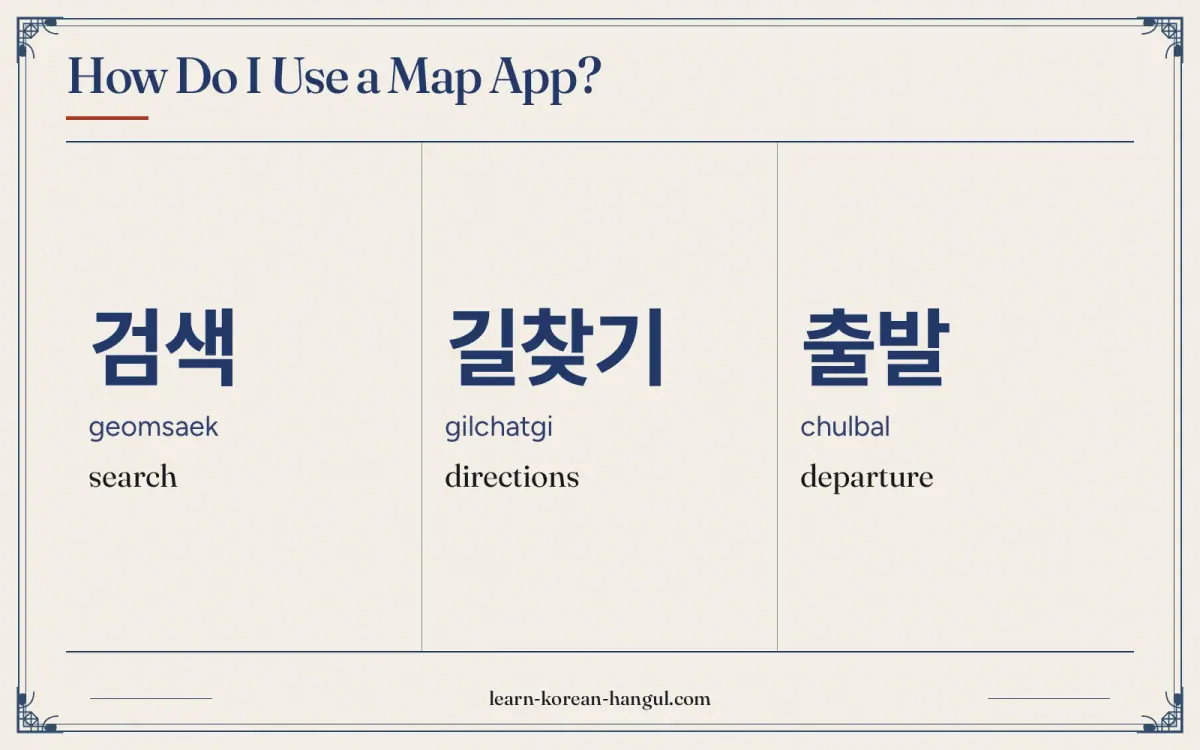
Use a map app in four steps: copy, paste, check and go. Korean map apps such as Naver Map (네이버 지도) and KakaoMap (카카오맵) expect Hangul in the search bar, so Hangul works better than English spellings.
- Copy the address in Hangul. Take it from the sign, the booking message or the business card.
- Paste it in the search bar. Tap 검색 (search) and paste the line.
- Check the pin. The result shows the place name, the road address and often the lot-number address too. Compare the district (구) with what you were told.
- Choose how to go. Tap 길찾기 (directions), then choose 도보 (walking), 대중교통 (public transit) or 자동차 (car).
| Korean | Revised Romanization | Meaning |
|---|---|---|
| 검색 | geomsaek | search |
| 길찾기 | gilchatgi | directions |
| 출발 | chulbal | departure |
| 도착 | dochak | arrival |
| 도보 | dobo | on foot |
| 대중교통 | daejunggyotong | public transit |
| 자동차 | jadongcha | car |
| 내 위치 | nae wichi | my location |
| 즐겨찾기 | jeulgyeochatgi | favourites |
Features differ by app and change over time, so check each app's current settings. Most apps let you switch the language, but the search works best with Hangul. If a search fails, use one of these fallbacks: type only the road name and number (테헤란로 152), type the building or shop name, or type the nearest subway station and exit, as in Korean subway signs.
At a taxi stand, show the Hangul address on your phone and say the sentence below. The word 주소 is the address, and 가 주세요 is "please go".
이 주소로 가 주세요.
i jusoro ga juseyo
Please go to this address.
For longer help with directions, see Korean directions phrases. To write an address on an envelope, see address format on envelopes.
What Is a Postal Code?
A Korean postal code (우편번호) has five digits. It identifies an area and appears at the top or end of an address on parcels and forms. A sample format is 06000, though that is only an example. The five-digit code replaced an older six-digit code. To find the code for a real address, use the official road-name address site (juso.go.kr), which also gives the road-name version of an older lot-number address.
In speech, you rarely say the postal code. You write it on forms and enter it at online checkouts. When a website asks for 우편번호, it wants these five digits. When it asks for 상세 주소 (detailed address), it wants the block, unit and floor.
Worked Example: 서울특별시 강남구 테헤란로 152
Take the address and read it step by step.
- Split at each suffix. 서울특별시 | 강남구 | 테헤란로 | 152. There are four chunks.
- Name the level. 특별시 marks the city (Seoul), 구 marks the district (Gangnam), 로 marks the road (Teheran) and the plain number marks the building.
- Read the sounds. 서울특별시 is said [서울특뼐씨]. 테헤란로 is commonly heard as [테헤란노]. 152 is 백오십이 [배고시비].
- Check the order. The address goes from large to small. In English, this becomes 152 Teheran-ro, Gangnam-gu, Seoul.
- Search. Copy 테헤란로 152 into the search bar and look for the pin in Gangnam.
Say the whole line slowly: 서울특별시 강남구 테헤란로 백오십이.
서울특별시 강남구 테헤란로 152
Seoul-teukbyeolsi Gangnam-gu Teheran-ro baegosibi
152 Teheran-ro, Gangnam-gu, Seoul
What Mistakes Do Learners Make with Korean Addresses and Maps?
Learners often make four mistakes.
| Learners often assume | Actually | Because |
|---|---|---|
| The number comes first | The number comes last | Korean goes large to small |
| 동 always means neighbourhood | 동 can mean an apartment block | A number before 동 marks a block |
| 로 and 길 are the same size | 대로 is widest, then 로, then 길 | The suffix shows the road size |
| An English search works best | A Hangul search works best | Korean apps index Hangul names |
A fifth slip is the postal code. Some learners type the lot number into the postal-code box. The code is five digits and has no hyphen. A related slip is to read 1203호 as "twelve oh three" in English. Say it in Korean, 천이백삼 호, and the floor is easy to find.
Practice and Answer Key
Part A: split the address. Split 경기도 성남시 분당구 예시로 7 into parts and name each one.
Part B: reverse the order. Write 서울특별시 마포구 예시로 25 in English order, starting with the building number.
Part C: read the unit. What do 101동 and 1203호 mean? Say them aloud in Korean.
Practice · 3
Which part of 서울특별시 강남구 테헤란로 152 is the district?
Show answer
강남구
구 marks a district, so 강남구 is the district.
What does 호 mean in 1203호?
Show answer
Unit or room
호 is the counter for a unit, and 동 is the counter for a block.
How many digits does a Korean postal code have?
Show answer
Five
A Korean postal code has five digits.
Answers
- Part A: 경기도 (province), 성남시 (city), 분당구 (district), 예시로 (road), 7 (building number).
- Part B: 25 Example Road (예시로), Mapo District (마포구), Seoul (서울특별시).
- Part C: 101동 is Block 101 (백일 동). 1203호 is Unit 1203 (천이백삼 호), usually on the 12th floor.
If Part A went wrong, go back to the suffix table and find each ending.
Where to Go Next
Other texts in this section follow the same pattern of fixed labels. Try Korean subway signs to use the station name and exit number from a map. To say directions in Korean, read Korean directions phrases. The full list of reading texts is under Korean signs.
This lesson covers the road-name address, the lot-number address, apartment details and the basic map app steps. It does not cover rural village addresses, English address forms for shipping or how to give directions turn by turn. A good next step is to take one real address from your own life and write it in the Korean order.
Frequently Asked Questions
How Do Korean Addresses Work?
A Korean address goes from large to small. It starts with the city or province, then the district (구), the road name (로 or 길), the building number and, for apartments, the block (동) and unit (호). English addresses go the other way, from the house number out to the city. Reverse your English order and the Korean order follows.
What Does 구 Mean in an Address?
구 means district, a division of a large city such as Seoul or Busan. In 서울특별시 강남구, Seoul has the district Gangnam-gu. Smaller towns use 시 (city), 군 (county) and 읍 or 면 (town or township) instead. In English, 구 is usually written -gu, as in Gangnam-gu.
What Are 로 and 길?
로 and 길 both mean road. 대로 is the widest, 로 is a main road and 길 is a smaller street or lane. A number before 길, as in 테헤란로8길, marks a side street that branches off the main road. On signs, these appear as -daero, -ro and -gil in English letters.
How Do I Search an Address on a Map?
Copy the address in Hangul from the sign, the message or the document. Paste it into the search bar of a Korean map app. If nothing comes up, try just the road name and building number, such as 테헤란로 152, or the building or shop name in Hangul. Then tap the result to see the pin.