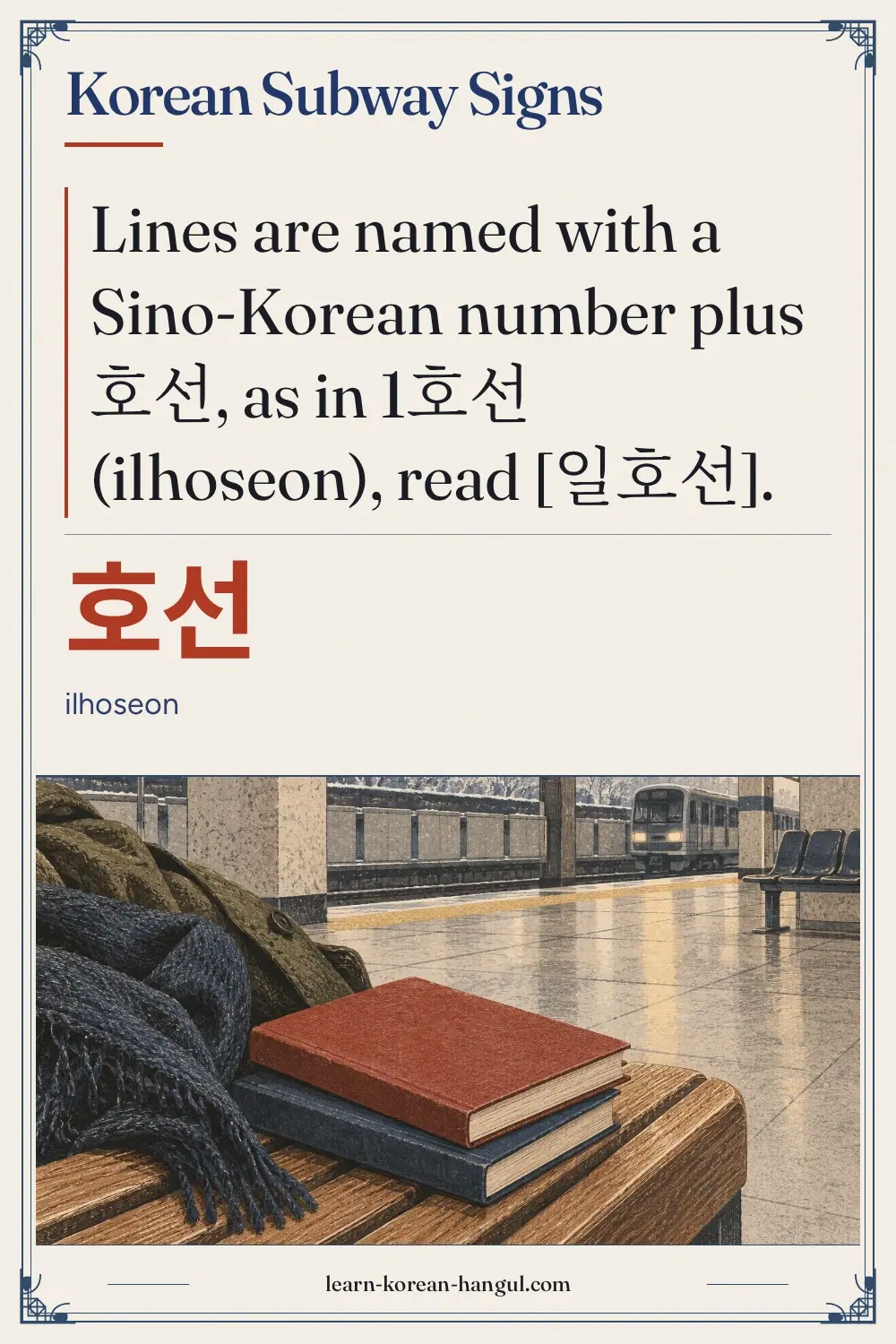
What you'll learn
- Read a line name such as 1호선 and say why it uses 일, not 하나.
- Tell 방면 from 행 and name the direction a platform sign points.
- Find and say an exit number, such as 3번 출구.
- Recognise 환승 (transfer), 승강장 (platform) and 개찰구 (fare gate) at a glance.
- Prerequisites: you can sound out Hangul syllables and know the Sino-Korean numbers 1 to 5. Estimated time: 20 minutes.
What Are Korean Subway Signs?
Korean subway signs are the boards, floor markings and platform maps that tell a rider which line they are on, which way the train goes and which exit to take. Most of the meaning sits in a few repeating words: 호선 (line), 방면 and 행 (direction), 번 출구 (exit number) and 환승 (transfer). The same words appear on signs, on route maps and in train announcements, so learning them once pays off three times.
A typical station sign in Seoul has four parts:
| Part | What it looks like | What it tells you |
|---|---|---|
| Station name | 시청 in Hangul, with the Roman spelling and Chinese characters nearby | Where you are |
| Line badge | A coloured circle with a number, with 호선 nearby | Which line this is |
| Neighbours | The previous station on one side, the next station on the other | Which way is which |
| Station number | A number in a small circle, such as 201 | A code that does not need reading Hangul |
In Seoul the first digit of the station number usually matches the line, so a 2xx number belongs to Line 2. This is a handy backup when a Hangul name is hard to read. Numbers and colours are a cross-check, not a replacement: Hangul is the layer that stays the same on every sign, map, app and announcement.
This page covers the signs you meet inside a station. For signs on the street outside, see Korean street signs. The next section explains why this topic is harder for English speakers than it looks.
Why Do English Speakers Struggle with Korean Subway Signs?
English speakers struggle because the signs mix two number systems and two direction words that look interchangeable but are not. The first trap is numbers. English uses one set of numbers everywhere: "Line 1", "Exit 3", "3 stops". Korean uses two sets, and a sign picks one of them. Line numbers and exit numbers use the Sino-Korean set (일, 이, 삼, 사, 오). Learners who have just practised the native set (하나, 둘, 셋) often try to say "하나 호선", which riders will not recognise.
The second trap is word order. English puts the direction word first: "toward City Hall". Korean puts the place first and the direction word after it: 시청 방면, literally "City Hall direction". A learner who looks for the direction word at the start of the line will skip the sign.
The third trap is Roman letters. The Roman text under a station name is a guide, but it is sometimes shortened or spelled differently on signs, maps and apps. If you rely on it, you can match the wrong station. Hangul gives you one stable form to read and to compare with an announcement.
| English habit | Korean sign | Fix |
|---|---|---|
| "Line one" using any number word | 1호선, always with Sino-Korean 일 | Learn the five line numbers as a set |
| "Toward" before the place | 시청 방면, place first | Look for 방면 or 행 at the end of the line |
| Trust the Roman spelling | Same station, different spellings | Match the Hangul to the announcement |
Once these three habits are fixed, the sign becomes a short, repeating pattern. The next section gives you the exact scan order.
How Do I Read a Station Sign?
Read a station sign in three steps: line, then direction, then exit. Each step uses one repeating word, so you never need to read the whole board.
- Line. Find the number followed by 호선, for example 2호선. This tells you which coloured line you are on.
- Direction. Find a station name followed by 방면 or 행, for example 시청 방면. This tells you which way the train goes.
- Exit. Find a number followed by 번 출구, for example 3번 출구. This tells you where to leave the station.
Here is the scan order applied to one board, written as it might appear on a platform.
| Step | You see | You read | Meaning |
|---|---|---|---|
| 1. Line | 1호선 | 일호선 (ilhoseon) | Line 1 |
| 2. Direction | 시청 방면 | 시청 방면 (sicheong bangmyeon) | toward City Hall |
| 3. Exit | 3번 출구 | 삼번 출구 (sambeon chulgu) | Exit 3 |
Say the scan out loud as "일호선, 시청 방면, 삼번 출구". The rhythm of line, direction, exit becomes automatic after a few signs. Two details help when you practise.
First, the line badge sets the order. If you are looking for a transfer, the line comes first, so look for 환승 plus a line number before you read anything else. Second, signs are placed in the order you will use them: a platform sign gives line and direction, and a sign near the stairs gives exits. You rarely need all three steps on one board.
If a Hangul block is hard to decode, review how to read Hangul first. Station names such as 시청 (sicheong) are just ordinary syllable blocks. The next section looks at each of the three key words in more detail, starting with 호선.
What Do 호선, 방면 and 행 Mean?
호선 (hoseon) is the word for a numbered subway line, 방면 (bangmyeon) means "in the direction of", and 행 (haeng) means "bound for" the final stop. Together they answer "which line, and which way?".
Why Is 호선 Read with Sino-Korean Numbers?
호선 is a counter word built on a Sino-Korean root, and Korean pairs such roots with the Sino-Korean number set. That is why Line 1 is 일호선, not "하나호선". The five lines you meet first look like this.
| Sign | Reading | Revised Romanization | Meaning |
|---|---|---|---|
| 1호선 | [일호선] | ilhoseon | Line 1 |
| 2호선 | [이호선] | ihoseon | Line 2 |
| 3호선 | [삼호선] | samhoseon | Line 3 |
| 4호선 | [사호선] | sahoseon | Line 4 |
| 5호선 | [오호선] | ohoseon | Line 5 |
The rule is: line = Sino-Korean number + 호선. If you want to practise the numbers themselves, work through the Sino-Korean numbers page, then return here.
The line name is also a useful listening cue. When an announcer says 이호선, you know without looking that the line is Line 2. Learners often hear the sound "ee" and miss that it is the number 2, so say the five names aloud with the audio until each one is familiar.
Line 2 is special in Seoul because it is a loop. On a loop line the sign often shows 내선순환 (inner circle) or 외선순환 (outer circle) instead of a terminal station. 내선 means "inner line" and 외선 "outer line"; they tell you which way round the loop the train runs.
What Is the Difference between 방면 and 행?
방면 and 행 both point to a direction, but they point to different things. 행 names the last stop of the train. 방면 names a general direction, usually a well-known station or area along the way. Both follow the place name.
| Word | Reading | Meaning | Example | Example meaning |
|---|---|---|---|---|
| 방면 | bangmyeon | in the direction of | 시청 방면 | toward City Hall |
| 행 | haeng | bound for (final stop) | 인천행 | bound for Incheon |
Use this rule of thumb. If the sign shows the last stop of that train, you will see 행. If the sign shows a direction for a platform where several trains stop, you will see 방면. In both cases the place name comes first.
Platform signs usually show both neighbours of the current station, so you can also find the direction by comparing the station names with the map. The next section turns to the part of the trip that happens last: finding the exit.
How Do I Find the Right Exit?
Find the right exit by reading the number before 번 출구, then following the signs with that same number. Every station exit has its own number, and the number is the Sino-Korean one: 일, 이, 삼, 사, 오.
번 (beon) is a counter word meaning "number" or "turn", and 출구 (chulgu) is "exit" (a compound of 출, "go out", and 구, "mouth" or "opening"). Read together, 3번 출구 is "Exit number 3" and is said 삼번 출구.
| Sign | Reading | Revised Romanization | Meaning |
|---|---|---|---|
| 1번 출구 | 일번 출구 | ilbeon chulgu | Exit 1 |
| 3번 출구 | 삼번 출구 | sambeon chulgu | Exit 3 |
| 5번 출구 | 오번 출구 | obeon chulgu | Exit 5 |
Here is a practical routine for large stations.
- Look up the place you want on the station map or in a map app. Note the exit number, for example 3번 출구.
- Follow signs that show the same number and an arrow. The arrow points the way, and the number tells you that you are still on the right path.
- At the top of the stairs, check the street name or a landmark before you walk away.
Another word you will see near exits is 개찰구 (gaechalgu), the fare gate where you tap your card. A related word is 승강장 (seunggangjang), the platform where you wait for the train. Learners often mix them up because both appear in the same area.
| Word | Reading | Meaning | Where you stand |
|---|---|---|---|
| 개찰구 | gaechalgu | fare gate | at the barrier, tapping a card |
| 승강장 | seunggangjang | platform | beside the track, waiting for a train |
The gate comes before the platform on the way in, and after the platform on the way out. With the exit found, one more situation remains: changing lines.
How Do I Read a Transfer Sign?
Read a transfer sign by finding 환승 (hwanseung, "transfer") and the line number beside it. The sign tells you which line you can change to and which way to walk, often with an arrow and a coloured line badge.
A transfer sign typically has three parts:
- 환승, the word for transfer.
- A line badge or number, such as 2호선.
- An arrow, showing the direction to walk.
A sign that reads 환승 2호선 with an arrow means "Transfer, Line 2, this way". At a station served by several lines, you may see several transfer signs close together, each with its own number and arrow. Pick the one whose number matches the line you want.
환승 also appears in announcements. A rider who hears 환승 knows a change of line is available at the next stop, even if they miss the rest of the sentence. For longer practice with spoken Korean, use the Korean audio dialogues, and for a phrase to ask for help, see where do I transfer in Korean.
Now that you can scan a sign, the next step is to hear what the same words sound like when a train announces them.
What Do Subway Announcements Sound Like?
Subway announcements repeat a small set of sentences, and each sentence contains words from the signs. The five sentences below are the ones you will hear most often. Play each one and find the sign word inside it.
| Announcement | Revised Romanization | Meaning | Sign word inside |
|---|---|---|---|
| 이번 역은 시청입니다. | ibeon yeogeun sicheongimnida. | This station is City Hall. | station name |
| 다음 역은 서울역입니다. | daeum yeogeun seoullyeogimnida. | The next station is Seoul Station. | 다음 역 |
| 내리실 문은 왼쪽입니다. | naerisil muneun oenjjogimnida. | The doors to get off are on the left. | direction |
| 이번 역은 환승역입니다. | ibeon yeogeun hwanseungnyeogimnida. | This station is a transfer station. | 환승 |
| 문이 닫힙니다. | muni dachimnida. | The doors are closing. | none, a safety cue |
Three words in these sentences are not said the way they are spelled. 서울역 is said [서울력] and 환승역 [환승녁]: an ㄴ sound is added before 역 when it ends a compound, and after ㄹ that ㄴ becomes ㄹ. 닫힙니다 is said [다침니다], because ㄷ + 히 becomes [치]. The romanization in the table follows these sounds.
Three patterns repeat in these sentences. 이번 역 means "this station" and 다음 역 means "the next station". The ending -입니다 is the polite, formal way of saying "is", which is the style announcements use. The sentence order matches the sign order: place first, then the label.
The word 다음 역 is the one to listen for on a long ride. When you hear it followed by a station name, compare that name with the sign. If the two match, you are on track. To hear longer exchanges in context, try the Korean directions dialogue.
The audio on this site is generated with text-to-speech and approved by a Korean teacher before publication; see how the audio is made. Real trains vary in speed and voice, so treat these clips as a clean model rather than a recording of a particular line.
Worked Example: 환승
This worked example reads 환승 from the Hangul blocks to the sound, and then uses it on a sign.
Step 1. Split the word into blocks. 환승 has two syllable blocks: 환 and 승.
Step 2. Break each block into letters. 환 is ㅎ + ㅘ + ㄴ. 승 is ㅅ + ㅡ + ㅇ.
| Block | Initial | Vowel | Final | Sound | Revised Romanization |
|---|---|---|---|---|---|
| 환 | ㅎ | ㅘ | ㄴ | [환] | hwan |
| 승 | ㅅ | ㅡ | ㅇ | [승] | seung |
Step 3. Put the sounds together. The word is said [환승], with no sound change at the block boundary. The Revised Romanization is hwanseung. The Revised Romanization is a learning aid; the Hangul is the spelling.
Step 4. Link the meaning. 환승 comes from Chinese-origin roots: 환 means "change" and 승 means "ride". So the word is "change-ride", or transfer. Many station words work the same way: 출구 is "exit", 승강장 is "boarding and alighting place".
Step 5. Use it on a sign. On a board that reads 환승 2호선 and shows an arrow to the left, you can say: "Transfer, Line 2, to the left". Check the line number first, then follow the arrow. If the number is 2호선, you are on the right path.
Notice how the three skills fit together: you read Hangul blocks, you know the Sino-Korean numbers, and you recognise a repeating sign word. This is the same chain you use for every other sign in the station. The mistakes below are the ones that interrupt that chain.
Common Learner Mistakes
Learners often make the same four mistakes with subway signs, and each has a simple fix.
Mistake 1: reading 호선 with native numbers. Learners often assume Line 1 is 하나호선; actually it is 일호선, because 호선 takes Sino-Korean numbers. Fix: memorise 일, 이, 삼, 사, 오 and say them with 호선.
Mistake 2: treating 방면 and 행 as the same. Learners often assume both mean "to", and they do overlap, but 행 names the last stop and 방면 gives a direction. Fix: if you see a final destination such as 인천행, trust it; if you see 시청 방면, it is a general direction.
Mistake 3: stopping at the Roman letters. Learners often assume the Roman text is the official spelling of the name. In practice, spellings differ between signs, maps and apps. Fix: match the Hangul to the announcement, and use the Roman letters only as a hint.
Mistake 4: confusing 개찰구 and 승강장. Learners often assume both words mean "platform" because both appear in the same part of the station. Actually 개찰구 is the gate where you tap your card, and 승강장 is where you stand for the train. Fix: remember that 개찰구 is a gate, so it is where you tap.
A fifth issue is not a mistake but a limit. Signs differ between operators and cities, so a layout in Busan or Daegu may not match Seoul exactly. The words here are the common core. When a sign uses an unfamiliar word, the line, direction and exit pattern is still the best way in.
Practice and Answer Key
Try these four exercises without looking at the page. Answers are at the end.
- Say it. How do you read 3호선 aloud? Choose from: (a) 셋호선 (b) 삼호선 (c) 세호선.
- Match it. Match each word to its meaning: 환승, 출구, 승강장, 개찰구. Meanings: transfer, exit, platform, fare gate.
- Scan it. A sign reads "2호선 | 잠실 방면 | 4번 출구". Give the line, the direction word and the exit number in English.
- Choose it. An announcement says "다음 역은 서울역입니다." What does it tell you? (a) The doors are closing. (b) The next station is Seoul Station. (c) This station is a transfer station.
Answer key
- (b) 삼호선. Line numbers use Sino-Korean 삼, not native 셋.
- 환승 = transfer; 출구 = exit; 승강장 = platform; 개찰구 = fare gate.
- Line 2; the direction is toward Jamsil (잠실 방면); Exit 4. Sino-Korean 사 is used for 4.
- (b) The next station is Seoul Station.
If you missed one, replay the matching clip in the sections above, then repeat the exercise a day later. Short, spaced repetition is more useful than one long session.
Where to Go Next
After Korean subway signs, learn the signs you meet outside the station in Korean street signs. Both lessons belong to the Real-World Texts (Signs, Menus) section, which lists every text type: other Korean signs such as menus, labels and elevator buttons are listed there. If your journey continues by road, the Korean taxi phrases page gives the destination patterns you need.
What this lesson does not cover: the fare system, card top-up and ticket machines; the English text on signs; and the full list of every Seoul station name. This page also does not teach the numbers themselves, which are taught in the Sino-Korean numbers page, and does not replace a live route planner. Use a map app for route planning, and use this page to read the signs the app sends you to.
Frequently Asked Questions
How Do I Read Seoul Subway Signs?
Scan in three steps. First find the line, such as 2호선. Second find the direction, written as a station name plus 방면 or 행. Third find your exit, written as a number plus 번 출구. Read the Hangul, not only the Roman letters, because the Hangul is the same on every sign and in every announcement.
What Does 환승 Mean?
환승 (hwanseung) means transfer: changing from one line to another. On a sign it is usually next to an arrow and a line number, such as 환승 2호선, which points you to the Line 2 platform. The word comes from Chinese-origin roots meaning change (換) and ride (乘), and it is the word you will hear in announcements.
What Does 호선 Mean?
호선 (hoseon) is the counter word for subway line numbers, so 1호선 means Line 1. It always takes a Sino-Korean number: 일, 이, 삼, 사, 오. It never takes the native numbers 하나, 둘, 셋. Read 2호선 as 이호선 [이호선], not as 둘호선. Seoul and several other Korean cities use the same system.
How Are Exits Numbered?
Exits are numbered in order, and the number is followed by 번 출구, for example 4번 출구 (sabeon chulgu). The number is Sino-Korean: 일, 이, 삼, 사. Large stations can have many exits, so find the number you want on the station map first, then follow the exit signs that show that number. Sign colours vary by operator.
Do I Need to Know Hangul to Use the Seoul Subway?
No, but it helps. Many signs also show Roman letters, and announcements on Seoul lines are usually repeated in English. Still, Hangul is the safe layer: map apps, exit signs and street names often show only Hangul. Knowing the dozen words on this page lets you use a sign when the English text is missing or small.