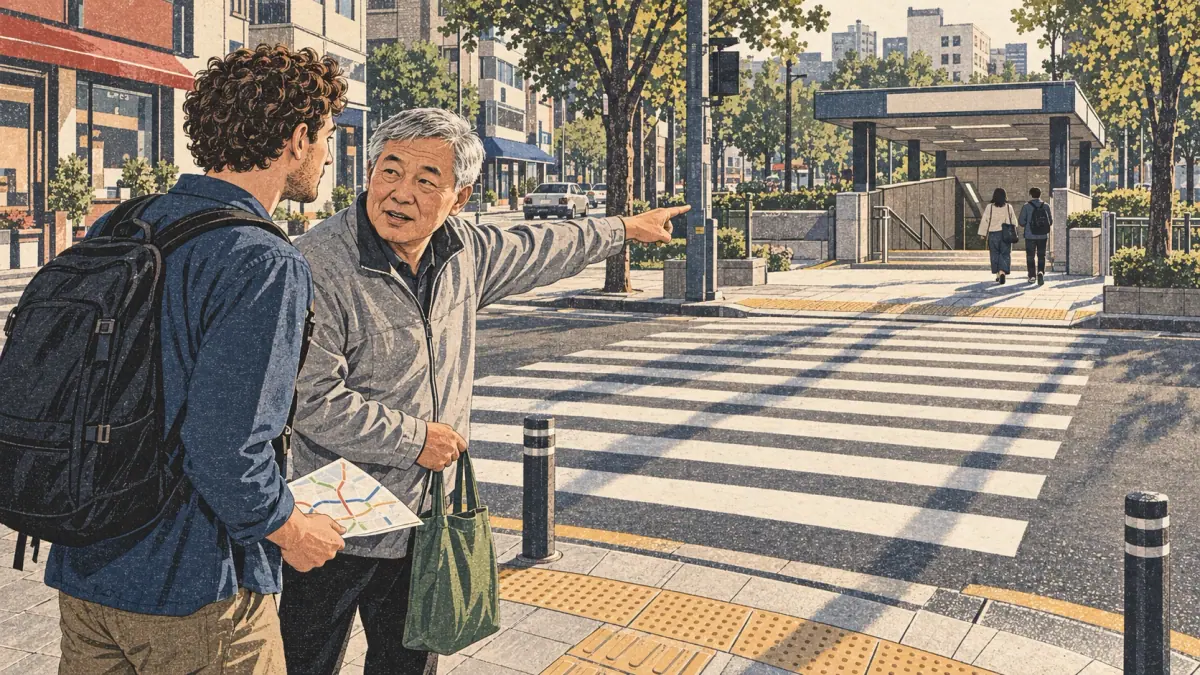
What Are the Most Useful Korean Directions Phrases to Learn First?
The most useful Korean directions phrases are the ones you can say and the ones you can understand. Learn the four questions first, then the four reply words you are most likely to hear.
| Step | Situation | Korean | Revised Romanization | Guide |
|---|---|---|---|---|
| 1 | Find a place | 지하철역이 어디예요? | jihacheollyeogi eodiyeyo | where is the subway station |
| 2 | Ask the route | 어떻게 가요? | eotteoke gayo | how do I get to |
| 3 | Check distance | 멀어요? | meoreoyo | is it far |
| 4 | Understand the reply | 직진하세요 | jikjinhaseyo | go straight |
Revised Romanization (the South Korean government standard of 2000) is shown only as a reading aid. Learn the Hangul first.
The reply is the hard part, because people answer fast and often point. Listen for these words:
| Korean | Revised Romanization | Meaning |
|---|---|---|
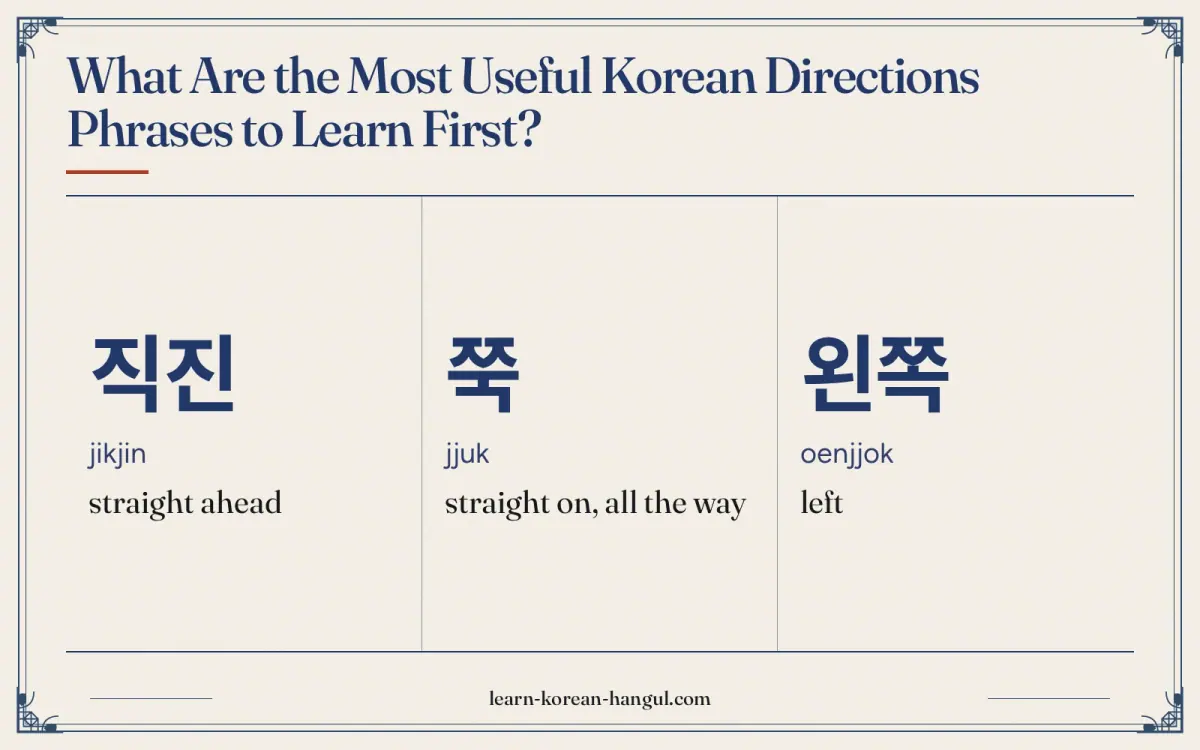
| 직진 | jikjin | straight ahead |
| 쭉 | jjuk | straight on, all the way |
| 왼쪽 | oenjjok | left |
| 오른쪽 | oreunjjok | right |
| 사거리 | sageori | intersection |
| 횡단보도 | hoengdanbodo | pedestrian crossing |
| 건너편 | geonneopyeon | the opposite side |
Koreans often give directions with landmarks and exit numbers, not street names. A typical reply is 3번 출구로 나가서 쭉 가세요 (sam beon chulguro nagaseo jjuk gaseyo), "leave by exit 3 and keep going straight." Subway lines use Sino-Korean numbers and 호선 (hoseon), as in 2호선 (i hoseon, line 2), and the Sino-Korean numbers page teaches them. With the order clear, the next question is which style to use.
How Do You Choose between Formal, Polite and Casual Korean Directions Phrases?
Use the polite style (해요체) when you ask, and expect polite commands when you listen. The page on Korean speech levels explains the three styles in depth. People who give directions usually use the -(으)세요 ending, a polite and respectful command, such as 직진하세요 and 가세요.
| Task | You say (polite) | You may hear (reply) |
|---|---|---|
| Get attention | 실례합니다 | 네? (yes?) |
| Find a place | 지하철역이 어디예요? | 저기 횡단보도 건너편이에요 (it is across the crossing) |
| Ask the route | 시청에 어떻게 가요? | 쭉 가세요 (keep going straight) |
| Check distance | 멀어요? | 아니요, 가까워요 (no, it is close) |
Casual 반말, such as 어디야? or 멀어?, fits only friends. With a stranger, an elder or a shop worker, 해요체 is the safe default, and 실례합니다 or 저기요 gets their attention first. Naver Map and KakaoMap are the map apps most people use in Korea, because Google Maps directions are limited there, so many people will also offer to look at your phone screen. With the style chosen, the cards below list every guide.
All Korean Directions Phrases Guides
The list below has all four guides, each with its lead phrase and a short audio clip. The Korean travel phrases hub holds the other travel clusters, and the Korean phrases hub holds every situation.
Start Here
Go Straight
The key phrase is 직진하세요 (jikjinhaseyo), which means "go straight." It is the reply you will hear most often.
How Do I Get To
The key phrase is 어떻게 가요? (eotteoke gayo), which means "how do I get there?" It is the question for a route, always with a place first, such as 시청에 어떻게 가요?.
Is It Far
The key phrase is 멀어요? (meoreoyo), which means "is it far?" It is a two-syllable question about distance.
Where Is the Subway Station
The key phrase is 지하철역이 어디예요? (jihacheollyeogi eodiyeyo), which means "where is the subway station?" It is the most useful single question for a traveller.
How Do You Practise Korean Directions Phrases?
Practise Korean directions phrases by asking, then by listening. Ask the four questions out loud with the audio on each card, then play the sample reply and write down which way it points.
- Play 직진하세요. 왼쪽으로 가세요. and say what it means in English.
- Repeat 왼쪽 and 오른쪽 five times each, with the tense [쪽] ending.
- Ask 멀어요? and answer yourself with 가까워요.
- Read a subway map aloud, saying 2호선 or 3번 출구 for each item.
The phrase flashcards drill the lines with audio. For a longer word list, see Korean directions vocabulary. If you have not yet learned the basics, start with Korean greetings. Listening practice matters most here, because a reply is only useful if you understand it.
What Mistakes Do Learners Make with Korean Directions Phrases?
Most mistakes with Korean directions phrases come from asking without being ready to listen.
| Mistake | Why it is a problem | Fix |
|---|---|---|
| Learning only the questions | You cannot follow the reply | Practise 직진, 왼쪽, 오른쪽 as sounds |
| Mixing 왼쪽 and 오른쪽 | Both end in 쪽, and a fast reply blurs the first syllable | Say each aloud with its gesture |
| Asking without the place name | 어떻게 가요? needs a destination | Say the place first |
| Expecting street names | Replies use landmarks and exit numbers | Listen for 출구 and 사거리 |
| Using 반말 with strangers | Casual speech is too familiar | Use 해요체 and 실례합니다 |
An expert tip: when you do not understand, repeat the one word you caught and ask again, such as 왼쪽이요? (oenjjogiyo, "left?"). The listener will nod or correct you. Keep your question short, listen for landmarks, and the Korean directions phrases in this hub will get you to the right exit.
Frequently Asked Questions
How do I ask for directions in Korean?
Start with 실례합니다 (sillyehamnida), "excuse me," then name the place and ask 어디예요? (eodiyeyo), "where is it?" For example, 지하철역이 어디예요? asks where the subway station is. To ask the route, say 시청에 어떻게 가요? (sicheonge eotteoke gayo), "how do I get to City Hall?"
What do left and right sound like in an answer?
Listen for 왼쪽 (oenjjok), "left," and 오른쪽 (oreunjjok), "right," often followed by 으로 or 로, as in 왼쪽으로 가세요. Both end in 쪽 with a tense sound, [왼쪽] and [오른쪽]. Straight ahead is 직진 (jikjin) or 쭉 (jjuk). Learn the three words as sounds first.
How do I ask if a place is far in Korean?
Ask 멀어요? (meoreoyo), "is it far?" The opposite is 가까워요? (gakkawoyo), "is it close?" To ask the time, say 얼마나 걸려요? (eolmana geollyeoyo), "how long does it take?" The answer is often 걸어서 오 분 (georeoseo o bun), "five minutes on foot," or 택시로 십 분 (taeksiro sip bun).
What if I do not understand the answer?
Say 천천히 말해 주세요 (cheoncheonhi malhae juseyo), "please speak slowly," or 다시 한번 말씀해 주세요 (dasi hanbeon malsseumhae juseyo), "please say it once more." You can also hold out your phone and say 지도로 보여 주세요 (jidoro boyeo juseyo), "please show me on the map." Most people will point and gesture.