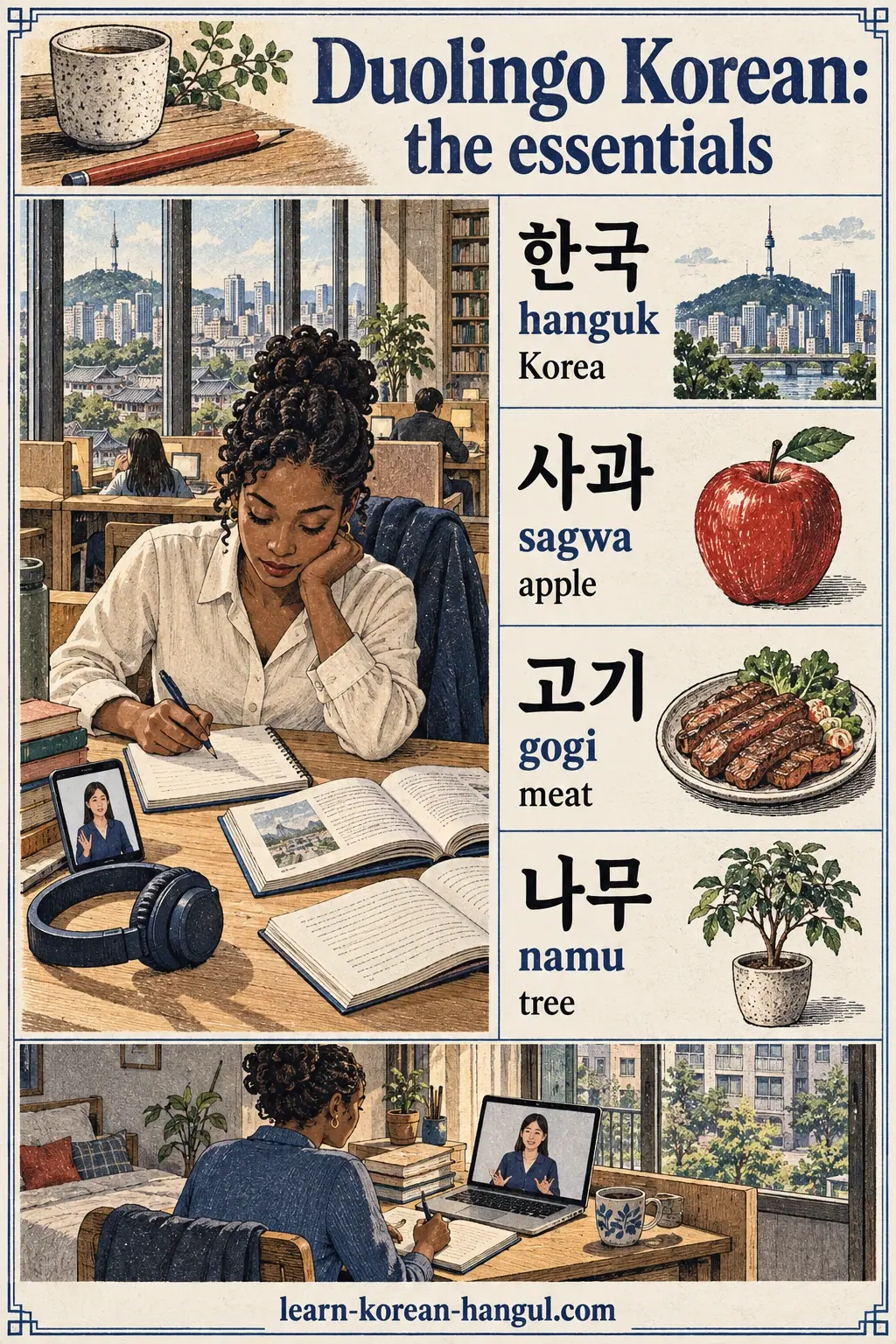
Duolingo Korean is a gamified app course that teaches Hangul and beginner vocabulary through short exercises, and it works best as a starter paired with grammar explanations and speaking practice. This page checks it against clear criteria, shows you a self-test to run in your first month and says who should use it and what to add.
Key facts
- Duolingo Korean is a game-style app course for beginners.
- It is best as a starter and habit builder, paired with grammar and speaking sources.
- It is not enough for TOPIK alone. Exam facts are on topik.go.kr.
- No scores or star ratings are given. Features and prices change, so check the store listing.
Last updated: 2026-10-09.
Duolingo Korean: the Essentials

Quick verdict. Use Duolingo Korean to start, to practise a little every day and to meet your first few hundred words. Do not expect it to teach you why Korean sentences work the way they do. Pair it with a grammar source and with real speaking.
| Question | Short answer |
|---|---|
| What is it? | A game-style course app with short exercises, streaks and rewards |
| Good for | Absolute beginners, habit-building, learning on the go |
| Not good for | Learning grammar in depth, speaking with feedback, exam preparation |
| Honest drawback | You can answer correctly without knowing why |
| Cost | A free version exists, with paid plans on top; check the current listing |
| Best partner | A grammar source and a speaking source |
What Is It?
Duolingo is a language-learning app and website. Its Korean course is made for English speakers and is organised in units made of many short exercises. A lesson takes a few minutes. You tap or type answers, hear audio and earn points. A streak counts the days in a row that you practise. The idea is that a small, fun daily habit leads to steady progress.
Think of it as a game that teaches. The game design is not a trick: a learner who studies 10 minutes a day for 100 days gets more practice than a learner who studies 3 hours once. The risk is the opposite one: the habit continues while skill growth stalls, because the exercises have become easy to guess.
How the course is organised can change, so this page does not describe screens. The things to check in your own version are listed in the criteria below.
How Did We Choose?
The review uses six criteria, the same ones applied to every app on this site. There are no scores, no star ratings and no affiliate links, and the page makes no claim of hands-on testing. Statements about the app are general, and the page tells you what to check yourself.
- What it is. The category and the course structure.
- Korean content depth. How much Hangul, vocabulary and sentence patterns it covers.
- Audio and speaking. Whether you hear Korean and whether you must say it.
- Grammar explanations. Whether it tells you why a form is used.
- Price model. What is free, what is paid.
- Fit by level. Which learners it suits.
What Does It Do Well?
It builds a habit. Short lessons, reminders and streaks make it easy to practise daily. For many learners, the hardest part of a language is turning up, and the app removes friction.
It gets you reading Hangul early. A beginner course should begin with the alphabet, and a game format suits it. Matching sounds to letters is repetitive and quick. You can check your progress with a simple test: cover the English and read these out loud.
안녕하세요?
annyeonghaseyo?
Hello.
It gives a sensible beginner vocabulary. Greetings, food, family and daily objects are the sort of words an app course teaches first. Expect to meet a few hundred words in the first stretch of a course, but check the unit list for your version.
It is flexible. You can practise on the bus, at lunch or at night. The exercises are short, and you can stop at any time.
It is accessible. A free version exists, so you can try it without paying. The paid plans add features, and the details change, so look at the store listing.
Where Does It Fall Short?
Grammar explanations are thin. A course built from short exercises teaches by pattern. You see 저는 학생이에요 ("I am a student") several times and learn to build it. But the app may not tell you that 는 marks the topic, that 이에요 follows a final consonant, or how the sentence would change for a different noun. Compare the two ways of learning.
저는 학생이에요.
jeoneun haksaengieyo.
I am a student.
If the app just says "correct", you have a sentence. If you also know why, you have a rule you can reuse for 저는 의사예요 and 저는 선생님이에요. The second kind of knowledge is what a grammar source adds. See the free grammar lessons on this site.
Speaking is limited. Some exercises ask you to say a sentence and check it with speech recognition. That is useful practice, but it cannot tell you the things a teacher can: that your vowel is flat, that your rhythm is off, or that the sentence sounds odd for the situation. A speech checker may also accept a sentence that a person would find unclear.
Sentences can be unnatural. Exercises are built to test one thing at a time, so sentences are sometimes odd or too formal for daily conversation. Learn the structure, then check real usage elsewhere.
Game goals can hide real progress. Points, leagues and streaks reward activity. They do not measure skill. A good rule: judge your progress by what you can do without the app, not by your score.
It does not reach advanced Korean. Any app course has a ceiling. Expect to outgrow it after the beginner levels, and have a next step planned.
A Self-Test for Your First Month

This test checks what the app has taught you, in plain terms. Do it after about four weeks of regular use, and be honest.
- Read. Take ten Korean words from a source other than the app, such as a menu or a sign. Read them without romanization. Aim for eight or nine.
- Listen. Play three short audio phrases from outside the app. Can you pick out any word?
- Say. Say, without looking, how to greet someone, introduce yourself and ask for water.
- Explain. Pick one sentence from the app and explain why each particle is there.
- Write. Type five sentences from memory in Hangul.
A typical result for a diligent month: reading is good, saying a few set phrases is fine, explaining and writing are weak. That tells you what to add. If step 4 fails, add a grammar source. If step 2 fails, add listening. If step 3 is hard, find a speaking partner.
물 주세요.
mul juseyo.
Please give me water.
What to Check in Your Own Version
Because apps change, the most reliable review is the one you run on the version in front of you. Use this checklist in your first week, and write down the answers.
| Criterion | What to check | Why it matters |
|---|---|---|
| What it is | How many short exercises make a lesson; how units are ordered | Shows how much repetition you get |
| Korean content depth | Whether Hangul comes first; whether sentences appear in the first units | A course that delays sentences keeps you in word-matching |
| Audio and speaking | Whether every item has audio; whether there are speaking prompts | Audio trains the ear; speaking prompts force you to produce |
| Grammar explanations | Whether tips or notes appear; how long they are | Notes are the only place an app explains why |
| Price model | What the free version limits; what the paid plan removes | Lets you decide whether paying solves a real problem |
| Fit by level | The last unit's topics | Tells you when you will outgrow it |
Treat the answers as your own review. If the app passes three or four rows for your goal, keep going. If it fails the grammar row, add a grammar source straight away instead of waiting.
Reading Hangul: How to Confirm It Worked

A beginner app should leave you able to read Korean without romanization. The check is simple. Read these words aloud, then check the English.
| Hangul | Reading | Meaning |
|---|---|---|
| 한국 | hanguk | Korea |
| 사과 | sagwa | apple |
| 고기 | gogi | meat |
| 나무 | namu | tree |
| 학교 | hakgyo [학꾜] | school |
If you can read the first four at once and the last with its tensed sound [학꾜], your reading is on track. If you are slow, you do not need to restart the course. Spend ten minutes a day on the alphabet separately: see the guide to the Korean alphabet, which builds syllables from consonants and vowels, for example 가 from ㄱ and ㅏ.
A final tip for the alphabet stage: write letters by hand a few times. The motion of writing builds memory that tapping does not.
How to Get More from Each Exercise

How you use an app matters as much as which app you use. These habits turn passive tapping into learning.
- Say every answer aloud. Even when the exercise does not ask you to speak, saying the sentence turns recognition into production.
- Type in Hangul when you can. Typing forces you to recall the spelling instead of picking from tiles.
- Slow down on wrong answers. Read the correction, say the right sentence twice and then continue.
- Keep a mistake notebook. Write the sentences you got wrong. Review them twice a week.
- Re-do old units. Revisiting earlier lessons works as a spaced review and often shows how much easier they have become.
- Close the app after the lesson. Do not drift into extra exercises when you are tired. Quality beats quantity.
When to Stay and When to Move On
You do not have to quit Duolingo to use other tools. Decide with signs, not mood.
Stay with it while: the exercises still teach you new words, you finish lessons most days and you can answer the explain-why question for most sentences.
Add a second tool when: you can pass the exercises but cannot form your own sentences. This is the usual sign that you need grammar and speaking practice.
Move to a different main course when: the lessons feel easy but you cannot understand real Korean audio, or when you hit the end of the available units. At that point choose a course with grammar notes, a textbook or a lesson library, and keep the app only for short daily review.
Thinking about Cost
Whether to pay depends on a clear question: what does the paid plan give you that you will use? Common additions in app subscriptions include fewer limits on how many mistakes you can make, no ads, offline use and extra practice features. None of these is a language skill in itself. They remove friction. If you already practise daily on the free version, you may not need them. If limits stop you from finishing lessons, the paid plan might be worth a trial.
A simple test: use the free version for four weeks. Count how many days you were stopped or annoyed by limits. If the answer is "many", paying may help. If the answer is "none", save the money for a book, a tutor or a month of a lesson site.
Prices differ by country and change often. This page gives no figures, so check the store listing before you decide.
Comparison with Alternatives
| Option | Strength | Honest drawback |
|---|---|---|
| Duolingo Korean | Habit, early Hangul, free to start | Little grammar explanation |
| LingoDeer | Grammar notes before exercises | Smaller speaking component |
| Talk To Me In Korean | Conversational lessons, long level ladder | You organise your own practice |
| Pimsleur | Audio-first speaking | Little reading or grammar explanation |
| Free lessons on this site | Hangul and grammar with audio, free | No live feedback |
If you are choosing between Duolingo and LingoDeer, read the head-to-head guide: LingoDeer vs Duolingo Korean. For other no-cost tools, see the guide to the best apps to learn Korean for free.
Who It Suits
Absolute Beginner Who Wants a Gentle Start
Duolingo is a good first step. Use it to learn the alphabet and the first words, and read the Korean alphabet lessons at the same time. Set a realistic goal, such as 10 minutes a day, and keep it for four weeks.
Learner Who Needs a Daily Habit
If you tend to start and stop, the streak is a helpful nudge. Put the lesson at a fixed time and pair it with an existing habit, such as your morning coffee. Once the habit is stable, add a second activity.
Learner Who Wants Grammar Understanding
Duolingo alone will frustrate you. Use it for drills and learn the rules elsewhere. Read one grammar page for each new pattern, then return to the app to practise.
TOPIK Candidate
Use Duolingo as a warm-up at best. TOPIK needs reading and listening at exam length and, at higher levels, writing. See the TOPIK section for preparation and topik.go.kr for the exam's own information.
Learner Who Wants to Speak
The app gives you phrases but not conversation. Add a tutor or language partner. See the guide to Korean speaking practice.
Pairing Duolingo with Other Tools

A good pairing fills the gaps the app leaves. Here is a plan for 40 minutes a day, six days a week, which is 4 hours a week.
- 10 minutes: Duolingo lessons for habit and review.
- 15 minutes: A grammar lesson or a chapter from one of the best Korean grammar books, with notes.
- 10 minutes: Flashcards for the words you want to keep, for example in Anki.
- 5 minutes: Shadowing: listen to a short phrase and repeat it aloud.
Over eight weeks this comes to 32 hours. After eight weeks, run the self-test above again and see the change. If one part of the plan feels useless, replace it rather than abandoning the whole routine.
A Four-Week Starter Plan
If you are about to begin, this plan uses the app for habit and adds the pieces the app leaves out. It assumes 25 minutes a day, six days a week, which is 150 minutes, or 2 hours 30 minutes, per week.
| Week | App (15 min) | Extra (10 min) |
|---|---|---|
| 1 | Alphabet units | Write each new letter by hand; say it aloud |
| 2 | First vocabulary units | Read five signs or menu items from outside the app |
| 3 | Short sentence units | Read one grammar page on the topic and particle patterns |
| 4 | Review old units | Run the first-month self-test and note the weakest skill |
Over four weeks, the total is 10 hours. At the end, decide what to add: grammar, listening or speaking. The test results tell you, so you do not have to guess.
Adding Real Speaking to an App Course
An app can get you to say a phrase, but speaking is a skill you build with other people. Three low-cost steps help a beginner.
- Shadow. Play a phrase such as 안녕하세요 or 물 주세요, pause and repeat it, copying rhythm and pitch. Do five phrases a day.
- Record yourself. Say a short sentence into your phone, then play the app's audio and your own back to back. Differences become easy to hear.
- Find a partner. A language exchange or a tutor lets you try your phrases on a person. Start with one 30-minute session a week. Even a short chat on the same five topics each week builds confidence.
The point is not perfection. It is to make your voice do what your eyes have learned.
Common Mistakes with Duolingo Korean
- Relying on romanization. If the app allows it, switch it off early so that you read Hangul.
- Racing for points. Speed encourages guessing. Slow down and say each answer aloud.
- Never reviewing outside the app. Write words in a notebook or flashcard deck. What you only tap may not stay.
- Skipping the tips. Where the app offers a short explanation, read it before the exercises.
- Staying too long. If the exercises feel easy and you cannot say why, you are practising recognition and not learning.
For a wider view of the options, see the guide to Korean learning apps.
FAQ
Can Duolingo take me to fluency?
No app alone can. Duolingo can build a daily habit, teach Hangul and give you a base of beginner words and patterns. Fluency also needs long listening, real conversation and reading, which an app course covers only in small amounts. Use it as one part of a plan, not the whole plan.
Does Duolingo teach Hangul?
The Korean course for English speakers starts with the alphabet. Check whether your version also explains how the letters combine into syllable blocks. Whatever the app does, confirm your reading with a separate source, such as the Hangul lessons on this site, because reading without romanization is the real goal.
Is Duolingo enough for TOPIK?
No. TOPIK tests reading and listening in real exam format, and the higher levels add writing. A beginner app course does not reach that depth. Use it for habit and basic vocabulary, then add grammar study, listening practice and past-style exam practice. Exam facts come from topik.go.kr.
What should I add to Duolingo?
Add three things. First, a grammar source that explains why endings and particles change. Second, a flashcard app for the words you want to keep. Third, a speaking source: a tutor, a language partner or at least regular shadowing with audio. These cover the gaps that a game-style course leaves.