This LingoDeer Korean review looks at an app course known for grammar explanations alongside vocabulary drills, and it suits learners who want structure but still need speaking practice. It checks the course against six clear criteria, gives a self-test for your first two units and ends with verdicts for different learners and a plan for what to add.
Key facts
- It suits learners who want structure and explanations, and it needs added speaking and listening practice.
- Honest drawbacks: limited speaking depth and the need to pay for the full course.
- It is a solid grammar base for TOPIK but not enough for the exam alone (exam facts: topik.go.kr).
- No scores or star ratings are given. Prices and features change, so check the store listing.
Last updated: 2026-10-09.
LingoDeer Korean Review: the Essentials
Quick verdict. LingoDeer is a good choice if you want an app that explains grammar in short notes and then drills it. It is a weaker choice if you want conversation practice. Treat it as the structured core of a beginner plan, not as the whole plan.
| Question | Short answer |
|---|---|
| What is it? | A course app with grammar notes, vocabulary and sentence exercises |
| Good for | Beginners who want structure and plain-English explanations |
| Not good for | Speaking with feedback, natural listening, advanced Korean |
| Honest drawback | Limited speaking depth; the full course is paid |
| Cost | Some free lessons, with a paid plan for more; check the listing |
| Best partner | A speaking source and a listening source |
What Is It?
LingoDeer is a language-learning app that started with Asian languages and offers Korean as one of its courses. Lessons are organised in units. Within a unit you usually meet a short note on a pattern or a set of words, then drills that practise them: choosing, matching, building a sentence from pieces and listening tasks.
The design idea is simple. Many apps assume you will pick up grammar by seeing it often. LingoDeer puts the explanation first, so that exercises test something you have been told. For adult learners who like to know the rule, that order is comforting.
Course details change, so this page describes the style and tells you what to check. The main parts you can expect to look for are an alphabet section, grammar-led units and vocabulary sets. Verify the current list in the app before you decide.
How Did We Choose?
The review uses six criteria, the same set applied to every app on this site. There are no scores, no star ratings and no affiliate links. The page makes no claim of hands-on testing of the current version. It states general strengths and limits and shows you how to test them yourself.
- What it is. Category and course structure.
- Korean content depth. Hangul, vocabulary and sentence patterns covered.
- Audio and speaking. Hearing Korean and saying it.
- Grammar explanations. Whether it tells you why a form is used.
- Price model. What is free and what is paid.
- Fit by level. Which learners it suits.
What Does It Do Well?
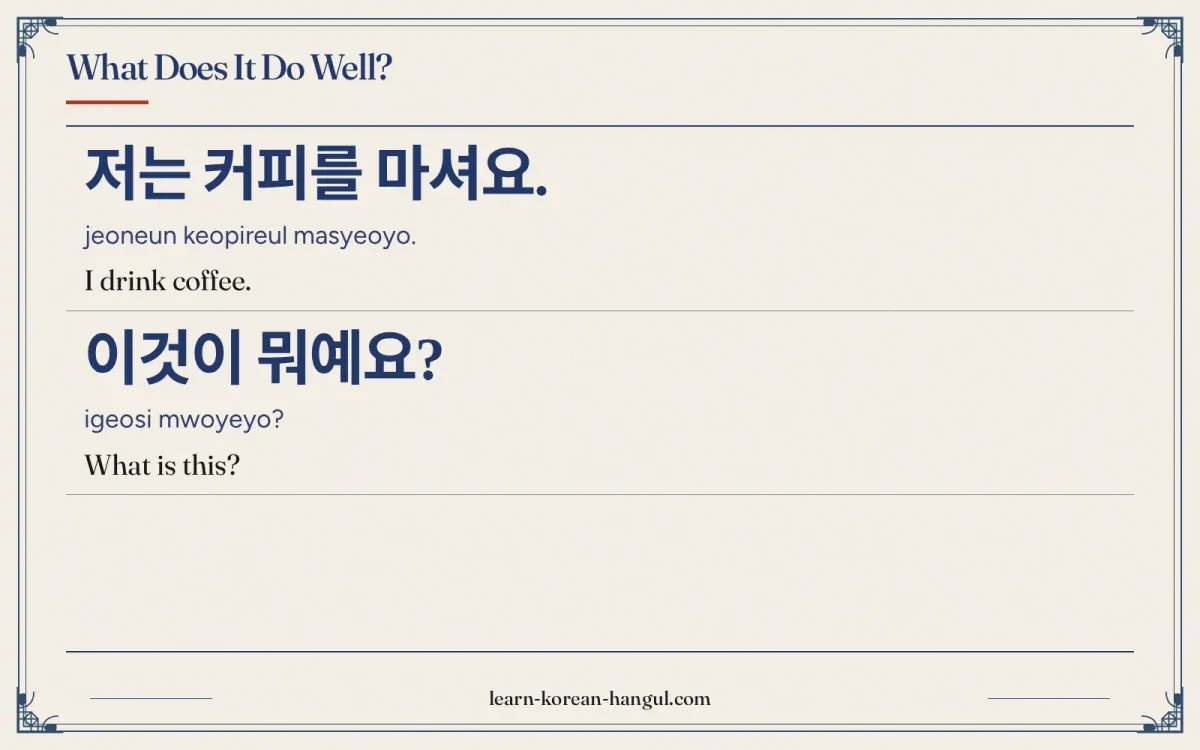
It explains before it drills. A short note before the exercises gives you a reason for the form. Take a basic example.
저는 커피를 마셔요.
jeoneun keopireul masyeoyo.
I drink coffee.
A grammar note can point out three things in this sentence: 는 marks the topic (저는, "as for me"), 를 marks the object (커피를, the thing you drink) and the verb comes last. It might also tell you that 마시다 becomes 마셔요 in the polite style. Seeing those parts named makes the next sentence easier.
It gives a clear order. A course with units and a path means you never have to decide what to study next. For someone who starts and stalls because of too many choices, that is a real benefit.
It teaches patterns that matter early. A beginner needs particles, polite endings, basic questions and numbers. A grammar-led course covers these in order. A sentence like the next one packs several of them.
이것이 뭐예요?
igeosi mwoyeyo?
What is this?
It suits short sessions. Units are small, so you can finish one in a few minutes on a commute.
It has a free way in. Some lessons can be tried without paying, so you can see whether the notes help before you commit.
Where Does It Fall Short?
Speaking depth is limited. An app can ask you to say a sentence, but it cannot hold a conversation or notice your habits. A question like 어디에 가요? ("Where are you going?") is easy to read and hard to answer quickly in real time. That comes only with practice with other people.
어디에 가요?
eodie gayo?
Where are you going?
Listening is short and clear. Course audio is slow and clean. Real speech is faster, contracted and noisy. You will need other listening material.
Notes are short. A few lines cannot compare two similar patterns in depth. For example, the difference between 은/는 (the topic particle) and 이/가 (the subject particle) needs a full lesson. Read the particles page when you reach it.
The full course costs money. If you want all the units, you need the paid plan. That is a fair model, but it is a cost.
It can feel like a textbook. Learners who want a game will find it more serious than a game-style app. Check the first units and see whether you enjoy them.
It has a ceiling. Like any app course, it covers the early levels best. Plan what comes after.
What a Good Grammar Note Looks Like
Since the notes are the main selling point, here is a model of what a good one contains. Use it as a yardstick for any note in any app. The pattern is -고 싶다, "want to".
Meaning. Add -고 싶다 to a verb stem to say that you want to do something.
Form. Take the stem, add -고 and then 싶어요 for the polite style: 가다 becomes 가고 싶어요, 먹다 becomes 먹고 싶어요 and 마시다 becomes 마시고 싶어요.
Example. 커피를 마시고 싶어요. "I want to drink coffee."
Watch out. It attaches to verbs, not to describing words such as 예쁘다. To say "I want to become pretty", use 예뻐지고 싶어요.
커피를 마시고 싶어요.
keopireul masigo sipeoyo.
I want to drink coffee.
Count what the note does. It states the meaning in one line, shows how to build the form with three verbs, gives a full sentence and warns about one limit. That is about 50 words and it answers four questions. If an app's note does at least this, it is doing its job. If it gives only the example sentence, it is leaving the explanation to you.
Notice the pronunciation too. 먹고 sounds like [먹꼬], with a tensed ㄱ. Audio that plays the sentence lets you hear this, but written romanization cannot show it.
How to Study One Unit in 15 Minutes
A unit is easiest to remember when you do more than tap through it. Try this routine.
- Minutes 0-3: Read the note slowly. Say the example sentence aloud. Write the pattern on paper in your own words.
- Minutes 3-9: Do the drills. Say every answer aloud. When you are wrong, read the correction before moving on.
- Minutes 9-12: Write three sentences from memory that use the pattern, with different words from the unit.
- Minutes 12-15: Check them. Look at the app's examples and see how close you came. Note one difference.
If you do this four days a week, you finish about four units a week. In eight weeks that is about 32 units, enough to feel real progress, if the units are small. Adjust to your own pace.
Gaps to Look for in Any Beginner Course
Run your eye over the list of patterns the course teaches in the first two months. The table shows the early patterns and the question to ask about each.
| Pattern | Example | Check |
|---|---|---|
| Topic and subject particles 은/는, 이/가 | 저는, 비가 | Does it explain both? |
| Object particle 을/를 | 커피를 | Is it taught early? |
| Location particles 에, 에서 | 학교에 가요 | Does it explain the difference? |
| Polite ending -아/어요 | 가요, 먹어요 | Are regular and 하다 verbs both shown? |
| Past tense -았/었어요 | 갔어요 | Is it taught before the future? |
| Wanting: -고 싶다 | 마시고 싶어요 | Is the verb-only limit mentioned? |
| Numbers, both systems | 하나, 일 | Does it say when to use each? |
If the course covers most of these within the first stretch, the order is sensible. If it leaves out particles you meet every day, add a lesson on them.
Reviews, Tracking and Offline Use
Beyond lessons, check how the app helps you remember. Does it have a review mode that returns old items? Does it show which units you know less well? Can you download lessons to use offline, for a flight or a poor connection? These features change with updates, so check the current version. A review mode matters more than it sounds: a course you never revisit loses most of its value after a month.
If the app has no good review, make your own. Keep a notebook with one line per pattern, and read it twice a week. Better, turn the key words into a deck in a flashcard app.
Thinking about Cost
The question is not "is it cheap?" but "will I use what I pay for?" If the free lessons show that the notes help and you open the app most days, a paid plan may be worth it. If you open it twice a week, the same money buys a book you can keep. Use this rule: try the free part for two weeks. If you finish all the free lessons and want more, pay. If you stop before you finish them, do not.
Prices differ by country and change. This page gives no figure, so check the store listing, and note the cancellation steps before you subscribe.
Pronunciation Points a Grammar Course May Skip
A course built around grammar notes spends little time on sound changes, but Korean spelling and speech differ in regular ways. Listen for these in the audio, and write them in your notebook.
| Written | Spoken | Why |
|---|---|---|
| 이것이 | [이거시] | A final consonant moves onto the next empty ㅇ |
| 먹고 | [먹꼬] | A ㄱ after a final ㄱ sound is tensed |
| 학교 | [학꾜] | The same tensing inside one word |
| 좋아요 | [조아요] | ㅎ before a vowel is not pronounced |
Hearing these patterns repeatedly teaches your ear to expect them. The pronunciation section explains the rules in order. If your course only gives written romanization, rely on the audio and on Hangul.
If You Finish the Course Early
Some learners work through the units faster than the plan above. If you reach the last unit and still feel at the beginner stage, that is normal: an app course ends before fluency does. The next steps are clear.
- Move your main study to a textbook or a lesson series that goes beyond the app's last level.
- Start a daily listening habit with short clips and transcripts.
- Read simple texts, such as graded readers or captions, with a dictionary beside you.
- Book regular speaking sessions, even if only once a week.
- Keep the app for a short daily review of the older units.
Do not restart the course from the beginning unless you have been away for months. Reviewing selected units is faster and more useful than repeating everything.
A Two-Unit Self-Test
You can test LingoDeer's teaching without a review. Do two units, then answer these questions.
- Did the note help? After reading it, could you explain the pattern in one sentence of your own?
- Did the drills match the note? Did the exercises use what you were told, or something new?
- Could you produce the pattern? Close the app and write three sentences that use it.
- Did you hear the sentences? Was there audio for the examples, and did it match how Korean really sounds?
- Would you come back tomorrow? Honest motivation counts.
A clear yes to questions 1 to 3 is a good sign that the teaching style suits you. A no on question 3 means the note did not stick: add your own sentences, or read a fuller lesson.
Comparison with Alternatives
| Option | Strength | Honest drawback |
|---|---|---|
| LingoDeer | Grammar notes before drills, a clear path | Limited speaking; full course paid |
| Duolingo Korean | Habit, free to start | Thin explanations |
| Talk To Me In Korean | Conversational lessons, wide level range | You plan your own practice |
| Pimsleur | Audio-first speaking | Little reading and grammar explanation |
| Free lessons on this site | Hangul and grammar with audio | No live feedback |
For a direct comparison, see LingoDeer vs Duolingo Korean. For other grammar options, see the guide to the best Korean grammar app.
Who It Suits
The Grammar-First Learner
LingoDeer is a strong fit. You like to understand a pattern before you drill it, and the notes-then-exercises order matches that. Add a book or a lesson site for deeper comparisons. Use the free Korean grammar lessons as a second explanation when a note is too short.
The Travel Learner
If you want to order food, ask directions and greet people in a few weeks, a structured course gives you useful sentences. But a trip needs listening and speaking more than grammar. Add an audio-first source and practise saying your phrases aloud. See the guide to Korean speaking practice. The guide to the best app for Korean speaking practice compares tools that make you talk.
The TOPIK Candidate
LingoDeer's grammar coverage helps with the patterns on the early TOPIK levels, but the exam tests reading and listening at length. Use it for the grammar base, add reading and listening practice, and check the official exam site topik.go.kr. The site's TOPIK section covers preparation.
The Learner Who Wants a Habit-Based Game
You may find it less playful than you hoped. Try the free lessons first. If a game-style tool keeps you coming back more, use that for daily practice and use LingoDeer for explanation.
What to Add to LingoDeer
The course gives you structure. These additions fill the gaps.
| Gap | Add | Example action |
|---|---|---|
| Speaking | Shadowing and a speaking partner | Repeat five sentences aloud each day |
| Listening | Podcasts or videos with transcripts | Listen to a 2-minute clip three times |
| Vocabulary | A flashcard deck | 10 new cards a day from your lessons |
| Reading | Short texts, signs, menus | Read three real words each day without romanization |
| Comparison of patterns | A book or lesson page | Read one fuller explanation each week |
A weekly plan with 30 minutes a day, six days a week, is 3 hours a week. A possible split:
- Three days: 15 minutes LingoDeer units, then 15 minutes flashcards.
- Two days: 15 minutes LingoDeer review, then 15 minutes listening.
- One day: 30 minutes speaking: shadowing or a partner.
Over eight weeks this is 24 hours. Ask yourself at the end of week eight what you can say and understand that you could not before.
Using LingoDeer with the Lessons on This Site
The two work well together because they cover different jobs. Let the app lead and use the site as your second opinion.
- When a note feels too short, read the matching page in the grammar section for fuller examples.
- When a sound surprises you, check the pronunciation lessons, which explain why a spelling is read the way it is.
- When you want to hold on to words, copy them into the site's flashcard decks or into your own deck.
Keep one notebook for all three, with a line for each new pattern: the form, one example you wrote yourself and one thing you got wrong. That notebook becomes your own short grammar book, and it is the most useful thing the course will leave you with.
Common Mistakes with LingoDeer
- Skipping the notes. The notes are the point of the course. If you tap past them, you lose what it does best.
- Learning only in the app. Write sentences by hand and say them aloud.
- Ignoring reviews. Revisit old units to keep the patterns active.
- Paying before testing. Use the free lessons first.
- Expecting conversation. A course teaches parts of a language. Conversation needs people.
For other tools, see the guide to Korean learning apps.
FAQ
Is LingoDeer worth paying for?
It is worth paying for when the free lessons show that the grammar notes help you and you will use the app most days. It is less worth it if you already have a grammar book or lesson site you follow. Try the free lessons for a week and keep a note of how often you open the app without a reminder.
Does it teach Hangul?
A beginner Korean course normally begins with the alphabet, and LingoDeer's course is organised that way. Check the first units for letter-sound practice and syllable building. To confirm that it worked, read a few real words, such as 사과 or 학교, without romanization.
How many levels?
The number of levels and units can change with updates, so check the course list in the app before you decide. Look at the final unit's topics to see where the course ends. Many learners find that an app course covers the early levels well and needs a textbook or lessons beyond that.
Is it good for TOPIK?
It helps with the grammar patterns that appear in TOPIK, mostly at the beginner level. The exam itself tests reading and listening at exam length and, at higher levels, writing. Use LingoDeer as one source, and use topik.go.kr for the official exam information.