지수 씨, 주말에 뭐 해요? / 저는 영화 보는 것을 좋아해요. / 아, 정말요? 어떤 영화를 좋아해요? / 한국 영화를 자주 봐요. 그럼 민수 씨는요? / 저는 운동을 좋아해요. 주말에 자주 등산해요. / 저도요! 저도 가끔 등산해요. / 그래요? 어디로 가요? / 북한산에 가요. 민수 씨도 영화 보는 것을 좋아해요? / 네, 가끔 봐요. 다음 주말에 같이 봐요! / 좋아요! 기대돼요.
What you'll learn
- Open small talk with 주말에 뭐 해요? and answer with a hobby.
- Turn a verb into a hobby with -는 것을 좋아해요.
- Say "me too" with 저도요 and pass the turn with 그럼 민수 씨는요?
- React with short words such as 아, 정말요? and 그래요? so the talk keeps going.
Before you start: you need to read Hangul, know the polite -요 style and have done the self-introduction role play. Time: about 20 minutes. Level: A1.
What Is Korean Hobbies Conversation Practice?
Korean hobbies conversation practice is a scripted small talk in which two people share what they like to do and keep asking each other questions. The topic is easy, but the skill is not the vocabulary. It is the habit of giving a short answer and handing the turn back, which shows the other person that you are interested.
Small talk between acquaintances in Korea often starts with the weekend, so 주말에 뭐 해요? is a safe opener at work and at school. The set phrases are collected in Korean small talk, and the short reaction words are in Korean filler words. This page puts them into one ten-turn exchange that you say aloud.
First, see where English speakers usually slip.
Why Is This Hard for English Speakers?
English small talk is built from "-ing" words and "too", but Korean needs a noun phrase and a different particle. Four habits cause the most trouble.
| English habit | Korean pattern | Example |
|---|---|---|
| "I like watching films" uses an "-ing" word | The verb becomes a noun with -는 것 | 영화 보는 것을 좋아해요 (yeonghwa boneun geoseul joahaeyo) |
| "Me too" keeps the same subject word | The particle 도 replaces 는 | 저도요 (jeodoyo), never 저도는 |
| "And you?" is a short question with "you" | A name plus 씨는요 is used | 민수 씨는요? (minsu ssineunyo) |
| Silence while listening is polite | Short reactions show interest | 아, 정말요? (a, jeongmaryo) |
The second row is a common slip. 도 means "also" and it already does the job of 는, so the two never appear together. The third row uses 는 in a different way: it marks a contrast, so 저는요 means "as for me" and shows that you are changing the subject to yourself.
Now see how the practice works.
How Does the Role Play Work?
You say the same ten turns twice, once in each role, and change the hobby in round two.
- Listen once to the whole conversation without the English column.
- Read Role B's lines aloud and answer as Role A from the model answers.
- Cover the Role A lines and answer from your prompt card.
- Swap roles and ask the questions yourself.
- Record round two and compare it with the audio.
- Score yourself with the rubric below.
If you practise alone, read the other role aloud and leave a pause for yourself. The key skill is the return question. Count how many times you pass the turn back, and aim for one return question after every answer about yourself.
Role a and Role B Prompt Cards
The cards tell you what to say and give you words to swap. In round two, take the second column, so that you change the hobby and the place.
| Role A, round one | Role A, round two | Role B (both rounds) | |
|---|---|---|---|
| Weekend hobby | 영화 보다 (yeonghwa boda) | 음악 듣다 (eumak deutda) | 운동하다 (undonghada) |
| Frequency | 자주 (jaju, often) | 가끔 (gakkeum, sometimes) | 자주 (jaju, often) |
| Extra detail | 한국 영화 | 재즈 (jaejeu, jazz) | 등산 (deungsan, hiking) |
| Must do | Pass the turn once | Pass the turn once | Ask what and where |
The hobby table below lists twenty verbs and phrases you can swap in. Each has an object or a noun plus its verb, so that you can say it in a full sentence.
| Hobby | Korean | Revised Romanization |
|---|---|---|
| Watching films | 영화 보다 | yeonghwa boda |
| Watching dramas | 드라마 보다 | deurama boda |
| Listening to music | 음악 듣다 | eumak deutda |
| Reading books | 책 읽다 | chaek ikda |
| Singing | 노래하다 | noraehada |
| Dancing | 춤추다 | chumchuda |
| Drawing | 그림 그리다 | geurim geurida |
| Taking photos | 사진 찍다 | sajin jjikda |
| Playing the piano | 피아노 치다 | piano chida |
| Cooking | 요리하다 | yorihada |
| Exercising | 운동하다 | undonghada |
| Hiking | 등산하다 | deungsanhada |
| Taking a walk | 산책하다 | sanchaekada |
| Swimming | 수영하다 | suyeonghada |
| Cycling | 자전거 타다 | jajeongeo tada |
| Playing football | 축구하다 | chukguhada |
| Shopping | 쇼핑하다 | syopinghada |
| Camping | 캠핑하다 | kaempinghada |
| Travelling | 여행하다 | yeohaenghada |
| Playing games | 게임하다 | geimhada |
Note the romanization of 산책하다: Revised Romanization shows the ㅎ merging with the ㄱ, so it is sanchaekada, not sanchaekhada. The next section gives the model answers.
Model Answers and Alternatives
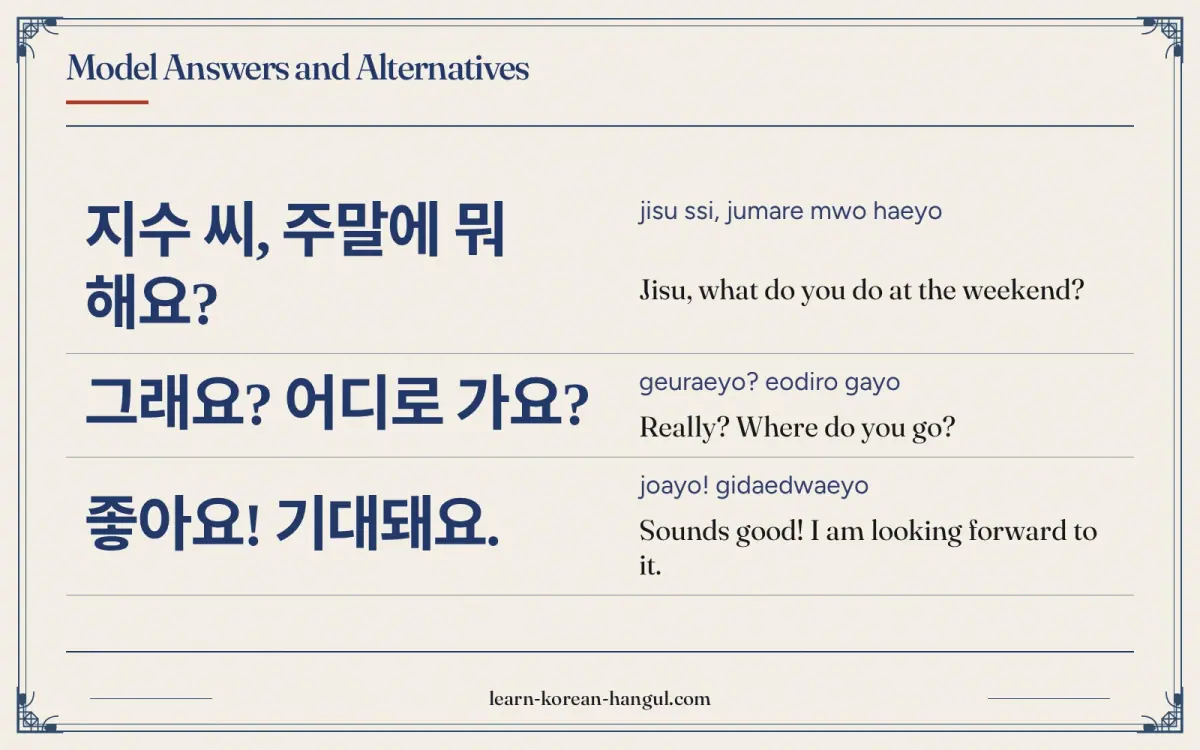
Here is the whole conversation. Each line has its own clip, so shadow one turn at a time.
Small Talk about Weekend Hobbies
Minsu (B)
지수 씨, 주말에 뭐 해요?
jisu ssi, jumare mwo haeyo
Jisu, what do you do at the weekend?
Jisu (A)
저는 영화 보는 것을 좋아해요.
jeoneun yeonghwa boneun geoseul joahaeyo
I like watching films.
Minsu (B)
아, 정말요? 어떤 영화를 좋아해요?
a, jeongmaryo? eotteon yeonghwareul joahaeyo
Oh, really? What kind of films do you like?
Jisu (A)
한국 영화를 자주 봐요. 그럼 민수 씨는요?
hanguk yeonghwareul jaju bwayo. geureom minsu ssineunyo
I often watch Korean films. And you, Minsu?
Minsu (B)
저는 운동을 좋아해요. 주말에 자주 등산해요.
jeoneun undongeul joahaeyo. jumare jaju deungsanhaeyo
I like exercise. I often go hiking at the weekend.
Jisu (A)
저도요! 저도 가끔 등산해요.
jeodoyo! jeodo gakkeum deungsanhaeyo
Me too! I also go hiking sometimes.
Minsu (B)
그래요? 어디로 가요?
geuraeyo? eodiro gayo
Really? Where do you go?
Jisu (A)
북한산에 가요. 민수 씨도 영화 보는 것을 좋아해요?
bukhansane gayo. minsu ssido yeonghwa boneun geoseul joahaeyo
I go to Bukhansan. Do you like watching films too, Minsu?
Minsu (B)
네, 가끔 봐요. 다음 주말에 같이 봐요!
ne, gakkeum bwayo. daeum jumare gachi bwayo
Yes, I watch them sometimes. Let us watch one together next weekend!
Jisu (A)
좋아요! 기대돼요.
joayo! gidaedwaeyo
Sounds good! I am looking forward to it.
Swap any answer for one of the alternatives below.
| Turn | Model | Alternative |
|---|---|---|
| 2 (hobby) | 저는 영화 보는 것을 좋아해요. | 저는 음악 듣는 것을 좋아해요. |
| 4 (detail and return) | 한국 영화를 자주 봐요. 그럼 민수 씨는요? | 재즈를 자주 들어요. 그럼 민수 씨는요? |
| 6 (me too) | 저도요! 저도 가끔 등산해요. | 저도 좋아해요! |
| 8 (place and return) | 북한산에 가요. 민수 씨도 영화 보는 것을 좋아해요? | 한강에 가요. 민수 씨도 산책하는 것을 좋아해요? |
Two small notes. First, the object of 좋아해요 takes 을 or 를: 보는 것을 ends in 을 because 것 ends in a consonant. Second, 북한산 is a mountain in Seoul. You say it [부칸산], but Revised Romanization keeps the h in nouns, so it is Bukhansan.
The Self-Check Rubric
Use the same four-part rubric as every speaking page: 0, 1 or 2 points per part, for a total out of 8.
| Part | What to check on this page | 0 | 1 | 2 |
|---|---|---|---|---|
| Sounds | [주마레] for 주말에 and [보는 거슬] for 보는 것을 | Often not understood | Understood with effort | Clear, with small slips |
| Flow | The return question follows the answer without a gap | Long pauses inside sentences | Pauses between sentences | Steady, natural pace |
| Form | -는 것을 좋아해요 and 저도 with no 는 | Endings or particles often missing | Mostly correct -요 forms | Correct throughout |
| Task | Hobby, detail, return question, place, plan | Not completed | Completed with the script | Completed without the script |
Eight is a perfect score. Six or more in round two means you can move on, and a score below five means repeating round one. A score of exactly five means one more practice round before you move on. A self-score is a rough guide, so ask a partner to check the Sounds row now and then.
What to Do after the Role Play
Run the role play again tomorrow with the second card and a hobby of your own. Then add one more reaction word to each of Role B's turns, such as 우와 ("wow") or 그래요? ("is that so?"). Reactions are short, and they are the part of small talk that most textbooks skip.
Next, practise the same pattern with food, and try the coffee order role play, which is the next page on the ladder. To put the pattern in writing, review the Korean object particle, because 영화를 and 것을 both use it.
Which Sound Changes Are Hidden in the Role Play?
Four spellings sound different from what you read. Listen to each, then say it twice.
In 주말에 [주마레], the final ㄹ links to the vowel in 에 (liaison, 연음). In 보는 것을 [보는 거슬], the final ㅅ of 것 moves to 을, and Revised Romanization writes geoseul. In 정말요, everyday speech often adds a ㄴ sound before 요, and the ㄹ turns it into ㄹ, so you commonly hear [정말료]. This is a feature of common speech, not of the written standard, and Revised Romanization writes jeongmaryo. In 북한산 the ㄱ and ㅎ merge into one aspirated ㅋ sound [부칸산]. Revised Romanization keeps the h in this noun, so it is bukhansan. The other three follow the standard pronunciation rules (표준 발음법) of the National Institute of Korean Language (국립국어원).
Worked Example: 주말에 뭐 해요?
The opening question is built from four small parts.
주말에 뭐 해요?
jumare mwo haeyo
What do you do at the weekend?
- Read 주말. It means "weekend".
- Read 에. The particle 에 marks the time, "at the weekend".
- Read 뭐. It means "what". This is a wh-question, so it does not end with a sharp rise; it falls or rise-falls.
- Read 해요. It is the polite present of 하다 (to do).
Now the answer.
영화 보는 것을 좋아해요.
yeonghwa boneun geoseul joahaeyo
I like watching films.
- Make the verb a noun. 보다 (to watch) becomes 보는 in the present, and 것 means "thing". Together, 보는 것 means "the act of watching".
- Add the object marker. 을 follows 것 because 것 ends in a consonant.
- Add the verb. 좋아해요 is the polite present of 좋아하다 (to like).
The reply "me too" is shorter.
저도요!
jeodoyo
Me too!
- Swap the particle. 저는 becomes 저도, "I too". The 요 makes it polite.
Finally, hand the turn back.
그럼 민수 씨는요?
geureom minsu ssineunyo
Then what about you, Minsu?
- Read 그럼. It means "then" or "in that case".
- Read 민수 씨는요. 씨 is a polite title after a name, 는 marks the contrast, and 요 makes the fragment polite. After ㄴ, the 요 often sounds like [뇨] in everyday speech.
These four sentences carry the whole conversation, so learn them first.
What Mistakes Do Learners Make Here?
Learners often assume that "I like watching films" can be translated word by word, but Korean needs 것 to turn the verb into a noun. Five slips are common.
- Saying 영화 보는 좋아해요. The word 것 is missing. Say 영화 보는 것을 좋아해요.
- Saying 저도는. 도 replaces 는. Say 저도요.
- Using 너는 for "you". Say 민수 씨는요? or leave the subject out.
- Answering with one word and stopping. Add a detail, such as 자주, and then ask back.
- Reading 정말요 letter by letter and missing it in speech. In everyday speech it is commonly [정말료], so listen for the linked 료.
Test these in the practice set.
Practice and Answer Key
- Ask "What do you do at the weekend?" politely.
- Say "I like listening to music" with -는 것을 좋아해요.
- Say "Me too" in the polite style.
- Pass the turn to Jisu with "Then what about you, Jisu?"
- Say "I like reading books" with the same pattern.
Answers
- 주말에 뭐 해요?
- 음악 듣는 것을 좋아해요.
- 저도요!
- 그럼 지수 씨는요?
- 책 읽는 것을 좋아해요. (chaek ingneun geoseul joahaeyo; the 읽는 sounds like [잉는].)
Where to Go Next
Play the conversation again tomorrow, hide the English column and use a new hobby. When it feels easy, continue with Korean coffee order role play, which moves from small talk to a real transaction. To go back a step, review the Korean self introduction role play. All role plays are in Korean conversation practice, and listening practice is in Korean audio dialogues.
What this page does not cover. It does not cover casual speech with close friends, long stories about hobbies or past-tense weekend reports.
Frequently Asked Questions
What does -는 것을 좋아해요 mean?
It means "I like doing" something. The verb takes -는 to become a modifier, 것 means "thing", and 을 marks the object of 좋아해요. So 보는 것을 좋아해요 is "I like watching". For a plain noun hobby you can drop the pattern and say 영화를 좋아해요, "I like films".
How do I say "me too"?
Say 저도요 (jeodoyo). The particle 도 means "also" and replaces 는, so you never say 저도는. If you want a full sentence, say 저도 좋아해요, "I like it too". With a close friend of your own age you can shorten it to 나도.
How do I ask the same question back?
Add a name and 씨는요: 그럼 민수 씨는요? means "Then what about you, Minsu?". The 는 marks a contrast with what you just said, and 요 keeps it polite. Skip the word for "you", because 너 is too direct and 당신 sounds cold.
What are common hobby words?
Common hobbies are 영화 보다, 음악 듣다, 책 읽다, 요리하다, 운동하다, 등산하다 and 여행하다. Put the dictionary form into the pattern with -는 것을 좋아해요: 요리하는 것을 좋아해요. The table on this page lists twenty, with Revised Romanization, so you can swap them into the model answers.